
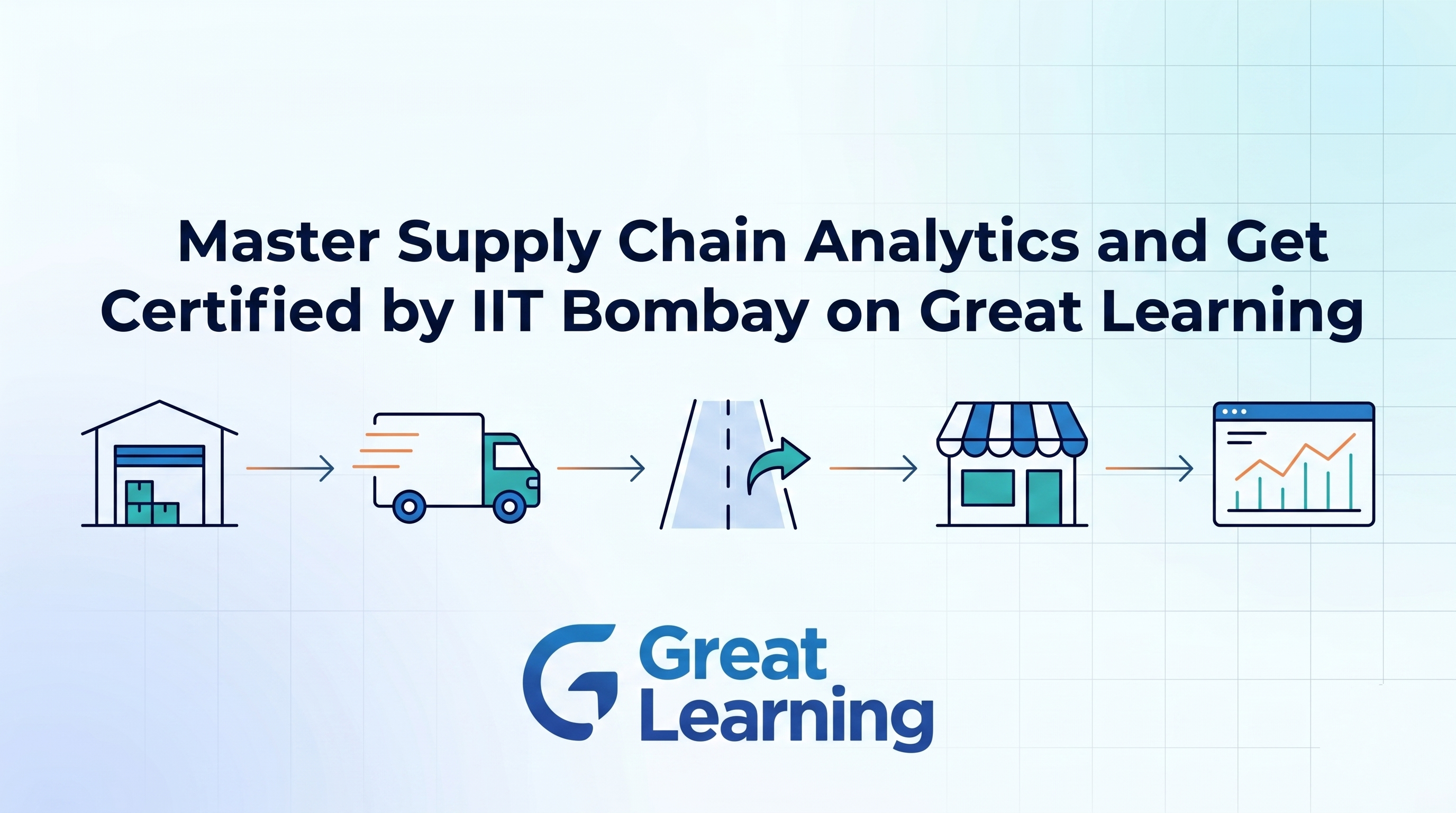
As modern supply chains face unprecedented complexity and disruptions, professionals need robust, data-centric frameworks to stay ahead. By integrating advanced optimization, statistical modeling, and cutting-edge artificial intelligence, organizations can build risk-resilient networks and drive data-driven transformation across logistics, procurement, and inventory planning.
To equip professionals with these high-demand skills, the Department of Industrial Engineering and Operations Research (IEOR) at IIT Bombay offers the Certificate in Supply Chain Analytics with AI and ML Applications. This program seamlessly integrates machine learning algorithms, simulation techniques, and GenAI to help leaders make end-to-end supply chain decisions.
Certificate in Supply Chain Analytics with AI and ML Applications
A 6-month hands-on curriculum designed to equip professionals with supply chain analytics using AI and ML applications, offered by IIT Bombay.
About the IIT Bombay Supply Chain Analytics Program
The Certificate in Supply Chain Analytics with AI and ML Applications is a six-month, online program designed and delivered by leading faculty from the Indian Institute of Technology, Bombay. Through a cohesive five-module curriculum, the course equips learners with rigorous frameworks in optimization and statistical modeling tailored for operations and logistics management.
The program emphasizes practical, hands-on learning through intensive case studies spanning advanced inventory models, network design, demand forecasting, and GenAI-driven scenario planning. Over six months, participants engage in live, interactive online sessions to foster peer learning and cohort collaboration.
Program Highlights
To deliver a comprehensive educational experience, the program features several key highlights:
- Flexible Online Format: The curriculum is designed as an online program tailored specifically for working professionals.
- Expert Instruction: The course is designed and delivered directly by IIT Bombay faculty.
- Live Interactive Sessions: Learners participate in weekly live sessions dedicated to learning and query resolution.
- AI-Integrated Curriculum: Artificial Intelligence topics and techniques are woven throughout the entire curriculum.
- Actionable Pedagogy: The program utilizes an industry-relevant, case-based teaching methodology.
- Comprehensive Support: Participants benefit from peer-to-peer learning, networking opportunities, and personalized assistance from a dedicated Programme Manager.
- Prestigious Credentials: Upon successful completion, learners earn a Certificate of Completion from IIT Bombay.
What Makes This Program Unique?
1. Prestigious Academic Standing:
IIT Bombay holds exceptional national and global rankings, securing the 1st spot in the NIRF India Innovation Rankings 2024 and 3rd in the NIRF India Engineering Rankings 2024. Globally, it is ranked 2nd in India by the QS World University Rankings 2025 and 28th globally in QS Rankings for Engineering and Technology 2025.
2. World-Class Faculty:
The curriculum is driven by leading academic experts, including Prof. Priyank Sinha, an Assistant Professor in the IEOR department. His research and teaching focus on applying network optimization techniques to complex supply chain, transportation, and logistics problems.
3. Actionable Pedagogy:
The curriculum bridges theoretical optimization with hands-on practice, empowering learners to formulate mixed-integer programs in Python, prototype GenAI-driven demand simulators, and build Artificial Neural Networks for inventory optimization.
Who Should Enroll?
To enroll, applicants must hold a Bachelor's degree (in any discipline) from a recognized university with a minimum aggregate of 50%, or possess 5+ years of relevant experience. The program is specifically tailored for:
- Supply Chain and Operations Professionals: Those responsible for inventory management who seek hands-on expertise to drive AI-enabled initiatives.
- Data and Business Intelligence Professionals: Individuals in logistics, procurement, or operations looking to apply advanced analytics and ML in supply chains.
- Supply Chain Consultants and Strategy Professionals: Experts wanting to incorporate analytics and AI into their client engagements.
- Emerging Leaders: Early to mid-career professionals in manufacturing, retail, or e-commerce aiming to build risk-resilient supply chains.
What You Will Learn?
The curriculum is structured into five comprehensive modules, enriched with detailed case studies:
Module 1: Introduction to Data-Driven Supply Chain Analytics Gain an overview of descriptive, diagnostic, predictive, and prescriptive analytics in the supply chain lifecycle. Apply Python to real-world cases and explore early GenAI use cases for rapid scenario generation.
Module 2: Supply Chain Network Design and Optimisation Learn supplier selection methods (WSM, AHP, DEA) and construct location-allocation models. Implement mixed-integer programs in Python to stress-test networks against disruptions.
Module 3: Demand Forecasting and Planning Contrast classical time-series models with machine learning approaches like decision trees, SVMs, and neural networks. Learn to measure forecast errors and integrate GenAI-driven simulators into planning.
Module 4: Data-Driven Inventory Models Master dynamic EOQ formulations, data-driven Newsvendor models, and multi-period stochastic control policies using Python. Understand how Artificial Neural Networks learn demand patterns to automate replenishment.
Module 5: Transportation and Risk Analysis Explore dynamic vehicle-routing problems, multi-modal analytics, and disruption risk modeling. Build learning-based route algorithms and use GenAI for scenario-based contingency planning.
Sample Case Studies
Apply skills through practical exercises such as analyzing the Impact of Predictive Analytics on Supply Chain Management, adapting the Bass Diffusion Model to Improve Electric Vehicle Sales, and building an Artificial Neural Network Model for Order-Cycle Management.
Key Learning Outcomes
Upon completing this program, participants will be fully equipped to:
- Demand Planning- Combine ARIMA, ETS, and ML models (trees, SVMs, neural networks) to improve forecast accuracy and build GenAI-based scenario simulators.
- Inventory Optimization- Apply EOQ, stochastic policies, and Newsvendor models. Use Python and neural networks to automate reorder points and replenishment.
- Supply Chain Network Design- Leverage WSM, AHP, DEA, and location-allocation models. Implement MILP in Python to balance cost, service, and disruption risks.
- Transportation & Risk Analytics- Optimize routing (VRP) and multi-modal logistics. Build smart routing systems, assess risks, and use GenAI for contingency planning.
- End-to-End Decision Making- Apply descriptive to prescriptive analytics across the supply chain to drive AI-led transformation in operations and procurement.
Next Step
The admission process is conducted in three steps: interested candidates first fill out a simple online application form. Next, applicants must go through a mandatory screening call with the registration office. Finally, selected candidates receive an offer letter and must pay the registration fee to secure their seat.