
Remember these lines from the movie Come September?
Bobby Darin sang it to woo Sandra Dee to the chagrin of Rock Hudson. That was in the 1960s. Six decades hence, the dating game has changed. It seems that romance has gone out of it, and the vacant space has been filled by cool data analysis and machine learning techniques.
Match-making is, in fact, an old skill. In all societies, in various forms, match-makers existed and brokered matches, often by financial and societal status. Individual choices of the two parties, the bride and the groom, hardly mattered. But of course, time changed, society became more fragmented, more individualistic, and young people felt pressured to look for partners among a faceless crowd.
The activity that used to be an enjoyable pass-time of family matriarchs and neighbourhood matrons was gradually taken over by supposedly infallible professionals, in other words, the computers. Even in the 1960’s, algorithmic matching of compatibility based on responses to questionnaires was done using an IBM mainframe, and answers were mailed back to the responders.
After evolving through various phases involving online dating sites, psychometric profiling, compatibility scores, and the revolution in hand-held devices, in the 2020’s, quite a few personalized and niche apps have been developed to bring together two individuals based on their religious affiliations, sexual orientations, and lifestyles.
The Rise of Algorithmic Matchmaking
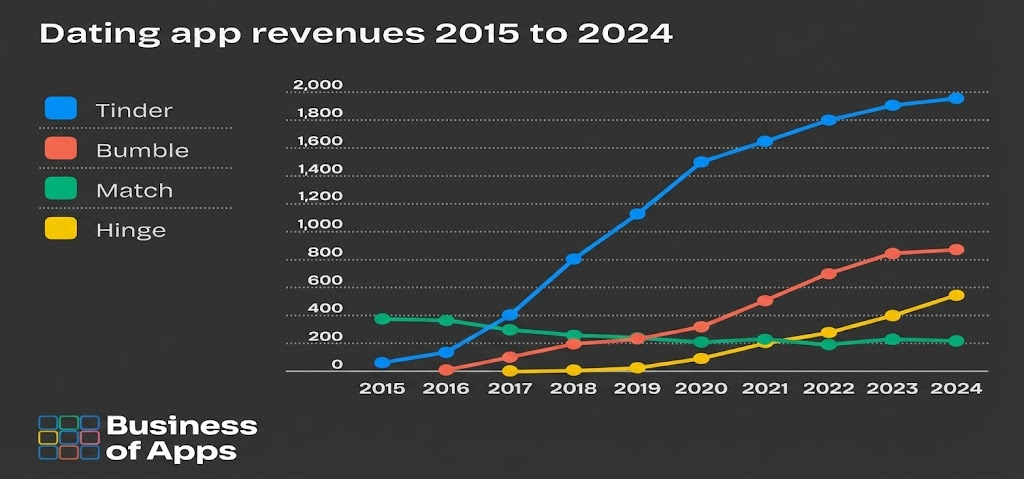
The business of dating is huge worldwide. The dating app industry had a market size of over $6 billion in 2024, a 15.7% increase from the previous year. Approximately 360 million people across the globe used dating apps in 2024, an increase of about 15 million from the previous year.
One of the market changers in the dating business, Tinder, has about 90 million users on its platform. Its two closest competitors, Bumble and Hinge, together have only about 70% of Tinder’s business, but the latter probably enjoys more goodwill among younger users looking for serious relationships. In India online dating app market generated a revenue of USD 547.9 million in 2023 and is expected to reach USD 1,015.4 million by 2030, expecting to grow at a CAGR of 9.2% from 2024 to 2030.
How Dating App Algorithms Actually Work?
What is the purpose of a dating app?
To bring together two ‘similar’ profiles so that a lasting or casual relationship may be formed. From an objective data science viewpoint, the basic algorithm is a recommendation system.
Just as in Netflix, movies are recommended to you based on your profile and past viewing history, choice of actors or search patterns, sophisticated dating apps make recommendations based on a user profile, perhaps including psychological traits, location, activities on social media, and other achievements or interests, that the user would like to showcase.
But there is an extra layer of complexity in a dating algorithm. While on Netflix, you choose the movies; the movies do not choose you; in a dating app, the choice must be mutual. Unless two users do not choose each other, no conversation may begin. In 2013, Tinder revolutionized online dating by introducing a swipe feature. Based on a few photos of A, B is to swipe right to indicate his/her interest in A.
Similarly, A must also swipe right on the profile of B to indicate his/her interest. Unless the interest is mutual, A and B are not allowed to interact in the app. Reciprocation is the key to success in simultaneously best-matching two profiles. Many of the basic features are available to users for free. But to enjoy the exclusive features, users have to pay. The dating apps, like any other gaming app, make money through paid subscriptions as well as through in-app purchases.
To put it simply, a recommendation system may be of two types: collaborative and content-based. To explain the difference in the most simplistic way, in the former past behaviour of an individual is important, whereas in the latter, the information, or the profile, is utilized to make recommendations. For example, if you have preferred disaster movies in past viewings, more of the same may be recommended.
But what will be recommended to you when you have just joined a platform, but have not created any history? Based on your demographic information, a set of options is presented to you. The more details available to a platform, the more personalized a bouquet may be offered. Now, if you are an outlier for your demographic category, the recommendations will not match your expectations!
Coming back to the algorithm running behind the match-making mechanism of the dating apps, it must be clearly mentioned that each app works in a different way, and their matching algorithms are proprietary. In the face of stiff competition, no business is interested in sharing success recipes publicly. But it may be assumed that one basic premise of matching is homogeneity, or similarity between two profiles, and not necessarily the aphorism that opposites attract! Different dating platforms may collect and process data in different ways.
Tinder, for example, collects less data compared to Hinge, which even has a semblance of verification of the user profile. In addition to homogeneity, for successful matching, male and female preference norms (such as women typically choosing taller men, who are possibly equally or more educated, and men not choosing taller women with a higher financial status) and the cultural acceptability within a society must be considered within the algorithm.
One research found that the questions answered by the singles are aggregated into broad groups, such as expectations from the relationship, desired characteristics in a partner, singles’ values and attitudes, their interests and hobbies, etc.
Personality tests are often incorporated in the questionnaires. The success of a matching algorithm depends on data insights and proper clustering. It has also been noted by the authors that categorization of important features does not necessarily partition the response space, leading to methodological flaws and sub-optimal results.
Success in any machine learning algorithm depends on a proper data collection method, critical appraisal of the data, domain knowledge, and business sense to mine the information intelligently. In the case of dating apps, since these target the core values and beliefs in a society, cultural sensitization is another requirement. The algorithmic rules acceptable in Western countries may not be acceptable at all in any Eastern society.
It is likely that the mutual preference is affected by a few key attributes. For different users, the importance of different attributes will vary. For example, someone may focus on the physical attributes, whereas someone else may rank intellectual attributes at a higher level. Based on these considerations reinforced random convolutional network (RRCN) may be applied with success for the reciprocal recommendation task.
RRCN randomly convolutes non-adjacent features to capture their interaction. The final recommendations are based on the feature embeddings of the key attributes of the users. It is even possible to integrate a reinforcement learning based strategy with the random CNN component to select salient attributes to form a candidate set of key attributes.
When it comes to the success rates of the dating apps, opinions vary.
- What is a success in dating?
- Is it finding a life partner?
- Is it finding an exclusive partner?
- Is it an enjoyable few hours where only sexual favours are exchanged?
- If the concept of ‘death do us part’ is old-fashioned, can success be measured in terms of the length of an exclusive relationship?
-Shall we all follow Elizabeth Barrett Browning and be satisfied with our candles burning at both ends?
-That is to say success of a dating app is measured by the number of enjoyable evenings in a year?
However large the global business or the user pool, one UK-based report puts Tinder’s success rate at a low 16.5% in 2022[5]. Not only that, there is no built-in security in the apps. Just like any social media, fake profiles are easy to create. Women, especially, are apprehensive of being taken advantage of.
The number of male profiles is typically way more than female profiles. In Tinder, it is 70:30, but in Hinge, it is 65:35, showing that females feel slightly safer with the long process of profile-making in Hinge. It may be argued that the inclusion of videos and verified snapshots acts as a deterrent.
The Dark Side of Digital Romance: Bias, Safety & Mental Health
There is no dearth of objections and reservations towards the dating apps. The criticisms range from superficiality and objectification to violation of privacy, data exploitation, commercial manipulation, and impact on mental health. Studies have suggested negative psychological effects on dating app users, such as frustration and mental and emotional fatigue. It has also been noted that developers’ bias influences the outcome of the matching process. So far, the developers are predominantly white males, bringing in their societal value bases in the matching algorithms, resulting in cultural homogenization.
Given today’s digital preference, dating apps are probably here to stay. Sophisticated machine learning algorithms are at the core of the reciprocal matching system. Beyond simple demographic, language, religious, and location filters, mutual interests, compatibility, and sustainability in a relationship need to be built into the algorithms meaningfully.
That itself requires long research, because quantization of abstract quality is not an easy problem to solve. Perhaps social scientists, behavioural psychologists, data scientists, and cybersecurity experts need to converge for the development of a more meaningful method of match-making.
The objective of the dating apps should be to open up as many channels or pathways to interactions as possible – for romance or for friendship. In an uncontrolled environment, like an educational institution, a workplace, or even at a party thrown by a friend, you get to meet many people of varied aptitude. Digitization and the internet have brought so much freedom to a person’s life. In her quest for knowledge, why would apps limit her search for a mate?
Next Step
If the science behind dating apps fascinates you, the Post Graduate Program in Artificial Intelligence and Machine Learning can help you build the expertise required to design such intelligent systems. From recommendation engines and clustering techniques to deep learning, reinforcement learning, and real-world deployment strategies, the program equips you with the practical skills needed to solve complex problems at scale. Whether it’s optimizing reciprocal matching algorithms or building bias-aware AI systems, this program empowers you to move beyond theory and create impactful, data-driven solutions across industries.
PG Program in AI & Machine Learning
Master AI with hands-on projects, expert mentorship, and a prestigious certificate from UT Austin and Great Lakes Executive Learning.