
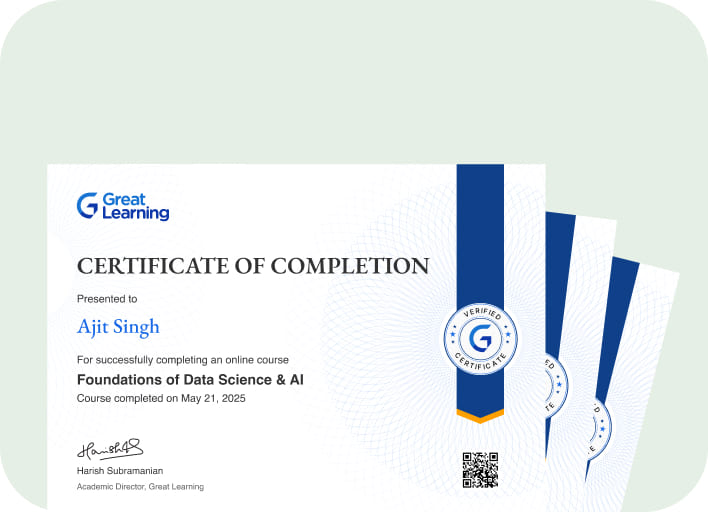
Earn a certificate & get recognized
Data Structures and Algorithms Interview Questions
 4.41
Beginner level
4.5 learning hrs
4.41
Beginner level
4.5 learning hrs
Instructor:
Mr. Bharani Akella




About this course
In this course, we will be discussing Data Structures and Algorithms. We will begin our discussion with Linear and Binary Searching. Next we will discuss Sorting algorithms such as Quick sort, Merge sort, Insertion sort and many more. Such algorithms will help you solve many problems while working with Data Structures.
Course outline
Linked List
A linked list is a linear type of data structure that comes in handy while solving complex problems. This module gives a brief on the linked list along with discussing its advantages, disadvantages, and applications. You also have a demonstration on a linked list with the help of a code example.
Stack
Stack comes under a linear data structure and is known for its FILO/LIFO property. The module focuses on introducing you to stack and goes through its several advantages, disadvantages, and applications. You will also learn about its demonstration using an array with the help of a code example.
Queue
A queue is a linear form of data structure and follows the FIFO/LILO property. The module starts by giving you a brief on queue, its advantages, disadvantages, and applications. Lastly, you will have a demonstration of the queue using an array with the help of a code example.
Bubble Sort
Bubble sort is a simple sorting algorithm that repeatedly steps through the list to be sorted. This module explains bubble sort and its algorithm in detail.
Insertion Sort
Insertion sort is a sorting algorithm in which each element is inserted into its correct position in a sorted array. This module explains insertion sort, time complexity, and algorithm with an example and demonstration.
Quick Sort
Quick sort is a sorting algorithm that uses a partitioning step to divide an array into subarrays, followed by a sorting step to sort the subarrays. This module explains the quick sort, time complexity, and algorithm with an example and demonstration.
Merge Sort
A merge sort is a sorting algorithm that sorts items by dividing them into two groups, sorting each group, and then merging the groups back together. This module explains the merge sort, time complexity, and algorithm with an example and demonstration.
Get access to the complete curriculum once you enroll in the course
 4.41
4.41








Our course instructor

Mr. Bharani Akella
Data Scientist



Recommended Free Interview Preparation courses
 FREE
FREE




Similar courses you might like

.jpg "Course thumbnail image")


Related Interview Preparation Courses

-

12 weeks · Online
Know More
-
MIT Professional Education
Applied AI and Data Science Program15 Weeks · Live Online · Weekdays & Weekend
Know More
-
Deakin University
Master of Data Science (Global) Program24 Months · Online
Top 1% UniversityKnow More