Leap Year Program in Python Free Course
Leap year program in Python
 4.52
Beginner level
1.5 learning hrs
4.52
Beginner level
1.5 learning hrs
Learn leap year program in python from basics in this free online training. Leap year program in python course is taught hands-on by experts. Learn introduction to python and operators in python in details with example.





About this course
In this course, you will learn about the Leap year program in Python.You will start this course by knowing what Python is, along with applications. Moving ahead you will learn the working of a jupyter notebook and essential concepts involved in python such as variables and different data types. Then, moving next you will get the idea about different types of operators.Then we will jump to Tokens and conditional statements in python. Later, you will be learning the concept of Leap year along with the coding implementation in python programming.
Explore our Software Engineering Courses today.
Course outline
Introduction to python
This module starts by briefly introducing Python programming, and you will go through its installation process and some essential hands-on examples.
Python Operators: Arithmetic, Relational, and Logical
Execute programmatic calculations using Python Operators. Apply Arithmetic operators for math, Relational operators for value comparison, and Logical operators (AND, OR, NOT) for complex Boolean evaluations.
Python Lexical Structure: Tokens, Keywords, and Identifiers
Analyze the lexical components of Python syntax. Identify standard Python Tokens including reserved Keywords, user-defined Identifiers, hardcoded Literals, and functional Operators.
Interactive Coding with the Jupyter Notebook Environment
Execute Python scripts interactively using Jupyter Notebook. Navigate the browser-based REPL (Read-Eval-Print Loop) environment for data analysis, code testing, and inline visualization.
Get access to the complete curriculum once you enroll in the course
 4.52
4.52









What our learners enjoyed the most
Easy to Follow
64% of learners found the course easy to follow
Frequently Asked Questions
Will I receive a certificate upon completing this free course?
Is this course free?
How do you write a leap year program in Python?
The logic to determine whether a given year is a leap year or not can be written using the conditional statements (if, else, elif )in python.
Is the leap year program in Python?
Yes, leap year program logic can be written in the python programming language.
How Can I learn python in the leap year program for free?
The leap year program in python can be found online easily. Enroll in this free course by great learning to get a clear picture of this program.
Will I get a certificate after completing this Leap Year Program in Python free course?
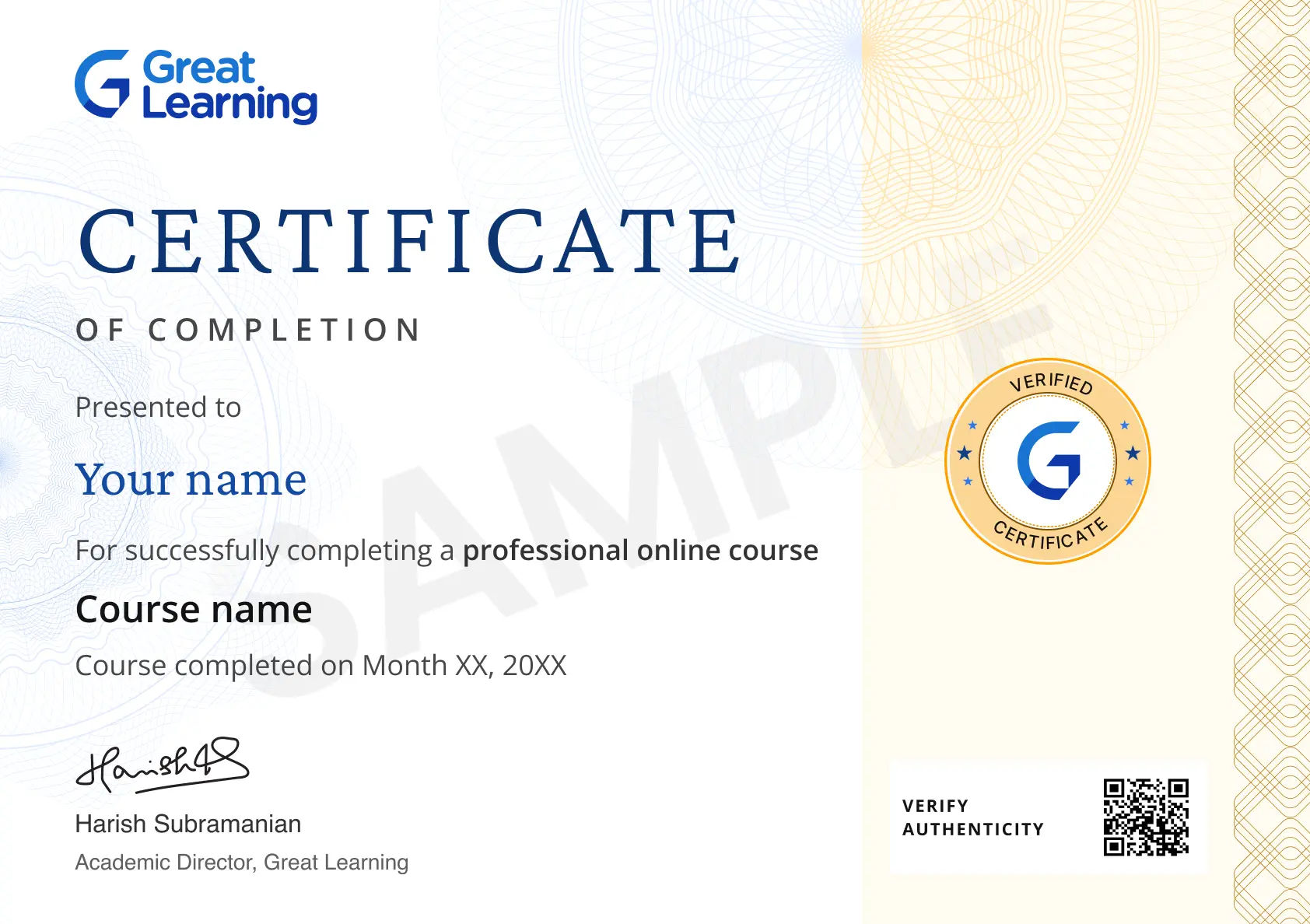
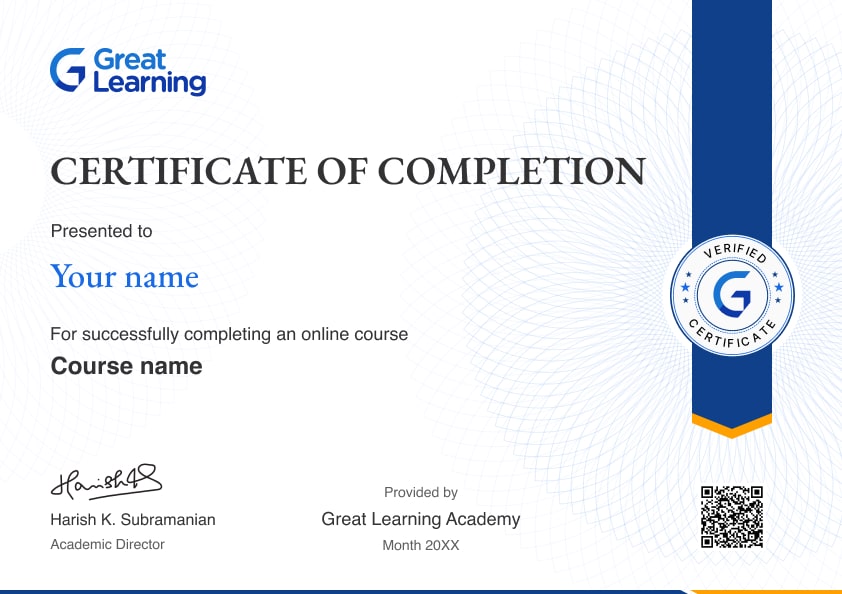
Yes, you will get a certificate of completion for Leap Year Program in Python after completing all the modules and cracking the assessment. The assessment tests your knowledge of the subject and badges your skills.
How much does this Leap Year Program in Python course cost?
It is an entirely free course from Great Learning Academy. Anyone interested in learning the basics of Leap Year Program in Python can get started with this course.
Is there any limit on how many times I can take this free course?
Once you enroll in the Leap Year Program in Python course, you have lifetime access to it. So, you can log in anytime and learn it for free online.
Can I sign up for multiple courses from Great Learning Academy at the same time?
Yes, you can enroll in as many courses as you want from Great Learning Academy. There is no limit to the number of courses you can enroll in at once, but since the courses offered by Great Learning Academy are free, we suggest you learn one by one to get the best out of the subject.
Why choose Great Learning Academy for this free Leap Year Program in Python course?
Great Learning Academy provides this Leap Year Program in Python course for free online. The course is self-paced and helps you understand various topics that fall under the subject with solved problems and demonstrated examples. The course is carefully designed, keeping in mind to cater to both beginners and professionals, and is delivered by subject experts. Great Learning is a global ed-tech platform dedicated to developing competent professionals. Great Learning Academy is an initiative by Great Learning that offers in-demand free online courses to help people advance in their jobs. More than 5 million learners from 140 countries have benefited from Great Learning Academy's free online courses with certificates. It is a one-stop place for all of a learner's goals.
What are the steps to enroll in this Leap Year Program in Python course?
Enrolling in any of the Great Learning Academy’s courses is just one step process. Sign-up for the course, you are interested in learning through your E-mail ID and start learning them for free online.
Will I have lifetime access to this free Leap Year Program in Python course?
Yes, once you enroll in the course, you will have lifetime access, where you can log in and learn whenever you want to.
Recommended Free Python courses
 FREE
FREE


Similar courses you might like


.jpg "Course thumbnail image")

Related IT & Software Courses

-

McCombs School of Business at The University of Texas at Austin
Post Graduate Program in Cyber Security20 weeks · Online
Know More

Relevant Career Paths >
Other IT & Software tutorials for you
Leap Year Program In Python
Guido Van Rossum created Python. Python is an interpreted, object-oriented programming language. It was designed to be highly readable. The language uses full English words, whereas other languages might use punctuation. For example, it uses "not" instead of "!" and "and " instead of "&&." This makes Python code more readable and navigable for humans if the code needs to be read by a computer later on. The official motto of Python is “batteries included” to indicate that the interpreter comes with many built-in modules, including support for many popular programming tasks such as reading and writing files, creating graphical user interfaces, connecting to databases, and various system utilities.
Python has a design philosophy that emphasizes code readability; its syntax allows programmers to express concepts in fewer lines of code than might be possible in languages like C++ or Java.
Why Python?
Python is a powerful, versatile programming language, which is pretty beginner-friendly. It is the best programming language for data analysis, managing projects, and creating websites. Python is designed to be readable, meaning that it’s not too challenging for beginners to understand how the code works. Photos are case sensitive, so they have to be typed correctly, or Python won't recognize them. Python is also very easy on our computers, which means you'll save time when writing your code. Python is an open-source programming language meaning that you can use its codes for free without having to worry about copyright infringement or money spent on using the codes. Whether you're interested in learning how to write programs or just curious about what they are, this intro will teach you everything you need to know about the Python programming language!
Python is a great programming language for beginners. One of the best aspects of Python is that it is easy to learn and doesn't require any previous knowledge of programming languages. This is because Python allows you to do things in whichever way you want, which can help beginners by not restricting them with what they can or cannot do.
Python is an interpreted language, meaning that the code is read and executed by an interpreter rather than directly by the computer. This has some advantages for beginners because there is no need to compile the code before executing it; just type it in and run it!
Python does have some disadvantages, however. The interpreter can sometimes take more time to execute code than compiled code would, but this usually isn't noticeable unless your program needs to be very fast, like making video games. Python also doesn't automatically include many features that most other languages would have built-in, so you will need to use a library if you want those features.
Leap Year :
A leap year is a year that contains an extra day, February 29th. Usually, February contains only 28 days in a year, but this month will have an extra day in a leap year. A leap year happens every four years, and it is used to account for the earth's orbit around the sun. Leap years are years with 366 days. A leap year occurs every 4th year (e.g., 2008, 2012, 2016). You can check whether a year is a leap year or not by dividing the total number of days in the year by 400. If this quotient is not an integer, then the year is a leap year.
We will learn how to write a program in Python to tell us if the year given is a leap or not. We will also see some implementations of how different people might write it.
Conditional Statements in Python:
Conditional statements allow you to perform different tasks depending on the conditions. This is done with if-elif-else statements in python. The syntax of the if condition in python is as follows :
if condition:
statements to be executed
Python will execute the instructions or statements after the colon if the condition is met. If not, it will check if the condition in elif is true instead and execute instructions accordingly. And an operator called 'modulo' divides two numbers and returns another number equivalent to the remainder. The syntax of if,elif, and else in python is as follows :
Conditional statements are expressions that will evaluate to either True or False.
The syntax is
if condition :
Statement 1
elif condition:
Statement 2
else:
Statement 3
Modulo :
The modulo operator in python provides the remainder. For example, 3%2 is 1
Consider the following statement:
if 3 %2 ==0 :
print("3 is even ")
else:
print("3 is odd ")
The first part of the statement with the if statement will only be executed if the remainder obtained after dividing 3 by 2 is zero. If not, the second part with the other keyword will be executed instead.