
Free Advanced Python Projects Course
Advanced Python Projects
With this free advanced Python projects course, you build QR code tools, a virtual assistant, ecommerce price trackers, and password generators while turning Python practice into portfolio-ready work.
Instructor:
Ms. Sampriti Chatterjee




About this course
Python starts becoming useful when learners build something they can show. This free advanced Python projects course moves beyond syntax into guided mini-projects such as QR code generation, a virtual assistant, ecommerce price comparison, Amazon price tracking, and password generation. It fits learners searching for advanced Python projects, Python project ideas, Python automation projects, or Python projects for beginners who already know the basics.
The value is practical proof. Each project teaches a different kind of application thinking: automation logic, working with libraries, handling web-oriented tasks, creating small tools, and turning Python knowledge into something visible. Learners can use these projects for portfolio discussion, interview examples, or personal productivity experiments, then continue into APIs, web scraping, Flask, Django, testing, or larger automation workflows.
Course outline
How to generate QR code using Python
In this module, you will learn the concept of QR code and how to generate QR code in Python.
Creating a Virtual Assistant using Python
In this module, you will learn the overview of Google Colab and Google Colab library, Natural language processing, ChatBot.
App to Compare Prices on E-Commerce Sites
In this module, you will learn the how to compare prices in e-commerce sites using Google Colab and Google Colab library.
App to Track Amazon Prices
In this module, you will learn how to Build a Python App to track e-commerce sites prices.
Create Password using Python
In this module, you will learn the Name time or Name part in the code, how to use Google Colab, Beautiful Soup, and SMTP to create a String password.
Get access to the complete curriculum once you enroll in the course




Our course instructor

Ms. Sampriti Chatterjee
Data Science Expert


Frequently Asked Questions
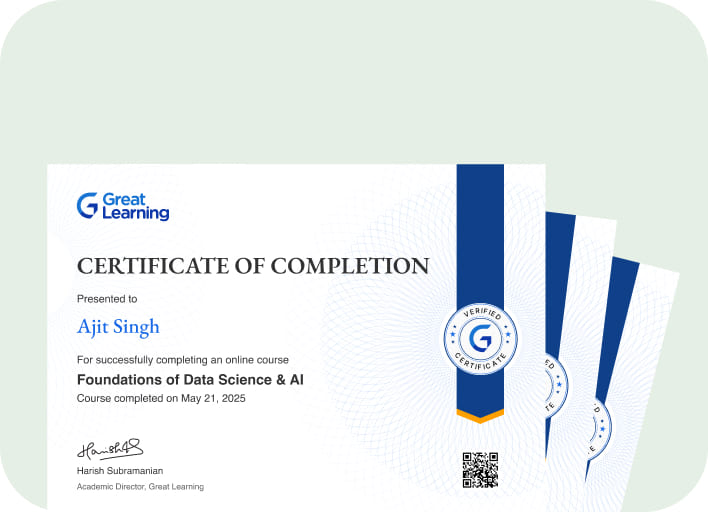
Will I receive a certificate upon completing this free course?
Is this course free?
What projects are included in this free advanced Python projects course?
Who should learn advanced Python projects?
Is this suitable for Python beginners?
Will I have lifetime access to the free course?
Yes, once you enroll in the course, you will have lifetime access to any of the Great Learning Academy’s free courses. You can login and learn whenever you want to.
Will I build Python automation projects?
Can these Python projects help my portfolio?
Is there any limit on how many times I can take this free course?
No. There is no limit. Once you enroll in the Advanced Python Projects Course, you have lifetime access to it. So, you can log in anytime and learn it for free online.
Does this course include ecommerce use cases?
What skills should I practise with these projects?
What should I learn after advanced Python projects?
Recommended Free Software courses
 FREE
FREE



Similar courses you might like


Related Data Science Courses

-
Scholarships upto ₹25K

McCombs School of Business at The University of Texas at Austin
Post Graduate Program in Data Science with Generative AI12 months · Online
Dedicated Career SupportKnow More
-
6 Months · Online
Know More
-
18 months · Online
IIT Bombay FacultyKnow More

Relevant Career Paths >



Other Data Science tutorials for you
Python Projects Course
Python is a versatile programming language that can be used for a wide range of applications. It is known for its simplicity, readability, and ease of use, which makes it a popular choice for beginners and experts alike. There are many advanced Python projects that can be developed to hone your skills and gain practical experience. Here are some examples of advanced Python projects that you can work on:
- Web Scraping: This involves writing scripts to extract data from websites. This data can be used for various purposes, such as building a database, conducting market research, or monitoring competitors. Web scraping requires knowledge of HTML, CSS, and Python libraries such as Beautiful Soup and Scrapy.
- Data Visualization: This involves using Python libraries such as Matplotlib, Seaborn, and Plotly to create interactive and informative visualizations from data. This project is ideal for those interested in data analysis, data science, and data journalism.
- Natural Language Processing (NLP): This involves using Python libraries such as NLTK and spaCy to analyze and process natural language data, such as text or speech. NLP has various applications, such as sentiment analysis, language translation, and speech recognition.
- Machine Learning: This involves using Python libraries such as Scikit-Learn and TensorFlow to develop algorithms that can learn from data and make predictions or classifications. Machine learning has various applications, such as image recognition, recommendation systems, and fraud detection.
- Game Development: This involves using Python libraries such as Pygame and Arcade to create games that can be played on desktop or mobile platforms. Game development requires knowledge of graphics programming, physics simulation, and user interface design.
- Desktop Applications: This involves using Python libraries such as PyQt and Tkinter to develop applications that can be installed and run on a desktop computer. Desktop applications can be used for various purposes, such as file management, data analysis, and productivity.
- Internet of Things (IoT): This involves using Python libraries such as Flask and Django to develop web applications that can interact with connected devices, such as sensors, cameras, and smart appliances. IoT has various applications, such as home automation, industrial monitoring, and healthcare.
- Robotics: This involves using Python libraries such as OpenCV and ROS to develop robots that can sense, act, and learn from their environment. Robotics requires knowledge of electronics, mechanics, and control theory.
In conclusion, advanced Python projects offer a great opportunity to build practical skills and gain experience in various domains. The projects listed above are just a few examples, and there are many other areas in which Python can be applied, such as finance, cybersecurity, and bioinformatics. Regardless of the project you choose, it is important to approach it with a curious and creative mindset and to seek guidance and feedback from experts in the field.