
In 2026, the global cybersecurity market is projected to reach US$ 211.69 billion, driven by the escalating frequency of data breaches and the growing integration of artificial intelligence into offensive tactics.
As cyber threats become more sophisticated and AI-powered attacks continue to evolve, the demand for skilled cybersecurity professionals has never been greater.
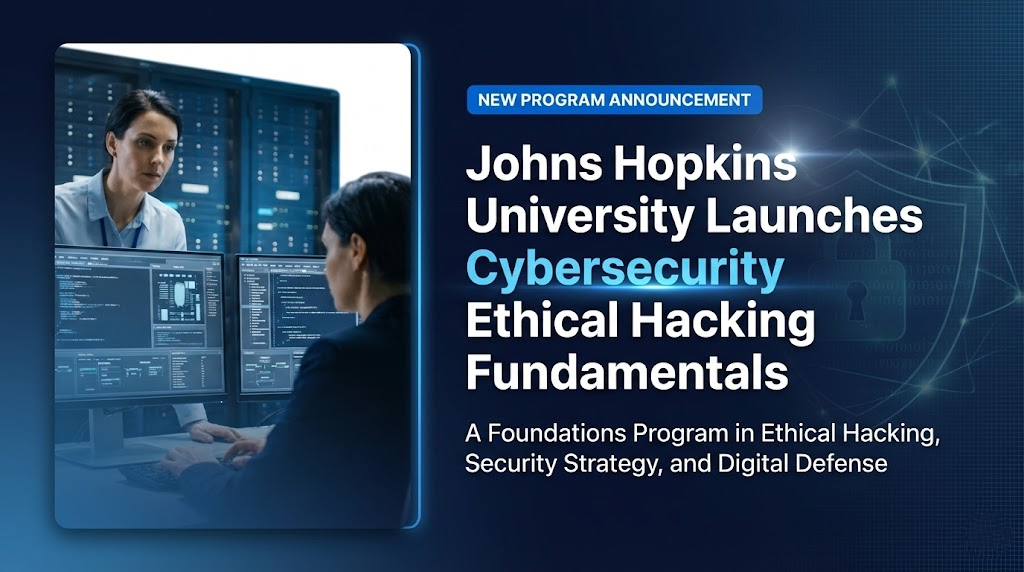
In response to this urgent industry need, Johns Hopkins University (JHU), consistently ranked among the top 10 universities in the U.S. and a global leader in research and development, has officially launched a new professional education course in collaboration with Great Learning: Cybersecurity: Ethical Hacking Fundamentals.
Developed by the Whiting School of Engineering, this program arrives at a critical juncture for global digital infrastructure. This course equips professionals with the specialized skills needed to mitigate risks and safeguard digital assets.
About Cybersecurity Ethical Hacking Fundamentals Program
Cybersecurity: Ethical Hacking Fundamentals is an asynchronous, self-paced course designed to provide a practical, "inside-out" view of security through the lens of ethical hacking.
Over the course of 20+ hours, learners explore the evolution and psychology of hackers, core ethical hacking practices, and defense-in-depth principles.
The program is structured to help students recognize adversary tactics and interpret cyber intelligence indicators to reduce exposure to threats.
What Makes This Program Unique?
Johns Hopkins University stands at the forefront of innovation, holding the 1 ranking for Computer Information Technology according to U.S. News & World Report. The program features:
- World-Class Faculty: Courses are taught by distinguished faculty with experience leading cybersecurity practices at Fortune 500 companies.
- Research-Driven Curriculum: The content is based on the latest developments in cybersecurity and decades of JHU leadership in R&D.
- Interdisciplinary Approach: The program leverages JHU’s strengths across computer science, AI, and engineering for a holistic understanding of the field.
- Case-Based Learning: The curriculum is complemented by real-world use cases and assignments to ensure practical application.
Who Can Enroll?
The program is designed for a broad spectrum of professionals aiming to strengthen their organization's security posture:
- Network and IT Specialists: Network Administrators and Infrastructure Professionals looking to enhance system defense skills.
- Compliance and Risk Experts: Compliance Officers, Auditors, and Security Consultants aiming to manage risk through ethical hacking principles.
- Aspiring Practitioners: Individuals looking to transition into dedicated cybersecurity roles.
What You Will Learn?
The curriculum is meticulously structured into four comprehensive modules, each focusing on a pillar of modern defensive operations:
- Module 01: Ideology, Motives & Behaviors of Hackers:
Gain a deep understanding of the types and generations of hackers, their psychological drivers, and the legal and ethical boundaries that define ethical hacking.
- Module 02: PenTest Reports & Executive Summaries:
Master penetration testing methodologies and the application of ethical hacking frameworks. Learn to structure and interpret executive-level security reports that drive organizational decision-making.
- Module 03: Cryptography & Public Key Infrastructure (PKI):
Analyze secret-key and public-key encryption. Understand how PKI enables authentication and secure communication while identifying cryptographic weaknesses often exploited by attackers.
- Module 04: Information Gathering & Social Engineering:
Conduct technical and open-source information gathering (OSINT). Master reconnaissance tools to identify vulnerabilities and understand social engineering attack patterns to recognize attacker observables.
Together, these four modules provide a strong foundation in ethical hacking, blending technical expertise with strategic thinking and real-world application.
By the end of the program, learners will be equipped to identify vulnerabilities, interpret security risks, and contribute meaningfully to strengthening an organization’s cybersecurity posture in an increasingly AI-driven threat era.
How You Will Learn?
The program is delivered fully online through a flexible, asynchronous format designed for working professionals.
Learners can progress at their own pace while gaining access to structured, high-impact content developed and delivered by world-renowned faculty from Johns Hopkins University.
1. Flexible, Self-Paced Online Learning
The course follows an asynchronous model, allowing you to learn anytime, anywhere. This format ensures that professionals can balance their upskilling journey alongside career and personal commitments without compromising depth or rigor.
2. Faculty-Led Video Sessions
Engaging video walkthroughs and recorded sessions simplify complex cybersecurity concepts. Each module is guided by expert faculty insights, ensuring academic depth combined with practical relevance.
3. Case-Based Learning Approach
Lessons are anchored in real-world cybersecurity scenarios. This case-driven methodology bridges the gap between theoretical foundations and how security challenges unfold in real organizational environments.
4. Applied, Hands-On Projects
- Hacker Mindset Analysis
Study real-world attacker motivations, ideologies, and behavioral patterns to better anticipate and defend against evolving threat vectors.
- Penetration Test Reporting
Gain hands-on exposure to PenTest reports and executive summaries, understanding how technical findings translate into strategic business decisions.
- Cryptography in Practice
Analyze how encryption techniques and Public Key Infrastructure (PKI) frameworks secure digital systems and identify potential weaknesses that attackers exploit.
- Reconnaissance & Social Engineering
Examine technical reconnaissance tools and human-centric attack techniques to recognize vulnerabilities and strengthen defensive strategies.
This structured and application-focused learning model ensures that you don’t just understand cybersecurity concepts, but also develop the practical skills needed to apply them confidently in real-world scenarios.
Key Learning Outcomes
By the end of this curriculum, learners will gain comprehensive expertise across the technical, analytical, and strategic dimensions of ethical hacking and cybersecurity.
1. Understand Hacker Ideologies & Evolving Threats
Examine and analyze the ideologies, motivations, and evolving tactics of different generations of hackers to better anticipate emerging cyber threats.
2. Apply Ethical Hacking & Penetration Testing Frameworks
Implement rigorous ethical hacking methodologies and penetration testing practices within organizational environments to proactively identify and mitigate vulnerabilities.
3. Evaluate Cryptography & Public Key Infrastructure
Interpret and assess complex cryptographic systems, including Public Key Infrastructure (PKI), to understand how secure communication is established and where weaknesses may exist.
4. Conduct Professional Information Gathering
Perform structured information gathering, reconnaissance, and social engineering analysis to uncover potential attack surfaces and risk exposures.
5. Communicate Security Findings Effectively
Develop the ability to translate technical discoveries into clear, executive-level penetration test reports and summaries that support informed decision-making.
6. Recognize Real-World Attack Techniques
Identify reconnaissance, scanning, and exploitation techniques commonly used in real-world cyber attacks to strengthen defensive strategies.
Collectively, these outcomes ensure that learners move beyond foundational theory to develop practical, decision-ready cybersecurity capabilities.
The program equips professionals with the analytical depth, technical precision, and communication skills required to operate confidently in today’s complex and AI-driven threat landscape.
Post-Completion Benefits
Graduating from this program offers not just knowledge, but globally recognized credentials and long-term professional value.
- Prestigious University Certification- Earn a formal Certificate of Completion from the Whiting School of Engineering at Johns Hopkins University, validating your expertise in ethical hacking fundamentals.
- Continuing Education Credits (CEUs)- Successfully completing the course awards 2 Continuing Education Units (CEUs), supporting ongoing professional development and credential advancement.
- Industry Expert Mentorship- Benefit from insights and guidance drawn from a network of more than 8,100 industry experts associated with Great Learning.
- Global Prestige & Academic Reputation- Leverage the credibility of a university ranked 13th among Best Global Universities, enhancing your professional profile and career prospects in the cybersecurity domain.
Beyond certification, this program strengthens your professional standing with globally recognized credentials, industry-aligned skills, and access to an expansive learning ecosystem, positioning you for accelerated growth in the high-demand cybersecurity domain.
Next Step
The enrollment process for this program is straightforward and conducted on a rolling basis. Interested professionals must submit their details through an online application to initiate the process.
Upon successful verification, candidates can confirm their enrollment by completing the course fee payment, after which they receive access to the learning platform.
Once enrolled, learners can immediately begin building the ethical hacking expertise required to thrive in today’s digital economy.