
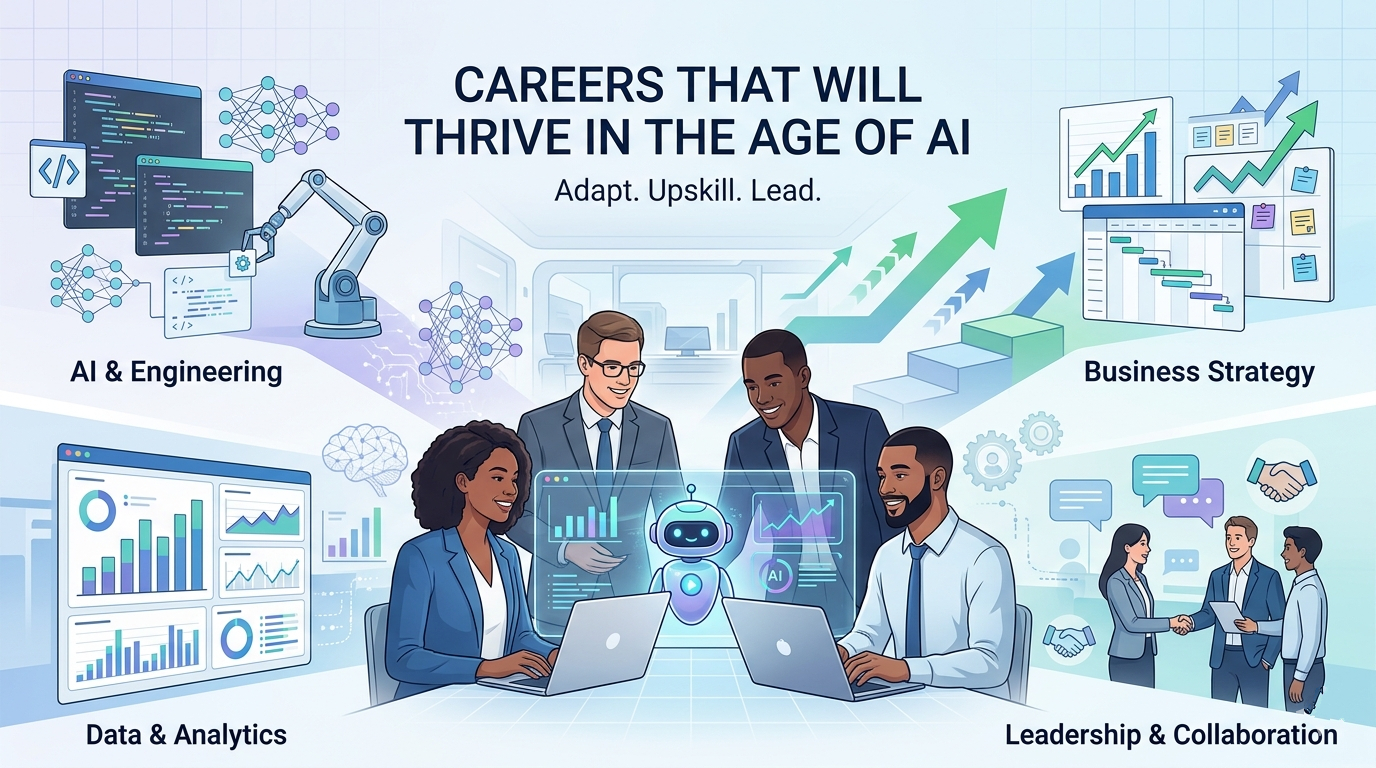
The rise of AI has sparked a global debate: will AI replace jobs or redefine them entirely?
The truth is, not all careers are at risk; some are becoming more valuable than ever. As machines take over repetitive tasks, roles that rely on human insight, creativity, strategy, and real-world adaptability are gaining ground.
In this blog, we explore the jobs and career paths that are not just surviving AI growth but thriving because of it, and what makes them future-proof in an increasingly automated world.
1. The "Irreplaceable" Human Element in Healthcare and Therapy
Artificial intelligence fundamentally lacks genuine empathy and complex emotional interpretation. While computer vision algorithms can seamlessly analyze medical scans with high accuracy, comprehensive patient care demands irreplaceable human interaction.
Mental health, physical rehabilitation, and holistic well-being require deep conversational and behavioral observation that neural networks simply cannot replicate. Key roles that will flourish:
- Mental Health Counselors
The employment of substance abuse, behavioral disorder, and mental health counselors remains incredibly secure. Therapy requires the profound ability to navigate complex emotional intelligence, interpret non-verbal cues, and build genuine rapport, which algorithms fundamentally cannot dispense.
- Nurse Practitioners
Diagnosing an ailment using data is only a fraction of comprehensive medical care. Nurse practitioners physically interact with patients, administer complex treatments, and provide vital emotional support during critical, high-stress times, relying on tactile precision in highly unpredictable hospital environments.
- Occupational and Physical Therapists
These professionals assess physical limitations and design highly customized rehabilitation plans based on a patient's pain tolerance, emotional state, and immediate feedback. A machine learning model cannot physically guide a patient or offer the empathetic encouragement required for recovery.
- Medical Directors and Healthcare Administrators
Leading a healthcare facility involves intricate ethical judgments, crisis management, and personnel coordination. Professionals managing human resources and aligning organizational goals require strong interpersonal skills; enhancing these capabilities can be achieved through courses exploring principles of leadership.
- Social Workers
Navigating complicated familial dynamics and systemic social issues requires extreme emotional intelligence and cultural awareness. Social workers operate in entirely unstructured environments, making localized, highly context-dependent decisions that bypass rigid, algorithmic logic.
2. Roles Building and Directing Artificial Intelligence
The surge in artificial intelligence adoption naturally generates a high demand for technical engineers who build, maintain, and refine these systems.
As deep learning and natural language processing models become standard business tools, the technical architects behind them hold the keys to enterprise innovation.
If you are exploring this expanding field, reviewing the diverse career options in AI is a crucial first step.
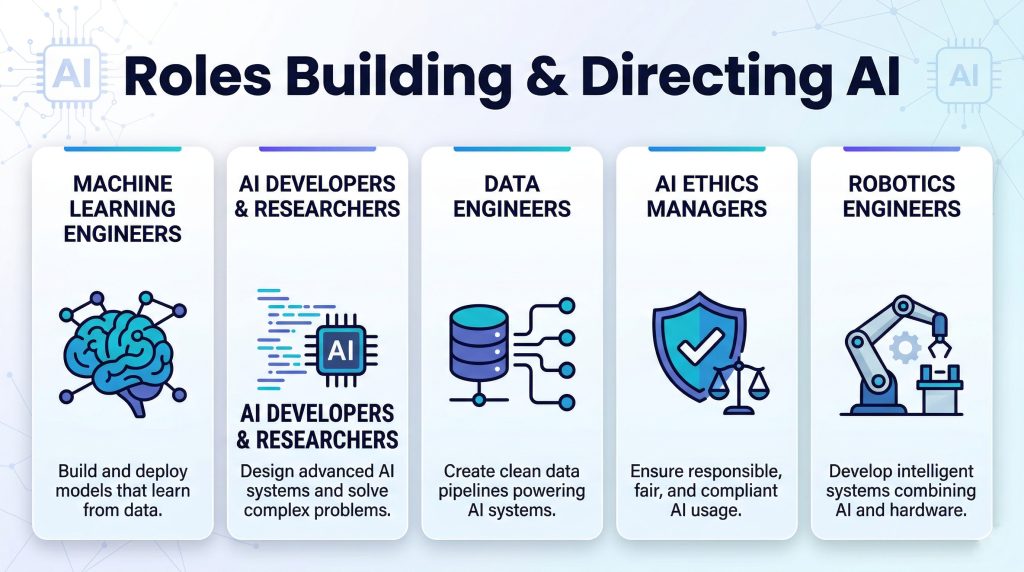
- Machine Learning Engineers
These professionals design the algorithms that allow machines to learn from vast datasets, constructing complex neural networks and ensuring smooth model deployment. Those entering the field should carefully review the top machine learning jobs for freshers and consistently monitor machine learning and AI job trends.
- AI Developers and Researchers
Creating generative AI requires deep theoretical knowledge and the ability to solve unprecedented technical challenges. Researchers work tirelessly to mitigate algorithmic bias and refine unsupervised learning methodologies. You can start laying the groundwork by taking a free course to build a career in AI.
- Data Engineers
Before an algorithm can make accurate predictions, unstructured data must be aggregated, cleaned, and properly formatted into structured pipelines. Exploring practical project ideas will help you build a verifiable portfolio in this crucial foundational area.
- AI Ethics Managers
As AI systems scale, companies require human oversight to ensure compliance, tackle algorithmic bias, and maintain ethical deployment frameworks. They serve as the critical human checkpoint ensuring that model outputs do not cause reputational or social harm.
- Robotics Engineers
Bridging the gap between software algorithms and physical hardware, robotics engineers utilize computer vision and deep learning to build autonomous systems. Understanding the foundational knowledge required for this intersection is well-detailed in the 5 Key Skills to Kickstart Your Career in Artificial Intelligence video.
For professionals seeking a structured, highly credible pathway into this technical domain, the PG Program in Artificial Intelligence & Machine Learning offers an exceptional opportunity.
PG Program in AI & Machine Learning
Master AI with hands-on projects, expert mentorship, and a prestigious certificate from UT Austin and Great Lakes Executive Learning.
Delivered in collaboration with the McCombs School of Business at The University of Texas at Austin, this 12-month online program empowers professionals to confidently transition into roles like Data Engineers and AI Consultants.
The comprehensive curriculum allows learners to gain hands-on expertise in Python, Generative AI, natural language processing, computer vision, predictive modeling, and SQL.
Guided by world-renowned faculty and industry mentors, participants work on real-world case studies and receive dedicated career support, yielding a proven track record of significant salary hikes and leadership transitions.
3. Data Translators: Decoding Algorithmic Outputs for Business Strategy
Raw data holds little value without the strategic context required to implement it effectively.
While artificial intelligence systems are excellent at identifying patterns through predictive analytics, they cannot formulate business strategies based on those insights.
Organizations desperately need professionals who can bridge the gap between technical outputs and executive decision-making.
- Business Intelligence Analysts
These professionals act as the critical bridge between complex data outputs and actionable operations, evaluating the competitive era and managing stakeholder expectations. Planning a robust long-term trajectory in this sector requires analyzing comprehensive careers and roadmap guides.
- Data Strategists
Modern companies need informed leaders who understand exactly what employers expect beyond basic AI tool usage. Strategists assess regional market nuances and contextualize algorithmic predictions against unpredictable human consumer behavior.
- Financial Analysts
While AI can effortlessly process massive financial ledgers, it cannot factor in geopolitical tensions or executive leadership changes when forecasting. Assessing these multi-layered financial risks requires human intuition; you can test your foundational knowledge through analytical quizzes.
- Supply Chain Managers
Logistics are frequently disrupted by unpredictable real-world events ranging from weather crises to labor strikes. While machine learning handles baseline forecasting, human managers orchestrate the rapid, on-the-ground adjustments needed to keep operations flowing.
- Marketing Strategists
Generative AI can write basic copy, but it lacks the human empathy required to construct deeply resonant brand campaigns. Marketing leaders blend consumer psychology with data insights to evoke genuine emotional reactions from target demographics.
To master these critical translation and strategy capabilities, professionals should consider the PG Program in Data Science with Generative AI.
Post Graduate Program in Data Science
Master data science skills with a focus on in-demand Gen AI through real-world projects and expert-led learning.
Offered by UT Austin’s McCombs School of Business, this comprehensive program provides a rigorous toolkit tailored specifically for professionals aiming to step into strategic data roles.
The curriculum covers a massive breadth of tools, including Python, Tableau, predictive modeling, unsupervised learning, ChatGPT prompt engineering, and business analytics.
Through 10+ hands-on projects, 60+ real-world case studies, and continuous 1:1 industry mentorship, learners gain the undeniable ability to translate complex data insights into actionable business strategies across the retail, finance, and marketing sectors.
4. Cybersecurity Professionals in the Age of Intelligent Threats
As artificial intelligence advances, so do the capabilities of malicious actors. AI-generated malware and highly sophisticated social engineering attacks require equally sophisticated defense mechanisms.
The modern cybersecurity era is evolving rapidly from reactive patching to proactive, intelligent threat hunting, demanding professionals who possess an adversarial mindset.
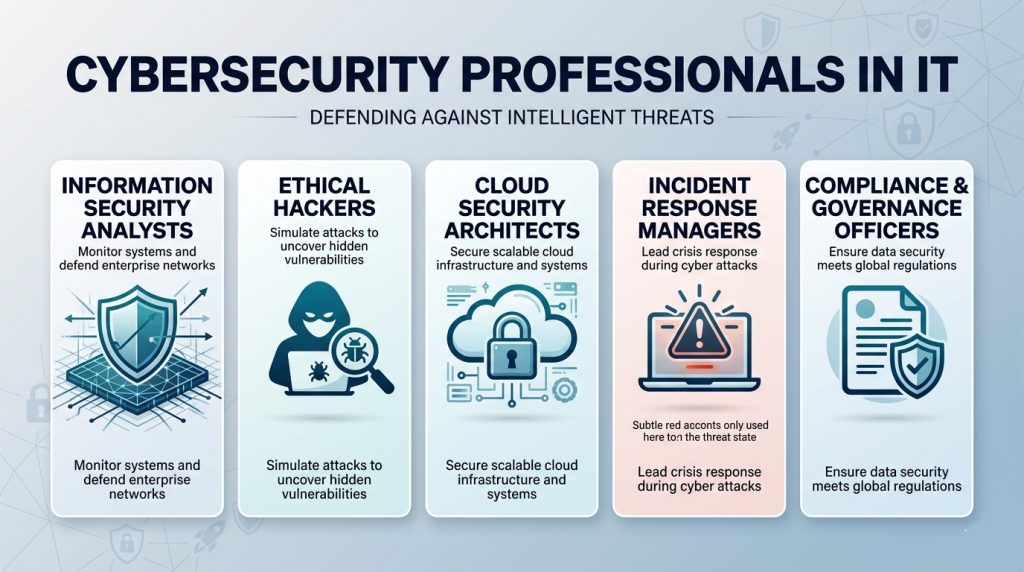
- Information Security Analysts
These professionals meticulously monitor enterprise networks, design robust zero-trust architectures, and evaluate cloud security postures. Artificial intelligence cannot autonomously design its own holistic defense frameworks across dynamic, multi-layered IT environments.
- Ethical Hackers (Penetration Testers)
Finding critical vulnerabilities in complex infrastructure requires creative problem-solving and an inherently human, adversarial mindset. Hackers must anticipate unpredictable behaviors; engaging in complex exercises to simulate threat scenarios is vital for maintaining a defensive edge.
- Cloud Security Architects
As enterprises migrate data to distributed networks, architects are required to secure scalable environments on platforms like AWS. Building foundational knowledge in IT networking is crucial, and you can explore this through foundational free online courses with certificates.
- Incident Response Managers
When a massive data breach occurs, algorithms cannot orchestrate the resulting public relations strategy, legal reporting, and cross-departmental coordination. Incident responders manage the acute chaos of a cyber crisis with high-level executive communication.
- Compliance and Governance Officers
Navigating shifting global data privacy laws requires interpreting dense legal text and ensuring technical architectures comply. Professionals must establish unified control programs to align with ever-changing government mandates.
For IT professionals ready to formally combat these intelligent threats, the Professional Certificate in Cybersecurity: IT and Data Security in the Age of AI is highly recommended.
JHU Cybersecurity Certificate Course
Build in-demand cybersecurity skills with JHU experts. Learn AI, cloud, and network security. Hands-on projects. Flexible online format.
Delivered by world-renowned faculty from Johns Hopkins University, this rigorous 14-week online program is expertly designed for professionals aiming to strengthen enterprise security.
The curriculum comprehensively covers risk management frameworks (NIST, CMMC), network security, zero-trust architecture, secure cloud design, and AI-powered threat defense.
Learners actively work on practical labs such as managing system vulnerabilities using Nessus, analyzing ransomware, and configuring robust firewalls, ultimately building the hands-on competencies required to successfully pursue global certifications like CISSP and CompTIA Security+.
5. Creative and Strategic Leadership
Automation excels at standardizing repetitive processes, but it fails completely at genuine innovation, moral reasoning, and empathetic leadership.
Jobs that require setting an organizational vision, managing human dynamics, and understanding cultural nuances remain deeply insulated from algorithmic disruption.
- Chief Executive Officers (CEOs)
Executives must actively navigate complex legal work, massive organizational pivots, and consistently inspire the workforce. Studying robust leadership and management principles remains an indispensable requirement for anyone aspiring to the C-suite.
- Creative Directors
While generative AI can rapidly produce art or marketing copy, it distinctly lacks original perspective. Curating resonant experiences and aligning them with a brand's specific cultural identity requires a deep understanding of skills that remain valuable even as AI advances.
- Human Resources Directors
Managing conflict resolution, negotiating complex compensation packages, and nurturing corporate culture are purely human endeavors. An algorithm cannot conduct a sensitive performance review or organically boost team morale during an organizational restructuring.
- Transformation Leads
Professionals guiding teams through massive technological shifts act as change agents. If you find yourself in a transitional period, reading about how an AI course can help you pivot after a layoff provides an excellent perspective on stepping into these strategic deployment roles.
Next Step
The narrative that robots will aggressively replace all workers is a profound oversimplification of the future global economy. Instead of facing total elimination, the modern workforce is entering an exciting phase of rapid augmentation.
The primary key to career survival is not competing with artificial intelligence on processing speed or data retention, but rather excelling phenomenally in areas where machines demonstrate fundamental deficiencies: complex problem-solving, emotional resonance, ethical judgment, and creative strategy.
By leaning confidently into uniquely human strengths and treating AI as an incredibly powerful operational tool rather than an adversarial force, forward-thinking professionals across all sectors can securely elevate their careers in the intelligent era.