
- What Are Electric Vehicles?
- Why the Automotive Industry Is Moving Toward EVs?
- How EVs Are Transforming Automotive Engineering Roles?
- Emerging Specializations for Automotive Engineers
- Skills Companies Are Looking for in EV Engineers
- How Structured Learning Can Accelerate Your EV Career?
- Real-World Examples of EV Innovation
- Conclusion
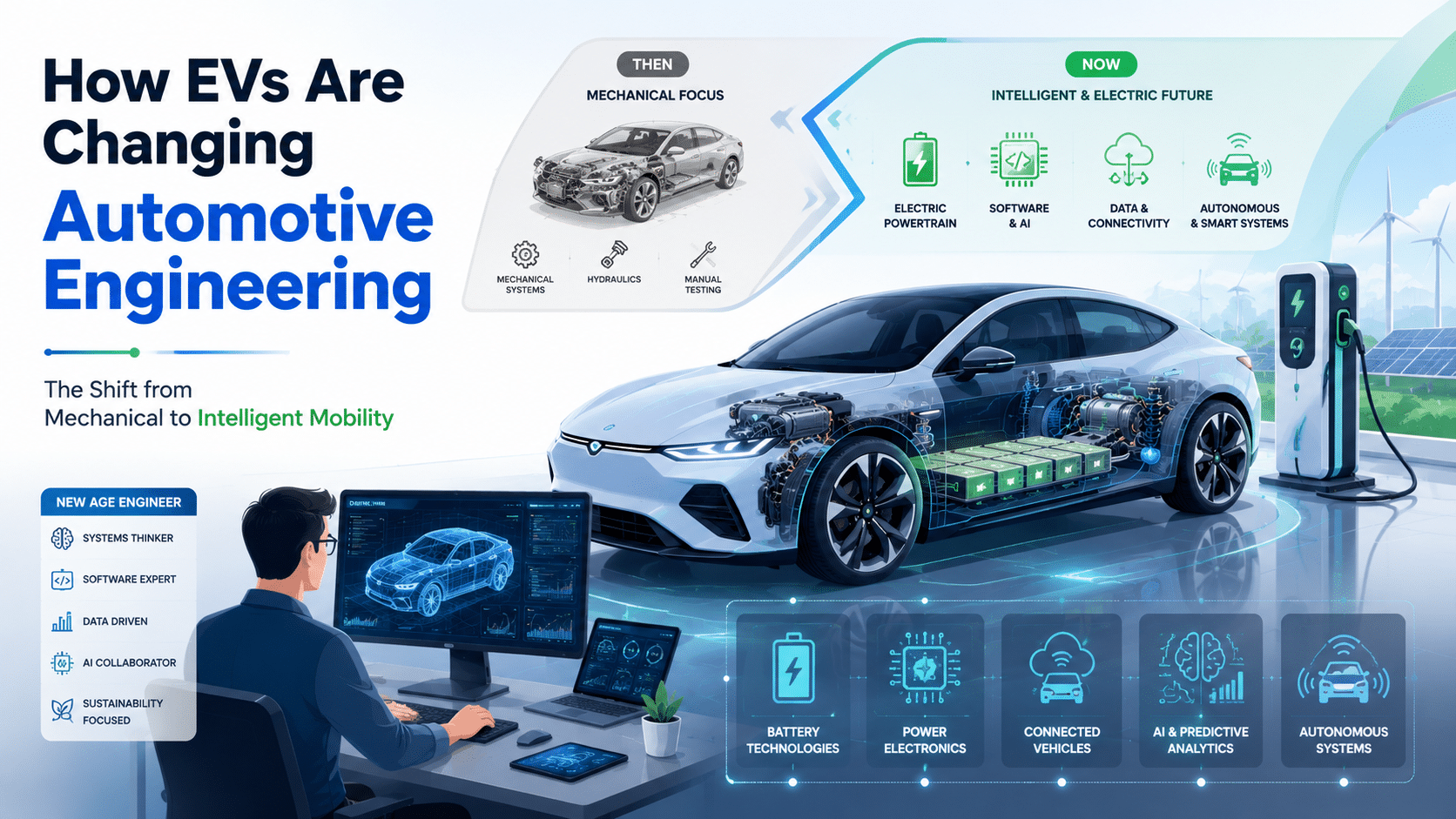
Cars are no longer just mechanical machines powered by fuel engines, they are becoming intelligent, software-driven systems built around batteries, electronics, and connected technologies. This shift is also transforming the role of automotive engineers, who now need to work across areas such as battery systems, embedded software, power electronics, and AI-based vehicle technologies.
In this blog, we will explore how electric vehicles are changing the role of automotive engineers, the new skills companies are looking for, and the career opportunities emerging as the industry moves toward electric mobility.
What Are Electric Vehicles?
Electric vehicles are transportation systems powered, either fully or partially, by electric motors rather than internal combustion engines (ICEs). They draw energy from onboard battery packs or alternative electrochemical sources, significantly reducing tailpipe emissions and dependence on fossil fuels.
Types of Electric Vehicles
- Battery Electric Vehicles (BEVs): Fully powered by electricity. They carry no combustion engine and rely entirely on high-capacity lithium-ion battery packs. Examples include the Tesla Model 3 and Tata Nexon EV.
- Hybrid Electric Vehicles (HEVs): Combine a conventional ICE with an electric motor. The electric motor assists during acceleration and recovers energy through regenerative braking, but cannot be charged externally. Examples include the Toyota Prius.
- Plug-in Hybrid Electric Vehicles (PHEVs): Similar to HEVs but include a larger battery that can be charged via an external power source. They offer a limited all-electric range before the combustion engine takes over.
- Fuel Cell Electric Vehicles (FCEVs): Generate electricity onboard through a chemical reaction between hydrogen and oxygen in a fuel cell stack. They emit only water vapor. Toyota's Mirai is a leading example.
If you're new to the EV space, Great Learning's free Introduction to Electric Vehicles course is an excellent starting point. It covers EV fundamentals and technology trends, and you earn a certificate upon completion at zero cost.
Why the Automotive Industry Is Moving Toward EVs?
The transition to electric mobility is driven by a convergence of regulatory mandates, market forces, and technological breakthroughs.
1. Government Regulations and Sustainability Goals
Governments worldwide are tightening emission norms and setting aggressive EV adoption targets. India's FAME (Faster Adoption and Manufacturing of Electric Vehicles) scheme and the EU's 2035 ban on new petrol and diesel car sales are examples of policy frameworks pushing OEMs to electrify their fleets. These mandates create both a legal imperative and a business opportunity.
2. Consumer Demand for Cleaner Transportation
Rising environmental awareness and the declining total cost of ownership of EVs are reshaping buyer preferences. Consumers are increasingly equating sustainable mobility with brand value, making EVs a strategic market priority for automakers.
3. Advancements in Battery Technology
The energy density of lithium-ion batteries has improved dramatically over the past decade, while costs have fallen by over 90% since 2010. Emerging technologies such as solid-state batteries, sodium-ion cells, and graphene-based alternatives promise even greater performance gains in the near future.
4. Reduced Carbon Emissions and Fuel Dependency
EVs produce zero tailpipe emissions and, when charged from renewable energy sources, offer a near-zero lifecycle carbon footprint. Nations seeking energy security are also incentivizing EVs to reduce dependence on imported crude oil.
Great Learning's free Sustainability in EV course is ideal for engineers who want to understand the environmental dimensions of the EV transition and how sustainability is being engineered into the product lifecycle.
How EVs Are Transforming Automotive Engineering Roles?
1. Shift from Mechanical to Software-Driven Engineering
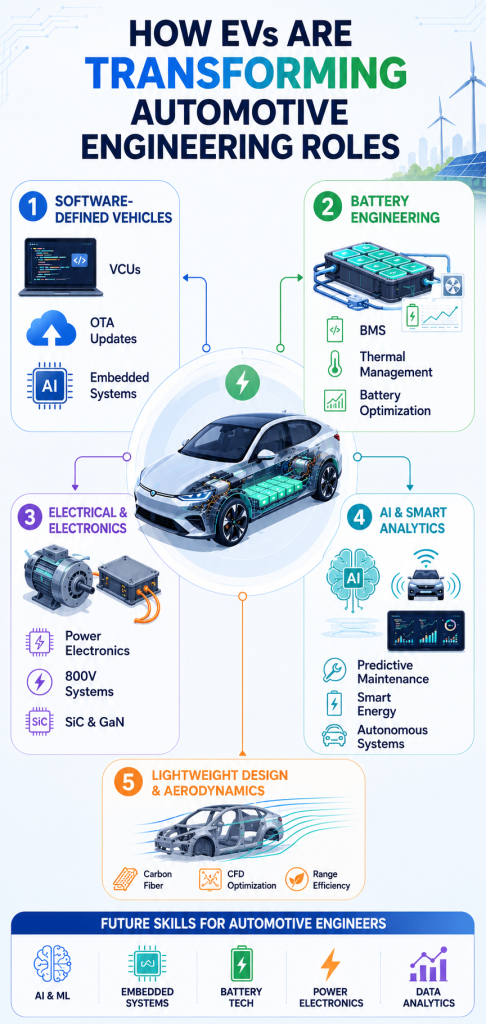
The most consequential change the EV revolution brings is the centrality of software. A modern electric vehicle contains tens of millions of lines of code, more than a commercial aircraft. Engineers who previously focused on engine calibration, exhaust systems, and fuel injection now need to engage with:
- Vehicle Control Units (VCUs): These are the brains of an EV, managing power distribution, torque vectoring, and regenerative braking through embedded software algorithms.
- Over-the-Air (OTA) Updates: Automakers like Tesla routinely push software updates to improve performance, fix bugs, and add features remotely, making software maintainability a key engineering discipline.
- Embedded Systems Development: AUTOSAR-compliant software architectures, real-time operating systems (RTOS), and model-based design using tools like MATLAB/Simulink are now core competencies.
This shift has given rise to the concept of the Software-Defined Vehicle (SDV), where the vehicle's capabilities are determined primarily by its software stack rather than its hardware configuration.
2. Rise of Battery Engineering
The battery system is the most critical and expensive component of an EV, typically accounting for 30 - 40% of the vehicle's cost. Battery engineers are now among the most sought-after professionals in the industry.
Key responsibilities include:
- Battery Management Systems (BMS): Designing algorithms that monitor cell voltage, temperature, and state-of-charge (SoC) to prevent overcharging, deep discharge, and thermal runaway.
- Thermal Management: Engineering liquid-cooled or phase-change cooling systems to maintain optimal cell temperature across varying ambient conditions and charge-discharge cycles.
- Lifecycle Optimization: Modeling battery degradation using electrochemical models and machine learning algorithms to extend pack life and maximize second-life applications.
- Cell Chemistry Selection: Choosing between NMC (Nickel Manganese Cobalt), LFP (Lithium Iron Phosphate), and emerging solid-state chemistries based on performance, cost, and safety trade-offs.
3. Increased Focus on Electrical and Electronics Engineering
EV powertrains are built around high-voltage electrical architectures that demand specialized expertise:
- Electric Motors: Permanent magnet synchronous motors (PMSMs) and induction motors are the dominant designs. Engineers must optimize rotor geometry, winding configurations, and magnetic flux paths for peak efficiency.
- Power Electronics: Inverters convert DC battery power to AC for the motor; DC-DC converters step down voltage for auxiliary systems; onboard chargers (OBCs) manage AC-to-DC conversion during charging. All these systems involve wide-bandgap semiconductors like Silicon Carbide (SiC) and Gallium Nitride (GaN).
- High-Voltage Architecture Design: EV platforms operate at 400V or 800V bus voltages. Engineers must design for electromagnetic compatibility (EMC), isolation resistance, and functional safety per ISO 26262.
4. Integration of AI and Data Analytics
Artificial intelligence is becoming foundational to EV engineering, enabling capabilities that go far beyond anything possible with traditional rule-based control systems.
- Predictive Maintenance: Machine learning models analyze sensor data from the battery, motor, and chassis systems to predict component failure before it occurs, reducing downtime and warranty costs.
- Smart Energy Management: AI-driven Energy Management Systems (EMS) optimize power flow between the battery, motor, and regenerative systems in real time, improving range by 10–15%.
- Autonomous and Connected Vehicles: Deep learning algorithms enable object detection, lane keeping, and path planning. Technologies such as LiDAR fusion, V2X (Vehicle-to-Everything) communication, and SLAM (Simultaneous Localization and Mapping) are at the frontier of EV development.
Understanding how AI integrates into automotive systems is increasingly vital. Great Learning's What is Artificial Intelligence resource provides a strong conceptual foundation.
For engineers curious about how AI is applied to vehicle safety specifically, the Distracted Driver Monitoring System Using AI article offers a compelling real-world example of AI at work in automotive contexts.
5. Lightweight Materials and Aerodynamics
Range remains the EV's primary competitive challenge. Engineers are addressing this through aggressive vehicle mass reduction and aerodynamic optimization.
- Advanced Materials: High-strength steel (AHSS), aluminum alloys, carbon fiber-reinforced polymers (CFRP), and magnesium components reduce vehicle weight without compromising structural integrity. A 10% reduction in mass can improve range by approximately 6-8%.
- Aerodynamic Optimization: Flush door handles, underbody panels, active grille shutters, and optimized A-pillar geometry are all designed using Computational Fluid Dynamics (CFD) simulations to minimize drag coefficients. Some EVs now achieve Cd values below 0.20.
- Manufacturing Innovation: Techniques such as gigacasting (pioneered by Tesla) consolidate multiple stamped parts into a single large aluminum casting, reducing weight, part count, and assembly complexity.
Emerging Specializations for Automotive Engineers
The EV era has created entirely new engineering career tracks that did not exist a decade ago:
| EV Engineering Specialization | Payscale Job Title Proxy | Average Base Salary | Core Engineering Focus |
|---|---|---|---|
| EV Battery Specialist | Chemical Engineer | ₹469,734 | Electrochemical properties, energy density, and thermal lifecycle optimization. |
| Power Electronics Engineer | Power Electronics Engineer | $91,186 (USD) | High-voltage conversion, inverters, and DC-DC converter hardware design. |
| Embedded Systems Engineer | Embedded Systems Engineer | ₹513,787 | Low-level C/C++ firmware, microcontroller logic, and ECU communication. |
| Autonomous Vehicle Engineer | Machine Learning Engineer | ₹1,186,436 | Neural network training, LiDAR/radar integration, and computer vision. |
| Charging Infrastructure Engineer | Electrical Design Engineer | ₹590,825 | High-capacity charger architecture, smart grid integration, and load balancing. |
| Vehicle Software Engineer | Software Engineer | ₹816,000 | Over-the-air (OTA) updates, infotainment UI/UX, and cloud telematics. |
Skills Companies Are Looking for in EV Engineers
| Skill | Definition | Why Companies Need It | Common Tools / Technologies |
|---|---|---|---|
| EV Architecture & Powertrain Systems | Understanding how batteries, motors, controllers, and drivetrain components work together in EVs. | Essential for designing efficient and high-performance electric vehicles. | MATLAB, Simulink, AVL Cruise |
| Battery Technology & Energy Storage | Knowledge of lithium-ion batteries, battery chemistry, thermal systems, and energy storage behavior. | Battery efficiency and safety directly impact EV range and reliability. | BMS Tools, Battery Simulation Software |
| Electric Drives & Motor Control | Designing and controlling electric motors used in EV propulsion systems. | Critical for vehicle acceleration, efficiency, and regenerative braking performance. | PMSM, Induction Motors, Motor Controllers |
| Power Electronics | Working with inverters, converters, and high-voltage electrical systems in EVs. | Required for efficient energy conversion and fast charging systems. | SiC, GaN, DC-DC Converters, Inverters |
| Embedded Systems Engineering | Developing low-level software and controllers that manage EV operations in real time. | Modern EVs rely heavily on software-driven control systems. | C/C++, AUTOSAR, RTOS, CAN Bus |
| Battery Modeling & Degradation Analysis | Analyzing battery performance, aging patterns, and lifecycle degradation. | Helps improve battery lifespan, safety, and predictive maintenance. | MATLAB, Python, Electrochemical Models |
| EV Charger Systems & Grid Integration | Understanding smart charging systems, V2G technology, and grid communication. | Important for scalable EV infrastructure and energy management. | Smart Chargers, V2G Systems, Grid Simulation Tools |
| Powertrain Simulation | Simulating EV subsystem behavior and overall vehicle performance digitally. | Reduces development cost and improves engineering accuracy. | MATLAB/Simulink, AVL Cruise, GT-SUITE |
| Lightweight Materials & Manufacturing | Using advanced materials and manufacturing methods to reduce EV weight. | Lower vehicle weight improves battery efficiency and driving range. | CFRP, Aluminum Alloys, Gigacasting |
| AI & Data Analytics for EVs | Using AI models and data analysis for predictive maintenance and energy optimization. | Improves vehicle intelligence, safety, and operational efficiency. | Python, TensorFlow, Power BI |
How Structured Learning Can Accelerate Your EV Career?
Transitioning from traditional automotive engineering to EV engineering requires expertise in battery systems, power electronics, embedded systems, and AI-driven vehicle technologies, areas that are often not deeply covered in conventional mechanical engineering education.
While self-learning can provide foundational knowledge, structured programs help professionals develop industry-ready skills through guided learning, practical exposure, and recognized credentials.
One such program is the E-Postgraduate Diploma in E-Mobility offered by the Indian Institute of Technology Bombay (IIT Bombay) in collaboration with Great Learning. Designed for engineering graduates and working professionals, the 18-month online program combines academic depth with hands-on EV-focused learning.
Advance your EV career with IIT Bombay's e-Postgraduate Diploma in E-Mobility. Gain real-world skills & credentials to lead in sustainable transportation innovation.
Key Areas Covered in the Program
- EV architecture and powertrain fundamentals
- Battery technology and energy storage systems
- Electric drives and motor control
- Power electronics, converters, and charging systems
- EV manufacturing technologies and lightweight materials
- Grid integration and smart charging infrastructure
The program also emphasizes practical learning through projects that simulate real-world EV engineering workflows. Participants work on applications such as:
- Battery modeling and degradation analysis
- Embedded controller design for electric motors
- EV charger modeling and control systems
- Power electronic system simulations
- EV impact assessment on grid infrastructure
Delivered by faculty from IIT Bombay’s C1973 EV PowerTrain Lab, the program provides additional benefits such as IIT Bombay alumni status, access to institutional hiring networks, and dedicated academic support.
As the EV industry continues to expand rapidly, structured learning programs like this help engineers bridge the gap between traditional automotive knowledge and the evolving demands of electric mobility.
Real-World Examples of EV Innovation
1. Tesla
Tesla redefined the automotive engineering paradigm by treating the car as a software product. Its continuous OTA update capability, Autopilot neural network, and in-house Dojo supercomputer for AI training set benchmarks that the rest of the industry is still racing to match. Tesla's 800V Cybertruck architecture and proprietary 4680 battery cells demonstrate its integration of chemical, electrical, and manufacturing engineering at scale.
2. BYD
China's BYD has emerged as the world's leading EV manufacturer by volume, leveraging its in-house Blade Battery (LFP chemistry) technology, which significantly improves thermal safety and energy density. BYD's vertical integration from raw material processing to semiconductor production gives it a structural cost advantage that is reshaping global supply chains.
3. Toyota
Toyota, the pioneer of hybrid technology with the Prius, is making a major push into solid-state battery development. Its proprietary e-TNGA platform underpins models like the bZ4X. Toyota's approach reflects how legacy OEMs are redesigning their engineering organizations to absorb EV-specific disciplines while retaining their manufacturing excellence.
4. Tata Motors
In the Indian context, Tata Motors has established itself as the dominant EV player with the Nexon EV and Tiago EV. Its Ziptron powertrain technology uses a permanent magnet AC motor and an IP67-rated battery pack designed to handle India's varied climatic and road conditions. Tata's success illustrates how EV engineering must be localized to specific market requirements.
As EVs grow in connectivity and intelligence, cloud infrastructure becomes equally important. Understanding how vehicle data platforms, remote diagnostics, and over-the-air systems are built requires cloud knowledge.
Great Learning's free Cloud Foundations Advanced course is a useful resource and builds the foundational skills needed to work with modern cloud-connected vehicle ecosystems.
Moreover, for engineers working on IoT-enabled charging networks or connected vehicle platforms, the free IoT course from Great Learning Academy provides essential grounding in the Internet of Things, a technology layer that is increasingly embedded in every aspect of EV infrastructure.
Conclusion
Electric vehicles are not simply a new product category; they are the catalyst for a wholesale reinvention of what it means to be an automotive engineer.
The discipline is evolving from a predominantly mechanical domain to one that is equally rooted in software engineering, electrochemistry, power electronics, artificial intelligence, and data science.
Engineers who adapt by building cross-disciplinary expertise will not only remain relevant but will be among the most valued professionals in one of the world's largest industries.