Free Oracle SQL Course for Beginners
Oracle SQL
 4.54
Beginner level
5.25 learning hrs
4.54
Beginner level
5.25 learning hrs
Learn Oracle SQL basics, from database design and SQL commands to functions, joins, subqueries, and database objects. Enroll in this free Oracle SQL course to build practical SQL skills.
Instructor:
Mr. Ritwik Raj


What you'll learn


About this course
In this Oraclecourse, you will understand the working of Oracle DBMS in-depth. First, you will start with an introduction to DBMS, the difference between data and database; after that, you will learn how to create tables and store or insert data inside them. Later, you will also learn various miscellaneous and small topics around Oracle, which are very important from an interview perspective.
Not only that, but you will also understand the core topics of SQL, such as functions, clauses, joins, and many more, which are used to write a query and find the resultant data for a problem in a database. At last, you are going to end this course by learning about SQL commands and Database objects.
Course outline
Database Management Systems (DBMS): Architecture and Storage
Define Database Management Systems (DBMS). Differentiate raw data from structured databases and explore core DBMS architecture designed to resolve data redundancy and management challenges.
DDL Basics: CREATE TABLE, Data Types, and Keys
Construct database schemas using the CREATE TABLE command. Define precise Oracle data types (VARCHAR2, NUMBER) and enforce referential data integrity by establishing Primary Keys and Foreign Keys.
Oracle Database Setup and Local Environment Configuration
Configure a functional local development workspace. Execute the step-by-step installation of the Oracle Database environment to write, test, and deploy SQL queries effectively.
The Relational Data Model: Attributes, Tuples, and Normalization
Master the theoretical foundation of Oracle SQL. Apply the Relational Model by mapping relations (tables), attributes (columns), and tuples (rows), and implement database Normalization principles.
Oracle Data Dictionary Views and Sequence Generation
Navigate critical Oracle functionalities for database administration. Query system metadata using Data Dictionary Views (USER_TABLES, ALL_OBJECTS) and automate primary key values via Sequence Generation.
SQL Operators: Arithmetic, Comparison, Logical, and Set Operations
Manipulate database records using Oracle SQL Operators. Apply Arithmetic operators for calculations, Comparison operators for filtering, Logical operators (AND, OR, NOT), and Set operators (UNION, INTERSECT) to combine query results.
Oracle SQL Functions: Single-Row and Aggregate Computations
Perform complex data transformations using built-in Oracle functions. Implement Single-Row functions (character manipulation, numeric math, date formatting) and Multiple-Row Aggregate functions (SUM, AVG, COUNT).
Core SQL Clauses: WHERE, GROUP BY, HAVING, and ORDER BY
Structure robust SQL queries to filter and sort enterprise data. Utilize the WHERE clause for row-level filtering, GROUP BY and HAVING for aggregated data segments, and ORDER BY for result sorting.
Advanced SQL: Subqueries and Nested Query Execution
Execute multi-step data retrieval using Nested Queries (Subqueries). Embed inner subqueries within outer queries to isolate specific values, perform comparative analysis, and resolve complex data fetching requirements.
Relational SQL Joins: Inner, Outer, Full, and Self Joins
Combine related dataset columns using relational SQL Joins. Execute Inner Joins for matched records, Outer Joins (Left, Right, Full) for unmatched records, and Self Joins for hierarchical data relationships.
Core SQL Command Categories: DDL, DML, DCL, and TCL
Categorize and execute the four pillars of SQL commands. Utilize Data Definition Language (DDL), Data Manipulation Language (DML), Data Control Language (DCL), and Transaction Control Language (TCL) commands like COMMIT and ROLLBACK.
Oracle Database Objects: Views, Indexes, and Synonyms
Optimize database performance and security using Oracle Database Objects. Abstract underlying table data using virtual Views, accelerate query retrieval speeds using Indexes, and simplify object referencing using Synonyms.
Master in-demand tools

SQL

Oracle Database
Get access to the complete curriculum once you enroll in the course
This course is ideal for
- Beginners interested in Database Management Systems
- Data analysts looking to learn SQL querying
- Software developers needing Oracle DB skills
- Students preparing for technical database interviews
 4.54
4.54
Earn certificates from world-renowned universities
Learn from top faculty with live mentorship and hands-on learning.
 UNIVERSITY


Highly Recommended
MIT Professional Education
Applied AI and Data Science Program
Career support
for your dream job
Industry-ready curriculum
designed by faculty
Mentorship
from industry experts
Hands-on learning
with real-world scenarios
View Program
Level up with advanced skills & become job ready with Pro+
Subscribe to Pro+ today to build skills with 50+ Pro courses and prep for jobs with advanced AI tools.
 PRO
PRO
.jpg "course thumbnail")


Practice exercises
Certificate from AWS
AI Resume Builder
AI mock interviews
















Our course instructor

Mr. Ritwik Raj
IT & Software Expert


Frequently Asked Questions
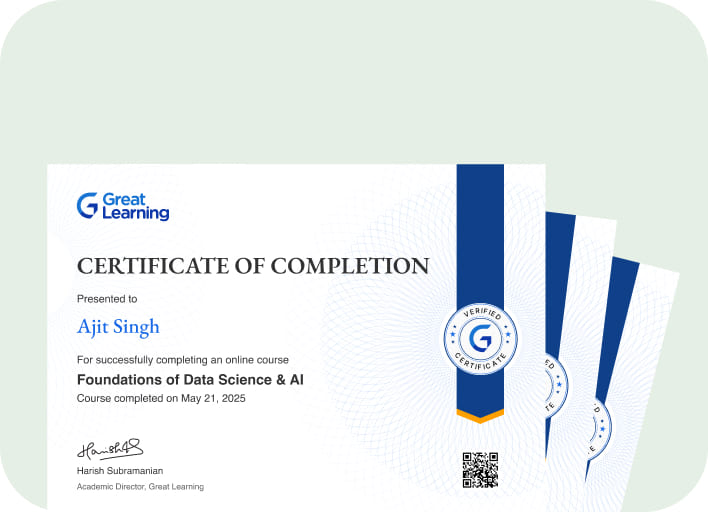
Will I receive a certificate upon completing this free course?
Is this course free?
What will I learn in this Oracle SQL course?
In this Oracle SQL course, you will learn how to use SQL to interact with Oracle databases. The course covers the basics of SQL syntax, including how to query data, manipulate data, and organize it using Oracle SQL commands. You’ll also explore advanced topics such as joins, subqueries, and functions that are essential for working with Oracle databases in real-world applications.
Can I learn Oracle SQL from the basics with this course?
Yes. You’ll start with DBMS concepts and the relational data model before progressing to table creation, queries, functions, joins, and other SQL concepts.
Who should take this free Oracle sql training Course?
This course is ideal for beginners, students, and professionals who want to learn Oracle SQL or deepen their SQL knowledge. It's also beneficial for anyone pursuing careers in database management, data analysis, or software development, as SQL is a key skill in these fields.
Will I learn how to create tables in Oracle SQL?
Yes. You’ll learn to use the CREATE TABLE command, define Oracle data types such as VARCHAR2 and NUMBER, and establish Primary and Foreign Keys.
Can I practice SQL queries in a local Oracle environment?
Yes. The course covers Oracle Database installation and local environment configuration so you can set up a workspace for writing and testing SQL queries.
How long does it take to complete this Oracle sql course free with certificate?
The course is 5.25 hours long and can be completed at your own pace. You can revisit sections as needed, allowing you to learn at your convenience and make sure you fully grasp each concept before moving forward.
What SQL query skills will I develop through this Oracle SQL training?
You’ll learn to filter, group, sort, combine, and analyze data using operators, WHERE, GROUP BY, HAVING, ORDER BY, subqueries, and SQL joins.
What topics are covered in this oracle SQL basics Course?
This course covers essential topics in Oracle SQL, including:
Introduction to DBMS
Creation of Table
Oracle Setup and Installation
Relational Model in Oracle
Miscellaneous Topics in Oracle
Operators as Keywords in Oracle
Functions in Oracle
Clauses in Oracle
Nested Query in Oracle
Joins in Oracle
SQL Commands in Oracle
Database Objects in Oracle
The course will equip you with the knowledge to work with Oracle databases efficiently.
Will I learn how to use functions in Oracle SQL?
Yes. You’ll work with single-row functions for character, numeric, and date operations, along with aggregate functions such as SUM, AVG, and COUNT.
Can I learn how to write subqueries in Oracle SQL?
Yes. You’ll learn how nested queries work and how subqueries can be used to retrieve values and perform more complex data queries.
Will this Oracle SQL course for beginners cover SQL joins?
Yes. You’ll learn how to combine related data using Inner, Left, Right, Full, and Self Joins.
Will I learn different types of SQL commands in this course?
Yes. You’ll explore DDL, DML, DCL, and TCL commands, including transaction commands such as COMMIT and ROLLBACK.
Do I need any prior experience to take this course?
No, this course is designed for beginners, and no prior experience with Oracle SQL or database management is required. The course starts with the basics and gradually builds up to more advanced concepts, making it suitable for anyone looking to learn Oracle SQL free.
What Oracle database skills will I gain from completing this course?
You’ll learn to work with database objects such as Views, Indexes, and Synonyms, while building practical knowledge of querying and managing relational data.
How can I apply the knowledge gained in this Oracle sql course free with certificate?
After completing this course, you will be able to apply the concepts you’ve learned to real-world situations, such as querying large datasets, optimizing data retrieval, and managing Oracle databases. You will be ready to handle common database tasks, such as data entry, reporting, and analysis.
What skills will I gain in this free Oracle SQL course?
The skills you will gain are:
- Java
- Java Projects
- Real-World Java Applications
- Project-Based Java Learning
- Hands-On Java Project Experience
- Beginner Java Project Ideas
- Intermediate Java Project Ideas
- Advanced Java Project Ideas
What kind of jobs can I get after completing an Oracle SQL course Online?
After completing an Oracle SQL course, you can pursue roles like Database Administrator, SQL Developer, Data Analyst, Business Intelligence Analyst, and Software Engineer. These positions require proficiency in SQL and an understanding of database management, which this course will help you develop.
Is this Oracle free SQL Course self-paced?
Yes, this is a self-paced course. You can start and finish the course at your own pace, making it easy to fit into your schedule. You can pause, revisit sections, and complete the course whenever it’s most convenient for you.
How long will it take to learn this course?
For beginner’s level, it may take up to a few hours to one to two weeks, but if you want to learn it in-depth, it may take more time. It also depends on how familiar you are with the database management, SQL server, and its commands.
Will I have lifetime access to this free Oracle SQL course?
Yes, once you enroll in the course, you will have lifetime access, where you can log in and learn whenever you want to.
What are the steps to enroll in this Oracle SQL course?
Enrolling in any of the Great Learning Academy’s courses is just one step process. Sign-up for the course, you are interested in learning through your E-mail ID and start learning them for free online.
Why choose Great Learning Academy for this free Oracle SQL course?
Great Learning Academy provides this Oracle SQL course for free online. The course is self-paced and helps you understand various topics that fall under the subject with solved problems and demonstrated examples. The course is carefully designed, keeping in mind to cater to both beginners and professionals, and is delivered by subject experts. Great Learning is a global ed-tech platform dedicated to developing competent professionals. Great Learning Academy is an initiative by Great Learning that offers in-demand free online courses to help people advance in their jobs. More than 5 million learners from 140 countries have benefited from Great Learning Academy's free online courses with certificates. It is a one-stop place for all of a learner's goals.
Can I sign up for multiple courses from Great Learning Academy at the same time?
Yes, you can enroll in as many courses as you want from Great Learning Academy. There is no limit to the number of courses you can enroll in at once, but since the courses offered by Great Learning Academy are free, we suggest you learn one by one to get the best out of the subject.
Recommended Free IT & Software courses
-
FREE

-
FREE
-
FREE
-
FREE
-
FREE
-
FREE
-
FREE
-
FREE
 FREE
FREE


Similar courses you might like
-
FREE
-
FREE
-
FREE
-
FREE

.jpg "Course thumbnail image")

Related IT & Software Courses

-
McCombs School of Business at The University of Texas at Austin
Post Graduate Program in Cyber Security20 weeks · Online
Know More