
Free Statistical Tests Course
Introduction to Statistical Tests
 4.6
Intermediate level
10.5 learning hrs
4.6
Intermediate level
10.5 learning hrs
Statistical Tests free lessons focus on datasets, metrics, and analysis choices, helping you understand the course value before choosing projects, practice, or deeper study.
Instructor:
Mr. Anirudh Rao




About this course
This free statistical tests course is built for analytics, data science, and business learners who want the topic explained with context and usable examples. The course introduces data preparation, model thinking, visual analysis, and evaluation in a way that shows how the pieces work together. Instead of treating statistical tests as a list of terms, it explains what to look for, how to reason through common tasks, and why the subject appears in real projects, teams, or business decisions.
The course is a good fit if you want to turn data, models, or analysis outputs into clearer decisions. You can use it to prepare for assignments, interviews, workplace conversations, or a first hands-on project depending on your goal. After finishing, you should be able to explain the core idea of statistical tests, recognize when it is relevant, and choose a sensible next step such as practice exercises, deeper tools, related frameworks, or a more advanced course.
Course outline
Inferential Statistics
This module will outline the techniques and significance of data collection. It'll cover the fundamental concepts and usage of probability, Central Limit Theorem and its role in statistical inference, etc.
Understanding Descriptive Statistics
This module will delve into key statistical concepts, starting with Measures of Variability. It will then explore the Measure of Skewness and conclude with an examination of Kurtosis.
Understanding Measures of Dispersion
This module will explain analytics with Excel, variance, and standard deviation.
Understanding Measures of Central Tendency
This module covers the case study based on Central Tendency concepts for Data Science and understands the importance of statistics.
Hypothesis Testing - Overview
This module will cover the major concepts that help carry out Hypothesis Testing successfully. You will learn about Type 1 and Type 2 errors and understand the Z-test in detail.
Central Limit Theorem
This module will delve into the Central Limit Theorem and Hypothesis Testing, exploring their concepts using various examples.
Chi-Square Test
This module will cover the essentials of statistics and delve into hypothesis testing, exploring both parametric and non-parametric testing. It also includes a detailed look at the Chi-Square Test.
Understanding the F Distribution
This module will delve into ANOVA (Analysis of Variance) and also cover the concept of F-Distribution, which is integral to ANOVA for determining the ratio of variances.
Get access to the complete curriculum once you enroll in the course
 4.6
4.6











Our course instructor

Mr. Anirudh Rao
Data Science Expert


Frequently Asked Questions
Will I receive a certificate upon completing this free course?
Is this course free?
What are the prerequisites required to learn this Statistical Tests Course?
You do not need any prior knowledge to learn this Statistical Tests Course.
What will I learn in this free Statistical Tests course?
How long does it take to complete this free Statistical Tests Course?
Statistical Tests is an 8-hour long course, but it is self-paced. Once you enrol, you can take your own time to complete the course.
Who should start with this Statistical Tests course?
Will I have lifetime access to the free course?
Yes, once you enrol in the course, you will have lifetime access to any of the Great Learning Academy’s free courses. You can log in and learn whenever you want to.
How does Statistical Tests help in practical learning?
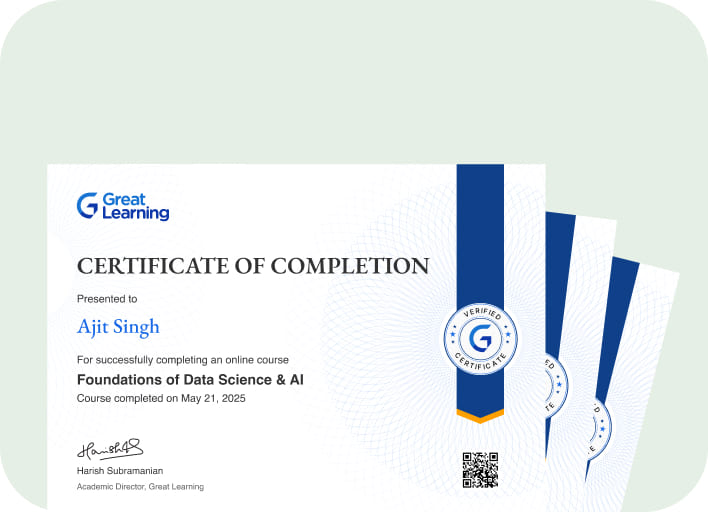
Will I get a certificate after completing this Statistical Tests Course?
Yes, you will get a certificate of completion after completing all the modules and cracking the assessment.
What Statistical Tests basics should I know before advanced study?
How much does this Statistical Tests Course cost?
It is an entirely free course from Great Learning Academy.
Can beginners learn Statistical Tests online through this course?
What makes this Statistical Tests training useful for projects?
Who is eligible to take this Statistical Tests Course?
You do not need any prerequisites to learn the course, so enrol today and learn it for free online.
How should I practice after finishing Statistical Tests?
What questions does this free Statistical Tests course answer for learners?

Recommended Free Data Science courses
-
FREE

-
FREE
-
FREE
-
FREE
-
FREE
-
FREE
-
FREE
-
FREE
 FREE
FREE



Similar courses you might like
-
FREE
-
FREE
-
FREE
-
FREE


Related Data Science Courses

-
12 weeks · Online
Know More
-
MIT Professional Education
Applied AI and Data Science Program15 Weeks · Live Online · Weekdays & Weekend
Know More
-
Deakin University
Master of Data Science (Global) Program24 Months · Online
Top 1% UniversityKnow More






Popular Topics to Explore
Relevant Career Paths >



Other Data Science tutorials for you
Introduction to Statistical Tests
Statistical tests are essential tools in the field of statistics that allow researchers and analysts to draw conclusions about populations based on sample data. These tests help assess the significance of relationships, differences, or patterns observed in the data, providing a framework for making informed decisions and generalizations. Here, we'll explore some common types of statistical tests and their applications.
1. T-Test:
The t-test is used to determine if there is a significant difference between the means of two groups. There are various types of t-tests, such as the independent samples t-test for comparing two independent groups and the paired samples t-test for comparing two related groups (e.g., before and after measurements). The t-test calculates a t-statistic, and the results are compared to a critical value or p-value to determine statistical significance.
2. Chi-Square Test:
The chi-square test is employed when dealing with categorical data to assess the independence of two variables. It is commonly used in contingency table analysis. The test compares the observed frequencies of categories with the frequencies expected under a null hypothesis of independence. A significant result suggests that there is a relationship between the variables.
3. ANOVA (Analysis of Variance):
ANOVA is a statistical test used to analyze the differences among group means in a sample. It is an extension of the t-test and is applicable when comparing means across more than two groups. The F-statistic is calculated, and if it exceeds a critical value or if the p-value is below a chosen significance level, the null hypothesis of equal means is rejected.
4. Regression Analysis:
Regression analysis is a statistical technique used to examine the relationship between one dependent variable and one or more independent variables. The goal is to model the underlying pattern of the data and make predictions. Simple linear regression involves one independent variable, while multiple linear regression deals with two or more. The significance of the regression coefficients is assessed using hypothesis tests.
5. Mann-Whitney U Test:
The Mann-Whitney U test, also known as the Wilcoxon rank-sum test, is a non-parametric test used to determine whether there is a difference between two independent samples. This test is appropriate when the assumptions of the t-test cannot be met. It assesses whether the distributions of the two groups are the same.
6. Kruskal-Wallis Test:
Similar to ANOVA but for non-parametric data, the Kruskal-Wallis test is used to determine whether there are significant differences among three or more independent groups. It ranks the data and assesses whether the distributions of the groups are equivalent.
7. Paired Wilcoxon Signed-Rank Test:
When dealing with paired data and non-normal distributions, the paired Wilcoxon signed-rank test is a non-parametric alternative to the paired samples t-test. It assesses whether there is a significant difference between two related groups.
8. Fisher's Exact Test:
Fisher's exact test is a statistical test used with small sample sizes or when the assumptions of the chi-square test cannot be met. It assesses the association between two categorical variables in a 2x2 contingency table.
In conclusion, statistical tests are powerful tools for making inferences from sample data to populations. The choice of a specific test depends on the nature of the data, the research question, and the assumptions underlying each test. These tests play a crucial role in various fields, including medicine, social sciences, economics, and more, providing a rigorous foundation for drawing meaningful conclusions from empirical observations.