
Free MySQL Course
End-to-End MySQL: Schema to Subqueries
 4.46
Beginner level
6.75 learning hrs
4.46
Beginner level
6.75 learning hrs
Enrolling in this beginners course will help you develop functional knowledge of one of the Relational Database Management Systems, MySQL, and its usefulness with practicality which will eventually improve your career prospects.




What you'll learn


About this course
This course will first introduce you to Database Management System (DBMS) with a few examples. Next, you will learn its various types and advantages, followed by the Relational Database Management System (RDBMS), wherein you will comprehend the differences between DBMS and RDBMS. Later, you will get familiar with different Keys and Normalization techniques with examples. Moving ahead, you will be introduced to MySQL and its various concepts like Commands, Filter Records, Operators, Pattern Matching, and Null Values. In addition, you will learn to implement all these concepts through hands-on demonstrations. Once you finish this free course, take the quiz and earn a completion certificate.
Are you ready to upskill further than MySQL? Look no further! Our professional Software Engineering courses cover every skill you need to become an accomplished expert in the domain.
Course outline
Introduction to Database Management System
This section begins by defining a database, gives you an overview of the database management system, and briefly explains how to manage and manipulate data in a database.
Types of Database Management System
This chapter will cover various types of DBMS, including Hierarchical, Network, Relational, and Object-Oriented Databases. You will also be familiarized with several advantages of DBMS.
What is a Relational Database Management System?
This chapter will familiarize you with the RDBMS concepts and a few critical differences between File System, DBMS, and RDBMS.
Key Concepts in Relational Database Management System
This module starts by explaining the concept of keys in RDBMS. You learn about its types and learn them in detail. You will go through the comparison between a super key and a candidate key.
Normalization Technique
This module discusses Normalization and the role it plays in DBMS. In detail, you will learn about its various types like 1NF, 2NF, 3NF, and BCNF(Boyce and Codd Normal Form).
What is SQL and getting started with MySQL
This chapter will brief you on the introduction to SQL and how to install it on your system.
Types of commands in MYSQL
In this chapter, you will learn how to implement various types of Commands in MySQL, such as DDL, DQL, DML, DCL, and TCL, with hands-on demos.
Filter records in MySQL
In this chapter, you will learn how to filter the records using the WHERE clause in MySQL.
Operators in MYSQL
Now, you will learn how to implement various Operators like AND, OR, and NOT with the help of hands-on demos.
Pattern matching in MYSQL
Here, you will learn to find patterns using the LIKE operator with the WHERE clause.
Null values in MySQL
In the final chapter, you will learn to insert a new record or update a record to an optional field without adding a value with the help of a Null value.
Get access to the complete curriculum once you enroll in the course
This course is ideal for
- Beginners wanting to learn database and SQL fundamentals.
- Students and job seekers exploring database administrator roles.
- Working professionals who manage or query company data.
- Learners who want a MySQL Basics certificate.
 4.46
4.46
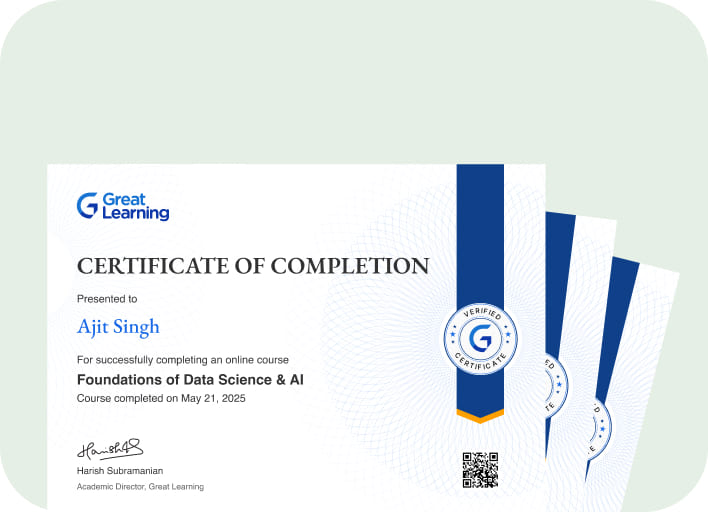
Earn certificates from world-renowned universities
Learn from top faculty with live mentorship and hands-on learning.
 UNIVERSITY


Highly Recommended
McCombs School of Business at The University of Texas at Austin
Post Graduate Program in Data Science with Generative AI
Career support
for your dream job
Industry-ready curriculum
designed by faculty
Mentorship
from industry experts
Hands-on learning
with real-world scenarios
View Program
Level up with advanced skills & become job ready with Pro+
Subscribe to Pro+ today to build skills with 50+ Pro courses and prep for jobs with advanced AI tools.
 PRO
PRO

Practice exercises
Guided Projects
AI Resume Builder
AI mock interviews














What our learners enjoyed the most
Skill & tools
61% of learners found all the desired skills & tools
Frequently Asked Questions
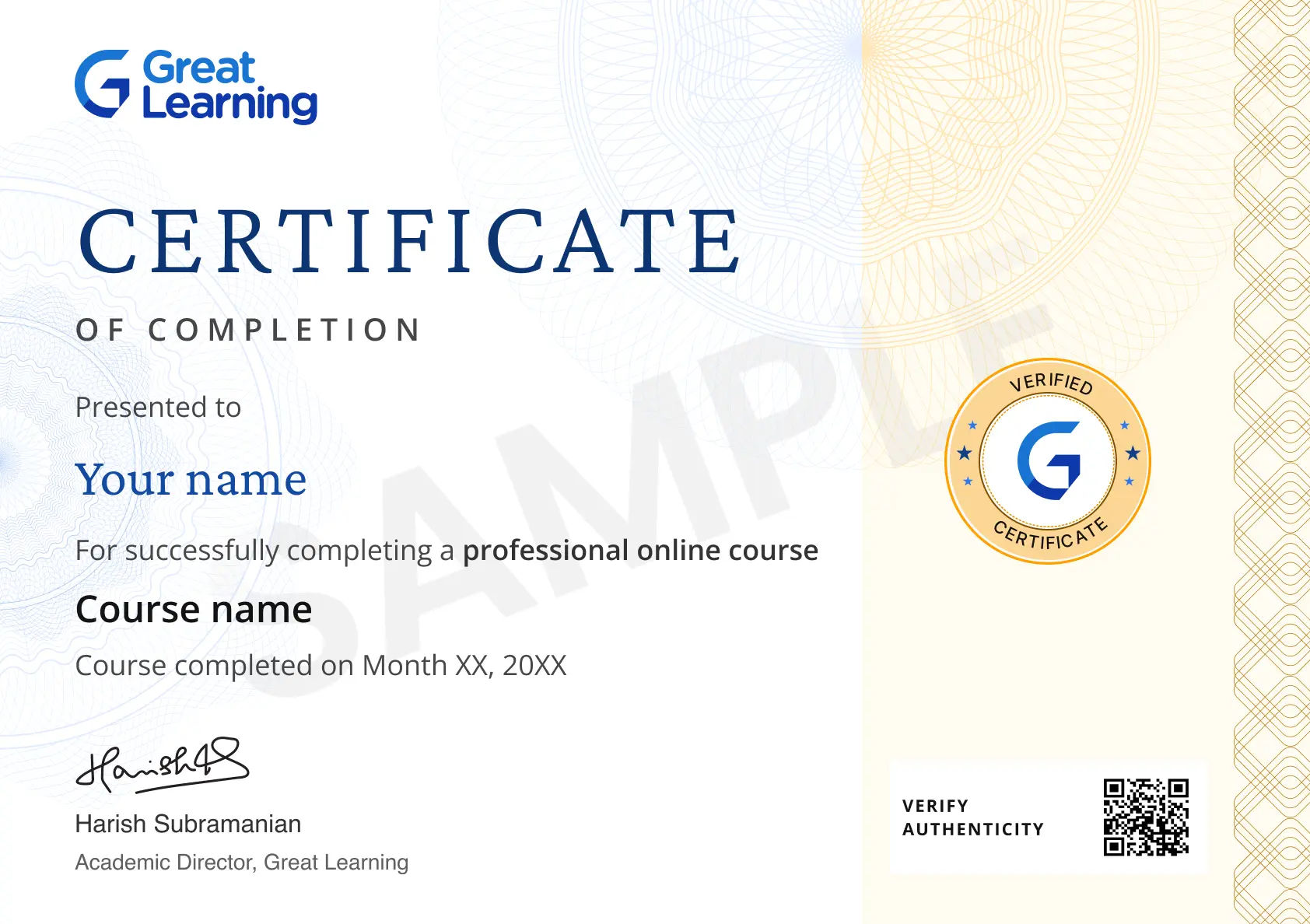
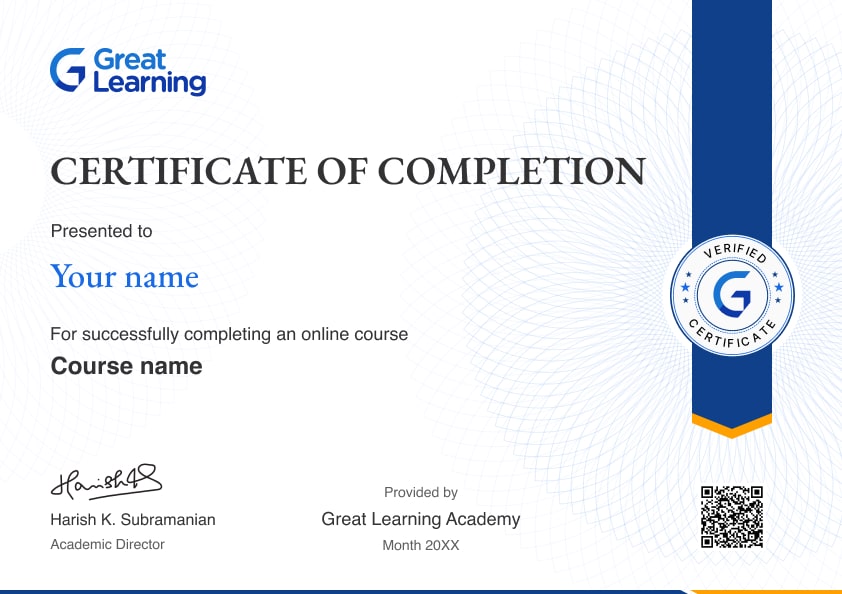
Will I receive a certificate upon completing this free course?
Is this course free?
What is MySQL, and why is it important in the world of databases?
MySQL is an open-source relational database management system (RDBMS) known for its speed, reliability, and ease of use. It is important because it allows users to store, manage, and retrieve structured data efficiently.
Is prior knowledge of databases or SQL required for this MySQL basics course?
No prior knowledge is usually required for a basic MySQL course. It is designed for beginners and covers fundamental concepts of databases and SQL.
What are the key topics covered in this MySQL basics course?
The course may cover topics such as database design, creating tables, inserting, updating, and querying data using SQL, and basic database administration.
Are there any prerequisites for enrolling in this course?
Prerequisites may include a basic understanding of computer concepts and familiarity with using a computer and its operating system.
How can I benefit from learning MySQL basics for database management?
Learning MySQL basics is valuable for anyone interested in working with databases, as it provides the foundational knowledge needed to create, manage, and query databases efficiently.
Is the MySQL Basics course a certification course?
Are there practical exercises or hands-on projects in this course?
Many MySQL basics courses include practical exercises or hands-on projects that allow learners to apply what they've learned by creating and manipulating databases.
Is this course self-paced, and how long does it typically take to complete?
The course's pace may vary depending on the platform or institution offering it. Some courses are self-paced, allowing learners to progress at their own speed. The duration can vary, but a basic course might be completed in a few weeks.
Are there any certifications or credentials available upon completing this course?
Some courses offer certificates of completion or digital badges to learners who successfully finish the course requirements. These certificates can be valuable for showcasing your skills.
Where can I find additional resources or courses on MySQL and database management?
In addition to the specific course you mentioned, there are many online platforms, textbooks, and tutorials dedicated to MySQL and database management. Popular platforms include Udemy, Coursera, and MySQL's official documentation.
Can you recommend any books or online resources for further study in MySQL?
Some recommended books include "MySQL Workbench: Data Modeling & Development" by Michael McLaughlin and "MySQL Explained" by Andrew Comeau. Online resources like MySQL's official website and W3Schools offer extensive tutorials and documentation.
How can I apply my knowledge of MySQL basics to real-world database projects?
After completing the basics course, you can start working on practical database projects, such as building a personal website with a database-driven application, creating a blog, or managing data for a small business.
Are there any MySQL certification exams available for advanced proficiency?
Yes, MySQL offers certification exams such as MySQL Database Administrator, MySQL Developer, and MySQL Database Administrator, among others, for those seeking advanced proficiency and recognition.
Will I have lifetime access to the free course?
Yes, this course is self-paced, where you can access it and learn at any time at your convenience.
How much does this course cost?
It is an entirely free course from Great Learning Academy. Anyone interested in learning MySQL and building web applications can get started with this course.
Can I sign up for multiple courses from Great Learning Academy at the same time?
Yes, you can sign up for multiple courses from Great Learning Academy and can enroll in any field you are interested in at the same time.
Recommended Free NoSQL courses
 FREE
FREE


Similar courses you might like




Relevant Career Paths >



Other IT & Software tutorials for you
Free Courses in Spanish with Certificates
Build in-demand skills with free online courses taught in Spanish.