
Object-Oriented Programming in C++ Free Course
OOPs Concepts in C++
 4.43
Beginner level
2.25 learning hrs
4.43
Beginner level
2.25 learning hrs
Learn class, objects, object modifier and different pillars of OOPs Concept in C++



What you'll learn


About this course
In this course, you will learn about Object-Oriented Programming in C++ programming language. Essential concepts such as class which is a blueprint for an object and object which is a real world entity are discussed. Moving further you will learn about Access Modifiers and its different types such as public, private and protected. Then we will jump to the most important part, that is four Pillars of OOPs, starting from encapsulation which is used to hide sensitive data. Following that second feature is Abstraction and then you will learn about Inheritance and its different types and lastly you will end this course by understanding the last principle that is polymorphism.
Explore our Software Engineering Courses today.
Course outline
Get access to the complete curriculum once you enroll in the course
This course is ideal for
- Beginners new to object-oriented programming concepts.
- Students and job seekers preparing for coding interviews.
- Working professionals brushing up on C++ fundamentals.
- Learners who want an OOPs Concepts in C++ certificate.
 4.43
4.43








Frequently Asked Questions
Will I receive a certificate upon completing this free course?
Is this course free?
What do you mean by the term OOPs in the context of C++? Explain with an example.
OOP stands for Object-Oriented Programming. Object-oriented programming focuses on creating objects containing both data and functions. OOP is faster and easier to execute and, at the same time, provides a clear structure for the programs. OOP, in a nutshell, binds together the data and the functions that operate on them so that only that function can access this data.
Let’s understand OOPS with a real-life example or a car. An engine powers a car, and it has components such as chassis, body, and wheels. Many operations are possible on a car, such as starting an engine, driving the car, putting brakes on the car, refilling fuel in it, etc. Car is driven by another entity, i.e., the driver. The co-passengers sit in the car but have no access to the steering or engine. The driver can adjust the oil circuit by stepping on the accelerator. The driver can control the speed of the engine and drive the wheels to rotate. So one object is interacting with another object via explicit methods, and all parts of one object are not exposed to another object.
What are the pillars of OOPs in C++?
The three pillars of OOPS in C++ are encapsulation, inheritance, and polymorphism. A true object-oriented program includes all three pillars. Let us deep dive into each pillar.
Encapsulation refers to placing both data and operations within a class definition to realize an abstract data type (ADT). The term abstraction refers to the process of extracting the crux or main part of a real-world thing or concept and modeling it with the data (data abstraction) and operations (procedural abstraction) of the ADT. The data portion of this tuple is generally placed in the "private" part of the class, while the operations from the public interface to the ADT, and is therefore placed in the "public" part of the class definition. Information hiding refers to the fact that we prevent a user of the class from having access to the data in the class implementation for that case where the user does not need such information. We expose data on a need-to-know basis. We say that we are practicing information hiding by defining our classes in this way.
Inheritance means acquiring all possessions or properties. In C++, we have two forms of inheritance, i.e., single inheritance and multiple inheritances. Single inheritance happens when one class (called the derived class) acquires the properties (data and operations) of another class (called the base class), whereas multiple inheritances occurs when one class acquires the properties of two or more base classes.
Thus a base class is the parent class from which other child classes are derived. Derived class or child class is also called an extended class. Poly means many, and morph means form. So polymorphism in C++ uses the same name for different operations on objects of different data types. Polymorphism may be achieved (or at least approximated) in several ways:
-
Using function overloading and operator overloading
-
Using function templates
-
Using virtual functions with dynamic binding or run-time binding
What are the main features of this course?
This course focuses on four principles of object-oriented programming, i.e., encapsulation, abstraction, inheritance, and polymorphism. Each principle is explained in sufficient detail with example programs. Apart from that, access modifiers are also taught along with different types of constructors used in a C++ class.
Is C++ same as Java?
No, they are different. Both Java and C++ have been heavily used for the last 4-5 decades. They both follow nearly the same syntax, both are based on object-oriented concepts, and they both are used in major enterprise platforms of the world. Hence converting a program from Java to C++ and vice versa is easy as the style and syntax of both are very similar.
However, despite these similarities, the two languages are very different. Java is an interpreted language, while C++ is a compiled language. Memory management (garbage collection) is automatic in Java, whereas memory has to be managed manually. Java is memory safe, i.e., any assignment of values outside of the given array parameters will result in an error, whereas C++ is not hardbound on this. Java being more of an interpreted language, is slower than C++. C++ code gets compiled to binaries and is faster to run than Java programs. Java has had multithreading support since its inception, whereas C++ has proper multithreaded support added in the C++11 revision. Java has no pointers, whereas C++ has. C++ has both global and local namespaces, where Java has no concept of the namespace. Java code is portable, whereas C++ code has to be compiled on each platform before it can be run.
How is C++ different from C?
C++ can be understood as a superset of C. Apart from all C functionality, C++ includes OOP, exception handling, and feature-laden libraries.
Why should I learn C++ ?
One should learn C++ for the following reasons:
-
C++ is a highly portable language that is the de-facto choice to develop applications that run for multi-device and multi-platform.
-
C++ is based on the foundations of object-oriented programming. It includes all major OOPS concepts like classes, inheritance, polymorphism, data abstraction, and encapsulation, whose application increases code reusability and maintainability.
-
C++ follows multi-paradigm programming, i.e.; it includes both modular programming and OOP. C++ programs can differ in logic, structure, and procedure. C++ follows three paradigms, i.e., Generic, Imperative, Object Oriented.
-
C++ is a multi-varietal language since it is useful both for low-level programming and for general purpose applications. C++ is used in GUI applications, in 3D graphics for games, and in real-time mathematical simulations.
-
C++ gives the user complete control over memory management. This is both a boon and a curse. The user, on the one hand, can manipulate memory as per his wish but, on the other hand, to manage memory rather than it being managed by the Garbage collector.
-
C++ is open source and has a huge community around it with active contributions and plenty of online support.
-
C++ skill opens the door for a variety of programming-based jobs in industries such as finance, app development, game development, Virtual reality, etc.
-
C++ is highly robust and scalable. It is an ideal choice for designing apps that are very resource-intensive and require near real-time response. As a statically written language, C++ is usually more performance-rich than dynamically written languages because the code is type-checked before it is executed.
-
C++ is highly compatible with C, and virtually every valid C program is a valid C++ program.
Where can I practice C++ programming?
You can practice C++ programming using two ways. First, you can install the GNU C++ compiler and any of its recommended IDEs on your local machine set the required path, and start writing, compiling, and running programs. Secondly, there are many websites that help programmers to practice C++ coding online. The coding skill of a programmer who is learning a programming language can be improved at a much faster rate if he or she solves more and more coding challenges and these websites offer challenging problems in abundance. The following platforms are recommended for this purpose.
-
TopCoder
-
Coderbyte
-
HackerRank
-
CodeChef
-
Project Euler
-
Codewars
-
CodinGame
-
CodeEval
-
SPOJ
-
LeetCode
What is the best source or place from where one can learn C++?
There are many places to learn C++. Great Learning is one of them. Most of the sources provide knowledge in the form of short to medium courses that convey comprehensive knowledge about the concepts.
Which compiler do you recommend for C++?
There are many C++ compilers available. Notable ones are given below:
-
Apple C++. Xcode
-
Bloodshed Dev-C++
-
Clang C++
-
Cygwin (GNU C++)
-
Mentor Graphics
-
MinGW - "Minimalist GNU for Windows"
-
GNU CC source
-
IBM C++
-
Intel C++
-
Microsoft Visual C++
-
Oracle C++
-
HP C++
What is the significance of the name C++?
Bjarne Stroustrup from Bell Laboratories developed C++ after years of hard work. Bjarne was trying to add object-oriented features and improve the memory model used in C. In fact, C++ was first named as ‘C with Objects.’ With the addition of new features in the language, Stroustrup named it C++ in 1983. He used the ++ operator used in C (it is increment operator) to show that the new language is a strict superset of C.
Which IDE do you recommend for C++ ?
A good IDE must include essential features such as syntax highlighting, auto code completion, auto-save code, code search, compiler, refactoring, debugging, version control, build, and deployment. Considering these facts, we recommend following IDEs for C++.
-
Visual Studio Code
-
Code::Blocks
-
CLion
-
Eclipse
-
CodeLite
Will I get a certificate after completing this OOPs Concepts in C++ free course?
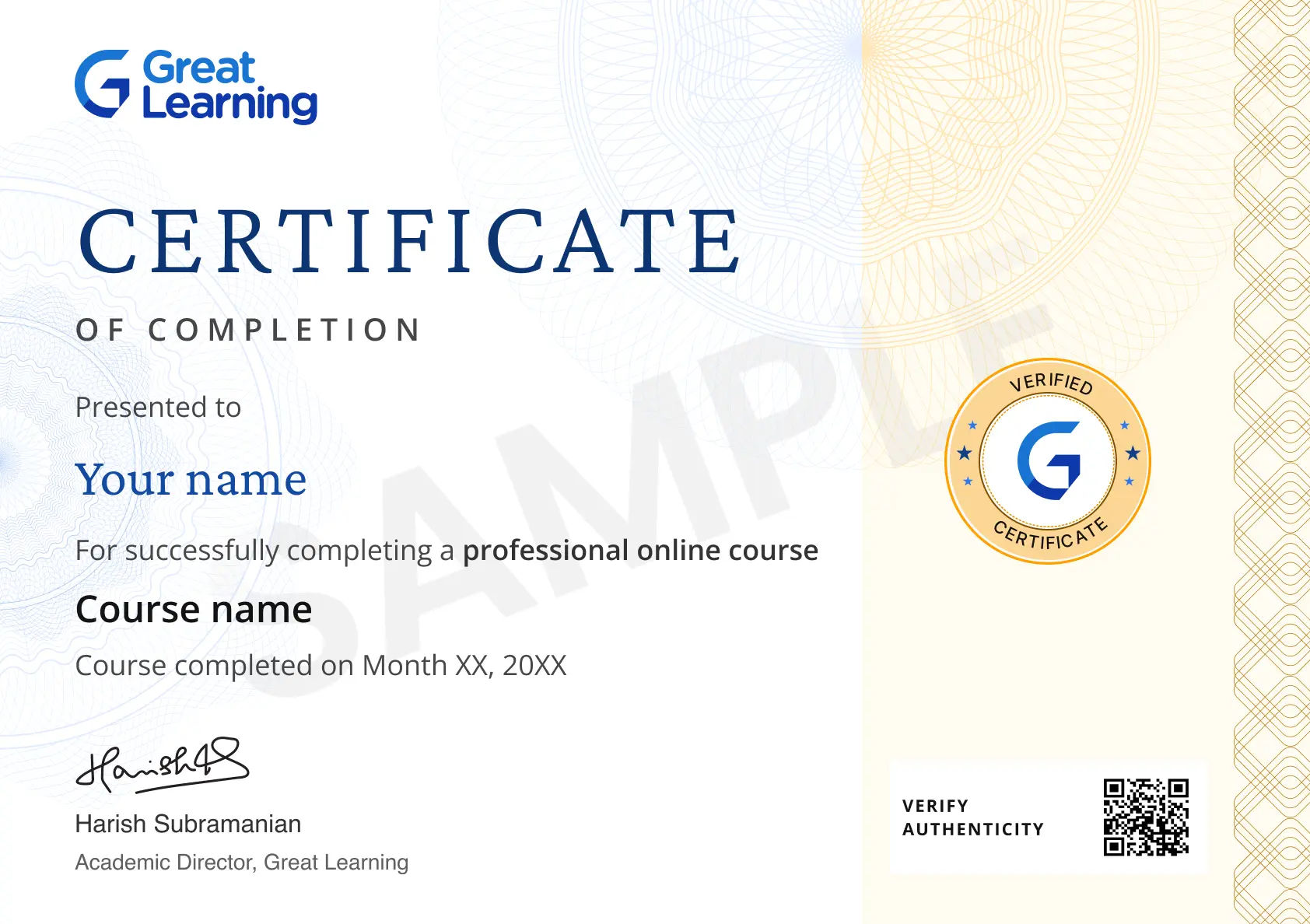
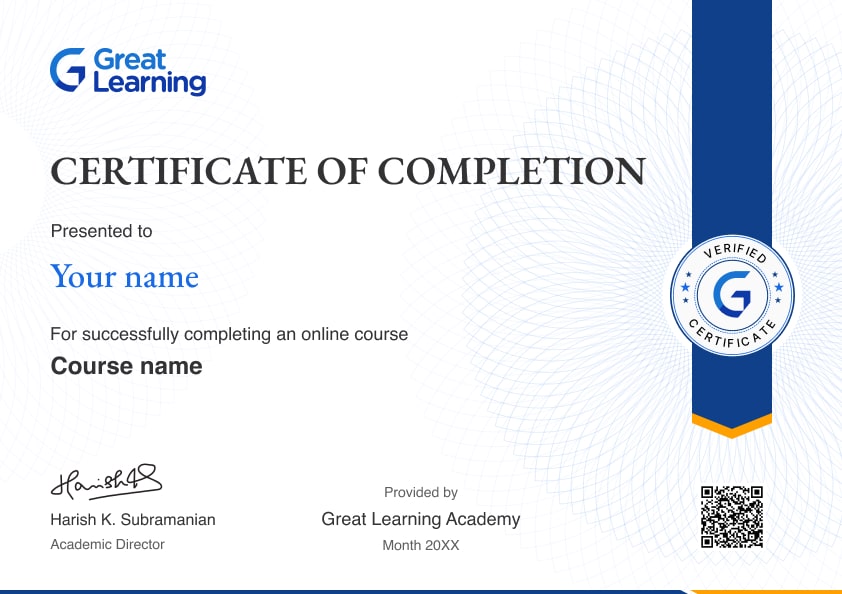
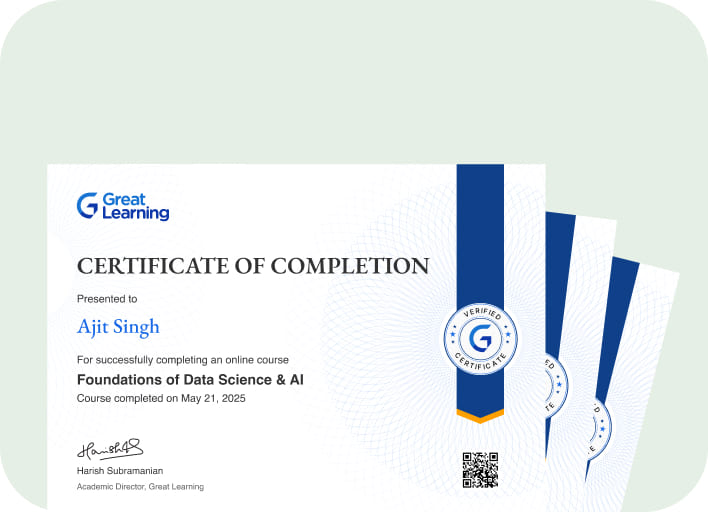
Yes, you will get a certificate of completion for OOPs Concepts in C++ after completing all the modules and cracking the assessment. The assessment tests your knowledge of the subject and badges your skills.
How much does this OOPs Concepts in C++ course cost?
It is an entirely free course from Great Learning Academy. Anyone interested in learning the basics of OOPs Concepts in C++ can get started with this course.
Is there any limit on how many times I can take this free course?
Once you enroll in the OOPs Concepts in C++ course, you have lifetime access to it. So, you can log in anytime and learn it for free online.
Can I sign up for multiple courses from Great Learning Academy at the same time?
Yes, you can enroll in as many courses as you want from Great Learning Academy. There is no limit to the number of courses you can enroll in at once, but since the courses offered by Great Learning Academy are free, we suggest you learn one by one to get the best out of the subject.
Why choose Great Learning Academy for this free OOPs Concepts in C++ course?
Great Learning Academy provides this OOPs Concepts in C++ course for free online. The course is self-paced and helps you understand various topics that fall under the subject with solved problems and demonstrated examples. The course is carefully designed, keeping in mind to cater to both beginners and professionals, and is delivered by subject experts. Great Learning is a global ed-tech platform dedicated to developing competent professionals. Great Learning Academy is an initiative by Great Learning that offers in-demand free online courses to help people advance in their jobs. More than 5 million learners from 140 countries have benefited from Great Learning Academy's free online courses with certificates. It is a one-stop place for all of a learner's goals.
What are the steps to enroll in this OOPs Concepts in C++ course?
Enrolling in any of the Great Learning Academy’s courses is just one step process. Sign-up for the course, you are interested in learning through your E-mail ID and start learning them for free online.
Will I have lifetime access to this free OOPs Concepts in C++ course?
Yes, once you enroll in the course, you will have lifetime access, where you can log in and learn whenever you want to.
Recommended Free C++ courses
 FREE
FREE



 (1).jpg "Course thumbnail image")
Similar courses you might like
.jpg "Course thumbnail image")


Related IT & Software Courses

-

McCombs School of Business at The University of Texas at Austin
Post Graduate Program in Cyber Security20 weeks · Online
Know More