
As organizations increasingly adopt intelligent automation and AI-driven workflows, professionals must go beyond traditional machine learning knowledge and develop the ability to design and deploy AI agents that can act, collaborate, and adapt in dynamic environments.
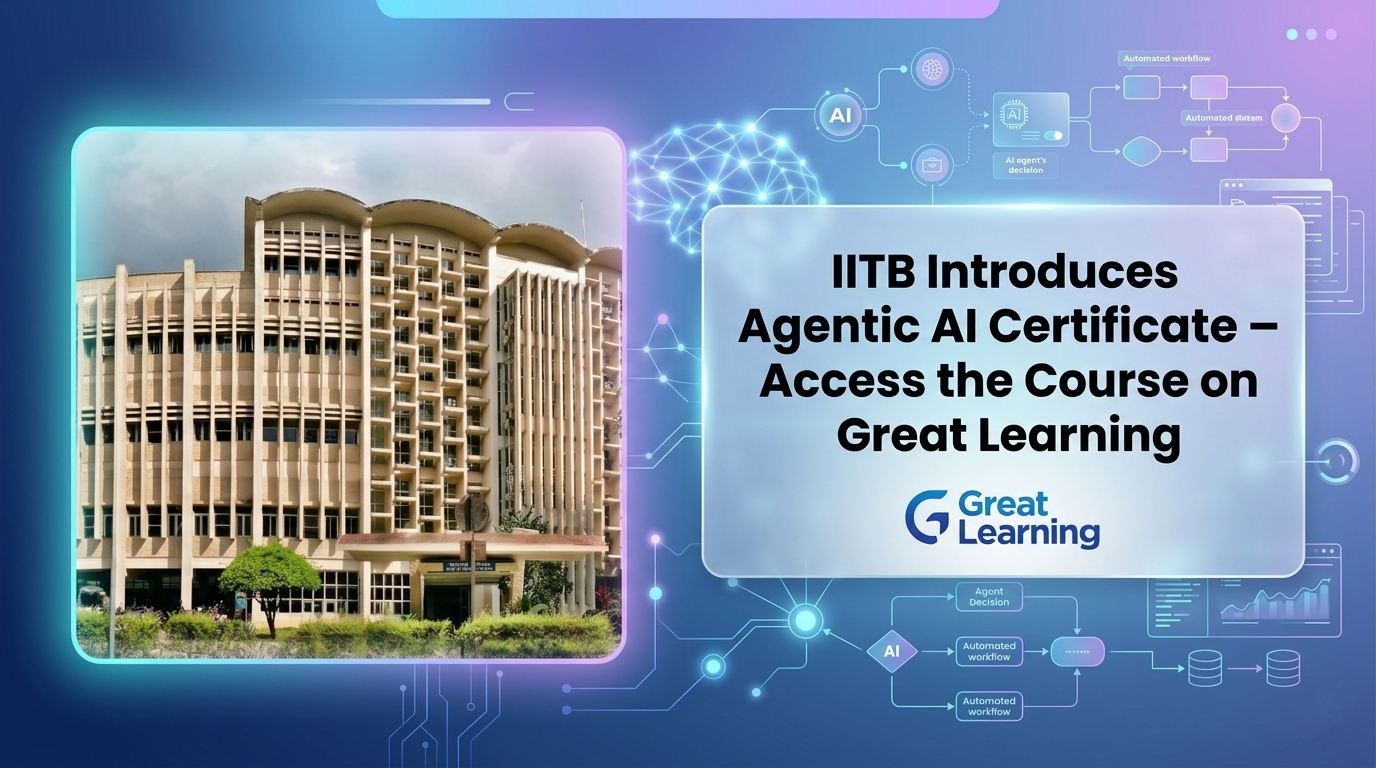
Recognizing this shift, the Department of Computer Science and Engineering at IIT Bombay has introduced the Certificate in Agentic AI, a five-month online program designed to equip technology professionals with the skills required to build intelligent autonomous agents.
The program is delivered by IIT Bombay faculty and made accessible to learners through Great Learning, enabling professionals to gain hands-on experience in building agentic systems that move beyond simple prompting and toward real business applications.
About the IIT Bombay Agentic AI Certificate
The Certificate in Agentic AI is a five-month online program designed for professionals in technology, software development, AI, machine learning, and data science.
Delivered by IIT Bombay’s Department of Computer Science and Engineering, the curriculum blends theoretical foundations with hands-on learning to build practical agentic systems.
It covers AI and LLM fundamentals, agent workflows, architectures, and memory frameworks like RAG and MCP, along with orchestration tools such as CrewAI and LangGraph.
As the course advances, participants explore planning, reasoning, decision-making, reinforcement learning, and multi-agent communication, preparing them to build AI systems capable of coordinating complex tasks.
What Makes This Program Unique?
IIT Bombay is one of India’s most prestigious technical institutions, with a strong global reputation for engineering and technology research.
The Agentic AI certificate program reflects this academic rigor while focusing on emerging AI technologies that are transforming the modern technology landscape.
1. Prestigious Academic Standing
IIT Bombay consistently ranks among the leading engineering institutions globally, including:
- Ranked 28 in Engineering and Technology (QS Rankings 2025)
- Ranked 2 in India (QS World University Rankings 2026)
- Ranked 1 in India Engineering Rankings (NIRF 2025)
- Ranked 3 Overall in India (NIRF 2025)
2. Designed and Delivered by IIT Bombay Faculty
The program is taught by experienced faculty members from the Department of Computer Science and Engineering, ensuring learners benefit from academic research combined with practical insights.
3. Industry-Focused Curriculum
The course is structured around real-world use cases and practical agentic system development, allowing participants to understand how autonomous AI systems are built and deployed in modern organizations.
4. Flexible Online Learning
The program is delivered online and designed for working professionals, enabling participants to continue their careers while advancing their technical capabilities.
5. Hands-On Learning with Modern Tools
Participants gain hands-on experience with industry-relevant frameworks, orchestration libraries, and deployment technologies, ensuring they can apply their knowledge to real-world AI challenges.
Who Should Enroll?
The Certificate in Agentic AI is designed for professionals seeking to move beyond traditional AI applications and build intelligent autonomous systems.
The program is particularly suitable for:
- Data and AI Professionals- Individuals who want to move beyond static LLM outputs and develop autonomous systems capable of reasoning, planning, and acting on organizational data.
- Software Development and Technology Professionals- Engineers responsible for deploying scalable AI solutions who want to master multi-agent orchestration, cost optimization, and human-in-the-loop AI governance.
- Technology Consultants and Technical Leaders- Professionals interested in designing agent architectures and AI-driven workflows that help organizations transition from manual processes to automated, agent-led operations.
What You Will Learn?
The curriculum is structured into four progressive modules, guiding learners from foundational concepts to advanced deployment of agentic systems.
Module 1: Foundations of Agentic Systems
Learners begin with a Python refresher focused on concurrency and API interactions before exploring the fundamentals of AI and Large Language Models.
Key topics include:
- Python refresher for Agentic AI
- AsyncIO and API interactions
- Introduction to AI and Large Language Models
- Transformer architecture and tokenisation
- Temperature, Top-P, and sampling methods
- Prompt engineering, including zero-shot and few-shot prompts
Module 2: Agentic AI Fundamentals
Learners understand how agents perceive, plan, and act in cycles, while exploring techniques for task delegation, knowledge retrieval, and memory management.
Key topics include:
- Agent workflows and architecture
- Tool use and function calling
- Router patterns for task delegation
- Memory and knowledge retrieval using RAG
- Vector databases and GraphRAG
- Model Context Protocol (MCP)
- Orchestration with LangGraph and CrewAI
Module 3: Advanced Agentic Systems
Learners implement advanced reasoning techniques, reinforcement learning strategies, and multi-agent collaboration systems.
These concepts allow AI agents to learn from previous actions and coordinate effectively in multi-step workflows.
Key topics include:
- Planning, reasoning, and decision-making techniques
- Reflection mechanisms for learning from past actions
- Reinforcement learning and reward training
- Prompt optimisation using DSPy
- Best-of-N sampling and feedback loops
- Multi-agent communication and coordination
Module 4: AI Agents in the Real World
The curriculum emphasizes human-in-the-loop design, safety mechanisms, and monitoring frameworks that ensure agentic systems operate securely and reliably.
Key topics include:
- Human-in-the-loop design and workflow control
- Agent alignment and prompt injection defense
- Guardrails and access control
- Monitoring and observability
- Evaluation methods for agent performance
- Deployment with FastAPI, Streamlit, and Docker
Sample Projects
To reinforce learning, participants complete hands-on projects that simulate real-world AI systems. Examples include:
1. The Analyst Agent
Build a single agent capable of searching the web and summarizing financial news using APIs and structured outputs.
2. Customer Support Agent
Develop a RAG-based chatbot that answers frequently asked questions and escalates complex cases to a human operator.
3. Software Engineering Team
Create a multi-agent system that manages an entire software development lifecycle—from feature requirements to working code and documentation.
4. Event Planner Crew
Design a collaborative system where multiple agents research travel options, coordinate schedules, and generate a complete itinerary.
Key Learning Outcomes
By completing the program, learners will gain the ability to:
- Use tools and Model Context Protocol (MCP) to enable agents to access and retain relevant knowledge within workflows
- Design and implement intelligent AI agents capable of reasoning, planning, and acting across multi-step tasks
- Develop multi-agent systems for coordinated decision-making and complex problem solving
- Deploy agentic applications in real-world environments with appropriate safeguards and monitoring frameworks.
Certification and Learning Ecosystem
Upon successful completion of the program and assessments, participants will receive a Certificate of Completion from IIT Bombay.
The program is delivered in collaboration with Great Learning, the ed-tech partner responsible for facilitating the learning experience and supporting the program’s delivery to professionals worldwide.
Great Learning supports millions of learners globally through industry-relevant programs designed in collaboration with leading academic institutions.
Next Step
Interested candidates can apply by submitting an online application form. Applicants must hold a Bachelor’s or Master’s degree in Engineering from a recognized university with at least 50% aggregate (or equivalent CGPA), have at least two years of relevant work experience, and possess prior exposure to programming.
Shortlisted candidates will go through a screening call, and upon selection, can confirm their enrollment by completing the required course fees payment.