
Deciding to pursue an Online MBA is a significant career commitment that requires careful consideration and alignment with your long-term professional objectives.
While online MBA courses offer flexibility, diverse specializations, and the convenience of remote learning, it is equally important to assess whether their curriculum, delivery format, and learning outcomes genuinely support your career direction.
In this blog, we share a practical checklist to help you determine if an Online MBA is the right investment for your career aspirations.
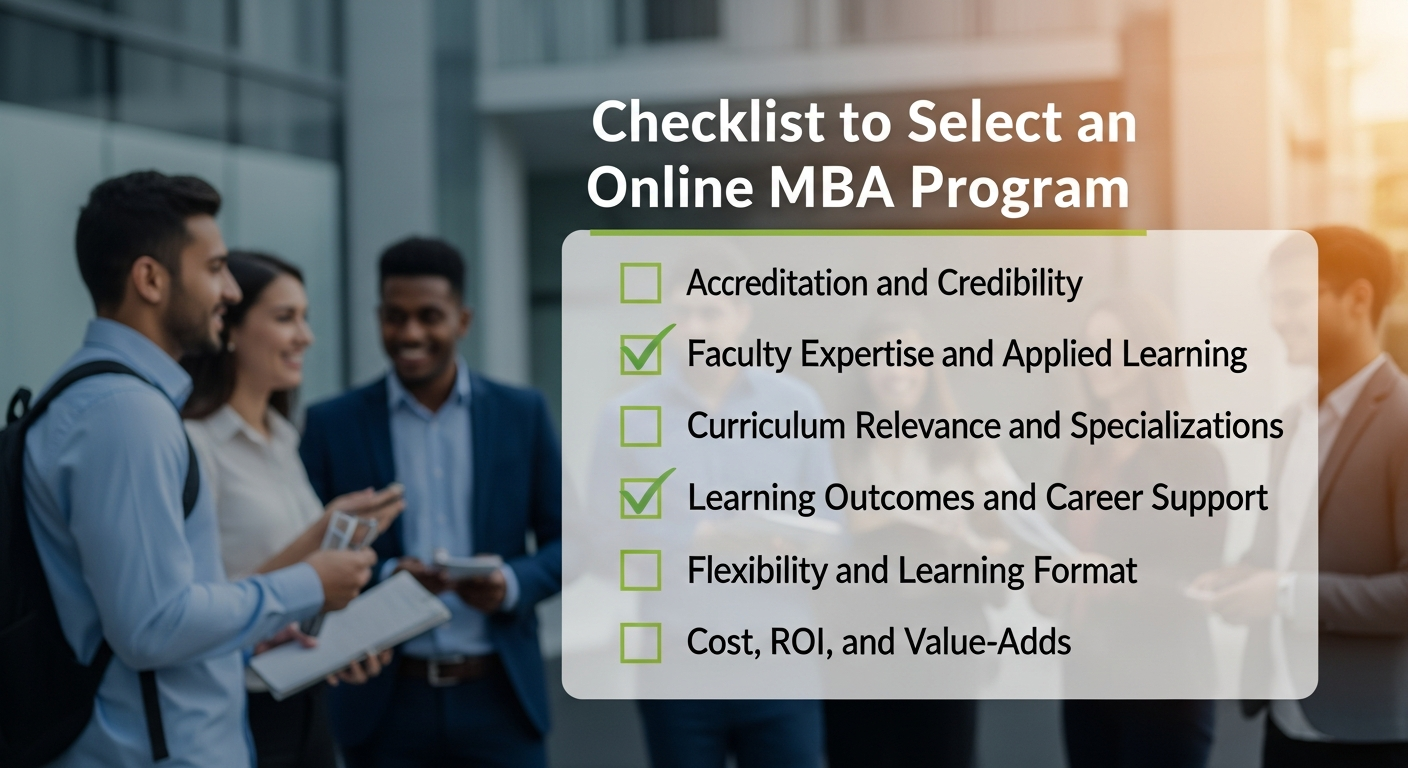
Checklist to Assess the Right Online MBA for Your Career Path
1. Accreditation and Credibility
When selecting between the online MBA vs the On-Campus MBA, regulatory approval and institutional credibility should be your top considerations.
Ensuring that the university holds the highest level of national recognition guarantees that your degree is valid for government positions, higher studies such as a Ph.D., and international employment opportunities. You should check:
- Regulatory Standards: Verify that the program is UGC-entitled and AICTE-approved. Such approvals are essential to ensure the legitimacy and acceptance of your degree across public and private sectors.
- Institutional Quality: Look for universities with NAAC A++ accreditation. This serves as a strong indicator of academic excellence and qualified faculty providing added assurance of the program’s overall quality.
2. Faculty Expertise and Applied Learning
The quality of an online MBA is closely linked to the expertise of its faculty and the emphasis on practical learning. Before enrolling, ensure you evaluate the following:
- Academic and Industry Expertise: Check that the faculty includes a balanced mix of academicians and experienced industry professionals. This combination ensures you gain both theoretical knowledge and practical insights that can be applied in real-world business scenarios.
- Project-Based Learning: Verify that the program emphasizes applied learning through projects, case studies, and business simulations. These components help develop hands-on expertise by applying theoretical concepts to complex business problems.
3. Curriculum Relevance and Specializations
You should check if the online MBA offers strong specializations and a comprehensive curriculum that covers emerging, high-demand areas such as Managerial Economics, Operations Management, Legal Business Environment, and Business Statistics, rather than focusing solely on traditional domains like Finance or Marketing. Before committing, check the following:
- Future-Ready Tracks: Look for the program that is designed around emerging industry roles and future-oriented business skills. For example, SRMIST’s Online MBA degree stands out by offering 9 in-demand specializations, including Artificial Intelligence and Data Science, Business Analytics, and Healthcare Management. Such a curriculum ensures you are not limited to traditional management theory but are building capabilities aligned with the next decade of business leadership.
- Exposure to Tools and Technologies: Evaluate whether the program integrates contemporary business tools, software, and technologies into the curriculum. Familiarity with such platforms prepares you for hands-on roles post-MBA.
Not sure which MBA specialization to choose?
Read “Which MBA Specialization Will Open the Right Doors for Your Career Goals?” to make an informed decision.
4. Learning Outcomes and Career Support:
Before opting for an online MBA course, ensure it delivers meaningful academic outcomes along with structured career assistance that supports long-term growth. Evaluate the program on the following two core dimensions:
- Learning Outcomes: Check whether the curriculum builds strategic thinking beyond day-to-day operations, prepares you for managerial or senior-level roles, and develops deep expertise in your chosen specialization, enabling confident decision-making and professional credibility.
- Career Support: Verify that the program offers structured career readiness support, including skill-based training, interview preparation, performance feedback, and access to a strong alumni network that can aid career transitions and advancement.
Check out the “Top MBA Interview Tips to Crack the Online Interview” to prepare effectively
5. Flexibility and Learning Format
For working professionals, the program’s delivery format is a critical consideration. You should check whether it combines live online sessions with recorded lectures, offering a balance of real-time interaction with faculty and the flexibility to learn at your own pace.
This structure ensures you can actively engage in discussions, clarify doubts, and collaborate with peers while managing professional commitments effectively.
6. Cost, ROI, and Value-Adds
You should carefully evaluate the financial commitment to ensure it is manageable and transparent, allowing you to focus on learning without undue stress or pressure to make hasty career decisions.
- Payment Flexibility: Check if the program allows installment or semester-wise payments rather than requiring a lump sum. Flexible payment options make it easier to manage tuition alongside your salary and reduce reliance on loans or other financial burdens.
- Value-Added Benefits: Consider additional benefits such as networking opportunities, mentorship, career support, and access to industry projects. These elements enhance the practical impact of the MBA and contribute to long-term career growth, making the investment more worthwhile.
By carefully evaluating these factors, you can ensure that you choose an online MBA program that aligns with your career goals, maximizes learning outcomes, and delivers long-term professional value.
Self-Assessment and Career Goals Checklist
1. Clarity of Career Goal
An MBA delivers impact only when guided by a clear objective. Define your 3–5 year post-MBA plan and understand why the degree is essential. Treat the MBA as a strategic bridge that aligns with your long-term career goals, supporting leadership or entrepreneurial aspirations and accelerating progress toward them.
2. Readiness for Online Learning
Online MBA programs demand autonomy and consistency. Evaluate your ability to manage self-paced deadlines, virtual collaboration, and independent study. Prior exposure to structured online learning is a strong indicator of success.
3. Time and Energy Availability
An MBA requires sustained mental effort alongside existing responsibilities. Consider whether you can maintain consistent study hours without compromising professional performance or personal well-being.
4. Financial Readiness and ROI
Compare the program's total cost with expected career-related monetary gains over the next 3–5 years, and ensure you have a clear plan to manage both upfront and ongoing expenses comfortably.
Master Checklist
| Category | Key Checkpoints (What to Verify) |
| 1. Accreditation & Credibility | • Is the program UGC-entitled and AICTE-approved? • Does the university hold NAAC A++ accreditation? |
| 2. Faculty & Pedagogy | • Does the faculty mix academicians with industry experts? • Is there an emphasis on project-based learning and case studies? |
| 3. Curriculum Relevance | • Are there future-ready specializations (e.g., AI, Data Science, Analytics)? • Does the curriculum teach modern business tools and software? |
| 4. Career Outcomes | • Does the syllabus target strategic & managerial skill building? • Is there structured career support available (interview prep, alumni network)? |
| 5. Flexibility | • Does the format offer a mix of live interactions and recorded sessions? • Can you study at your own pace when work demands are high? |
| 6. Financials & ROI | • Are there flexible payment options available (semester-wise/installments)? |
| 7. Clarity of Goal | • Do you have clarity on the role, industry, and career direction you aim to follow after completing your MBA? |
| 8. Long-Term Vision | • Does the MBA align with broader goals like leadership or entrepreneurship? • Will it meaningfully accelerate your specific career narrative? |
| 9. Personal Readiness | • Do you have the discipline for self-paced, online learning? • Can you take out consistent study hours without burnout? |
| 10. Financial Planning | • Have you calculated the program's total cost against your expected salary hike? |
Conclusion
Choosing an online MBA requires careful evaluation of your career goals, learning readiness, and long-term aspirations. Programs like SRMIST’s Online MBA, with its industry-aligned curriculum, future-ready specializations, and flexible learning structure, provide the strategic advantage to accelerate your career while equipping you with skills relevant for the next decade of business leadership.