
- Why Most Data Science Roadmaps Fail Beginners
- Stage 1: Understand Data Science Before Learning Python
- Stage 2: Learn Data Science Tools That Match Real Workflows
- Learn SQL to Work With Real Data Sources
- Learn Python for Data Work, Not Software Development
- What You Should Be Able to Do Before Moving Ahead?
- Why This Stage Matters More Than It Looks
- Stage 3: The Real Shift, Learning How to Think With Data
- Stage 4: Statistics That Actually Help You Make Decisions
- Stage 5: Machine Learning, Only When It Starts Making Sense
- Moving from data analysis to applied machine learning
- Start with applied machine learning fundamentals
- Move into end-to-end machine learning workflows.
- Moving into advanced machine learning and AI systems
- What you should be able to do after this
- Why this stage matters more than it looks
- Stage 6: Moving From Models to Real Decisions
- Moving from model building to decision-making
- Structured learning for decision-focused data science
- Reinforcing decision-making through real scenarios
- What you should be able to do after this
- Why this stage matters more than it looks
- Stage 7: Where Data Science Is Heading in 2026
- Understanding the shift: from prediction to generation
- If you’re new to generative AI, start here.
- When you want to go beyond basics and build real applications
- When generative AI is not enough anymore
- If you want to understand how AI systems act, not just respond
- For deeper specialization in agent-based systems
- What you should be able to do after this
- Why this stage matters more than it looks
- Stage 8: Projects Are What Actually Get You Hired
- What strong projects actually look like
- Start with core machine learning problems
- Move into recommendations and user behavior problems
- Build one project with deeper modeling or AI
- Include one end-to-end capstone-style project
- What makes a project stand out
- What you should be able to show after this
- Why this stage matters more than it looks
- How Long Does It Take to Become Job Ready in Data Science
- Final Thought: The Roadmap Is Not the Goal
If you search for a data science roadmap, most roadmaps look complete.
They list Python, SQL, machine learning, and a few tools. On paper, everything seems covered.
Then you start learning, and nothing connects.
You finish a course,e but cannot work on a real dataset. You learn machine learning, but don’t know when to use it. You keep switching courses, hoping the next one will fix the confusion.
The issue is not effort. It is a sequence.
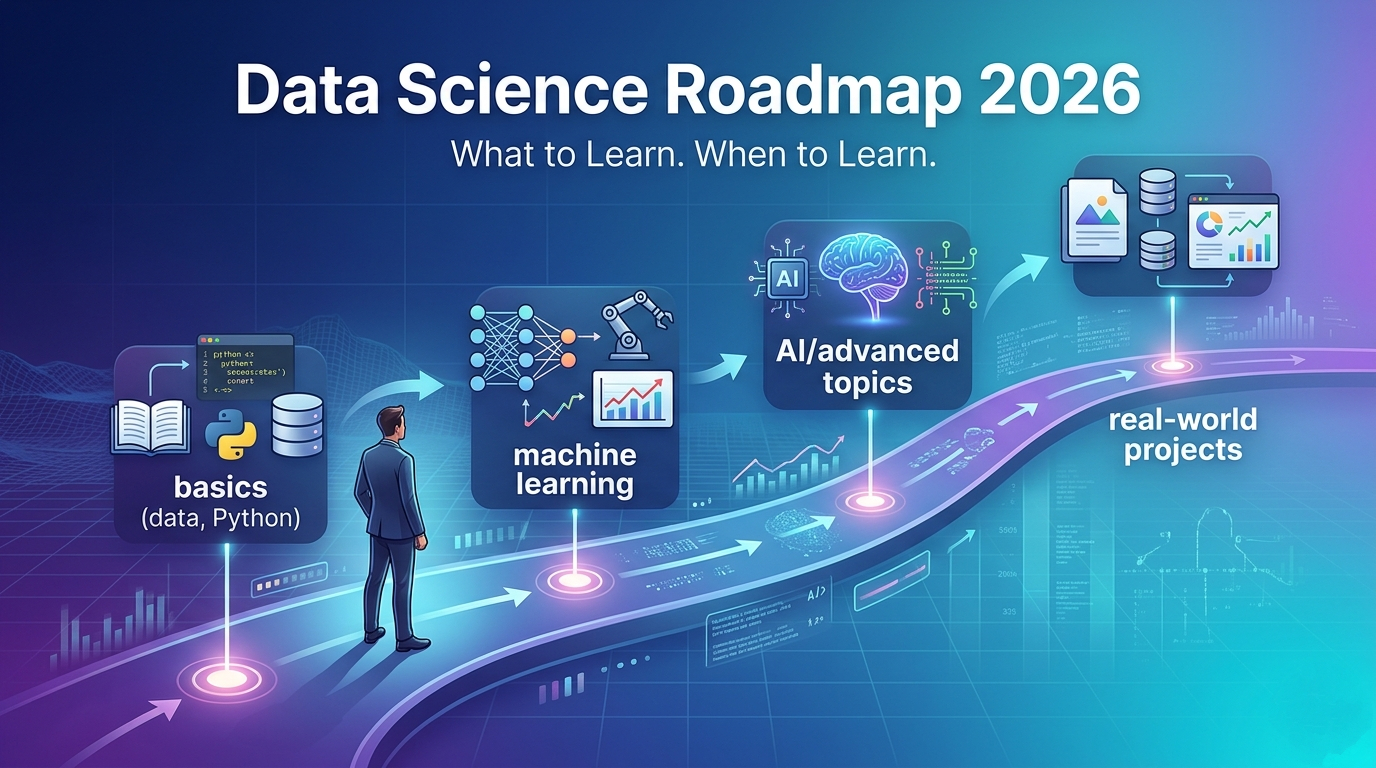
A data science learning roadmap in 2026 needs to focus on progression, not topics. What you learn matters less than when you learn it.
This guide breaks that down clearly, with real decision points and where structured programs actually make sense.
Why Most Data Science Roadmaps Fail Beginners
Before jumping into the roadmap, it helps to understand why most learners get stuck.
- They start with tools instead of problems.
- They move to machine learning before understanding data.
- They complete courses but skip the real application.
This creates a false sense of progress.
You know syntax, but you cannot solve problems. That gap is what this roadmap fixes.
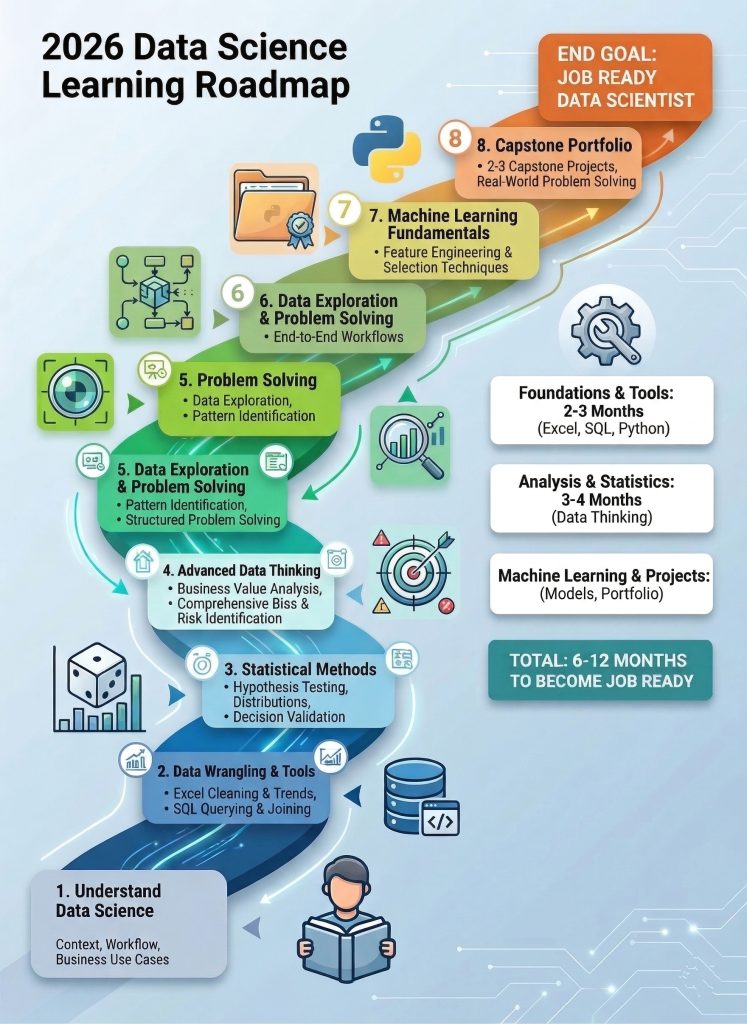
Stage 1: Understand Data Science Before Learning Python
How you start looking for answers: “how to start data science”, “data science for beginners.”
Most beginners rush into Python.
That is the first mistake.
At this stage, your goal is not to learn coding. Your goal is to understand how data science works in real scenarios.
You need clarity on:
- What problems does data science solve
- How companies use data to make decisions
- What the workflow looks like from raw data to insights
Without this, everything later feels disconnected.
A short, structured free course works best here because you are exploring, not committing.
A practical starting point is the Free Data Science Foundations by Great Learning.
This course makes sense at this stage because it focuses on:
- Core concepts like data types, probability, and visualization
- How tools like Python, R, and Excel fit into the workflow
- Real-world examples instead of coding-heavy lessons
You are not building skills yet. You are building context.
If you want to explore similar beginner-friendly options before committing further, you can browse a curated set of free introductory data science courses here: https://www.mygreatlearning.com/data-science/free-courses
This helps you compare different topics like Python, analytics, and visualization, and choose what to start with based on your comfort level.
Stage 2: Learn Data Science Tools That Match Real Workflows
Search intent: data science tools for beginners, what to learn after data science basics
This is where learning becomes practical.
You move from understanding concepts to actually working with data. Most learners make one mistake here. They try to master programming instead of learning how data works in real roles.
In reality, early data work is simple.
You clean data. You explore patterns. You answer questions.
To do that, you only need three tools to start.
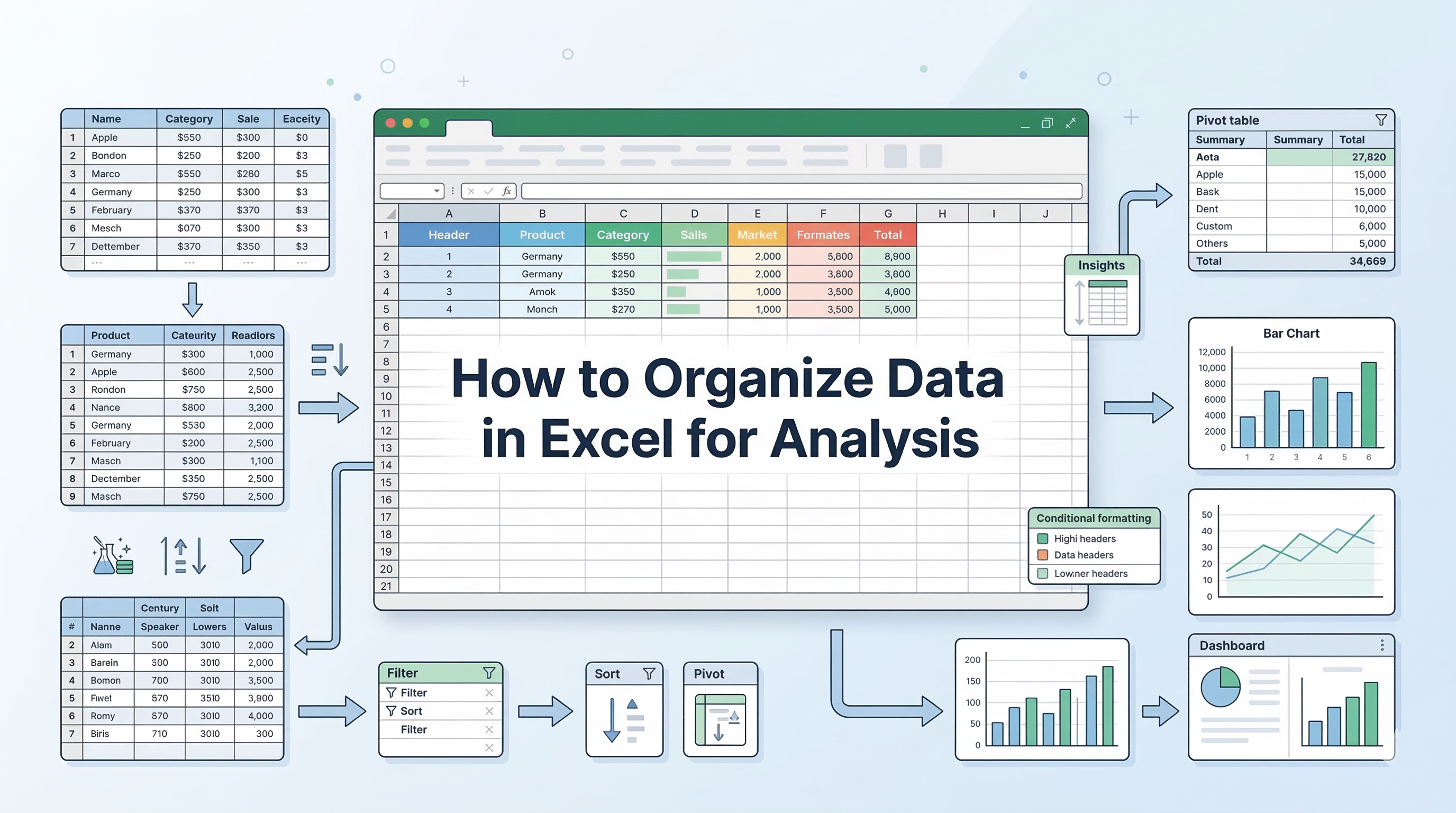
Start with Excel, because this is how real analysis begins
Before Python, before machine learning, most teams still relied on Excel for quick analysis and reporting.
This is where you learn:
- How to clean messy data
- How to structure information
- How to identify trends quickly
If you are starting from scratch, exploring multiple beginner-friendly options helps.
You can browse a structured set of Excel-based free courses. Once you are comfortable with the basics, moving into deeper, project-based learning makes a difference.
A strong next step is Master Data Analytics in Excel
Learn Excel for powerful data analysis and enhance your skills for better decision-making.
Why this course fits here:
- Goes beyond basics into data cleaning, aggregation, and analysis
- Covers PivotTables, Power Query, and dashboard creation
- Includes exploratory data analysis using univariate and multivariate techniques
- Comes with guided projects like e-commerce and aviation analysis
- Includes mock interview preparation for real job scenarios
- Taught by industry practitioners like Denver Dias, who has experience building ML systems for enterprise use cases
This is where Excel shifts from a basic tool to a decision-making tool.
Learn SQL to Work With Real Data Sources
Once you understand structured data in Excel, the next step is accessing larger datasets.
That is where SQL becomes essential.
Without SQL, you rely on others to give you data. With SQL, you can explore databases independently and answer questions on your own.
At this stage, you don’t need complex database theory. You need to get comfortable with:
- Filtering data
- Joining multiple tables
- Aggregating results to answer business questions
If you are starting out, it helps to first build familiarity with basic queries.
You can explore beginner-friendly options here:
https://www.mygreatlearning.com/sql/free-courses
These introduce core concepts like SELECT statements, joins, and simple aggregations so you can understand how data is structured and retrieved.
Moving from SQL Basics to Real-World Usage
This is where most learners get stuck.
You understand syntax, but when given a real dataset, you struggle to write queries that solve actual problems.
This gap is common because beginner courses focus on concepts, not application.
Once you are comfortable with basic queries, you need to move into hands-on practice with real scenarios.
A strong next step is learning Practical SQL Training through the Academy Pro+ course.
Master SQL and Database management with this SQL course: Practical training with guided projects, AI support, and expert instructors.
Why this course fits at this stage:
- Covers advanced querying techniques like subqueries, transactions, and complex joins
- Introduces database design concepts such as normalization and efficient structuring
- Includes hands-on exercises and projects that simulate real business use cases
- Helps you move from writing queries to solving data problems
This is the point where SQL becomes a working skill, not just a concept you understand.
At this stage, practice becomes the most important part of learning.
You can strengthen your SQL skills with structured exercises here:
https://www.mygreatlearning.com/blog/sql-exercises/
These cover real scenarios like joins, aggregations, and filtering, which are commonly used in data roles.
If you want to test queries instantly without setting up a database, you can use this SQL editor
This helps you experiment, debug, and build confidence faster.
What should you be able to do after this?
By the end of this stage, you should be able to:
- Extract data from multiple tables confidently
- Write queries to answer real business questions
- Work with structured datasets without guidance
If you can do this, you are ready to move into deeper data analysis and Python-based workflows.
Learn Python for Data Work, Not Software Development
Once you are comfortable working with structured data using Excel and SQL, the next step is handling larger datasets and automating analysis.
That is where Python becomes useful.
Python is not important because it is a programming language. It is important because it allows you to:
- Clean large datasets efficiently
- Perform a deeper analysis
- Build workflows that go beyond manual tools
At this stage, you don’t need to learn everything about Python.
You need to focus only on what is used in data work:
- Basic syntax
- Working with lists and dictionaries
- Data handling using libraries like pandas
If you are starting out, it helps to explore beginner-friendly options before committing to a full program.
You can browse structured Python learning paths here: https://www.mygreatlearning.com/python/free-courses
These help you get familiar with core concepts and understand how Python is used in data science without overwhelming you.
Moving from Python basics to real data work
This is where most learners struggle.
You understand syntax. You can write small scripts. But when given a dataset, you don’t know how to structure your approach.
Because learning Python is not the goal.
Using Python to work with data is the goal.
Once you are comfortable with the basics, you need to move into structured learning that connects programming with real use cases.
A strong next step is learning Python Programming with the Academy Pro+ course.
In this course, you will learn the fundamentals of Python: from basic syntax to mastering data structures, loops, and functions. You will also explore OOP concepts and objects to build robust programs.
Why this course fits at this stage:
- Covers core programming concepts like data structures, loops, and functions with practical examples
- Introduces object-oriented programming, which becomes useful in larger data workflows
- Includes hands-on projects like building applications and working with structured data
- Teaches error handling and modular code design, which improves code quality in real projects
This is important because once you move into machine learning, weak coding fundamentals slow you down.
At this stage, consistent practice matters more than learning new concepts.
You can start with structured Python exercises here: https://www.mygreatlearning.com/blog/python-exercise/
These help you strengthen problem-solving and core programming skills.
If you want to practice without setting up a local environment, you can use this Python compiler.
This allows you to write and test code instantly, which helps you build consistency.
What should you be able to do after this?
By the end of this stage, you should be able to:
- Load and clean datasets using Python
- Perform basic analysis and transformations
- Write reusable code for data tasks
- Combine Python with SQL or Excel workflows
If you can do this, you are ready to move into deeper data analysis and machine learning.
What You Should Be Able to Do Before Moving Ahead?
By the end of this stage, you should be able to:
- Take a dataset and clean it
- Query data using SQL
- Analyze patterns using Excel or Python
- Answer simple business questions
If you cannot do this yet, learning machine learning will only create confusion.
Why This Stage Matters More Than It Looks
Most people rush past this stage.
But this is where real capability is built.
If you get this right:
- Machine learning becomes easier
- Projects become meaningful
- Confidence builds naturally
If you skip this:
- You keep switching courses
- You feel stuck despite learning
- Nothing connects
Stage 3: The Real Shift, Learning How to Think With Data
This is where most learners hit a wall.
You know Python. You can write queries. But when given a new dataset, you don’t know where to start.
Because tools don’t create insights, thinking does.
You need to learn how to:
- Break down messy problems
- Explore data without step-by-step guidance
- Identify patterns that matter
This is also the stage where learning shifts from “following tutorials” to “working independently”.
Moving from guided learning to independent thinking
Most learners struggle here because they rely too much on structured exercises.
To improve, you need exposure to open-ended problems.
If you are unsure where to start, you can explore practical data science project ideas here:
https://www.mygreatlearning.com/blog/project-ideas/
These help you understand how real problems are framed, which is the first step toward independent thinking.
Strengthening analytical thinking through structured learning
At this stage, structured programs that focus on real-world case studies become useful.
This is where learning shifts from tools to problem-solving.
Programs that include guided analysis workflows, business case studies, and feedback help you:
- Learn how to approach problems
- Improve decision-making
- Build confidence working with unfamiliar datasets
What you should be able to do after this
By this point, you should be able to:
- Take an unstructured dataset and define a problem
- Explore data without step-by-step instructions
- Extract meaningful insights and explain them clearly
If you cannot do this yet, moving to machine learning will only increase confusion.
Stage 4: Statistics That Actually Help You Make Decisions
Many learners understand statistical terms but struggle to apply them.
They know what probability means, but cannot use it to validate decisions. They know hypothesis testing exists, but don’t know when to use it.
That gap is what creates confusion later in machine learning.
Structured learning for applied statistics
To bridge this gap, you need structured learning that connects statistical concepts with real data scenarios.
A strong option here is to learn Statistics for Data Science and Analytics.
Statistics Course for Data Science and Analytics
Learn statistical methods crucial for data science, including regression and hypothesis testing, to extract valuable insights from data.
Why this course fits at this stage:
- Covers core concepts like probability, distributions, and hypothesis testing in a practical context
- Focuses on how statistical thinking is applied in data analysis and decision-making
- Helps you connect statistical theory with real-world datasets
- Prepares you for machine learning by strengthening your understanding of data behavior
This is important because most machine learning mistakes come from weak statistical understanding, not weak coding.
Reinforcing statistics through real analysis
Statistics should not be learned in isolation.
When you:
- Analyze datasets in Python
- Work with real queries in SQL
You naturally apply statistical thinking.
That is where real understanding develops.
What you should be able to do after this
By this point, you should be able to:
- Validate assumptions using data
- Identify whether a result is meaningful or random
- Apply hypothesis testing in simple scenarios
- Explain your findings in clear, logical terms
If you cannot explain your analysis, you are not ready for machine learning yet.
Stage 5: Machine Learning, Only When It Starts Making Sense
Search intent: “machine learning roadmap”, “how to learn machine learning after Python.”
Machine learning is where most learners rush.
But it only starts making sense when:
- You can analyze data independently
- You understand patterns and limitations
- You are comfortable working with real datasets
At this stage, your focus shifts from tools to models.
You start working with:
- Regression and classification
- Model evaluation
- Improving performance
Moving from data analysis to applied machine learning
This is where most learners struggle.
You know Python. You can analyze data. But you don’t know how to apply machine learning to solve real problems.
Because machine learning is not about learning algorithms in isolation.
It is about:
- Preparing data correctly
- Choosing the right model
- Evaluating results
- Understanding how models behave with real data
This is the gap that needs to be solved before moving to advanced programs.
Start with applied machine learning fundamentals
Before jumping into advanced AI programs, you need to build confidence with how machine learning works in practice.
A strong starting point is learning Machine Learning Essentials with Python.
Learn Machine Learning with Python
Learn machine learning with Python! Master the basics, build models, and unlock the power of data to solve real-world challenges.
Why this course fits at this stage:
- Covers core supervised learning techniques like regression, decision trees, and ensemble methods
- Introduces concepts like PCA, hyperparameter tuning, and model evaluation
- Includes hands-on work with data preprocessing and exploratory data analysis
- Helps you understand how models are trained and interpreted in real scenarios
You also build a practical project like a loan approval prediction system, which helps connect theory with real-world use cases.
This stage is where machine learning starts becoming practical instead of theoretical.
Move into end-to-end machine learning workflows.
Once you are comfortable with core concepts, the next step is learning how everything fits together in a complete workflow.
A strong next step is to learn data science and machine learning in Python.
Master Python for ML & Data Science
Learn Python for data science and machine learning to unlock endless opportunities. Its ease of use and powerful libraries help you transform data into insights & build intelligent systems seamlessly.
Why this course fits here:
- Covers end-to-end workflows from data preprocessing to model building
- Combines Python, data science, and machine learning into one structured path
- Focuses on applying models to real datasets instead of isolated concepts
- Helps you understand how different components connect in real-world scenarios
This is where you move from learning models to building complete solutions.
Moving into advanced machine learning and AI systems
Once you are comfortable with applied machine learning, the next step is depth.
This is where advanced programs become valuable.
A strong option here is the MIT Applied AI and Data Science Program.
MIT Professional Education's Data Science Course
Gain the expertise top companies seek and open doors to Data Science jobs.
Why does this fit at this stage?
Covers the full pipeline from machine learning to deep learning and AI
- Includes clustering, neural networks, and generative AI
- Provides capstone projects solving real business problems
- Taught by MIT faculty
This program works best when you already:
- Understand machine learning fundamentals
- Have experience working with datasets
- Can build basic models independently
What you should be able to do after this
By this point, you should be able to:
- Choose the right model for a problem
- Train and evaluate models using real datasets
- Improve model performance based on results
- Explain outcomes and limitations clearly
If you can do this consistently, you are ready to move into advanced AI systems and decision-making.
Why this stage matters more than it looks
This is where most learners lose momentum.
Not because machine learning is difficult, but because they skip the application layer.
If you get this right:
- Advanced programs feel structured instead of overwhelming
- Projects become meaningful instead of being copied
- Interviews become easier because you can explain decisions
If you skip this:
- You understand models but cannot apply them
- You rely on tutorials instead of solving problems
- Learning feels fragmented
This stage connects everything you’ve learned so far.
Stage 6: Moving From Models to Real Decisions
Search intent: “advanced data science skills”, “responsible AI course.”
Machine learning helps you build models.
But real-world work is not about models. It is about decisions.
At this stage, the question changes from
“Which model should I use?”
to
“What decision should I make based on this model?”
This is where most learners feel uncertain.
They can build models, but struggle to:
- Interpret results in context
- Understand the impact of predictions
- Identify risks like bias or incorrect assumptions
Moving from model building to decision-making
This is where machine learning alone is not enough.
You need to understand:
- How models influence decisions
- When results can be trusted
- How bias and data limitations affect outcomes
This is especially important in real-world scenarios like:
- Credit scoring
- Healthcare predictions
- Business forecasting
Where incorrect interpretation leads to wrong decisions.
Structured learning for decision-focused data science
To build this capability, you need structured learning that connects:
data → models → decisions
A strong option here is AI and Data Science: Leveraging Responsible AI, Data, and Statistics for Practical Impact by MIT IDSS.
MIT Data Science and Machine Learning Course
Unlock the power of data. Build hands-on data science and machine learning skills to drive innovation in your career.
Why this program fits at this stage:
- Focuses on applying machine learning to real decision-making scenarios
- Covers statistics, deep learning, and recommendation systems together
- Introduces concepts like responsible AI and bias
- Includes multiple real-world projects across domains
- Taught by MIT IDSS faculty with expertise in AI systems and decision science
This is where your understanding shifts from “building models” to “using models responsibly”.
Reinforcing decision-making through real scenarios
At this stage, learning is not about new tools.
It is about applying what you already know in more complex situations.
You should focus on:
- Interpreting model outputs
- Explaining decisions clearly
- Understanding trade-offs in results
This is what differentiates a beginner from a professional.
What you should be able to do after this
By this point, you should be able to:
- Interpret model outputs in a business context
- Identify risks like bias or incorrect assumptions
- Use data to support decisions, not just generate predictions
- Explain results clearly to non-technical stakeholders
If you can do this, you are ready to move into advanced AI systems and emerging technologies.
Why this stage matters more than it looks
Most learners stop at machine learning.
But that is not where real value comes from.
If you get this right:
- Your work becomes impactful, not just technical
- You can contribute to real business decisions
- You stand out in interviews and real roles
If you skip this:
- You build models without understanding their impact
- You struggle to explain your work
- Your skills remain theoretical
This stage is what turns technical skills into real-world value.
Stage 7: Where Data Science Is Heading in 2026
Search intent: “future of data science”, “generative AI roadmap.”
Up to this point, you’ve built a solid foundation.
You can work with data. You can build models. You understand how decisions are made.
But the field is shifting.
Data science is no longer limited to predicting outcomes. It’s moving toward systems that generate, automate, and act.
That shift is already visible in how companies are building products.
Understanding the shift: from prediction to generation
Traditional models answer questions like:
“What will happen?”
Modern AI systems answer:
“What can be created or automated?”
That’s where generative AI becomes your next step.
If you’re new to generative AI, start here.
Before going deeper, you need a clear mental model of how generative systems work.
The IIT Bombay Certificate in Generative AI is a good entry point if you’re transitioning from machine learning.
IIT Bombay Certificate in Generative AI
Learn Generative AI from IIT Bombay. Build hands-on skills in LangChain, LLMOps, and Agentic AI. Apply now!
What makes this useful early on is its structure.
Instead of jumping straight into tools, it walks through:
- How large language models function
- How prompts influence outputs
- How generative systems are built and deployed
This helps you move from curiosity to clarity.
When you want to go beyond basics and build real applications
Once the concepts start making sense, the next challenge is applying them.
That’s where many learners slow down.
You understand prompts, but not how to build systems around them.
The Applied Generative AI Certificate Program by Johns Hopkins comes in at this point.
Certificate Program in Applied Generative AI
Master the tools and techniques behind generative AI with expert-led, project-based training from Johns Hopkins University.
This program leans more toward application.
You’ll work with:
- Prompt engineering in real workflows
- Transformer-based models
- Use cases like content generation and automation
It’s less about learning what GenAI is and more about using it effectively.
When generative AI is not enough anymore
At some point, generating outputs is not the goal.
You want systems that:
- Decide what to do next
- Interact with tools
- Execute multi-step tasks
This is where agentic AI comes in.
If you want to understand how AI systems act, not just respond
The IIT Bombay Certificate in Agentic AI program is built for this transition.
IIT Bombay Certificate in Agentic AI
Master Agentic AI with IIT Bombay. Build dynamic, autonomous agentic systems and master multi-agent orchestration using LangGraph and CrewAI.
What stands out here is the focus on systems.
You move into:
- Multi-agent workflows
- Memory and context handling
- Orchestration frameworks
This is closer to how real AI products are built today.
For deeper specialization in agent-based systems
If you’re looking to go further into system design and architecture, there are more specialized paths.
For example:
These are more structured around:
- Designing AI systems end-to-end
- Understanding how components interact
- Building scalable AI workflows
They make more sense if you’re already thinking in terms of systems, not just models.
What you should be able to do after this
By this stage, your thinking should shift.
You should be able to:
- Understand how generative AI systems produce outputs
- Build simple applications using LLMs
- Recognize how agent-based systems operate
- Identify where automation fits into real workflows
The field is shifting.
It is no longer limited to traditional machine learning.
You now see:
- Generative AI
- AI agents
- No-code AI workflows
To stay relevant, you need exposure to these areas.
A strong example is No Code and Agentic AI by MIT Professional Education.
MIT No Code AI and Machine Learning Program
Learn Artificial Intelligence & Machine Learning from world-renowned MIT faculty. Get a completion certificate and grow your professional career.
This program stands out because:
- Covers generative AI, RAG, and agentic AI systems
- Includes topics like recommendation systems, neural networks, and prompt engineering
- Uses tools like RapidMiner and KNIME for no-code workflows
- It is taught by MIT professors such as Stefanie Jegelka and Devavrat Shah
This is not for beginners. It is for professionals expanding into AI-driven roles.
Why this stage matters more than it looks
This is where your career direction starts to diverge.
If you stay with traditional machine learning:
- You continue building models
- You compete in a crowded space
If you move into generative and agentic AI:
- You start building systems
- You align with how products are evolving
This stage is not about learning more.
It’s about expanding how you think.
Stage 8: Projects Are What Actually Get You Hired
Search intent: “data science projects for beginners”, “how to build a data science portfolio.”
Courses help you learn.
Projects prove you can apply.
This is where most learners either stand out or get ignored.
You don’t need more courses at this stage.
You need proof of work.
What strong projects actually look like
Good projects are not about complexity.
They are about clarity.
Each project should:
- Solve a clear problem
- Use real data
- Show your thinking, not just output
You don’t need many.
Two to three well-structured projects are enough.
Start with core machine learning problems
Your first project should focus on structured data and clear outcomes.
Examples:
- Customer churn prediction
- Loan approval prediction
- Sales forecasting using historical data
What matters here:
- Clean data preparation
- Model selection and evaluation
- Clear explanation of results
This shows you understand the fundamentals.
Move into recommendations and user behavior problems
Once you are comfortable with basic models, build something more applied.
Examples:
- Product recommendation system
- Movie or content recommendation engine
- User segmentation using clustering
These projects reflect how data is used in real products.
They also show you can:
- Work with user data
- Build systems that influence decisions
- Think beyond simple predictions
Build one project with deeper modeling or AI
At least one project should go beyond basic machine learning.
This is where you explore:
- Neural networks for tasks like image classification
- Natural language processing for text analysis
- Generative AI use cases like summarization or content generation
You don’t need to master everything.
You need to show that you can learn and apply new approaches.
Include one end-to-end capstone-style project
This is your most important project.
Think of it as your portfolio anchor.
It should include:
- Problem definition
- Data collection or sourcing
- Data cleaning and exploration
- Model building
- Evaluation and insights
- Clear presentation
Examples:
- End-to-end demand forecasting system
- Fraud detection system
- AI-powered chatbot or automation workflow
This is where everything connects.
What makes a project stand out
Most projects fail for one reason.
They look copied.
To stand out:
- Use a dataset that is not overused
- Add your own problem framing
- Explain your decisions clearly
- Highlight trade-offs and limitations
Even a simple project stands out if your thinking is clear.
What you should be able to show after this
By this stage, you should have:
- 2 to 3 strong projects with clear problem statements
- At least one end-to-end project
- Experience working with real datasets
- Confidence in explaining your approach
Why this stage matters more than it looks
This is where your learning becomes visible.
If you get this right:
- Your resume tells a clear story
- Interviews become easier
- You can demonstrate real capability
If you skip this:
- You rely on course completion instead of proof
- You struggle to explain what you’ve done
- You blend in with other candidates
This stage is not about learning more.
It is about showing what you already know.
How Long Does It Take to Become Job Ready in Data Science
Most timelines you see online are either too optimistic or too vague.
The truth is, it depends less on time and more on how you progress through each stage. Still, a realistic range helps set expectations.
Here’s what it typically looks like when done properly.
Foundations and tools: 2 to 3 months
This is where you build your base.
You learn:
- What data science actually involves
- How to work with tools like Excel, SQL, and Python
- How to clean and explore data
This stage moves fast if you stay focused.
But rushing here creates problems later. If you don’t understand data properly, everything else feels harder.
Analysis and statistics: 3 to 4 months
This is where learning slows down.
Not because it is harder, but because it requires thinking.
You move from:
- Running code
to - Understanding what the results mean
You start asking:
- Is this result reliable
- Does this pattern make sense
- What assumptions am I making
Most learners underestimate this stage. It takes time because this is where real understanding develops.
Machine learning and projects: 3 to 5 months
This is where everything comes together.
You:
- Build models
- Work on real datasets
- Start creating projects
Progress here depends on how much you practice.
If you only follow tutorials, you stay stuck.
If you build your own projects, even small ones, your progress accelerates.
This stage is also where your portfolio starts taking shape.
Total: 6 to 12 months
This is a realistic range for becoming job-ready.
Not an expert. Not a specialist.
But someone who can:
- Work with data independently
- Build and evaluate models
- Explain their work clearly
Anything faster usually skips depth.
And that shows up later in interviews or real work.
What affects your timeline the most
Time alone doesn’t determine progress.
What matters more is:
- Consistency over intensity
- Whether you practice or just watch
- How often do you work on real problems
Someone studying 1 to 2 hours daily with practice will progress faster than someone binge-learning without applying anything.
A simple way to measure progress
Instead of asking “how long will it take?”, ask:
- Can I take a dataset and explore it without help
- Can I write queries to extract what I need
- Can I build a simple model and explain the result
If the answer is yes, you are moving in the right direction.
Final Thought: The Roadmap Is Not the Goal
Most people treat a roadmap like a checklist.
Finish Python. Move to machine learning. Complete a course. Move to the next.
That approach looks productive, but it doesn’t build capability.
What the goal actually looks like
The goal is not to complete topics.
The goal is to reach a point where you can:
- Take an open-ended problem
- Work with messy, incomplete data
- Decide what approach makes sense
- Build a solution step by step
- Explain your decisions clearly
That’s what real data work looks like.
Why most learners feel stuck
It’s not because they lack effort.
It’s because they move forward too quickly.
They:
- Start machine learning before understanding data
- Learn tools without applying them
- Complete courses without building anything
So nothing connects.
What changes when you follow the right progression
When you move stage by stage:
- Concepts start making sense
- Tools feel useful, not overwhelming
- Projects become easier to build
- Confidence builds naturally
You stop guessing what to learn next.
How to use this roadmap properly
Don’t treat this as something to finish.
Use it to check:
- Am I ready for the next stage
- Can I apply what I’ve learned
- Do I understand what I’m doing
If not, stay where you are and build depth.
The real outcome
If you follow this progression, you won’t just complete a roadmap.
You’ll reach a point where:
- You can solve problems independently
- You can explain your work clearly
- You feel confident working with data
That’s when you know you’re ready.