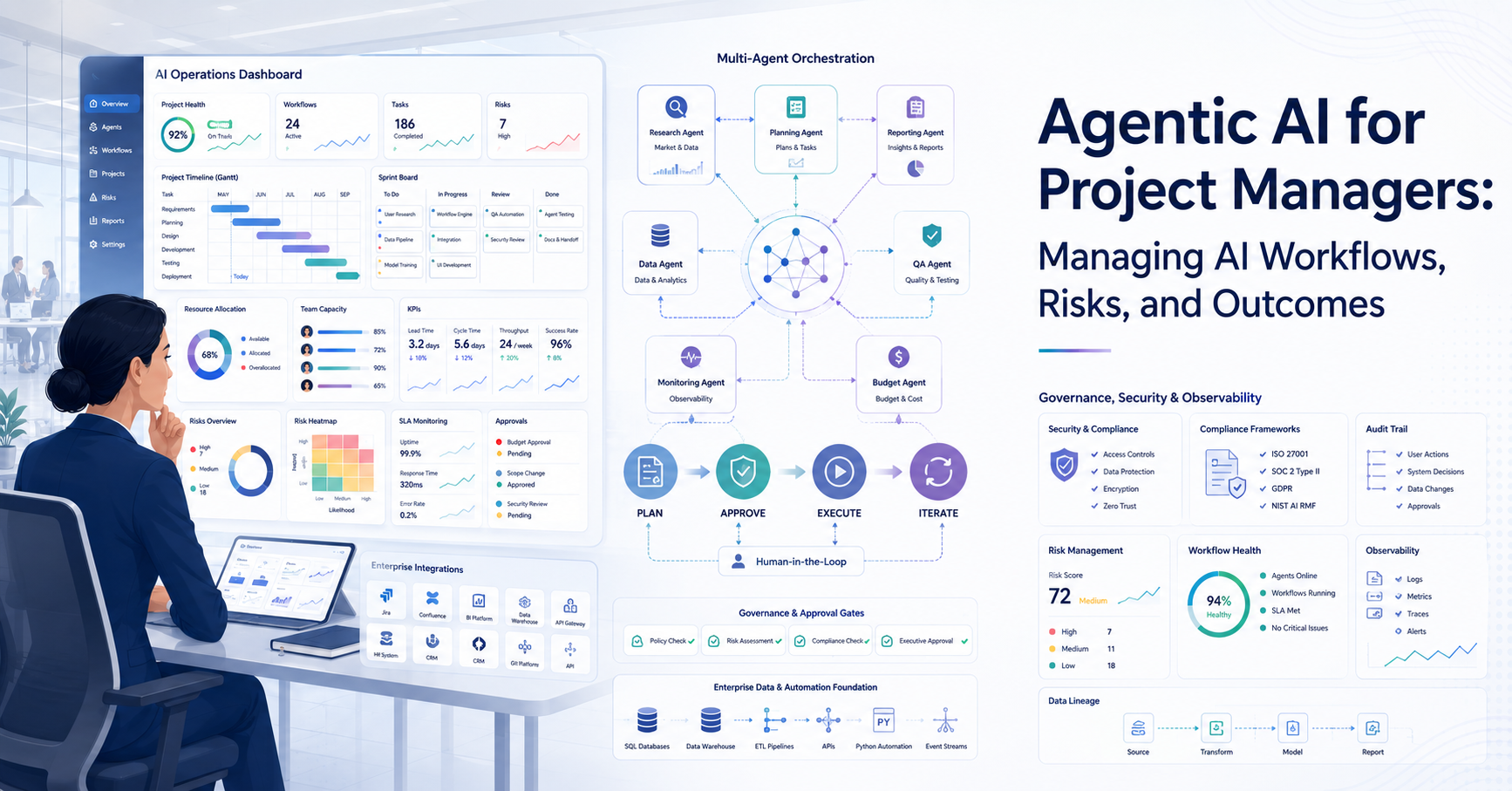

We are no longer debating whether artificial intelligence can automate tasks; we are witnessing intelligent systems that autonomously plan, execute, and adapt multi-step workflows with minimal human intervention. This is agentic AI, and its implications for business economics and professional careers are both immediate and structural.
According to Great Learning's Upskilling Trends Report 2025-26, 69% of professionals believe their roles are being disrupted by technology, particularly AI, and 44% identify Machine Learning and Artificial Intelligence as their top priority domain for upskilling. The race to understand and leverage agentic systems is no longer optional. It is the defining differentiator of the decade.
What Exactly Is Agentic AI?
Agentic AI refers to AI systems capable of pursuing complex, multi-step goals autonomously perceiving their environment, planning a course of action, executing via tools and APIs, and self-correcting based on feedback loops.
The four core architectural components define what makes an AI agent truly "agentic":
- Goal-driven architecture: Agentic systems receive high-level objectives and independently decompose them into sub-tasks. They do not wait for step-by-step instructions; they infer the intermediate actions needed to reach the defined outcome, dynamically replanning when conditions change.
- Memory and context retention: Agents maintain episodic and semantic memory across sessions, enabling continuity of context within and across workflows. This prevents redundant processing and enables more accurate decision execution over time, a capability that separates agentic AI from stateless large language models.
- Tool usage and API integration: Agentic AI interacts with external systems, CRMs, ERPs, databases, and third-party APIs to retrieve data, trigger actions, and complete real-world tasks embedded within existing enterprise infrastructure.
- Feedback loops and self-correction: Through reinforcement learning principles and continuous monitoring, agents evaluate the outcomes of their actions, compare results against intended goals, and recalibrate their approach without requiring human escalation.
For a sharper perspective on how this paradigm diverges from conventional systems, this comparison of AI agents versus traditional AI is worth reading before going further.
Ready to start building with these systems?
Great Learning's free course,Agentic AI with ChatGPT and AutoGPT, introduces you to agent frameworks, prompt chaining, and task automation using real tools, with no prior experience required. Paired with Getting Started with Agentic AI, another free course covering agent concepts and practical use cases, these form a solid entry point into the agentic AI space.
Learn to design AI agents that can perform tasks autonomously, from problem-solving to automating workflows, without any prior experience.
For a broader view of how these technologies are reshaping business workflows at the leadership level, watch:
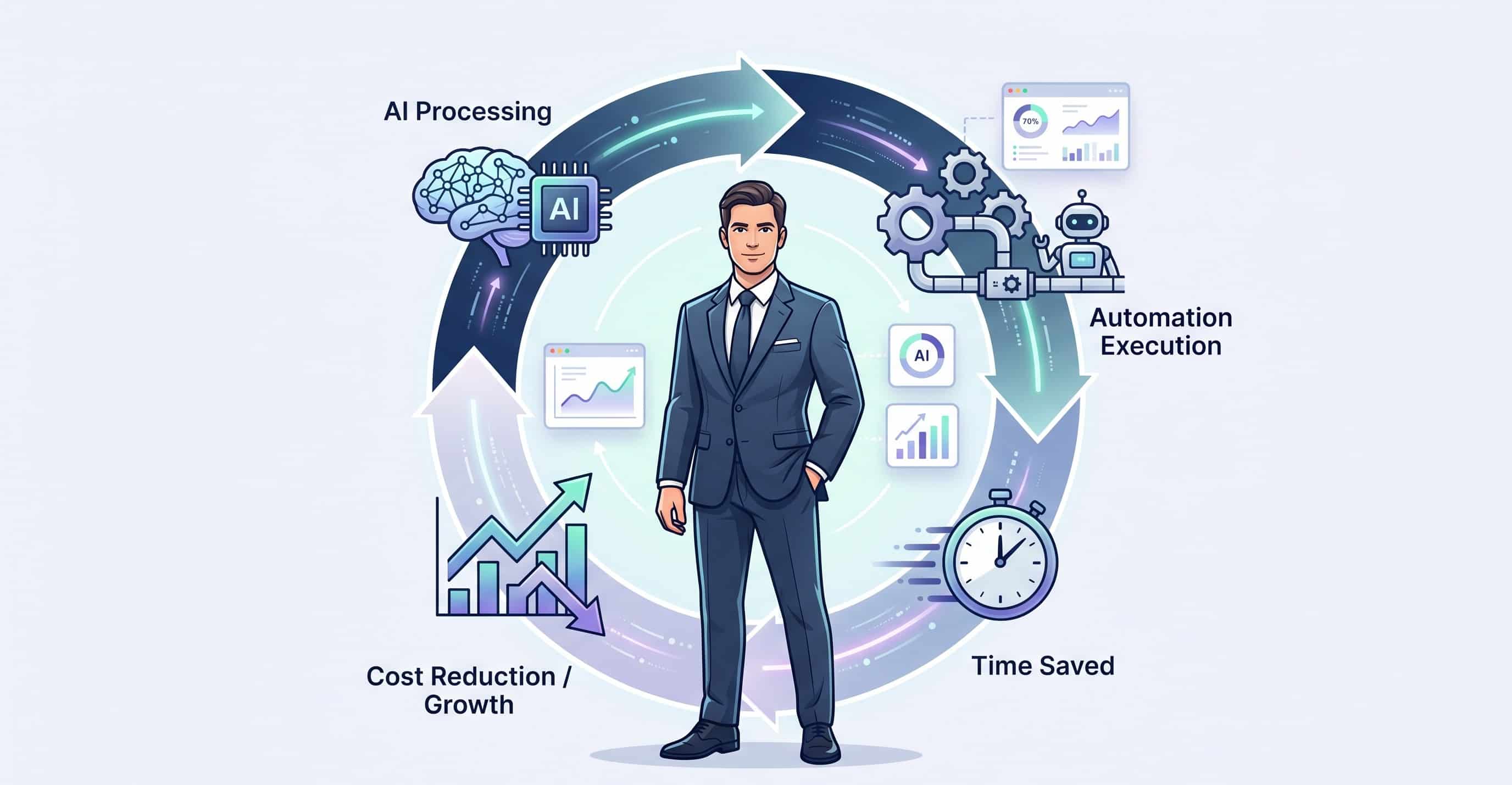
The Real Cost-Saving Engine
Cost reduction through agentic AI is not incidental; it is structural. Before examining how, it is worth asking: are companies genuinely achieving ROI from AI adoption, or is there an element of hype? The answer lies in where value is actually generated.
1. Elimination of “Coordination Overhead.”
- Fewer handoffs between teams: Traditional enterprise workflows suffer from immense friction during inter-departmental handoffs (e.g., Operations passing data to QA, which then escalates to Support). Agentic AI eliminates these bottlenecks by serving as a unified execution layer that handles cross-functional data synthesis instantly.
- Agents execute multi-step workflows independently: Instead of requiring three different specialists to pull data, analyze it, and draft a report, a singular agentic workflow navigates the entire pipeline autonomously, drastically reducing the labor costs associated with project management and cross-team coordination.
2. Compression of Time-to-Execution
- Tasks that took days now take minutes: Complex processes such as financial reporting, large-scale data analysis, and deep-level code debugging are compressed from multi-day human efforts into instantaneous computational cycles.
- Faster cycles = lower operational drag: When execution speed increases exponentially, the associated operational drag, including waiting periods, stalled projects, and delayed decision-making, evaporates. The fundamental cost equation shifts as Time × Human Involvement is minimized to near zero for routine execution.
3. Reduction in Error-Correction Costs
- Continuous monitoring + auto-correction loops: Human fatigue inevitably leads to costly errors, necessitating expensive QA layers and rework. Agentic AI operates with deterministic precision, utilizing continuous monitoring to catch anomalies instantly.
- Less rework, fewer escalations: For example, finance reconciliation agents can process tens of thousands of ledger entries, cross-referencing them against banking APIs in real-time. By resolving discrepancies autonomously, they eliminate the costly downstream escalations that typically plague accounting departments.
4. Always-On Operations Without Marginal Cost Increase
- 24/7 execution without overtime or shifts: Human capital requires downtime, shift differentials, and overtime pay. Agentic infrastructure runs continuously, processing global workflows across all time zones seamlessly.
- Scalability without proportional hiring: As business volume surges, organizations traditionally scale by hiring proportionally. Agentic AI allows for non-linear scaling, where doubling operational output merely requires spinning up additional cloud computing instances rather than expanding human headcount.
5. Replacement of “Low-Leverage Roles,” Not Just Tasks
- Roles built around coordination shrink fastest: The roles most vulnerable to cost-saving measures are not necessarily the lowest paid, but those entirely dedicated to reporting, repetitive execution, and acting as middlemen between disparate software systems.
- Insight: True cost savings are realized not by shaving minutes off individual tasks, but by restructuring entire departments, allowing the organization to achieve more output with a leaner, highly specialized human workforce.
Career Differentiation: Why Most Professionals Will Get Left Behind?
Great Learning's Upskilling Trends Report 2025-26 reveals a critical divergence: 69% of professionals feel disrupted by AI, yet 78% express a positive outlook about its career impact.
The gap between disruption and opportunity is preparation. Understanding what employers now expect beyond basic AI tool usage is the essential first step.
The Collapse of Execution-Based Value
Historically, professional value was derived from the ability to execute and produce reports, coordinate tasks, and implement defined processes reliably. Agentic AI systematically absorbs these functions:
- Reporting and dashboarding: Autonomous agents pull, clean, and visualize data continuously without manual intervention.
- Basic analysis: Pattern recognition, anomaly detection, and threshold-based forecasting now fall well within the capability of deployed agentic systems.
- Workflow coordination: Multi-agent orchestration replaces human coordination across sequential, rule-based task chains.
Professionals whose value proposition is tied exclusively to execution face acute displacement risk.
The Rise of Intelligence-Led Roles
The new labor market is not smaller; it is restructured. High-value roles are emerging around the design, governance, and optimization of agentic systems:
- AI workflow designers: Professionals who translate complex business processes into agent-compatible architectures, defining goal hierarchies, tool access, and escalation logic.
- Agent supervisors and auditors: Individuals responsible for monitoring agent behavior, evaluating decision quality, and ensuring alignment with business objectives and regulatory requirements.
- Decision architects: Senior professionals who determine where human judgment must remain in the loop and design robust escalation pathways.
The New Skill Stack That Differentiates You
- Agent design thinking: Evolving beyond prompt engineering into the design of goal hierarchies, context management strategies, and multi-agent orchestration logic.
- Systems thinking: Understanding how workflows connect across departments, APIs, and data pipelines and where failure points emerge.
- Data interpretation and judgment: The capacity to assess AI-generated outputs critically, identify edge cases, and apply contextual judgment that agents cannot replicate.
- AI auditability and governance: Designing oversight mechanisms that maintain accountability, traceability, and ethical integrity in agentic deployments.
The career signal is shifting. The old signal was: "I can do X task." The new signal is: "I can design systems that perform X at scale."
To acquire this exact skill set, Great Learning offers the JHU Certificate Program in Applied Generative AI & Agentic AI, developed in collaboration with Johns Hopkins University.
Certificate Program in Applied Generative AI
Master the tools and techniques behind generative AI with expert-led, project-based training from Johns Hopkins University.
This program covers foundational and advanced generative and agentic AI concepts from large language models and prompt engineering to multi-agent systems and enterprise deployment, structured for working professionals ready to move from AI consumers to AI architects.
For professionals pivoting from disrupted roles, the free Pathway to Becoming an AI Engineer course provides a structured roadmap from Python and ML fundamentals to deploying autonomous AI agents.
Moreover, if you are currently navigating a career transition,this guide on how an AI course can help you pivot after a layoff provides a practical perspective on leveraging education as a repositioning strategy. For executive-level perspectives on navigating the organizational transformation ahead, watch:
How to Start Leveraging Agentic AI?
Great Learning's Upskilling Trends Report 2025-26 shows that 81% of professionals intend to pursue upskilling in FY2026, with AI and Machine Learning identified as the top domain by 44% of respondents. Intention, however, must translate into structured action.
Here is a five-step framework for organizations and professionals ready to implement.
Step 1: Identify High-Friction Workflows- Begin by auditing your department for processes that are heavily repetitive, require multi-step approvals, or rely on decision-heavy routing based on standardized rules. These friction points are the ideal testing ground for autonomous agents.
Example:
The Accounts Payable (AP) department spends 40 hours a week manually downloading PDF invoices from emails, verifying the vendor details, checking them against Purchase Orders (POs), and flagging discrepancies. This is a high-friction, repetitive workflow ripe for agentic AI.
Step 2: Break Tasks into Agent-Compatible Units- Deconstruct the identified workflows into a strictly logical sequence of Inputs, Actions, and Outputs. Agents require unambiguous boundaries and clear definitions of success to operate effectively without human intervention.
Example:
You break the AP process into distinct units:
- Input: Receive an email with a PDF attachment.
- Action 1: Extract text and data from the PDF.
- Action 2: Cross-reference the extracted data (vendor name, amount) with the corresponding PO in the database.
- Output: Draft an approved payment record or flag the invoice as a mismatch.
Step 3: Introduce Tools + APIs- An agent without tools is just a chatbot. You must safely connect these agents to your real enterprise systems, such as your ERP, CRM, or cloud databases, using secure APIs, allowing them to take deterministic actions within your environment.
Example:
You connect the AP Agent to Microsoft Outlook (to fetch emails), a Document AI service (to read the PDFs), and your company’s ERP system, like NetSuite or SAP (via secure APIs). Now, the agent can physically open the email, extract the data, and log the invoice into the ERP software just like a human accountant would.
Step 4: Add Feedback Loops- Implement mechanisms for continuous improvement. The agent must have a way to evaluate its own success rate, learn from failed API calls or rejected outputs, and dynamically adjust its approach for future iterations.
Example:
If the agent encounters a blurry invoice where the OCR (optical character recognition) fails, instead of crashing, it is programmed to automatically reply to the vendor requesting a clearer copy. If it misclassifies a recurring tax code and a human corrects it, the agent updates its internal rules to apply the correct tax code for that specific vendor next time.
Step 5: Build Oversight Mechanisms- Never deploy autonomous agents blindly. Establish robust human review layers, specifically for high-stakes decisions. Use "human-in-the-loop" (HITL) protocols to approve major actions until the agent has proven strict reliability.
Example
The AP Agent is allowed to autonomously process and approve any matching invoices under $1,000. However, for any invoice exceeding $1,000 or where the PO amounts do not perfectly match, the agent queues the task in a dashboard. A human finance manager must review the agent's summary and click "Approve" before any funds are actually transferred.
If you lack a deep coding background but still want to build these workflows, the No-Code Artificial Intelligence Machine Learning Online Program is highly relevant. This program empowers professionals to harness the power of AI and Machine Learning without writing a single line of code.
MIT No Code AI and Machine Learning Program
Learn Artificial Intelligence & Machine Learning from world-renowned MIT faculty. Get a completion certificate and grow your professional career.
By focusing on intuitive, visual interfaces and pre-built models, it allows business leaders and operations managers to deploy sophisticated AI solutions rapidly and democratize automation across the enterprise.
Conclusion
The transition toward agentic AI is not merely an IT upgrade; it is a fundamental redesign of enterprise operating models.
By replacing the manual coordination overhead with autonomous, self-correcting agents, businesses are unlocking unprecedented cost efficiencies and redefining their profit margins.
However, this shift requires a corresponding evolution in human capital. Professionals must urgently pivot from execution-based roles to systems-thinking, AI orchestration, and strategic oversight.
The future belongs to those who do not compete with the machine's ability to execute, but rather differentiate themselves by mastering the architecture, governance, and scalable deployment of these intelligent, autonomous agents. The mandate is clear: adapt your skill stack to orchestrate AI, or risk being automated by it.