

How do AI systems move from simply assisting humans to independently completing tasks end-to-end?
That shift is already underway with AI agents designed to plan, execute, and adapt without constant human follow-ups. Clawdbot is a strong example of this evolution, using intelligent agents to understand intent, make decisions, and resolve tasks autonomously across workflows.
In this blog, we explore how Clawdbot leverages AI agents to eliminate manual handoffs, reduce operational friction, and deliver faster, more reliable outcomes at scale.
What is Clawdbot?
Clawdbot (recently rebranded as Moltbot or OpenClaw) is an open source, self-hosted personal AI assistant designed to act as an "agent" rather than just a chatbot.
Unlike typical AI interfaces that wait for you to type a prompt, Clawdbot is built to live on your hardware, stay always-on, and perform real-world tasks across multiple apps and messaging platforms.
Clawdbot serves as a central integration layer that connects a user-selected AI model, such as Anthropic’s Claude or OpenAI’s GPT-4, with their digital ecosystem, including messaging platforms, files, and web browsers.
Core Models and Technical Frameworks
- Large Language Models (LLMs): It is model agnostic, meaning it can be powered by Claude 3.5 Sonnet, GPT-4o, or local models like Llama 3 via Ollama. These serve as the "Reasoning Engine."
- Model Context Protocol (MCP): A standardized open protocol that allows the agent to connect to over 100 external services (Google Workspace, GitHub, Slack) without custom API code for every task.
- Retrieval-Augmented Generation (RAG): Used for "Long-Term Memory," where user preferences and past interactions are stored in a SQLite database with FTS5 (Full-Text Search) and vector embeddings.
- Node.js Runtime: The orchestration layer that maintains the "Always-On" state and manages the Gateway Server.
- Containerized Sandboxing: Employs Docker to execute potentially "dangerous" shell commands in an isolated environment to protect the host system.
Step-by-step: How Clawdbot Works
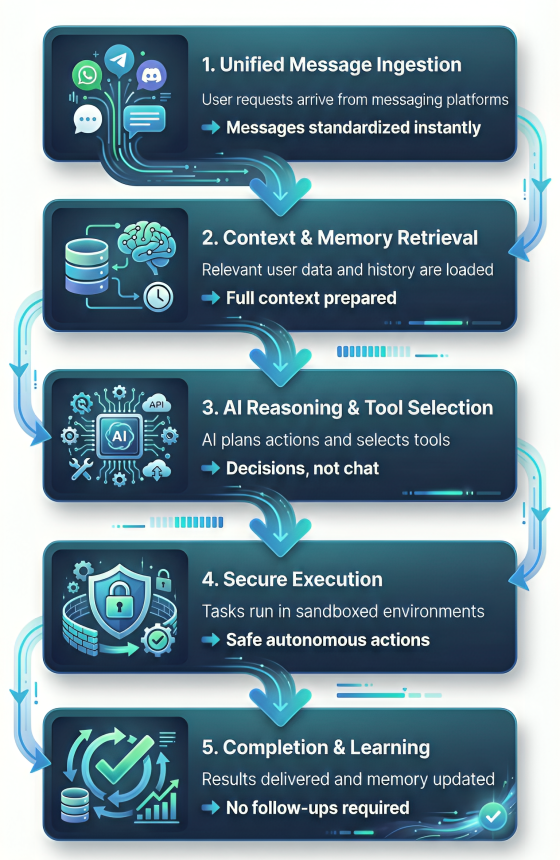
1. Unified Message Ingestion and Normalization
The process initiates when a user sends a command through a connected messaging channel like WhatsApp, Telegram, or Discord. The Channel Adapter layer intercepting the message performs normalization, converting platform-specific metadata into a standardized JSON envelope.
Example: You send a WhatsApp message stating, "Find all newsletters in my Gmail from last week and unsubscribe from them."
The Gateway Control Plane receives this standardized input and assigns it to a specific Session Router. This ensures that the conversation context is isolated from other concurrent tasks or group chats.
2. Contextual Retrieval and State Assembly
Before the request reaches the AI model, Clawdbot populates the "Context Window" by querying its local storage. It utilizes a Hybrid Search mechanism that combines Vector Embeddings (via SQLite) for semantic similarity and FTS5 (Full-Text Search) for keyword matching.
Example: Clawdbot retrieves your USER.md file to confirm your Gmail address and searches its MEMORY.md to see if you have previously redlisted specific senders or provided unsubscription preferences.
This phase assembles the System Prompt, which includes active "Skills" definitions, current session history, and retrieved long-term memory.
3. Reasoning and Model Orchestration
The assembled context is dispatched to the configured AI Brain. Clawdbot is model-agnostic, typically utilizing high-reasoning models like Claude 3.5 Sonnet, GPT-4o, or local models via Ollama. The model analyzes the request and determines which "Tools" are necessary to fulfill the objective.
Example: The model recognizes that it needs the "Gmail Skill" to list messages and the "Browser Skill" to navigate unsubscription links. It generates a structured Tool Call instead of a text response.
The agent uses the Model Context Protocol (MCP) to interact with these external services, ensuring the model understands the exact schema required for each action.
4. Sandboxed Execution and Human-in-the-Loop
Once the model selects a tool, the Execution Layer takes over. To maintain security, shell commands and scripts are often run within a Docker Sandbox or a restricted local environment. For web-based tasks, the bot utilizes the Chrome DevTools Protocol (CDP) to control a headless browser.
Example: Clawdbot opens a sandboxed browser instance, navigates to your Gmail, identifies three newsletters, and prepares to click the "Unsubscribe" buttons.
If the action is classified as high-risk, the Pairing Code System triggers a confirmation request. The bot messages you back on WhatsApp, asking, "I found 3 newsletters. Should I proceed with unsubscription?" Once you reply "Yes," the execution continues.
5. Task Completion and Memory Logging
After the actions are executed, the bot captures the results and formats a final report for the user. Simultaneously, it performs a Memory Write operation. It appends the outcome to a daily Markdown file (e.g., 2026-02-03.md) and updates the vector database with new learnings.
Example: Clawdbot sends a final WhatsApp message: "Successfully unsubscribed from 3 newsletters. I have noted that you want to avoid marketing emails from these specific domains in the future."
The Auto-compaction technique then shrinks the conversation history to save tokens while preserving the essential facts in permanent storage, ensuring the agent remains efficient for future interactions.
Understanding how these technical layers, RAG, CoT, and ReAct, interact is the key to moving from manual execution to true autonomous agency. For professionals looking to build and lead these systems, the JHU Certificate Program: Generative and Agentic AI Fundamentals provides the necessary deep dive.
Certificate Program in Generative AI & Agents Fundamentals
A program focused on the foundational concepts of Generative AI and AI agents. It covers topics like NLP, Prompt Engineering, and Responsible AI, with practical applications for various industries.
While Clawdbot offers a look at what is possible today, this program equips you with the fundamental skills to design, deploy, and govern these very types of agentic systems in a professional landscape.
How This Program Empowers You?
- Foundational Mastery: Gain a comprehensive understanding of Generative AI, focusing on Large Language Models (LLMs) and their role as reasoning engines.
- Agentic System Design: Learn the architecture of AI agents, moving beyond simple prompts to creating systems that can plan and execute complex tasks.
- Practical Application: Bridge the gap between theory and practice by understanding how to implement these technologies to solve real-world business challenges.
- Strategic Leadership: Position yourself as a leader in the AI transition, prepared to oversee the shift from human-led tasks to autonomous, high-output agentic workflows.
How Clawdbot Uses AI Agents to Resolve Tasks Without Human Follow-Ups
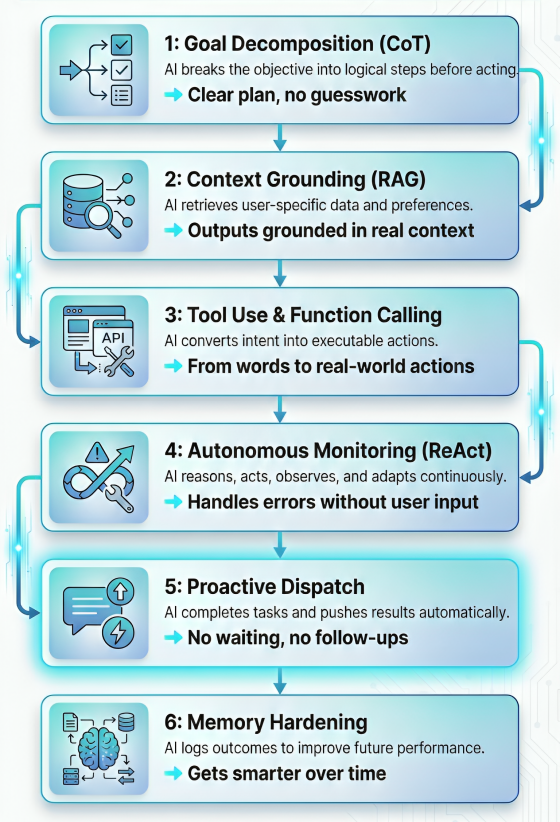
To understand this, we will examine the process through the scenario of a Content Creator requesting the agent to "Find three trending AI news stories from this morning and draft a LinkedIn post for each in my specific brand voice”.
Step 1: Goal Decomposition via Chain of Thought (CoT)
The process begins with the agent receiving the high-level objective. Instead of executing immediately, the agent utilizes Chain of Thought (CoT) reasoning.
- The Role of CoT: This technique acts as the "Executive Function" of the agent. It forces the model to generate intermediate steps in a logical sequence before producing an output. This prevents "hallucinated shortcuts" and ensures the agent identifies hidden requirements, such as the need to browse the web before drafting.
- Example: The agent verbalizes an internal plan: First, I must access current news via the browser. Second, I need to retrieve the user's "Brand Voice" document from local storage. Third, I will draft the posts.
Step 2: Contextual Grounding via Retrieval-Augmented Generation (RAG)
To fulfill the request accurately, the agent must know what "my specific brand voice" means. It employs Retrieval-Augmented Generation (RAG) to search its local knowledge base.
- The Role of RAG: Traditional AI is limited by its training data cutoff. RAG allows the agent to pull "live" or "private" data from the user’s files or chat history and inject it into the prompt. This ensures the output is grounded in the user's actual reality rather than generic AI patterns.
- Example: The agent performs a vector search across the user’s style guide.md file to identify specific preferences, such as "avoiding emojis" or "using a professional tone."
Step 3: Interfacing via Tool Use and Function Calling
Once the plan and context are established, the agent interacts with the external world through Function Calling (also known as Tool Use).
- The Role of Tool Use: This represents "The Hands" of the agent. It translates natural language intent into machine-executable code. Without this tool allows it to trigger browser instances, run Python scripts, or access APIs.
- Example: The agent generates a structured request to trigger a browser (Playwright). It navigates to tech news sites to scrape the top three headlines regarding AI developments from the last six hours.
Step 4: Autonomous Monitoring via the ReAct Framework
As the agent executes tools, it follows the ReAct (Reason + Act) pattern. This is a recursive loop where the agent "Reasons" about the current state, "Acts" by using a tool, and then "Observes" the result.
- The Role of ReAct: This is "The Inner Critic." It provides the autonomy required to handle unexpected errors. If a news site is behind a paywall, the ReAct loop allows the agent to recognize the failure and pivot to a different source without asking the user for a new URL.
- Example: After failing to scrape a specific site, the agent observes the "403 Forbidden" error. It reasons that the site is blocked and autonomously decides to search for an alternative feed to find the necessary stories.
Step 5: Final Synthesis and Proactive Dispatch
After gathering the news and drafting the content, the agent uses a Proactive Dispatch mechanism.
- The Role of Proactive Dispatch: This breaks the traditional "request-response" cycle. In a standard chatbot, you must stay on the page to see the result. A proactive agent completes the task in the background and pushes the notification to the user’s preferred communication channel (like WhatsApp or Slack) once finished.
- Example: The agent does not wait for the user to check the status. It sends a message to the user: "I have drafted three LinkedIn posts based on this morning’s AI trends. You can find them in your 'Drafts' folder, formatted in your requested brand voice."
Step 6: Continuous Learning via Memory Hardening
The final step involves Memory Hardening, where the agent updates its long-term logs with the outcomes of the task.
- The Role of Memory Hardening: This serves as "The Chronicler." It ensures the agent becomes more efficient over time. By recording which sources provided the best news and which drafting style the user preferred, the agent reduces the "Reasoning" overhead for future, similar requests.
- Example: The agent records a metadata note: "User prefers AI news from 'Source X' over 'Source Y'. Future content requests should prioritize 'Source X' for efficiency."
Moving from manual execution to autonomous agency requires a shift in leadership mindset. The AI Agents for Business Applications Online Course from UT Austin is designed specifically for leaders who want to implement these exact agentic strategies. By learning how to design and deploy AI agents for tangible business outcomes, you can transition your team from managing tasks to overseeing self-sufficient, high-output systems.
PG Program in AI Agents for Business Applications
This program focuses on applying Agentic AI to solve business problems, improve operational efficiency, and drive innovation. Learn to build AI agents using Generative AI, Large Language Models, and other advanced tools.
Real-World Use Cases
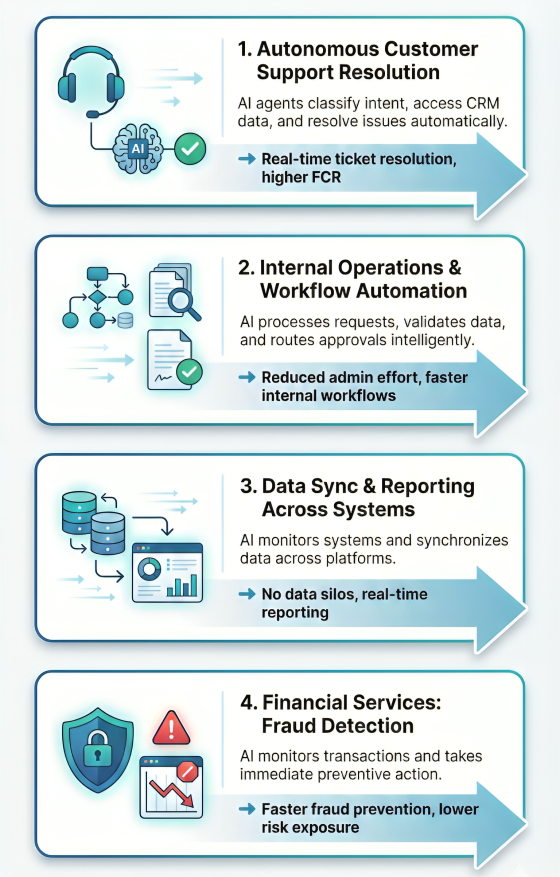
1. Autonomous Customer Support Ticket Resolution
In high-volume service environments, Clawdbot transitions from a basic auto-responder to an Autonomous Resolution Agent. It manages the entire lifecycle of a ticket by interacting with backend databases and external service portals.
- The Workflow: Upon receipt of a support request (e.g., via WhatsApp), the agent utilizes Natural Language Processing to classify the intent. It then retrieves the user's account history from a CRM (like Salesforce) and identifies the specific technical issue.
- Agentic Technique: The agent employs a ReAct (Reason + Act) loop to autonomously execute a fix, such as resetting a cloud permission or updating a shipping address in an ERP, before sending a proactive confirmation to the user.
- The Outcome: Tickets are resolved in real-time without being queued for a human agent, significantly improving First Contact Resolution (FCR) metrics.
2. Internal Operations and Workflow Execution
For internal business processes, Clawdbot acts as an Orchestration Layer that manages multi-step administrative tasks that typically require cross-departmental handoffs.
- The Workflow: When an employee submits an expense report via Slack, the agent automatically extracts the receipt data using Optical Character Recognition (OCR). It cross-references the amounts against the corporate budget stored in an internal database and flags any discrepancies.
- Agentic Technique: Using Chain of Thought (CoT) reasoning, the agent decides whether to approve the request automatically (if within policy) or route it to a specific manager's calendar for a 1-minute "approval window" notification.
- The Outcome: The administrative overhead for finance teams is reduced by automating the verification and routing phases of internal operations.
3. Data Updates, Reporting, and System Coordination
Clawdbot serves as a Data Synchronization Agent, ensuring that information remains consistent across disparate legacy systems and modern cloud applications without requiring manual data entry.
- The Workflow: The agent monitors a legacy SQL database for new entries. Once a change is detected, it utilizes Playwright or Selenium to log into a cloud-based dashboard and replicate the update.
- Agentic Technique: The agent performs Semantic Verification; it does not just copy data but interprets the context to ensure the data is mapped to the correct corresponding field in the target system, even if the schemas differ.
- The Outcome: This eliminates "data silos" and ensures that executive reports are generated with real-time accuracy across the entire technological stack.
Governance Framework for Autonomous Execution
| Pillar | Focus Area | Technical Implementation & Role |
| Security & Guardrails | Permissions & Compliance | Employs Role-Based Access Control (RBAC) and sandboxed environments (e.g., Docker). Its role is to restrict the agent’s reach to specific directories or APIs, preventing unauthorized system changes or data leaks. |
| Control Mechanisms | Human-in-the-Loop (HITL) | Intervenes only when the agent encounters high-risk decisions or ambiguity beyond its confidence threshold. This serves as a safety valve, ensuring that critical actions (like large financial transfers) require explicit human authorization. |
| Operational Trust | Auditability & Transparency | Maintains a comprehensive, immutable log of the agent’s Chain of Thought (CoT) and tool outputs. This allows stakeholders to reconstruct the reasoning behind any decision, ensuring full accountability for every autonomous action. |
| Data Integrity | Encryption & Privacy | Utilizes end-to-end encryption for all data in transit and at rest. Within a self-hosted context, this ensures that sensitive credentials and personal information remain within the user's controlled infrastructure. |
| Risk Mitigation | Boundary Enforcement | Implements "Hard" and "Soft" constraints. Hard constraints are non-negotiable rules (e.g., "never delete system files"), while soft constraints are guidelines that the agent uses to prioritize safety over speed. |
Strategic Gains from Zero-Follow-Up Workflows
1. Accelerated Completion and Reduced Operational Delays
Clawdbot works around the clock, eliminating delays caused by manual approvals and handoffs. Tasks that once took days are now completed in minutes, accelerating project timelines and removing operational bottlenecks.
2. Reduced Cognitive Load
Clawdbot handles routine administrative tasks and background processes, freeing teams from “shadow work.” Professionals can focus on strategic and creative decisions while the agent manages the operational details.
3. Enhanced Reliability and Scalability
Clawdbot executes every task with consistent accuracy, following a standardized workflow. This ensures predictable outcomes and allows organizations to scale operations without increasing human errors or oversight.
4. Measurable Productivity and Cost Benefits
By completing tasks autonomously, Clawdbot lowers the cost per task and boosts throughput. Teams achieve higher efficiency and ROI, handling more work without expanding headcount.
Conclusion
Clawdbot demonstrates how AI agents can take full ownership of tasks, resolving them autonomously without the need for human follow-ups. By combining intelligent decision-making, real-time adaptation, and self-correction, it transforms workflows, boosts productivity, and allows teams to focus on strategic work instead of repetitive oversight.