
- What Are Infosys SP and DSE Roles?
- Infosys SP vs DSE: Key Differences
- Infosys SP and DSE Exam Pattern 2026
- Infosys Technical Interview Questions
- Infosys HR Interview Questions and Answers
- Infosys SP and DSE Salary Breakdown (2026)
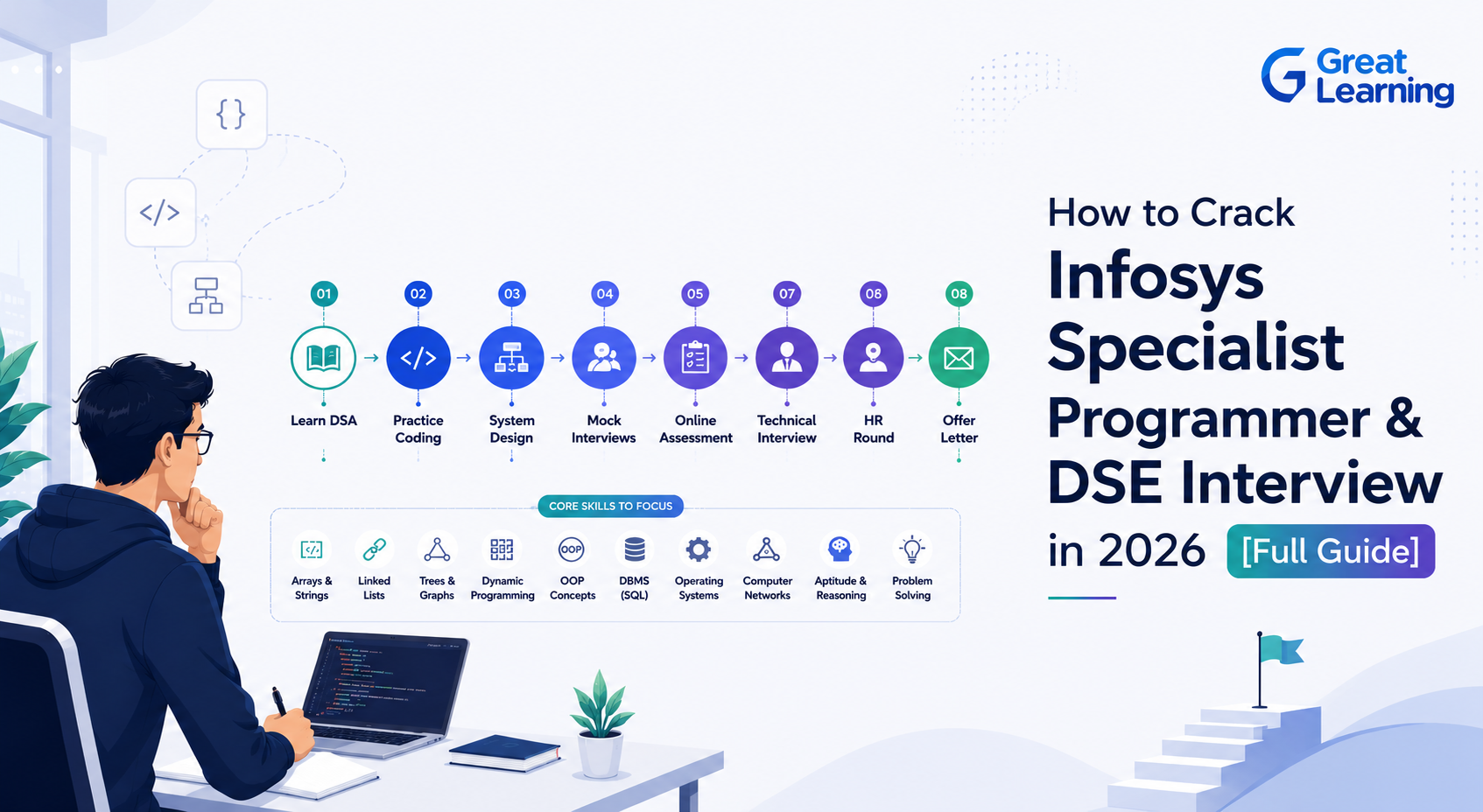
- How to Prepare for Infosys SP and DSE Interview
- Final Word
- Frequently Asked Questions
Getting a Specialist Programmer (SP) or Digital Specialist Engineer (DSE) offer from Infosys is not just about clearing one more campus placement; it is one of the most financially rewarding opportunities available for freshers in 2026, with packages going all the way up to ₹21 LPA.
But the bar is higher than a typical SE role, and the interview process tests you on things most placement prep courses never cover.
This guide walks you through everything: what the roles actually are, the Infosys SP and DSE exam pattern, coding questions asked in previous years, technical interview questions on DSA, OOP, SQL, and system design, Infosys interview questions and answers, the salary breakdown, and a preparation plan you can act on today.
Whether you are a recent batch graduate preparing for HackWithInfy, an off-campus drive, or your first Infosys interview, this is the only resource you need.
What Are Infosys SP and DSE Roles?
Infosys is one of India's largest IT companies, serving clients in 50+ countries and employing over 300,000 professionals. In recent years, Infosys shifted its hiring strategy to offer premium technical roles, Specialist Programmer (SP) and Digital Specialist Engineer (DSE), targeted at graduates with strong coding and problem-solving skills.
These are not your average entry-level IT support roles. Both SP and DSE positions are part of Infosys's push toward an AI-first, digital-first organization, and they involve real engineering work from day one.
The Infosys Specialist Programmer (SP) role is a high-level coding role for candidates who are strong in data structures, algorithms, and competitive programming. SP engineers work on complex development problems, and the role demands the ability to write optimized code efficiently for Medium to Hard-level problems.
The Infosys Digital Specialist Engineer (DSE) is a digital, full-stack-focused role that covers modern technologies, including automation, analytics, cloud, and application development. The DSE role offers good growth for candidates who are strong in programming and have exposure to modern tech stacks.
Build Your Core Competency: Before tackling advanced development, ensure your foundations are rock solid with the Programming Basics free course. This beginner-friendly module on Great Learning Academy helps you grasp core programming logic, syntax, and fundamental coding paradigms through self-paced video lectures, culminating in a free certificate of completion.
Additionally, if you are eyeing backend DSE roles, the Python Foundations course is an excellent starting point to understand variables, loops, and basic Python syntax from scratch.
Infosys SP vs DSE: Key Differences
Before you start preparing, understand exactly what separates these two roles because the same test is used to select for both.
| Parameter | Specialist Programmer (SP) | Digital Specialist Engineer (DSE) |
| Focus Area | DSA, algorithms, optimization | Full stack, automation, digital tech |
| Coding Difficulty | Medium to Hard (LeetCode equivalent) | Easy to Medium |
| Salary (2026) | ₹10 LPA (L1), ₹16 LPA (L2), ₹21 LPA (L3) | ₹6.25 LPA |
| Joining Bonus | ₹1,00,000 (L1) | ₹75,000 |
| Stock Options | Yes (SP L2 and L3) | No |
| Selection Threshold | Solve 2+ coding questions correctly | Solve 1–1.5 coding questions |
| Work Type | Complex backend/algorithm development | Digital projects, automation, full stack |
The most important thing to understand here: both roles share the same online assessment. Your performance in that single 3-hour coding test determines whether you get the SP or DSE offer. Score very well, and you get SP. Score moderately, and you get DSE.
Infosys SP and DSE Exam Pattern 2026
The selection process for Infosys SP and DSE roles has three stages:
Stage 1: Online Assessment (3 Hours)
This is the core test and the make-or-break round. The Infosys SP and DSE exam pattern consists of 3 coding questions to be solved in 3 hours, with sectional cut-offs applying to each question.
| Question | Difficulty | Topics |
| Question 1 | Easy | Arrays, strings, basic logic, simple algorithms |
| Question 2 | Medium | Dynamic Programming, Graph Traversal, Greedy |
| Question 3 | Hard | Segment Trees, 2D DP, advanced graphs |
| Question 4 | Complex | Mixture of Segment Trees, 2D DP, and advanced graphs |
Supported languages: Java, Python, C++, C (varies by test portal, usually Infosys Wingspan).
Scoring note: Partial scoring exists. A brute-force solution that handles most test cases correctly can still earn you 50–60% marks on that question. If you are stuck on the hard problem, do not spend 40 minutes chasing a perfect solution. Submit what works and move on.
How the SP/DSE split works: Candidates who correctly solve 2 or more questions are shortlisted for the SP interview. Candidates who solve 1 to 1.5 questions correctly qualify for DSE. This means if your goal is SP, you need to consistently practice at the Medium–Hard LeetCode level.
Master the Logic: To consistently hit the SP threshold, enroll in the free Competitive Programming Course by Great Learning Academy. This course systematically teaches you how to optimize your code for strict time complexities, a crucial skill for medium-to-hard assessment questions.
Stage 2: Technical Interview (F2F or Virtual)
Shortlisted candidates are called for an offline or virtual interview at an Infosys campus. Before the interviews begin, there is typically an ID verification, and candidates may be given a short additional coding challenge on the same portal.
The interview itself covers:
- 2 DSA problems (Easy to Medium, solved live on a shared screen)
- OOP concepts
- DBMS and SQL queries
- Questions based on your resume and projects
- Scenario-based questions
Stage 3: HR Interview
The final round assesses communication skills, cultural fit, and willingness to relocate (Mysore/Bangalore for training).
Infosys Technical Interview Questions
After clearing the online assessment, the technical interview is where SP and DSE selections get finalized. Here is a section-wise breakdown of everything asked.
DSA Questions Asked in the Interview
The technical interview typically begins with 1–2 live coding problems. Based on recent Glassdoor and GFG interview experiences, here are the most commonly asked topics:
Graph Algorithms
- BFS and DFS traversal on a grid or adjacency list
- Detect a cycle in a directed graph
- Shortest path in an unweighted graph (BFS)
- Number of connected components
Dynamic Programming
- Knapsack problem (0/1 and unbounded)
- Longest Increasing Subsequence
- Edit Distance between two strings
- Matrix chain multiplication
Trees and Binary Search Trees
- Inorder, Preorder, Postorder traversal (recursive and iterative)
- Lowest Common Ancestor of two nodes
- Check if a binary tree is a BST
- Level-order traversal using a queue
Stacks and Queues
- Implement a stack using queues and vice versa
- Valid parentheses
- Next greater/smaller element
Strings and Arrays
- Two-sum and three-sum problems
- Sliding window maximum
- Anagram detection
- Merge intervals
Consolidate Your DSA Knowledge: A strong conceptual grasp is just as important as writing code. The Top 50+ Data Structure Interview Questions blog to memorize the theoretical definitions and space-time complexities that your interviewers will certainly ask about.
OOP Concepts Questions
OOP is heavily tested in Infosys DSE and SP technical interviews. These are the questions that come up most often:
Core Concepts
- What are the four pillars of OOP? Explain each with a real-world example.
- Answer: Encapsulation (binding data and methods, e.g., a capsule hides medicine), Abstraction (hiding implementation, e.g., a car's accelerator), Inheritance (parent-child relationship), Polymorphism (same method, different behavior).
- What is the difference between method overloading and method overriding?
- Answer: Overloading = same method name, different parameters, resolved at compile-time. Overriding = child class redefines parent method, resolved at runtime.
- What is the difference between an abstract class and an interface?
- Answer: An abstract class can have implemented methods and instance variables; a class can extend only one abstract class. An interface is a pure contract; a class can implement multiple interfaces. Use an abstract class for shared base behavior; use an interface for capability contracts.
- What is the difference between HashMap and ConcurrentHashMap? When would you use each?
- Answer: HashMap is not thread-safe and allows one null key. ConcurrentHashMap is thread-safe using segment-level locking, allowing concurrent reads and writes. Use HashMap for single-threaded code; use ConcurrentHashMap in multi-threaded environments to avoid race conditions.
- What is the difference between == and .equals() in Java?
- Answer: == compares references (memory addresses). .equals() compares object content/values. Always use .equals() for String comparison in Java.
- Explain the concept of polymorphism with a code example.
- What is a constructor? What is constructor overloading?
- What is the final keyword in Java? How does it apply to variables, methods, and classes?
- What is a static method? Can it access instance variables?
- Explain garbage collection in Java and the role of the JVM.
Object-Oriented Mastery: Never lose points on fundamentals. Reading through the Top 60+ OOPs Interview Questions ensures you have perfectly articulated, real-world examples ready for the four pillars.
DBMS and SQL Questions
SQL is consistently tested across all Infosys interview rounds for DSE and SP roles.
SQL Queries You Should Be Ready to Write
1. Find employees who joined after a specific date using a JOIN.
SELECT e.name, d.department_name
FROM employees e
INNER JOIN departments d ON e.dept_id = d.id
WHERE e.joining_date > '2022-01-01';
2. Find duplicate records in a table.
SELECT email, COUNT(*) as count
FROM employees
GROUP BY email
HAVING COUNT(*) > 1;
3. Delete duplicate rows, keeping only one.
DELETE FROM employees
WHERE id NOT IN (
    SELECT MIN(id) FROM employees GROUP BY email
);
Conceptual DBMS Questions
- What is normalization? Explain 1NF, 2NF, and 3NF with examples.
- 1NF: No repeating groups; each column has atomic values.
- 2NF: 1NF + no partial dependency (non-key attributes fully depend on the entire primary key).
- 3NF: 2NF + no transitive dependency (non-key attributes depend only on the primary key).
- What is the difference between TRUNCATE, DELETE, and DROP?
- DELETE: Removes specific rows, can be rolled back, and activates triggers.
- TRUNCATE: Removes all rows quickly, cannot be rolled back in most databases, and does not activate row-level triggers.
- DROP: Permanently removes the entire table structure and data.
- What are the different types of JOINs? Explain with examples.
- INNER JOIN: Returns rows where there is a match in both tables.
- LEFT JOIN: Returns all rows from the left table, NULLs for non-matching right table rows.
- RIGHT JOIN: Returns all rows from the right table.
- FULL OUTER JOIN: Returns all rows from both tables.
- What is a primary key vs a foreign key?
- What is an index? When should you use an index, and when should you not?
- What is a transaction? Explain ACID properties.
- What is the difference between a clustered and a non-clustered index?
Excel in Database Rounds: If complex subqueries and tricky JOINs slow you down, the free Advanced SQL course by Great Learning Academy is precisely what you need. It covers window functions and optimization techniques through comprehensive video content, providing a certificate upon completion.
For rapid revision just before your interview, the 35+ SQL Interview Questions and Answers blog acts as the perfect cheat sheet for conceptual database queries.
System Design Basics (Especially for SP Level)
System design is tested more rigorously for SP candidates. You do not need to know full-scale distributed systems design, but you should be comfortable with the basics.
Topics to Know
- What is the difference between monolithic and microservice architectures?
- Monolith: Single deployable unit; easier to develop initially; harder to scale individual components.
- Microservices: Each service is independently deployable, easier to scale, but with higher operational complexity.
- Design a URL shortener (a common beginner system design question)
- Components: API layer, hashing function (Base62 encoding), database to store mappings, cache (Redis) for fast lookups.
- Estimate: If 100M URLs are created per day, you need ~36.5 billion records in 10 years. Use a distributed ID generator.
- What is REST? What makes an API RESTful?
- Stateless communication, standard HTTP methods (GET, POST, PUT, DELETE), resources identified by URLs, responses in JSON/XML.
- What is the difference between SQL and NoSQL databases? When to use each?
- SQL: Structured data, strong consistency, complex queries. Use for banking and ERP systems.
- NoSQL: Flexible schema, horizontal scaling, high availability. Use for user activity feeds and product catalogs.
- What is caching? Where would you apply it in a web application?
- Cache frequently read, rarely changing data. Apply to: database query results, API responses, and static assets. Tools: Redis, Memcached.
- What is load balancing? Name two load-balancing algorithms.
- Distributes incoming traffic across multiple servers. Algorithms: Round Robin (equal distribution) and Least Connections (routes to the server with the fewest active connections).
Resume and Project-Based Questions
Infosys interviewers will check your resume closely. Be ready for their questions by using the free resume builder by Great Learning.
- Walk me through your final year project.
- What was the most challenging problem you solved in this project?
- Which technology did you use for the backend? Why did you choose it over alternatives?
- What is the time complexity of the key algorithm in your project?
- If you had to redesign this project from scratch, what would you do differently?
- You have listed FastAPI on your resume. Write a basic GET and POST endpoint for me. (This is a real question from a recent Infosys DSE interview.)
- What version control system did you use? Describe your Git workflow.
Tip: Know every bullet on your resume cold. If you listed "built a recommendation engine," be ready to explain the algorithm, dataset, tech stack, model accuracy, and what you would improve.
Infosys HR Interview Questions and Answers
The HR round is the final gate. While it rarely disqualifies technically strong candidates, a poor performance here can cost you your offer. The HR interview tests your communication skills, attitude, and fit with Infosys's culture.
Here are the most commonly asked HR interview questions for freshers, along with model answers you can personalize:
1. Tell me about yourself.
Structure your answer: Name → Education → Key skills or project → Why you are excited about Infosys. Keep it under 90 seconds. Example: "I am a Computer Science graduate from [College]. During my final year, I built [Project] using [Tech], which involved [brief technical detail].
I have been actively practicing competitive programming and have solved 200+ problems on LeetCode. I am particularly excited about the Specialist Programmer role at Infosys because it aligns with my interest in building scalable solutions."
2. Why do you want to join Infosys?
Mention: global client exposure, structured learning pathways (Lex, Springboard), Infosys's AI-first direction, and the caliber of the SP/DSE programs. Avoid generic answers like "Infosys is a great company."
3. What are your strengths and weaknesses?
Strength: Tie it to something the role actually needs (problem-solving, quick learning, attention to edge cases in code). Weakness: Choose something real but not disqualifying, and follow it with what you are doing to improve it.
4. Where do you see yourself in 5 years?
Be honest and ambitious. Mention growing within Infosys, taking on technically complex projects, and potentially becoming a team lead or architect. Avoid saying, "I want to start my own startup in 2 years."
5. Are you willing to relocate to Mysore or Bangalore?
The training at Infosys's Mysore campus is mandatory. Answer yes clearly. Hesitation here is a red flag.
6. What do you know about Infosys?
Mention: Founded in 1981 in Bangalore, one of India's largest IT companies, serves clients in 50+ countries, with a recent focus on AI, cloud, and digital transformation.
7. How do you handle pressure or tight deadlines?
Use a STAR format: Situation → Task → Action → Result. Reference a real college project or internship experience.
8. Do you prefer working alone or in a team?
The safe answer is that both mention that you can work independently when needed, but also collaborate well. Give one example of each.
9. What is your biggest achievement so far?
Academic, technical, or extracurricular, pick something concrete with a measurable outcome. "I ranked in the top 500 in a national coding contest" beats "I did well in studies."
10. Do you have any questions for us?
Always have 1–2 questions ready. Good ones: "What does the typical first 6 months look like for an SP/DSE at Infosys?" or "What are the most common technology stacks SP engineers work on?"
Perfect Your Delivery: HR rounds are won on confidence. Familiarize yourself with standard non-technical patterns by reading the 25 Common Job Interview Questions and Answers blog.
For visual learners, watch the Common Interview Questions and Answers | How to Ace Interviews? YouTube session to observe strong body language and pacing.
Make sure you crush the most critical question by reviewing Interview Question: Tell me about yourself | Tips and Tricks to Crack Interviews.
Infosys SP and DSE Salary Breakdown (2026)
One of the most-searched topics during this hiring drive is compensation. Here is the complete salary structure:
| Role | CTC Per Annum | Joining Bonus | Stock Options |
| Specialist Programmer L3 | ₹21 LPA | ESOPs | |
| Specialist Programmer L2 | ₹16 LPA | ESOPs | |
| Specialist Programmer L1 | ₹10 LPA | ₹1,00,000 | |
| Digital Specialist Engineer (Trainee) | ₹6.25 LPA | ₹75,000 |
To put this in context, most mass-recruiter IT companies, TCS, Wipro, and Cognizant, offer freshers between ₹3.5–4.5 LPA. The Infosys SP package at L3 is 5–6 times that figure.
Additional benefits across roles include comprehensive health insurance, access to the Infosys Learning Platform (ILP) and internal certifications, flexible and hybrid work arrangements on select projects, and global mobility opportunities.
The role you are assigned to (SP L1, L2, L3, or DSE) depends entirely on your coding test performance. The same assessment is used for all levels. Your score determines your track.
How to Prepare for Infosys SP and DSE Interview
Here is a realistic, week-by-week preparation plan that covers the Infosys exam questions, aptitude, coding, technical interview, and HR round.
Phase 1: Strengthen DSA Foundations (3–4 Weeks)
The Infosys SP and DSE exam pattern is entirely coding-based, so your preparation should be 70% DSA.
Topics to cover in order:
- Arrays and Strings (sorting, two pointers, sliding window)
- LinkedLists (reversal, cycle detection, merge)
- Stacks and Queues (monotonic stack, BFS)
- Trees and Binary Search Trees (traversals, LCA, BST operations)
- Graphs (BFS, DFS, cycle detection, shortest paths)
- Dynamic Programming (1D, 2D, memoization vs tabulation)
- Greedy Algorithms
- Segment Trees and Fenwick Trees (specifically for SP hard level questions, which often use these)
Daily practice targets:
- Solve at least 3–5 problems daily on LeetCode
- Aim to complete LeetCode's Top 150 Interview Questions list
- Tag and revisit every problem you could not solve in under 30 minutes
Best platforms for Infosys coding questions practice:
- LeetCode (primary)
- Codeforces (for competitive programming habits)
Phase 2: Core CS Subjects (2 Weeks)
Alongside DSA, revise the following subjects, all of which appear in the technical interview:
OOP: Study from GeeksforGeeks or a standard Java/Python OOP book. Write code for every concept; do not just read definitions.
DBMS and SQL: Practice at least 30 SQL queries covering JOINs, subqueries, GROUP BY, HAVING, and window functions. Revise normalization (1NF to 3NF), ACID properties, indexing, and the difference between TRUNCATE, DELETE, and DROP.
System Design: For DSE candidates, focus on basic concepts, REST APIs, monolith vs microservices, caching, and load balancing. For SP candidates, go deeper and design a URL shortener, a rate limiter, and a notification system.
OS Basics (occasional): Process vs thread, deadlock conditions, paging vs segmentation.
Phase 3: Resume Deep-Dive (1 Week)
Go through every project and skill on your resume and prepare answers for the following for each:
- What problem does it solve?
- What tech stack did you use and why?
- What was the time/space complexity of key functions?
- What would you improve if you rebuilt it?
Phase 4: Mock Interviews and HR Prep (1 Week)
- Do at least 5 mock technical interviews on Pramp or InterviewBit
- Practice HR questions out loud, not just in your head
- Record yourself answering "Tell me about yourself" and watch it back
Quick Revision Resources
| Resource | What to Use It For |
| LeetCode Top 150 | Core DSA practice |
| GeeksforGeeks Infosys SDE Sheet | Infosys-specific DSA questions |
| PrepInsta Infosys SP/DSE Page | Previous year coding questions + exam pattern |
| IndiaBix HR Questions | HR interview questions and answers practice |
| Infosys HackWithInfy Sample Questions (official PDF) | Understand actual difficulty calibration |
Final Word
Cracking the Infosys SP or DSE interview in 2026 comes down to one thing: how well you can write correct, efficient code under time pressure. The online assessment is the hardest part; if you get through that, the interview round is manageable for anyone with solid DSA and CS fundamentals.
Start with Medium-level LeetCode problems. Get comfortable with DP and graphs before anything else. Revise OOP and SQL until you can answer any question on them without hesitation. And when you sit in the HR round, know your resume better than the interviewer does.
The packages on offer up to ₹21 LPA for freshers make this one of the most valuable placement opportunities in the country. The preparation is demanding, but it is entirely within reach.
Good luck.
Frequently Asked Questions
Q: What is the difference between Infosys SP and DSE?
SP (Specialist Programmer) is a higher-level coding role focused on DSA and algorithm development, offering salaries from ₹10–21 LPA.
DSE (Digital Specialist Engineer) is a full-stack and digital tech role offering ₹6.25 LPA. Both are hired through the same coding test; your score determines which offer you receive.
Q: How many coding questions are asked in the Infosys SP and DSE exam?
The Infosys SP and DSE exam pattern includes 3 coding questions in a 3-hour window: 1 Easy, 1 Medium, and 1 Hard. There is a sectional cut-off for each question.
Q: Where can I find Infosys SP and DSE coding questions PDF?
PrepInsta's SP and DSE section, the official Infosys HackWithInfy sample questions PDF, and the GitHub repository by karthikreddy-7 are reliable sources for previous year questions and Infosys SP and DSE coding questions PDF.
Q: Is the Infosys SP interview hard?
The online assessment is harder than most campus placement test questions, which are Medium to Hard on LeetCode. The interview round is comparatively easier, focusing on live coding at Easy–Medium difficulty, OOP, SQL, and your project. Strong DSA preparation, combined with revision of core CS subjects, is sufficient to clear both.
Q: What is the HR round in an Infosys interview?
The HR interview is the final stage. It assesses communication, attitude, willingness to relocate, and cultural fit. Common HR interview questions include: Tell me about yourself, Why Infosys, Where do you see yourself in 5 years, and Are you open to relocating to Mysore or Bangalore for training?
Q: Can a DSE later move to the SP track at Infosys?
Yes. Internal role transitions are possible at Infosys. Candidates who join as DSEs and consistently perform well on high-complexity projects can move toward SP-level responsibilities over time.
Q: What topics should I focus on for the Infosys exam questions?
Dynamic Programming, Graph algorithms (BFS/DFS), Trees, Greedy algorithms, Sliding Window, and Segment Trees cover the vast majority of Infosys coding questions asked across the Easy, Medium, and Hard slots.
Q: Is the 2026 batch eligible for the Infosys SP and DSE off-campus drive?
Infosys runs both on-campus and off-campus drives at different times. Eligibility varies by drive; some recent off-campus drives have been limited to graduates of the recent batches. Check the official Infosys careers portal (infosys.com/careers) and your registered email for current eligibility.