
- Why Choose Johns Hopkins University for an AI Leadership Program?
- What Makes the Johns Hopkins AI for Senior Executives Program Different?
- How Is the Learning Experience Structured?
- Learning Journey and Curriculum Breakdown
- What Are the Key Learning Outcomes?
- Who Should Apply for the Johns Hopkins AI for Senior Executives Program?
- Who Are the Faculty and Industry Mentors?
- What Credential Will Participants Receive?
- How Does the Admission Process Work?
- What Career Value Does the Program Offer?
- Is the Johns Hopkins AI for Senior Executives Program Worth It?
- What’s the Next Step for Interested Executives?
- Frequently Asked Questions
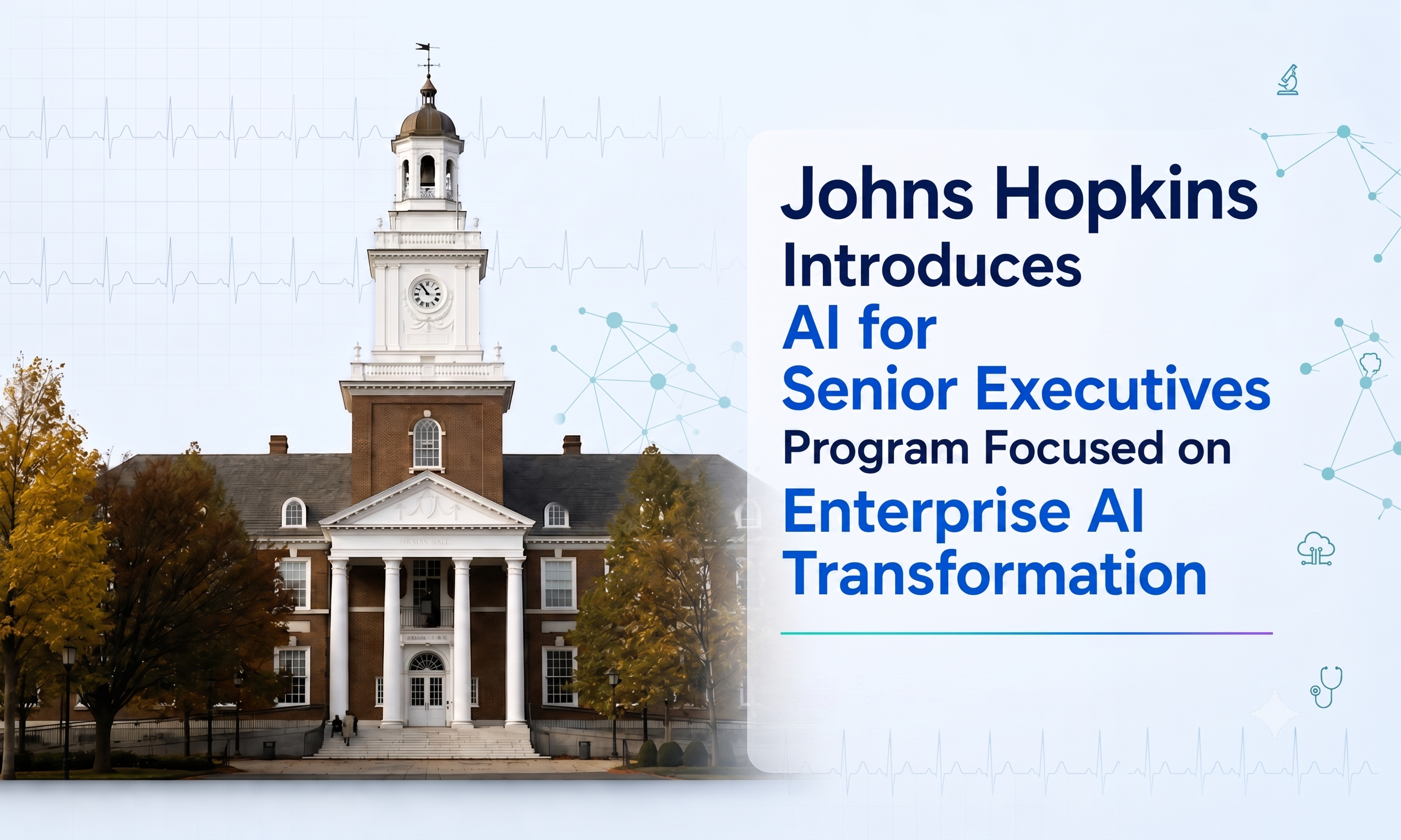
The AI for Senior Executives Program from Johns Hopkins University is a 6-month blended-learning executive program designed for senior leaders seeking to scale artificial intelligence initiatives across their organizations.
Combining live virtual sessions, self-paced learning, and a 4-day on-campus immersion at Johns Hopkins University, the program helps executives move beyond AI experimentation toward enterprise-wide AI transformation.
This article explores the program's structure, curriculum, faculty, eligibility, learning outcomes, admission process, and how it prepares leaders for strategic AI implementation.
Why Choose Johns Hopkins University for an AI Leadership Program?
The Johns Hopkins University AI for Senior Executives Program is designed for CXOs, transformation leaders, and decision-makers seeking to implement AI at scale and align it with long-term business strategy.
Ranked among the top universities in the United States, Johns Hopkins University combines interdisciplinary research, AI innovation, and executive education to help leaders understand how AI impacts business operations, governance, organizational design, and competitive advantage.
The program offers direct exposure to leading research centers at Johns Hopkins University, including the Malone Center for Engineering in Healthcare and the Data Science and AI Institute (DSAI). Participants also gain insights from scientists and experts associated with the Applied Physics Laboratory (APL).
| Parameter | Details |
|---|---|
| Program Name | AI for Senior Executives Program |
| Offered By | Johns Hopkins University |
| Duration | 6 Months |
| Learning Format | Blended Learning |
| Mode | Live Virtual + Self-Paced + On-Campus Immersion |
| Capstone | Enterprise AI Roadmap Presentation |
| Certificate | Certificate of Completion from Johns Hopkins University |
| Program Partner | Great Learning |
What Makes the Johns Hopkins AI for Senior Executives Program Different?
The program is specifically designed for enterprise AI transformation, rather than for technical coding or model building alone.
Key differentiators include:
- Live virtual sessions with Johns Hopkins faculty and industry experts
- A 4-day on-campus executive immersion experience
- Research-driven curriculum focused on enterprise AI implementation
- Strategic “Shark Tank”-style capstone presentations
- Exposure to AI governance, AI-first organizations, and responsible AI deployment
- Peer collaboration with senior executives and business leaders
- Executive-focused AI roadmapping frameworks
The program helps leaders connect AI adoption directly to business outcomes, operational efficiency, and long-term organizational strategy.
How Is the Learning Experience Structured?
The program follows a blended executive learning format that combines flexibility with applied strategic learning. Participants engage through:
- Self-paced online learning modules - Flexible online modules allow executives to learn AI concepts, frameworks, and strategy at their own pace.
- Live virtual sessions with faculty and mentors - Interactive sessions with Johns Hopkins faculty and industry experts provide practical insights into enterprise AI transformation.
- Collaborative workshops and peer discussions - Group discussions and executive workshops encourage knowledge-sharing around real-world AI implementation challenges.
- Real-world enterprise AI case studies - Applied case studies help participants understand how organizations scale AI initiatives across business functions.
- On-campus immersion experiences at Johns Hopkins University - A 4-day campus residency includes faculty-led sessions, AI research center visits, and executive networking opportunities.
The overall commitment includes:
- 7 live virtual sessions with Johns Hopkins faculty - Faculty-led sessions focus on AI strategy, governance, organizational transformation, and enterprise-scale implementation.
- 8 live virtual sessions with industry mentors - Industry leaders share practical experience in deploying, scaling, and governing AI systems within organizations.
- 2-hour sessions designed for executive schedules - Short executive-friendly session formats are structured to fit alongside professional responsibilities.
- A final capstone presentation reviewed by experts - Participants present a production-ready Enterprise AI Roadmap before faculty and industry reviewers in a “Shark Tank”-style showcase.
Learning Journey and Curriculum Breakdown
The curriculum is structured into four major phases over six months.
Phase 1: Foundations and Technical Strategy (Weeks 1–7)
This phase establishes the strategic and technical foundations required for enterprise AI adoption.
Course 1: AI Leadership Foundations
- Defining AI strategy
- Understanding AI failure modes
- Framing long-term AI vision and innovation
Course 2: From Statistics to Agentic AI
- Machine Learning Fundamentals
- Deep Learning concepts
- Agentic AI systems
- AI decision-making frameworks
Course 3: Data as a Strategic Asset
- Data maturity assessment
- Data quality metrics
- Linking AI initiatives to organizational KPIs
Phase 2: Scaling and Organizational Design (Weeks 8–13)
This phase focuses on scaling AI systems across enterprise operations.
Course 4: AI and Agentic AI at Scale
- Scaling AI beyond pilot projects
- Cloud infrastructure decisions
- Vendor partnerships
- Buy vs. Build AI strategies
- Cost optimization
Course 5: Building the AI-First Organization
- AI-driven organizational structures
- High-impact technical teams
- Process mapping
- AI-powered product development
Phase 3: Execution and Governance (Weeks 14–18)
This stage emphasizes responsible implementation and operational governance.
Course 6: AI Strategy and Roadmapping
- AI roadmap development
- MVP prioritization
- Execution frameworks
- Translating strategy into operations
Course 7: Responsible AI and Governance for Sustainable Impact
- AI governance frameworks
- Risk mitigation
- Bias and compliance management
- Change management practices
Phase 4: Capstone and On-Campus Immersion (Weeks 20–24)
The final phase combines strategic application with immersive executive learning.
Enterprise AI Roadmap Capstone
Participants:
- Identify real-world organizational AI challenges
- Develop architecture blueprints
- Build financial projections
- Present solutions to expert panels
4-Day On-Campus Residency
The campus immersion includes:
- Faculty-led executive sessions
- Visits to the Malone Center and DSAI
- Industry executive panels
- Graduation ceremony
- Peer networking opportunities
What Are the Key Learning Outcomes?
By the end of the program, participants will be able to:
- Translate AI strategy into enterprise execution - Learn how to move from AI experimentation to structured enterprise-wide implementation using strategic frameworks and execution roadmaps.
- Scale AI systems beyond isolated pilots - Understand how to deploy scalable AI systems across business operations while managing infrastructure, cost, and organizational complexity.
- Align AI initiatives with business KPIs - Connect AI investments directly with growth objectives, operational efficiency, and measurable organizational outcomes.
- Build AI-first organizational structures - Design teams, workflows, and operational models that integrate AI into core business functions and decision-making.
- Implement responsible AI governance frameworks - Develop governance practices to manage AI risks, compliance, security, bias, and long-term sustainability.
- Evaluate AI systems for high-stakes business decisions - Build the strategic and technical intuition required to assess AI systems and avoid common implementation failures.
- Develop production-ready Enterprise AI Roadmaps - Create practical AI transformation blueprints covering use-case prioritization, architecture planning, and implementation strategy.
- Drive long-term competitive advantage using AI - Learn how to embed AI as a sustainable strategic capability that supports innovation and enterprise growth.
The program is particularly valuable for organizations looking to operationalize Generative AI, Agentic AI, and enterprise automation initiatives.
Who Should Apply for the Johns Hopkins AI for Senior Executives Program?
The program is designed for experienced professionals and decision-makers involved in enterprise transformation initiatives.
Ideal participants include:
Senior Executives and CXOs
- CEOs
- CTOs
- CIOs
- Business Heads
- Strategy Leaders
Digital Transformation and Functional Leaders
Professionals across:
- Operations
- Technology
- Marketing
- Finance
- Innovation
- Enterprise Strategy
Emerging AI Leaders
Experienced professionals preparing for AI-focused leadership and transformation roles.
Who Are the Faculty and Industry Mentors?
The program is taught by distinguished Johns Hopkins faculty members, AI researchers, and senior industry practitioners.
Featured faculty and experts include:
Industry mentors include executives and AI leaders from organizations spanning cloud computing, healthcare, enterprise AI, biotechnology, analytics, and government technology sectors.
The faculty combine academic expertise with real-world experience in enterprise AI implementation, particularly in regulated and high-stakes environments.
What Credential Will Participants Receive?
Participants who successfully complete the program earn a Certificate of Completion from Johns Hopkins University. The credential is designed to strengthen the credibility of executive AI leadership and demonstrate expertise in enterprise AI transformation, governance, and organizational implementation.
How Does the Admission Process Work?
Step 1: Apply Online
Submit the online application form.
Step 2: Application Review
Eligible applications are reviewed by the admissions panel.
Step 3: Offer Letter
Selected candidates receive an official offer letter.
Step 4: Join the Program
Enroll and begin the executive AI learning journey.
What Career Value Does the Program Offer?
The program is designed to help leaders build the strategic capability required for enterprise-wide AI transformation. Participants gain:
- AI leadership credibility
- Enterprise AI implementation frameworks
- Exposure to advanced AI research ecosystems
- Strategic AI governance capabilities
- Executive peer networks
- Hands-on AI transformation planning experience
The curriculum is especially relevant for leaders responsible for:
- AI adoption
- Digital transformation
- Innovation strategy
- AI governance
- Organizational modernization
Is the Johns Hopkins AI for Senior Executives Program Worth It?
For senior professionals looking to move from AI experimentation to scalable business implementation, the program offers a strong blend of executive strategy, applied AI learning, and institutional research exposure.
The combination of:
- Johns Hopkins research ecosystem
- Enterprise AI curriculum
- On-campus immersion
- Executive peer learning
- AI governance frameworks
- Strategic capstone development
Makes the program particularly valuable for organizations seeking structured AI transformation leadership.
What’s the Next Step for Interested Executives?
Professionals looking to lead enterprise-wide AI transformation can apply online through the AI for Senior Executives Program admission portal. Since admissions are conducted on a rolling basis and seats are limited, early application is recommended for executives planning to build strategic AI leadership capabilities and scalable AI implementation expertise.