
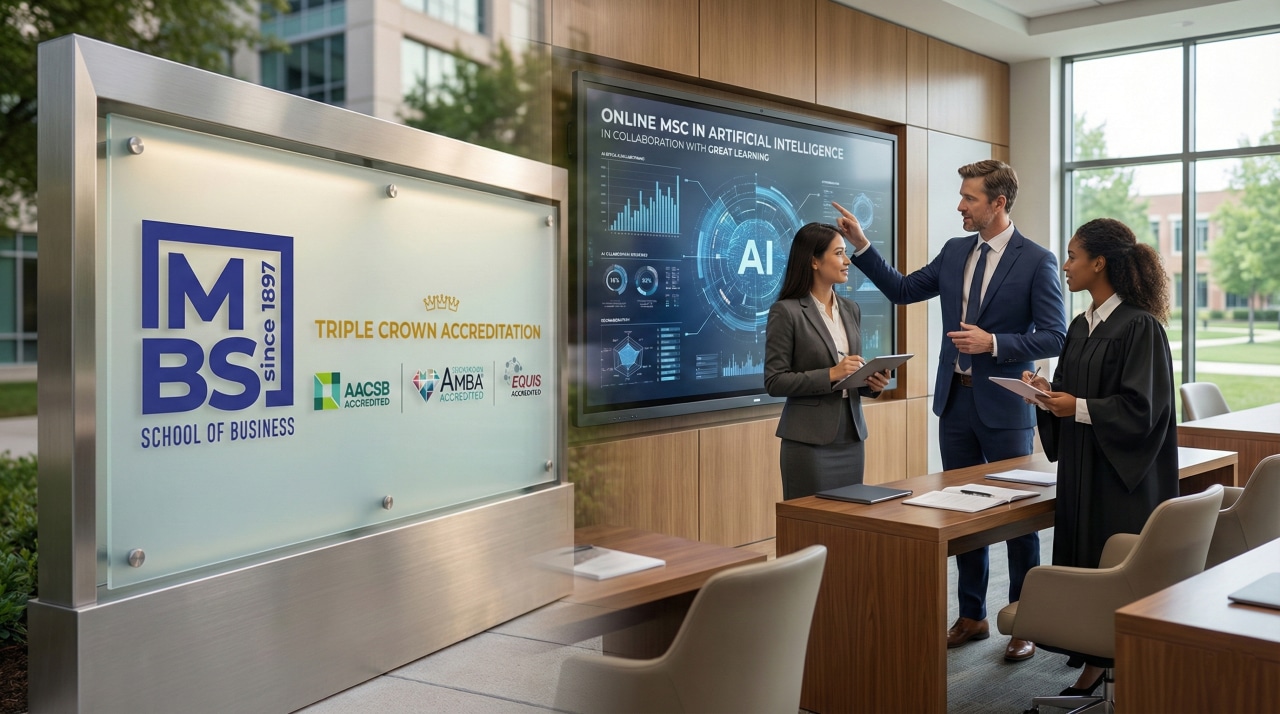
MBS Business School, a Triple Crown-accredited institution, in partnership with Great Learning, has launched the fully online Master of Science (MSc) Artificial Intelligence programme.
This programme is designed for working professionals across technical and business domains, aiming to bridge the growing skills gap in the $1.77 trillion global AI market.
The curriculum combines foundational knowledge in Python, Applied Statistics, and Machine Learning with advanced topics such as Generative AI, NLP, and AI strategy.
Learners will gain hands-on experience with industry-standard tools, preparing them to drive innovation, implement AI solutions at scale, and secure high-impact leadership roles in the rapidly evolving digital economy.
About the Master of Science (MSc) in Artificial Intelligence Programme
MSc in Artificial Intelligence
Gain advanced AI mastery, apply industry-ready skills, and achieve career growth through hands-on projects and dual credentials.
This 2-year, fully online programme is specifically designed to equip working professionals with advanced, research-driven AI expertise.
The curriculum follows a rigorous progression, starting with the foundations of Python and Applied Statistics before advancing into Machine Learning and Generative AI.
To bridge the gap between theory and real-world application, students master industry-standard tools such as TensorFlow, Keras, LangChain, and ChatGPT throughout the journey.
The programme’s defining characteristic is the elite global standing of its awarding body, Montpellier Business School (MBS). Founded in 1897, MBS is a prestigious French Grande École recognized for academic excellence and a deep commitment to ethical and responsible leadership.
As a Triple Crown-accredited institution, holding simultaneous recognition from AACSB, EQUIS, and AMBA, MBS belongs to the top 1 percent of business schools worldwide.
This prestigious status ensures that graduates earn a degree that is respected across borders and remains highly aligned with global industry demands.
- AACSB (Association to Advance Collegiate Schools of Business): Held by less than 5% of business schools globally, this accreditation is the gold standard for quality in business education, recognising institutions that demonstrate excellence in teaching, research, and curriculum development.
- EQUIS (EFMD Quality Improvement System): Awarded by the European Foundation for Management Development to less than 1% of schools, EQUIS accredits institutions that evidence high academic standards, robust research capabilities, and a strong connection with the corporate world.
- AMBA (Association of MBAs): Focusing on the quality of postgraduate management education, AMBA accreditation is held by fewer than 2% of MBA programmes worldwide and evaluates faculty academic standing and programme content.
For learners, this Triple Crown status provides assurance that their degree is respected across borders and industries, reflecting a curriculum that is not only academically sound but also ethically grounded.
Designed for the Modern Professional
Recognising the time constraints faced by today’s workforce, MBS School of Business and Great Learning have structured this MSc to be flexible yet rigorous.
- 100% Online Delivery: This two-year MSc is delivered entirely online, offering learners the flexibility to manage studies alongside full-time professional responsibilities.
- No GRE/GMAT Requirement: Admissions are based on academic background and professional motivation, removing the need for standardised test scores and widening access for experienced professionals.
- Live Masterclasses: In addition to self-paced learning, participants gain access to live masterclasses led by MBS faculty, providing direct academic engagement and expert guidance.
Who Should Enrol?
This programme is designed to support professionals at different stages of their careers:
- Early-Career Professionals: Individuals seeking to transition into data-driven roles, with a focus on building strong foundations in applied mathematics and practical AI skills.
- Mid-Career Professionals: Practitioners aspiring to roles such as Data Scientist or Business Analyst who require deeper technical and analytical expertise.
- Senior Professionals: Consultants and functional leaders aiming to apply AI strategically to drive innovation and informed decision-making within their organisations.
What You Will Learn?
The two-year curriculum is structured to guide learners from foundational programming to strategic leadership in AI.
It avoids being purely theoretical by integrating industry-standard tools and languages, such as Python, TensorFlow, Keras, and LangChain, directly into the learning experience.
Year 1: The Technical Foundation
The first year begins with teaching Python for AI and Machine Learning, enabling learners to master syntax, object-oriented programming concepts, and essential data science techniques.
The programme then advances to Applied Statistics, equipping professionals with evidence-based analytical skills to validate data-driven insights. The core areas of focus are
- Supervised and Unsupervised Learning: Exploration of regression, classification, clustering, and dimensionality reduction, with guidance on selecting appropriate algorithms for specific datasets.
- Ensemble Techniques: Study of methods that combine multiple models to enhance predictive accuracy.
- Computer Vision & Natural Language Processing (NLP): Hands-on work with Convolutional Neural Networks (CNNs) for image analysis and NLP techniques for text processing, progressing to advanced sequential models.
- Generative AI & Large Language Models (LLMs): In-depth coverage of Generative AI, prompt engineering, and the technology stack behind tools such as ChatGPT, including transformer models.
Year 2: Strategic Leadership and Application
While Year 1 builds AI capabilities, Year 2 focuses on managing and leveraging AI within organisations. The curriculum emphasises business strategy, leadership, and ethical considerations.
- AI Strategic Management: Formulation of business strategies for AI adoption, leading digital transformation, and overseeing governance frameworks.
- AI-Based Value Creation: Harnessing Big Data to optimise customer experiences, develop new business models, and generate measurable business impact.
- Leading Technical Teams: Skills for managing data science teams, including project management, cross-functional collaboration, and communication within technology-driven environments.
- Ethical AI & Sustainability: Examination of ethical frameworks, GDPR compliance, algorithmic bias, and the societal implications of AI deployment, reflecting MBS’s commitment to responsible leadership.
How You Will Learn?
The programme includes over 12 hands-on projects and more than 30 case studies with 10+ industry-standard languages and tools, including Python, TensorFlow, Keras, Statsmodels, ChatGPT, LangChain, and Hugging Face, ensuring that theoretical knowledge is translated into job-ready skills.
Some of the specific case studies included in the programme are:
- Renewind (Energy Sector): Learners analyse equipment health data from a wind energy provider. Using TensorFlow and Artificial Neural Networks, they build models to predict component failures, enabling proactive maintenance and cost reduction.
- Stock News Sentiment Analysis (Finance): In this project, learners develop an AI system that processes news articles to gauge market sentiment. Leveraging Transformers and Large Language Models (LLMs), the system summarises updates to help analysts optimise investment strategies.
- EasyVisa (Immigration Services): To facilitate visa processing, learners build a predictive model using Random Forest and Gradient Boosting techniques. The model analyses applicant data to identify factors influencing decisions, streamlining approvals and denials.
- FoodHub Order Analysis (F&B): Using Python, Pandas, and Seaborn, learners perform exploratory data analysis for a food aggregator to understand demand patterns across restaurants and cuisines, directly impacting business performance.
The programme concludes with 2 Capstone Projects, in which learners tackle a real-world business challenge, devise an AI strategy, and demonstrate the practical application of the skills acquired throughout the programme.
Post-Completion Benefits and Access
Graduating from this programme grants learners more than just a certificate; it grants entry into an exclusive global community and unlocks the following benefits:
- Dual Credentials: Upon successful completion, learners earn a Master of Science (MSc) degree in Artificial Intelligence from MBS Business School and a globally recognised certificate in AI and Machine Learning: Business Applications from the McCombs School of Business at The University of Texas at Austin.
- Global Career Opportunities: Graduates gain exclusive access to the MBS recruitment platform, which features job opportunities updated weekly from around the world.
- Lifelong Knowledge Access: Alumni retain permanent access to a database of over 3 million books and articles, supporting continuous professional development long after graduation.
- Digital Connection Hub: Through the eCampus Portal, graduates can stay connected for resources, updates, and ongoing engagement with the institute community.
- Global Alumni Network: Learners gain access to an extensive alumni network of over 24,000 professionals, supporting career progression, professional networking, and global exposure.
Learning Outcomes
By the end of the curriculum, learners will have developed the expertise to:
- Design and Deploy Scalable Models: Gain the ability to design, implement, evaluate, and deploy robust AI, Machine Learning, and deep learning models capable of operating at scale.
- Build Generative AI Solutions: Construct practical solutions using Python tailored to diverse industry use cases.
- Create Recommendation Systems: Master both the theoretical principles and practical techniques required to build and apply sophisticated recommendation engines.
- Ensure Ethical and Compliant Governance: Apply critical ethical frameworks and regulatory standards, such as GDPR, to ensure the responsible deployment and governance of AI systems.
- Optimise Data Representations: Develop and evaluate advanced data representation techniques to achieve optimal predictive performance.
These outcomes equip learners with the practical skills and strategic insight to drive AI initiatives and deliver measurable impact in real-world business environments.
Next Step
The admissions process for this programme is straightforward and supportive. Prospective learners with a bachelor’s degree (or equivalent) in any discipline and proficiency in English can complete an online application.
A key requirement for applicants is proficiency in English reading and writing. As the medium of instruction for this programme is English, candidates who hold degrees from non-English speaking institutions are required to submit a valid English Proficiency Test (EPT) score.
The Admissions Team will then review applications through a pre-screening and assessment process, and successful candidates will receive an acceptance letter. Enrollment is confirmed upon payment of the programme fee, securing your place in this transformative MSc in Artificial Intelligence.