
The transition from 2025 to 2026 marks a definitive shift where upskilling is no longer a peripheral activity but a foundational professional requirement.
As the How India Upskilled in 2025 report demonstrates, the movement from early adopters to core career professionals actively investing in structured upskilling for a secure future in this AI-powered era reflects a structural transformation in workforce priorities and long-term career planning.
For individuals entering 2026, leadership will be defined by the ability to move beyond tool-based proficiency toward end-to-end capability.
The statistics and data below from Great Learning's own enrollments suggest that the upskilling wave of the previous year has established a new baseline for what constitutes a "job-ready" professional: measurable, application-driven expertise aligned with evolving industry demands.
To understand how this new benchmark is reshaping careers, let us examine the key domains, trends, and data points driving this transformation.
The Core Domains Driving Career Growth
The 2025 year established a clear hierarchy of technical domains that now define leadership expectations for 2026.
Professionals who built expertise in these areas during 2025 are better positioned to create measurable impact and sustain career growth in an environment where AI-led programs continue to dominate professional enrolments.
1. Artificial Intelligence and Machine Learning
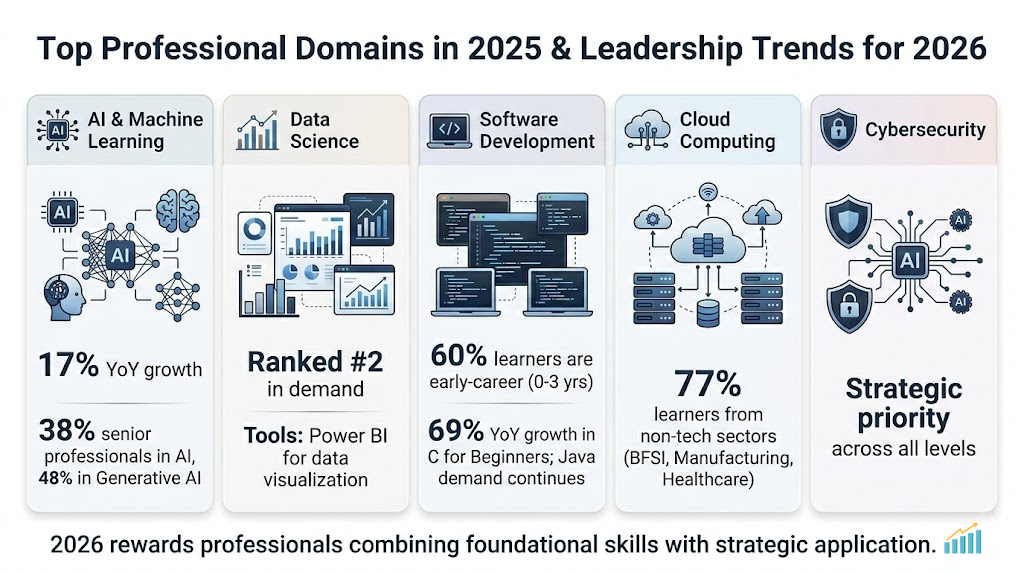
As the most in-demand domain of 2025 with a 17% Year-on-Year growth in popularity, AI and ML have evolved from niche skills into core professional capabilities. Leadership in 2026 requires moving beyond basic tool usage to developing end-to-end AI and Generative AI expertise.
This shift was strongly influenced by senior professionals with over 15 years of experience, who represented 38% of AI and ML enrolments and 48% of Generative AI enrolments.
To capitalize on this momentum and transition from foundational awareness to enterprise-ready capability, professionals can leverage the IIT Bombay Certificate in Generative AI.
IIT Bombay Certificate in Generative AI
Learn Generative AI from IIT Bombay. Build hands-on skills in LangChain, LLMOps, and Agentic AI. Apply now!
Designed and delivered by IIT Bombay faculty, this 5-month online certificate uses a hands-on, LLM-first approach specifically for software professionals, data scientists, product managers, and tech consultants.
It empowers you to design reliable workflows, adapt foundation models to enterprise data using Retrieval-Augmented Generation (RAG), and build agentic applications that coordinate multi-step business tasks.
Through practice with over 12 AI tools and a focus on LLMOps, privacy, and security, you will gain the exact skills needed to confidently evaluate, deploy, and monitor dependable Generative AI systems in real-world environments.
2. Data Science
Ranking second, Data Science attracted learners at all experience levels, from freshers to professionals with more than 15 years of experience. In 2026, the ability to extract actionable insights through data visualization, highlighted by the popularity of tools such as Power BI, will be essential for leadership roles across both technology and non-technology sectors.
For those looking to establish a robust foundation in this domain, especially early-career professionals aiming to accelerate their career, the PG Program in Data Science (with Specialization in Gen AI) offers an immersive and structured pathway to mastery.
Gain in-demand skills with a Data Science and Engineering course tailored for tomorrow’s tech leaders.
Delivered in a 5-month classroom format by Great Lakes Executive Learning, this program provides a face-to-face, personalized learning experience tailored for final-semester students and recent graduates with 0-3 years of experience.
You will tackle industry-like data science problems through a hands-on capstone project under the weekly mentorship of industry experts.
Supported by extensive placement assistance, including CV reviews and interview preparation, this program equips you with the technical depth and career momentum to thrive in high-growth data roles.
3. Software Development
Primarily driven by early-career professionals with 0 to 3 years of experience, who accounted for 60% of learners in 2025, Software Development continues to set strong technical standards.
The 69% Year-on-Year growth in C for Beginners and the sustained demand for Java Programming underline the importance of solid coding fundamentals for leaders managing modern development teams in 2026.
4. Cloud Computing
Recognized as a leading domain in 2025, Cloud Computing remains the backbone of the digital economy. Leadership in 2026 will require guiding the transition of professionals, particularly the 77% of learners from non-technology industries such as BFSI, Manufacturing, and Healthcare, toward cloud-enabled operational frameworks.
5. Cybersecurity
As one of the top five domains in 2025, Cybersecurity has become a strategic priority for professionals at all levels. In 2026, this emphasis translates into a leadership responsibility where security is embedded across functions, ensuring organizational resilience in an increasingly AI-driven and interconnected environment.
In summary, the patterns observed in 2025 clearly indicate that 2026 will reward professionals who combine foundational expertise with strategic application.
Mastery across AI, Data, Software, Cloud, and Cybersecurity is no longer optional but central to sustained career progression and organizational leadership in a technology-driven economy.
Senior Leadership and the Expansion of Technical Skills
A defining trend from 2025 that will shape leadership expectations in 2026 is the proactive upskilling of senior professionals with over 12 years of experience.
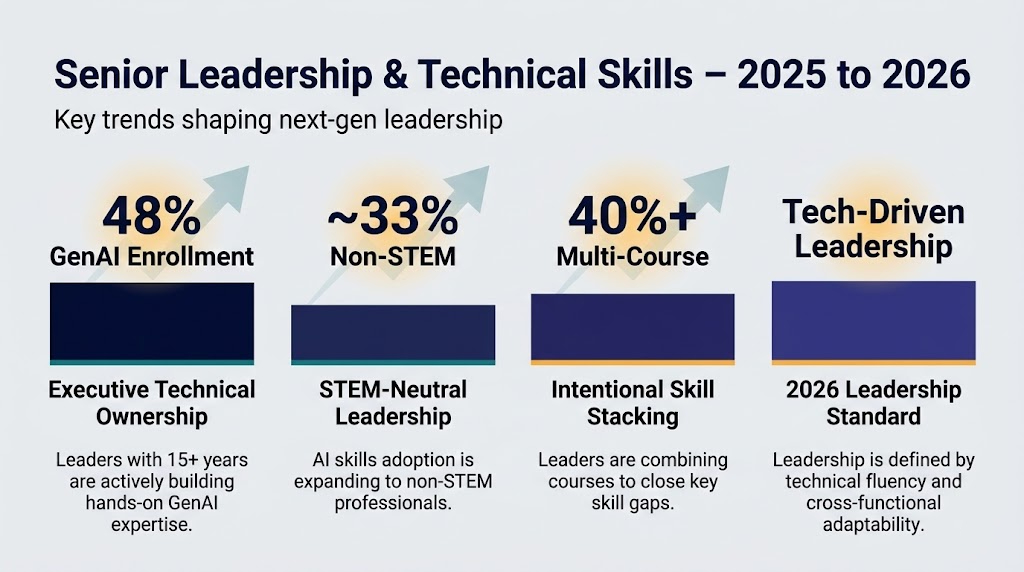
This group is no longer limited to overseeing technical teams; it is now actively building expertise in GenAI, AI, and ML. As a result, executive-level technical fluency is becoming a core leadership requirement in 2026.
1. Executive Technical Ownership
Senior professionals with more than 15 years of experience represented 48% of GenAI enrolments in 2025. This indicates that leadership in 2026 will be characterized by direct involvement with advanced technologies rather than high-level supervision alone.
2. STEM Neutral Leadership
Nearly one-third of AI learners in 2025 came from non-STEM academic backgrounds. This trend highlights that leadership pathways in 2026 are accessible to professionals who can successfully integrate their domain expertise with emerging technologies, regardless of their original field of study.
3. Intentional Skill Stacking
More than 40% of learners enrolled in multiple courses during 2025, demonstrating a focused approach to capability building. In 2026, effective leaders will adopt a similar strategy by combining short, application-oriented programs to close specific organizational and skill gaps.
Collectively, these trends indicate that 2026 leadership will not be defined solely by tenure or designation, but by measurable technical understanding, cross-functional adaptability, and a structured approach to continuous learning.
Leaders seeking to build this deep technical ownership and drive organizational transformation can achieve this through the IIT Bombay e-Postgraduate Diploma (ePGD) in Artificial Intelligence and Data Science, which provides the academic rigor necessary for strategic decision-making.
IIT Bombay ePGD in AI & Data Science
Master AI and data analytics with IIT Bombay's e-Postgraduate Diploma. Build hands-on skills to advance your career.
Moving beyond typical short-term, tool-based courses, this 18-month online ePGD offers a rigorous, credit-based academic structure taught by IIT Bombay faculty. It focuses on conceptual depth, research orientation, and real-world application.
You will master essential tools like Python, PyTorch, and Hugging Face while working on industry-focused projects such as predicting credit card defaults and building business applications using language models.
Non-Tech Industries Keeping Pace with Change
One of the most important signals from 2025 for career strategy in 2026 is the clear shift in upskilling momentum beyond the traditional IT and ITES ecosystem.
A substantial 77% of learners in 2025 were from non-technology industries such as BFSI, Energy, Manufacturing, and Healthcare.
This indicates that leadership opportunities in 2026 will expand rapidly within conventional sectors undergoing digital and AI-led transformation rather than remaining concentrated in core technology companies.
- Non-Tech Majority Influence: The 77% participation rate signals that career growth in 2026 will depend on applying digital skills to operational, financial, and industrial systems rather than remaining within core tech roles.
- Broad Industry Upskilling Demand: BFSI, Energy, Manufacturing, Pharma, and Healthcare have become key centers of digital capability building. Leadership roles will increasingly focus on embedding AI, data, cloud, and security into core business functions.
- Transformation Focused Leadership: With most learning occurring outside IT and ITES, 2026 leaders must act as internal transformation drivers who align technology initiatives with business outcomes and modernize legacy systems.
- Application Driven Skill Use: The emphasis on practical, application-led learning highlights a 2026 expectation that technical knowledge must directly improve efficiency, decision making, and measurable performance.
Freshers and the New Entry Level Standard
Data from 2025 indicates that 48% of total upskilling enrolments came from professionals with 0 to 3 years of experience. This strong early-career participation has redefined entry-level expectations for 2026.
A traditional degree alone is no longer adequate, as many freshers now enter the workforce with specialized certifications in Software Development, Data Science, and Cybersecurity.
1. Junior Specialization:
Early-career professionals accounted for 60% of Software Development learners in 2025, intensifying competition at the entry level in 2026. Employers now expect junior candidates to demonstrate focused technical expertise from the outset.
2. Dual Spectrum Demand:
Fields such as Data Science and Cybersecurity attracted both freshers and professionals with over 15 years of experience. This creates a 2026 environment where entry-level and senior talent operate within the same technical frameworks and tools.
3. Continuous Learning Mindset:
With a 48% participation rate, the 0 to 3-year cohort has emerged as the most proactive in upskilling. Their commitment to continuous learning establishes a benchmark that mid-career professionals must meet to remain competitive.
Overall, the entry-level standard in 2026 is defined by specialization, practical exposure, and adaptability. Freshers are no longer preparing for the future of work; they are entering it with advanced, job-aligned capabilities from day one.
Conclusion
The 2025 upskilling data provided by Great Learning serves as a roadmap for 2026 professional excellence. Leadership in this new era requires a blend of AI/ML mastery, industry-specific technical application, and a commitment to continuous skill stacking.
As upskilling moves to a core requirement, the professionals who will lead in 2026 are those who have already transitioned from viewing technology as a "tool" to viewing it as a "core capability".