
- The Immediate Answer: Why is Artificial Intelligence ROI Lagging?
- Are Companies Actually Achieving Positive Financial Returns in 2026?
- The Unique Challenges of Enterprise Implementation
- The Truth About "Soft ROI" vs. "Hard ROI"
- Top AI Strategies for High ROI Deployments
- Essential Metrics and KPIs You Should Track First
- Practical Steps to Maximize Your Investment Today
- How to Leverage Proven Technologies Over Speculative Trends
- Conclusion
Are you wondering if the current corporate obsession with artificial intelligence is mostly smoke and mirrors?
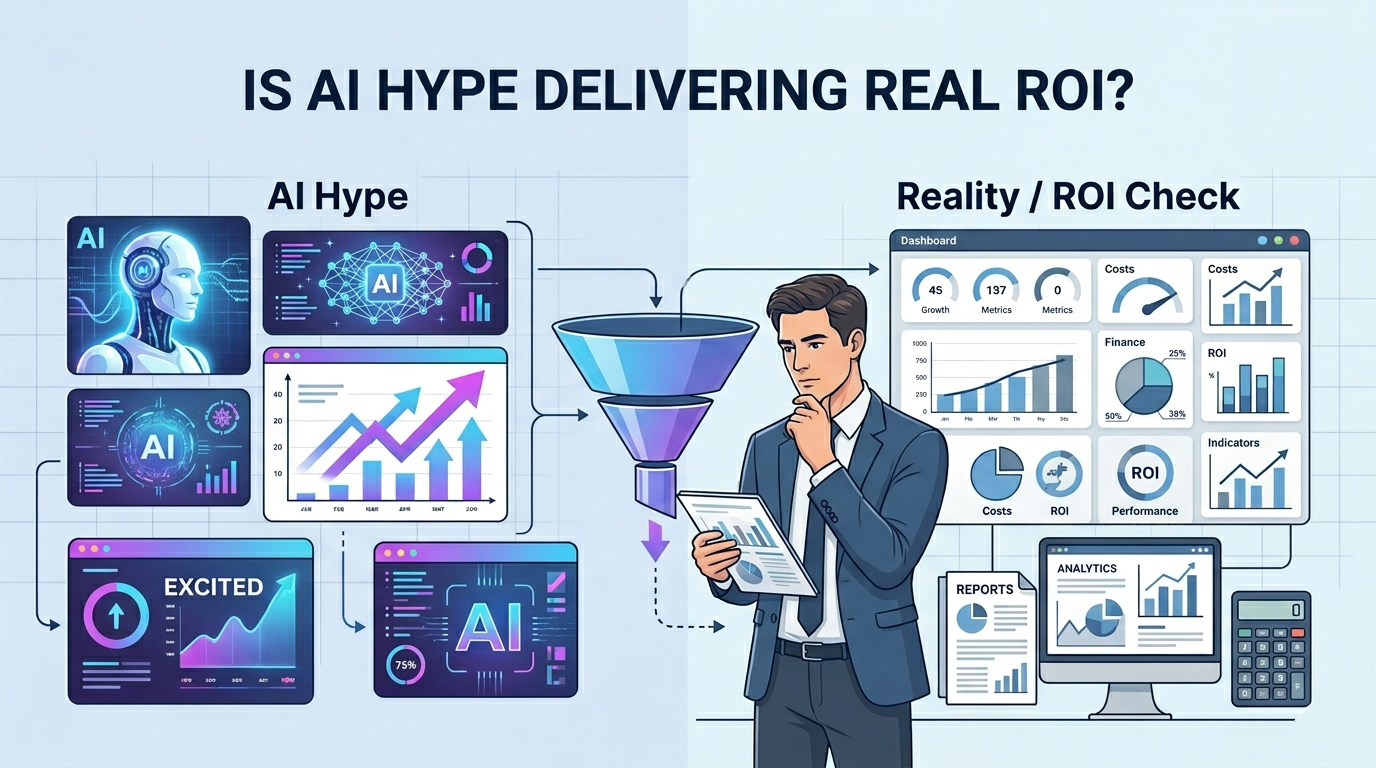
The answer is yes, many companies are indeed overhyping their immediate AI adoption while struggling to demonstrate a real return on investment (ROI).
While global spending on artificial intelligence is projected by Gartner to reach a staggering $2.52 trillion in 2026, actual financial returns remain largely elusive for the average enterprise. In fact, recent IBM executive studies show that only about 25% of enterprise AI initiatives actually deliver their expected ROI.
The Immediate Answer: Why is Artificial Intelligence ROI Lagging?
The most critical thing to understand is that buying AI technology does not instantly create business value. It is about fundamentally rethinking workflows, infrastructure, and data management.
Many executives purchase expensive algorithms expecting immediate automated magic, only to face severe operational bottlenecks. When an organization rushes into technology adoption, they often ignore the foundational data work required.
They expect generic large language models to instantly solve complex, highly specific corporate problems. This disconnect between expectation and reality is why the technology currently sits in a phase of disillusionment.
However, this does not mean the technology is useless. It simply requires a much more disciplined, mature approach to yield sustainable financial results.
To help build this essential technical foundation, the AI Data Management course offers a free, comprehensive look at how to structure and govern the data that powers successful AI systems.
Are Companies Actually Achieving Positive Financial Returns in 2026?
The global technology sector is seeing record-breaking capital expenditures, yet the payback periods are much longer than anticipated. Traditional software investments usually show reliable returns within a few months.
However, Deloitte's recent global survey reveals that most executives now expect a two-to-four-year wait before seeing a satisfactory payoff on a typical AI use case.
Here is what the current financial data shows for enterprise AI adoption:
- Payback periods are extended: Only 6% of companies report achieving full financial payback from their AI investments in under a year.
- Scaling is extremely difficult: While experimental pilot programs are everywhere, only 16% of enterprise initiatives are successfully scaled company-wide.
- Expectations are correcting: Executives are shifting away from flashy generative experiments and prioritizing proven, practical applications that solve specific operational issues.
- Infrastructure costs dominate: Building technical foundations alone will drive a massive 49% increase in spending on AI-optimized servers throughout 2026.
The Unique Challenges of Enterprise Implementation
Real-world deployments of artificial intelligence frequently encounter data silos, security risks, and massive skills gaps. Fixing these internal problems requires deep organizational change rather than just installing better software.
Consider these specific areas where corporate AI initiatives naturally stall:
- Poor Data Readiness: Nearly 38% of IT leaders cite poor data quality or limited data availability as a direct cause of project failure.
- Skill Shortages: Companies lack internal talent who can properly manage ModelOps and ensure algorithms run efficiently after deployment.
- Lack of Executive Alignment: Automation initiatives fail when they operate as isolated side projects without full support from the core business units.
- Unrealistic Timelines: Leadership often expects software to immediately eliminate massive operational costs, leading to project abandonment when early results look modest.
To bridge this leadership learning gap, you can enroll in the online Post Graduate Program in Artificial Intelligence for Leaders from The University of Texas at Austin and Great Lakes Executive Learning.
Post Graduate Program in Artificial Intelligence for Leaders
Turn insights into action—use AI to make faster decisions, optimize teams, and lead digital transformation.
It equips you to master generative technologies and develop practical, industry-ready skills across the ecosystem without needing any prior programming experience. You will ultimately learn to scope, oversee, and guide successful implementations while driving intelligent business transformation within your organization
The Truth About "Soft ROI" vs. "Hard ROI"
Evaluating the success of a technology rollout requires looking beyond immediate profit margins. Organizations must balance explicit financial gains with intangible improvements to corporate health.
Focusing solely on immediate cost-cutting often blinds leadership to the broader organizational benefits. Understanding the difference between these two ROI categories is essential for maintaining momentum:
- Hard ROI: This includes direct financial returns, explicit operational cost savings, and measurable revenue growth from new AI-powered applications.
- Soft ROI: This encompasses benefits like increased employee morale, improved customer experience, and better adherence to corporate sustainability goals.
- Cycle Time Reduction: Tracking how much faster teams can process insurance claims or resolve IT tickets bridges the gap between soft efficiency and hard savings.
- Risk Mitigation: Avoiding legal fines and data breaches through automated compliance monitoring is a massive financial win that rarely shows up as top-line revenue.
Top AI Strategies for High ROI Deployments
You do not have to abandon your digital transformation goals to avoid the industry hype. The industry's top performers have created entirely new playbooks that prioritize discipline and data governance over chasing trends.
These leading strategies offer excellent financial stability and tremendous operational growth potential. Here are the top approaches that perfectly suit enterprises looking for real returns:
- Zero-Copy Architecture: The fastest path to ROI is avoiding costly data migration by using platforms that allow models to analyze data exactly where it already lives.
- Domain-Specific Agents: Instead of generic chatbots, deploy specialized AI agents trained exclusively on your industry's specific regulations and corporate workflows.
- Embedded Solutions: Integrate artificial intelligence directly into the systems and processes your employees already use daily, such as IT service management tools.
- Strategic Upskilling: Pioneering companies do not just buy tools; they mandate AI fluency training for their existing workforce to ensure high adoption rates.
- Hybrid Measurement: Successful firms explicitly use different measurement frameworks for tracking the returns of generative systems versus agentic systems.
For leaders ready to turn these high-level strategies into practical reality, the AI for Business Innovation: From GenAI to PoCs program provides the roadmap needed to move from experimental concepts to scalable business results.
AI for Business: From GenAI to POCs
Learn how AI drives business innovation, from GenAI to POCs. Gain practical skills to implement AI solutions and lead in your industry.
Essential Metrics and KPIs You Should Track First
When transitioning your enterprise into an automated model, do not try to measure everything at once. You must focus your limited tracking resources on the indicators that provide the most accurate picture of business impact.
Avoid getting bogged down in vanity metrics like the sheer number of text prompts generated by staff. Prioritize tracking the following core KPIs:
- Direct Financial Return: Measure the exact revenue growth generated by new product development cycles or intelligent recommendation engines.
- Operational Cost Savings: Track the explicit reductions in external vendor costs or manual labor hours resulting from workflow automation.
- Customer Satisfaction Scores: Monitor NPS and CSAT improvements directly linked to faster, AI-assisted support resolution times.
- Error Reduction Rates: Calculate the money saved by utilizing algorithms to minimize human error in data entry or financial compliance monitoring.
Practical Steps to Maximize Your Investment Today
Starting a massive technological overhaul can feel overwhelming to any corporate board. However, breaking the implementation process down into manageable, highly targeted steps makes it highly achievable.
Start by focusing on core operational bottlenecks rather than attempting to reinvent your entire business model overnight. Follow these actionable steps to start your disciplined technology journey:
- Identify Quick Wins: Launch low-effort, high-impact projects first to build internal credibility and demonstrate early financial momentum.
- Audit Your Data: Before buying new algorithms, invest time in cleaning your corporate databases and establishing strict information governance policies.
- Celebrate Feedback: Encourage stakeholder input during early rollouts to quickly identify what works and eliminate ineffective automated processes.
- Build Cross-Functional Teams: Ensure your technology leaders and business executives co-own the strategy to prevent isolated, useless pilot programs.
How to Leverage Proven Technologies Over Speculative Trends
When evaluating new software vendors, you must frame your purchasing criteria correctly. Do not hide your demand for strict data security and proven use cases from aggressive sales representatives.
Instead, clearly highlight how your organization requires immediate integration with the existing enterprise infrastructure. Use these strategies when selecting enterprise software tools:
- Demand Proof of Value: Require vendors to show validated case studies from your specific industry, not just general capability demonstrations.
- Focus on Security: Prioritize platforms that offer robust, fit-for-purpose guardrails and maintain strict compliance with global data privacy regulations.
- Evaluate Total Cost of Ownership: Look past the initial licensing fees and carefully calculate the long-term costs of computing power, data storage, and staff training.
- Start Small and Iterate: Introduce new capabilities in small stages to prevent employee fatigue and reduce the massive financial risk of broad rollouts.
Conclusion
Companies are absolutely overhyping the immediate returns of artificial intelligence, but the long-term value remains incredibly real. The technology industry requires mature business leaders who can look past the excitement and implement strategic, data-driven transformations.
You can gain massive competitive advantages by prioritizing data readiness, robust security, and comprehensive employee training over flashy, unproven tools. Your long-term profitability will increase significantly when you treat artificial intelligence as a core organizational shift rather than a quick software fix.
The upcoming years will bring the highest financial rewards to organizations that choose strict operational discipline over industry hype.