
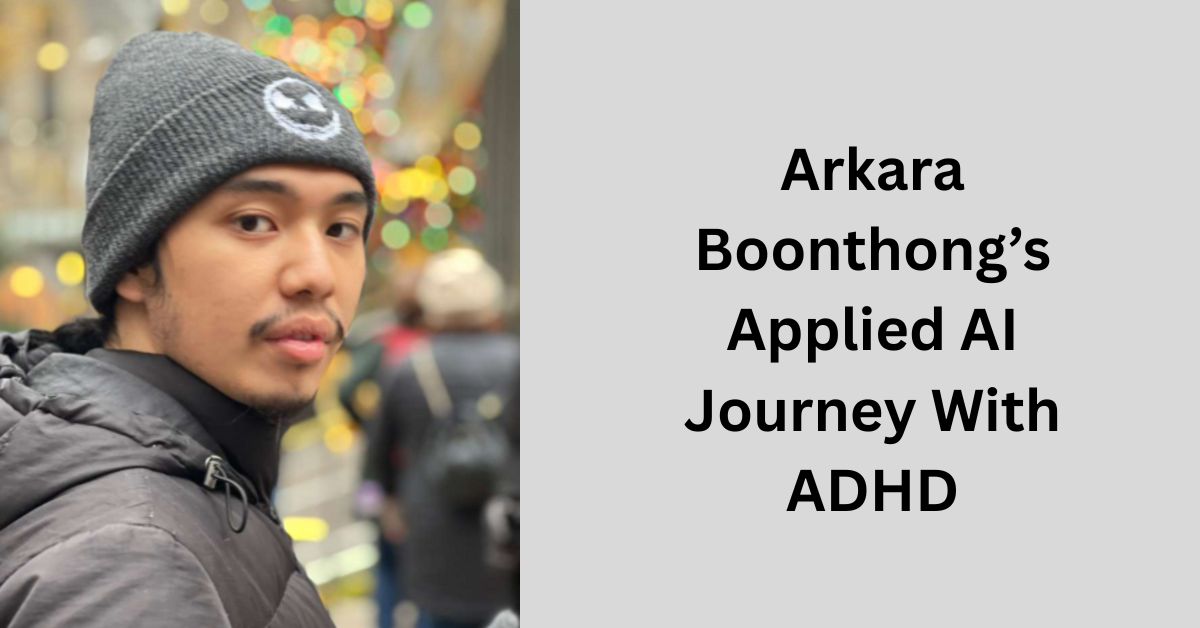
Arkara Boonthong has always lived at the intersection of science and art. Raised, as he puts it, “by both the microscope and the paintbrush,” his path has consistently bridged logic and imagination through curiosity. His ADHD has shaped the way he engages with ideas, fueling exploration, creative depth, and a natural drive to understand how things work beneath the surface. From an early age, he was drawn to places where structure and creativity coexisted. Over time, he began looking for a way to bring greater clarity and intention to that way of thinking, without losing the creativity that defined it.
A Creative Foundation Shaped by Experience
Arkara’s understanding of design took shape through lived experience. Wandering through museums like the MoMA and the Guggenheim, he learned that art is not just something to observe, but something to engage with. These places revealed how light, texture, and structure could tell stories, and how design shapes the way people move, feel, and remember.
That understanding became more personal during a visit to Disney World. Being inside immersive environments where storytelling, architecture, sound, and movement worked together showed him how design could make imagination tangible. “That moment became my compass to create experiences people can feel, not just see,” he shares. With a background in Mechanical Engineering and Integrated Design and Media from NYU Tandon, Arkara learned to move comfortably between technical rigor and creative expression.
This philosophy carries through his work as the Founder and Creative Director of his own studio, which he has led since 2019. Based in New York, the studio is devoted to hand-crafted dolls, fashion design, and immersive miniature worlds. It serves as a space where fantasy, narrative, and artistry come together, reflecting his deep commitment to narrative thinking, visual design, and human connection.
A Step Toward Deeper Technical Insight
As his creative work evolved, Arkara wanted a stronger analytical foundation to support it. He joined the Applied AI and Data Science Program by MIT Professional Education to strengthen the technical side of his work. He shares, “I’ve always been curious about how things function behind the scenes, and I wanted to understand how models learn, how data shapes decisions, and how AI can be used responsibly and imaginatively.”
The program’s structured learning path helped him approach complex concepts step by step, covering statistics and Python, Deep Learning, Recommendation Systems, and the foundations of Generative AI. One of his biggest challenges was not the pace or the coding itself, but adjusting his creative, exploratory ADHD brain to a highly structured, logic-heavy environment.
“I was used to working through intuition, emotion, and exploration. This program required precision, logic, and sticking to formulas and frameworks,” he shares. What initially felt like a clash gradually expanded the way he approached problem-solving. “Instead of shutting the creative part of myself down, I learned to let my creativity inform how I approached problems, and to let the program’s structure sharpen how I approach them.”
Mentored learning sessions and the built-in AI assistants supported this shift throughout the program. “Having real humans and AI tools to ask questions, clarify concepts, and troubleshoot made the material feel accessible, collaborative, and even enjoyable,” he reflects.
Finding Structure Without Losing Creativity
As Arkara progressed through the program, the technical foundation he built began to support his creative work more clearly. Learning how data, models, and AI systems function gave him the structure he needed to approach creative ideas with greater confidence and intention. Rather than changing how he thinks creatively, the program helped him strengthen it with clarity and discipline.
Today, he applies this balance of structure and imagination in his work across creative technology and experience design. With a stronger understanding of how AI can be used responsibly and thoughtfully, he feels better equipped to create work that is both technically sound and emotionally meaningful. For Arkara, design remains closely tied to empathy and care, focused on helping people feel seen, understood, and inspired.