

- The Barriers Prevent Leaders from Focusing on Strategic Decision-Making
- Understanding AI’s Role in Leadership Contexts
- AI in Leadership: Task VS. Decision Automation
- Key Differentiators for leaders
- How AI Streamlines Work for High-Impact Decisions?
- Challenges and Risks Leaders Must Navigate
- Building an AI-Ready Leadership Culture
- Conclusion
Managerial effectiveness has long been a fundamental principle of effective management; however, many leaders continue to be constrained by the operational noise of day-to-day activities.
The integration of artificial intelligence into leadership workflows presents a strategic solution to this challenge by systematically automating routine processes with precision and consistency. AI automation in leadership represents a shift from manual oversight to strategic orchestration.
This blog examines the practical applications of AI in streamlining standard tasks and highlights how this transformation enables leaders to redirect their efforts toward long-term strategic managment and high-impact decision-making.
The Barriers Prevent Leaders from Focusing on Strategic Decision-Making
- Administrative Overload:
The burden of "busy work" is heavier than ever. According to a 2025 Deloitte Global Human Capital Trends report, leaders and employees spend approximately 41% of their workday on tasks that do not contribute to the organization's core value. This includes manually tracking approvals, aggregating data for reporting, and navigating fragmented scheduling across multiple platforms.
- Fragmented Information & Cognitive Drag:
Strategic thinking requires deep, uninterrupted focus, yet the tools designed to help often do the opposite. Research highlights that workers spend an average of 257 hours annually simply navigating inefficient processes. When a leader has to jump between 10+ apps to find one piece of information, the resulting "context switching" can reduce productive time by up to 40%.
- The Scalability Gap in Human-Only Workflows:
There is a physical limit to how much information a human can process. McKinsey’s 2025 research suggests that currently available technologies could automate roughly 57% of work hours.
Understanding AI’s Role in Leadership Contexts
For a leader, AI serves two distinct but complementary purposes:
- Automation:
Taking over the "doing." This involves high-volume, repetitive tasks where consistency and speed are paramount. According to Deloitte’s 2026 State of AI report, 66% of organizations have already achieved significant productivity gains by implementing AI automation in leadership to handle routine workflows.
- Augmentation:
Enhancing the "thinking." This is where AI provides "decision intelligence," processing millions of data points to offer real-time insights that a human brain couldn't synthesize alone.
Moreover, a recent IBM study (January 2026)highlights that 79% of leaders expect AI to be a primary driver of revenue by 2030, largely through its ability to augment human judgment and intuition, helping leaders to make faster, more informed decisions, anticipate risks, and focus on high-value strategic initiatives rather than day-to-day operational tasks.
However, with only 1% of leaders considering their companies “mature” in AI deployment, most organizations are underutilizing automation, leaving a significant opportunity to scale decision-making, improve efficiency, and unlock strategic value.
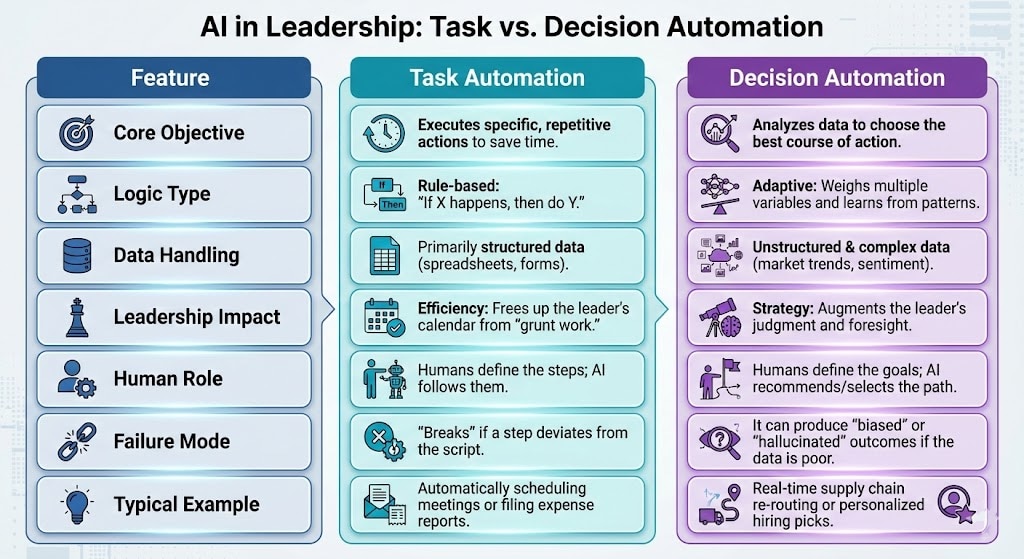
AI in Leadership: Task VS. Decision Automation
Key Differentiators for leaders
- Autonomy Levels: Task automation is essentially a digital assembly line. It follows a fixed sequence (e.g., an AI bot summarizing a Slack thread). Decision automation acts more like a digital consultant, providing a range of options or autonomously executing a choice based on probability and historical success.
- Operational vs. Strategic: Task automation is operational; it reduces the "cost of doing." Decision automation is strategic; it reduces the "risk of choosing."
- Scalability: While task automation scales by doing more volume, decision automation scales by increasing the complexity of problems a company can solve without increasing headcount.
With AI handling both execution and insight, leaders can focus on vision, impact, and long-term value creation.
To effectively lead this transition from operational oversight to strategic foresight, leaders must possess more than just a surface-level understanding of AI, and the Post Graduate Program in Artificial Intelligence for Leaders provides the precise strategic pathway to achieve this.
Developed in collaboration with the McCombs School of Business at The University of Texas at Austin and Great Learning, this program is specifically designed for leaders to leverage AI not as coders, but as strategic leaders. Here's how it helps:
Post Graduate Program in Artificial Intelligence for Leaders
Unlock strategic AI insights with the AI for Leaders course, designed to equip business leaders with practical skills to drive innovation.
- Master AI Without the Code:
The curriculum is tailored to help you understand, evaluate, and deploy AI without requiring programming expertise. You will gain "Decision Calculus" skills to prioritize Generative AI use cases based on business value rather than technical hype.
- Lead with Agentic AI:
Directly addressing the "Decision Automation" concepts discussed, the program features dedicated modules on Agentic AI for leaders. You will learn to conceptualize use cases where AI automation in leadership allows agents to automate your routine tasks, escalating only exceptions to leaders.
- Practical, Project-Based Application:
You will apply these concepts through hands-on projects, such as "Agentic AI-Driven Decision Orchestration" for enterprise operations. This project focuses on defining decision scope, autonomy levels, and human-in-the-loop design, critical skills for implementing responsible and scalable AI practices.
- Strategic Implementation & ROI:
Beyond theory, you will learn to build AI project roadmaps, calculate ROI, and assess "Build vs. Buy" scenarios. The program ensures you can oversee cross-functional AI teams and integrate AI into product and operational strategies to drive tangible business transformation.
By joining this program, you will gain the confidence to lead AI-driven initiatives that improve efficiency and competitiveness, backed by a certificate from a top-tier public university.
How AI Streamlines Work for High-Impact Decisions?
1. Executive Information Synthesis & Briefing Reports
Leaders are frequently inundated with extensive reports, industry analyses, and internal project updates. Manually reviewing these documents to identify the most critical insights is a time-intensive, low-value activity.
How AI Helps:
Rather than spending 45 minutes reading a 30-page report to identify a single risk factor, AI can provide a concise "Bottom Line Up Front" (BLUF). This enables leaders to allocate time to analyzing the implications of the risk with their team, rather than merely identifying it.
Implementation Steps:
Step 1: Establish an Insight Repository
Create a centralized, AI-powered document space (e.g., Adobe Acrobat AI Assistant, NotebookLM, or a customized ChatGPT solution) to store weekly reports, financial statements, and industry news.
Step 2: Utilize a Decision-Focused Prompt
Instead of requesting a generic summary, employ a prompt designed for leadership insights:
"Identify the top three risks, two missed opportunities, and one actionable decision from these documents. Highlight any contradictions between the reports."
Step 3: Automate Executive Synthesis
Implement a workflow (via Zapier or Make.com) to automatically compile all documents added to the "To Read" folder and deliver a one-page executive briefing to your inbox every Friday, ready for Monday morning review.
Step 4: Enable Deep-Dive Analysis
Leverage AI as a strategic sounding board. For example, if the summary notes a 5% dip in Q3 projections, prompt the AI:
"Which specific region is driving this decline, and how did it perform during the previous market correction?"
By automating routine information synthesis, leaders can focus on strategic priorities, make informed decisions faster, and drive meaningful business outcomes.
2 Autonomous Performance Intelligence & Predictive Dashboards
Modern leadership demands a shift from static reports to a dynamic, real-time data ecosystem. By automating the integration of fragmented data, organizations can eliminate time-intensive information retrieval and gain a forward-looking perspective.
How AI Helps?
This automation removes uncertainty and misalignment in decision-making. Rather than spending board meetings verifying data accuracy, leaders can focus on scenario planning and strategic foresight, transitioning from retrospective analysis to proactive navigation of potential challenges.
Implementation Steps:
Step 1: AI-Driven Data Consolidation
Use an AI integration layer such as Microsoft Fabric, Salesforce Data Cloud, or Polymer to unify disparate silos. Connect CRM (Sales), ERP (Operations), and HRIS (People) into a central hub. The AI automatically cleans and maps data for example, reconciling “Revenue” in Sales with “Invoiced Sales” in Finance without manual intervention.
Step 2: Real-Time Monitoring
Deploy AI-powered anomaly detection to continuously track key metrics. For example, monitor customer churn and subscription revenue. If churn exceeds a predefined threshold or revenue dips by two standard deviations from expected values, the AI sends an immediate alert, enabling leaders to act before issues escalate.
Step 3: Generating Predictive Insights
Transition from descriptive reporting to predictive analytics using machine learning. Apply models such as Random Forest, Gradient Boosting, or ARIMA to forecast churn trends and revenue.
Example Prompt:
"Based on the last six months of customer behavior and subscription data, what is the probability of exceeding our churn target next quarter? Identify the top three factors driving potential losses."
Step 4: Automated Narrative Reporting
Configure the system to generate a weekly predictive memo focused on the example:
- Traditional Report: Customer churn increased by 3% last week.
- AI-Enhanced Predictive Report: “Customer churn increased by 3% last week.
Predictive modeling indicates a potential 10% churn over the next six weeks in Segment A.
- Recommended action: Launch targeted retention campaigns for high-value customers immediately.
Step 5: Scenario-Based Decision Support
Use the predictive dashboard as a strategic sandbox. For instance:
"If we increase retention campaign spend by 20% for Segment A while maintaining current acquisition budgets, how will projected revenue and churn rates change over the next quarter?"
The AI recalculates in real time, enabling leaders to make informed, data-driven decisions within minutes.
By integrating predictive intelligence, machine learning, and real-time monitoring around a unified scenario, leaders gain a clear, forward-looking view of operations, allowing them to anticipate challenges, optimize resources, and make high-impact decisions with confidence.
3. Dynamic Resource Allocation & Capacity Forecasting
Approving a new high-priority initiative often involves uncertainty around workforce capacity.
Leaders frequently rely on subjective assessments or incomplete workload visibility, which can result in team burnout, missed deadlines, and the “feature factory” effect, where output volume is prioritized over sustainable delivery capacity.
How AI Helps?
AI introduces an objective, data-driven view of workforce capacity. It enables leaders to visualize the downstream impact of resource allocation decisions before they are made. This shifts leadership conversations from:
“Can we take this on?” to “What should we deprioritize to deliver this successfully?”
Implementation Steps
Step 1: Unify Work and Capacity Data
Integrate time-tracking and project management tools such as ClickUp, Linear, and Harvest into a centralized analytics layer. This establishes a reliable baseline by comparing actual delivery velocity against planned velocity for Engineering and Design teams.
Step 2: Predictive Capacity Modeling
Apply AI-powered capacity forecasting using tools such as Motion. Machine learning models (e.g., regression-based forecasting or gradient boosting) analyze historical task completion data to identify systematic estimation gaps.
Insight: The system learns that Engineering consistently underestimates development effort by approximately 20% and automatically adjusts future capacity projections for Project Alpha.
Step 3: Scenario-Based Planning
Before approving Project Alpha, run capacity simulations to evaluate trade-offs.
Example Prompt:
"Project Alpha requires 400 hours starting next month. Based on current Engineering and Design workloads, which option minimizes delivery risk: (a) pausing the ‘Legacy Refresh’ initiative, or (b) extending Project Alpha’s timeline by four weeks? Quantify schedule risk and capacity strain for both scenarios."
This allows leaders to make informed prioritization decisions grounded in quantified impact rather than assumptions.
Step 4: Burnout Risk Detection
Configure AI to monitor overutilization patterns across teams. If key contributors on Project Alpha exceed 120% capacity for three consecutive weeks, the system automatically flags the risk to leadership, enabling early intervention and protecting long-term team performance.
By combining predictive capacity modeling with scenario-based planning, leaders can allocate resources with confidence, ensuring strategic initiatives like Project Alpha are delivered without compromising team well-being or execution quality.
4. Intelligent Meeting Enablement & Accountability Loops
Leadership effectiveness often diminishes when senior leaders spend significant time following up on action items, clarifying verbal commitments, or reviewing meeting notes that lack strategic context. This execution gap reduces organizational speed and accountability.
How AI Helps?
AI transforms leadership meetings from informal conversations into structured, traceable execution inputs.
By automatically capturing decisions, assigning ownership, and tracking progress, leaders can focus on removing constraints rather than managing follow-ups.
The result is a clear, objective record of commitments that establishes accountability without micromanagement.
Implementation Steps
Step 1: Deploy AI Meeting Assistants with System Integration
Implement AI meeting assistants such as Fireflies.ai, Otter.ai, or Microsoft Teams Premium and integrate them directly with work management platforms like Jira or Asana.
For each Weekly Executive Sync, the AI captures decisions and links them directly to execution systems used by teams.
Step 2: Structure Outputs for Accountability
Move beyond raw transcripts. Configure the AI to structure meeting outputs using a formal accountability framework such as RASCI (Responsible, Accountable, Support, Consulted, Informed).
Custom Prompt:
"Review the Executive Sync transcript. Extract all finalized decisions. For each action item, assign a single Owner and a Due Date. If no date is specified, flag it as ‘TBD – Delivery Risk.’ Map each action to the relevant Q3 Strategic Pillar."
This ensures every discussion translates into an execution-ready outcome.
Step 3: Automate Follow-Up and Commitment Confirmation
Set up an automated workflow using Zapier or Make.com that triggers immediately after the meeting summary is generated. Assigned owners receive a personalized notification via Slack or Microsoft Teams:
"You have been assigned [Task] from the Executive Sync. Please confirm ownership and deadline in Asana."
This replaces manual follow-ups and ensures commitments are acknowledged in real time.
Step 4: Blocker and Execution Pattern Analysis
Before the next executive review, query the AI to analyze execution trends across recent meetings, focusing on systemic friction rather than individual performance.
Decision-Focused Prompt:
"Analyze the last four Executive Sync meetings. Which function has the highest number of carried-over action items? Identify the top three recurring blockers (e.g., legal review delays, budget approvals, cross-team dependencies)."
This enables leaders to address structural constraints and improve execution velocity across the organization.
By converting meetings into structured execution systems, leaders close the gap between intent and action, ensuring strategic decisions translate into measurable outcomes with speed, clarity, and accountability.
Challenges and Risks Leaders Must Navigate
| Challenge / Risk | Description | Strategic Mitigation |
| Over-reliance on AI Recommendations | Leaders may passively accept AI outputs without critical scrutiny, leading to "automation bias" where algorithm errors go unnoticed. | Enforce "Human-in-the-Loop" protocols. Require leaders to validate AI insights against intuition and external data before finalizing high-stakes decisions. |
| Bias, Transparency, & Explainability | AI models can perpetuate historical data biases or function as "black boxes" that offer conclusions without showing the logical derivation. | Mandate citation and auditing. Configure tools to cite sources (e.g., specific report pages). regularly audit outputs for demographic or operational bias. |
| Change Management & Employee Trust | Widespread automation can trigger workforce anxiety regarding job security, leading to resistance or sabotage of new tools. | Frame as augmentation, not replacement. Clearly communicate that AI is automating tasks, not roles. Invest in upskilling teams to manage these new systems. |
| Aligning AI with Organizational Values | AI optimizes for efficiency and math, not ethics. It may suggest cost-cutting measures that violate company culture or brand promises. | Implement "Value-Based" Constraints. embed core values into system prompts (e.g., "Prioritize long-term customer trust over short-term revenue spikes"). |
Building an AI-Ready Leadership Culture
The successful adoption of AI automation in leadership requires more than just software; it requires a cultural shift:
- Encouraging Experimentation And Continuous Learning:
Leaders must be supported to pilot AI initiatives, test new approaches, and learn from failures without fear. Continuous learning ensures leaders stay updated on evolving AI capabilities and limitations.
- Cross-Functional Collaboration Between Business And Tech Teams:
Effective AI adoption depends on close collaboration between leadership, domain experts, and technical teams. This alignment ensures AI solutions address real business problems rather than becoming isolated technical projects.
- Investing In Upskilling Leaders And Managers:
Leaders need foundational AI literacy to interpret insights, ask the right questions, and make informed decisions. Upskilling programs help managers move beyond intuition to data-informed leadership.
- Creating Feedback Loops Between AI Systems And Leadership Outcomes:
Regular feedback helps refine AI models and ensures their outputs remain relevant and aligned with strategic objectives. Leaders play a critical role in evaluating outcomes and guiding continuous improvement.
Conclusion
The future of leadership is not about doing more, but about deciding better. AI enables leaders to step away from operational noise and move toward strategic clarity. Those who adopt AI as a decision-support partner today will define the pace, resilience, and competitive advantage of their organizations tomorrow.