
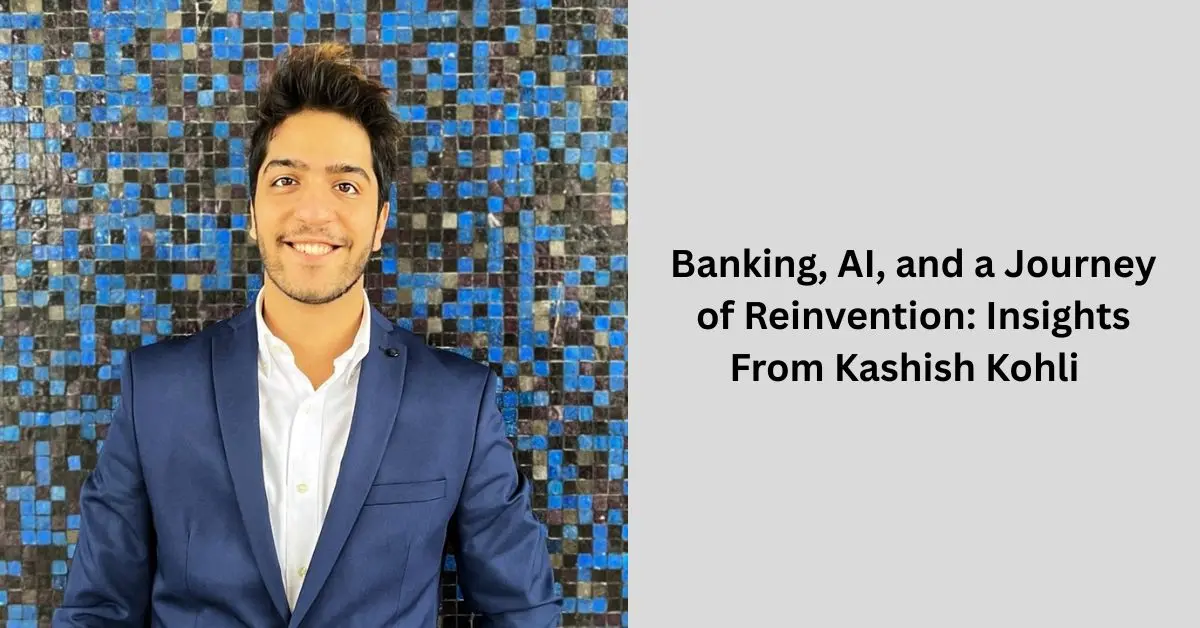
Kashish Kohli: Solution Intelligence Associate Manager, Essex Lake Group
Written By: Mehak Malik
Artificial Intelligence is transforming the global banking landscape, reshaping how institutions detect fraud, personalize services, and streamline operations. To understand this shift more closely, we spoke with Kashish Kohli, a Data and AI professional working within the Canadian banking ecosystem and a mentor at Great Learning.
His experience spans analytics, consulting, and applied machine learning. He also works extensively with Generative AI, giving him a grounded view of how the financial sector is evolving and how learners can prepare for the opportunities ahead.
How AI Is Reshaping Banking
Kashish has spent the last few years closely observing how AI and ML are being embedded into banking workflows. He describes this transformation as both fast-moving and deeply impactful.
“In my experience of working very closely with the industry, AI and ML have revolutionized banking by making it quicker, smarter, and customer-centric,” he says. “In operations, models now identify fraud in real time and help compliance teams filter huge amounts of data. In wealth management, robo-advisors and portfolio optimizers provide customized strategies at scales we couldn’t imagine earlier. And in retail banking, AI powers smarter credit scoring, personalized offers, and intuitive self-service.”
What excites him most is the rapid adoption of Generative AI, especially within enterprise environments.
“Generative AI has added another layer of impact, particularly through Natural Language Processing,” he explains. “Banks now use it to improve call-center interactions, summarize lengthy documents, and even provide real-time staff support. These are some of the things I’m working on right now.”
“The major banks are integrating tools like Microsoft Teams Copilot, while many are experimenting with advanced foundational models such as LLaMA, Mistral, and GPT through APIs. Dedicated Generative AI teams, distinct from traditional ML groups, are becoming a standard fixture in large financial institutions.”
“The Canadian banking sector is undergoing a real transformation in how it uses AI capabilities,” he emphasizes.
Growing as a Data Professional in the Age of GenAI
As GenAI takes center stage, the responsibilities of data professionals are changing.
“Generative AI is reshaping Data Science work and consulting life,” Kashish reflects. “Routine analytics and reporting are increasingly automated, shifting the focus to interpretation, validation, and strategy.”
For him, this shift is opening exciting possibilities.
“This creates opportunities for innovation, from auto-generating client-ready deliverables to building synthetic data and even entirely new products. For consulting, the future isn’t number crunching; it’s about guiding organizations through ethical AI adoption, making outputs credible, and translating technical findings into actionable business strategies.”
MARS: When Data Science Meets Creativity
Kashish’s curiosity extends beyond financial systems. One of his most meaningful projects is MARS, the ‘Music Analysis and Recommendation System’, which he built to explore how Data Science could quantify artistic expression.
“MARS was a project I built to understand how Data Science could quantify creativity and audience response. We analyzed thousands of songs, tagged emotions, detected trending subjects, and combined those sentiment features with metadata like genre, tempo, artist history, and release date.”
The system didn’t just recommend songs, it explained why listeners gravitated towards them.
“What made MARS unique was that, beyond prediction, it produced explainable insights into how subjects in lyrics influenced success,” he says. “Nostalgia-driven lyrics consistently performed well in certain genres, while upbeat and cheerful content often correlated with higher streaming metrics.”
For Kashish, MARS highlighted how data pipelines can connect culture, creativity, and analytics in surprisingly meaningful ways.
A Perspective on AI and Professional Growth
Through his work, Kashish emphasizes that AI’s impact is not confined to technical execution; it extends to strategy, ethics, and real-world problem-solving. By combining technical expertise with creativity and insight, he mentors learners to navigate the evolving AI landscape, helping them apply data-driven solutions responsibly and innovatively. For Kashish, the excitement lies in using AI not just to process data, but to create meaningful, interpretable, and impactful outcomes that resonate beyond the numbers.