- Why Are Traditional KYC and AML Processes Becoming Inefficient?
- How Is AI Transforming KYC and AML Compliance in Banking?
- How Does an AI-Powered AML Investigation Work?
- What Challenges Do Banks Face When Implementing AI in KYC and AML?
- How Can the Agentic AI Course by Johns Hopkins University Help Professionals Build AI Agents for Financial Compliance?
- Final Thoughts
- Frequently Asked Questions
Banks must verify customer identities, monitor financial transactions, and identify suspicious activities across complex payment networks.
Traditional compliance systems often struggle with fragmented customer records, static monitoring rules, and large volumes of alerts requiring manual investigation.
Artificial intelligence (AI) helps address these limitations. Machine learning detects unusual transaction patterns, natural language processing (NLP) improves customer screening, and AI agents coordinate investigation workflows.
Together, these technologies help banks identify risks, investigate suspicious activities, and strengthen compliance operations.
TL;DR
AI is helping banks strengthen KYC and AML by improving identity verification, customer risk assessment, suspicious transaction detection, and AML investigations. Machine learning, NLP, and AI agents help identify potential risks, connect transaction patterns, and prepare evidence-based investigation reports. The Johns Hopkins University AI Agents Course covers the technologies and skills needed to build intelligent, responsible, and human-supervised compliance workflows.
Why Are Traditional KYC and AML Processes Becoming Inefficient?
Know Your Customer (KYC) and Anti-Money Laundering (AML) serve different compliance purposes:
- KYC: Verifies customer identity, financial background, and risk profile.
- AML: Identifies and helps prevent attempts to conceal illegally obtained money through financial transactions.
For example, KYC involves verifying identity documents and screening customers during onboarding. AML involves monitoring subsequent transactions for suspicious activity.
Traditional approaches face four major limitations:
- Fragmented customer information: Identity records, transaction histories, and ownership details often exist across separate systems.
- Static monitoring rules: Predefined thresholds may miss suspicious patterns that do not match existing rules.
- False positives: Legitimate transactions can trigger alerts, increasing investigators' workloads.
- Delayed reassessment: Periodic KYC reviews may fail to capture changes in customer behaviour or ownership immediately.
AI helps banks analyse connected information and identify changes that require investigation.
How Is AI Transforming KYC and AML Compliance in Banking?
AI supports several compliance activities, from customer onboarding to suspicious transaction investigations.
1. AI-Powered Identity Verification
AI combines optical character recognition (OCR), computer vision, and machine learning to extract and validate information from identity documents.
When customers upload passports or government-issued IDs, these systems can:
- Extract names, dates of birth, and identification numbers.
- Compare document details with application information.
- Detect altered documents and suspicious image patterns.
- Support facial matching and liveness detection.
For example, if an identity document contains a different name from the submitted application, the system flags the discrepancy for manual verification.
2. Improving Customer Screening and Risk Assessment
Banks screen customers against sanctions lists, politically exposed person (PEP) databases, watchlists, and adverse media sources.
NLP and entity resolution improve screening by comparing names, alternative spellings, dates of birth, nationality, and organisational relationships.
AI can also assess customer risk using occupation, business activities, geographical exposure, ownership structures, and transaction behaviour. This enables more contextual risk assessments as customer information changes.
3. Detecting Suspicious Transactions With Machine Learning
Traditional monitoring systems rely on predefined transaction thresholds. However, suspicious activities may involve multiple smaller transfers, accounts, and beneficiaries.
Machine learning analyses historical transaction patterns to identify unusual behaviour.
For example, a business account that normally receives payments from established customers suddenly starts receiving transfers from unrelated individuals and distributes the funds to new beneficiaries.
AI can identify changes in transaction frequency, unusual deposits, rapid withdrawals, and previously unseen counterparties.
Graph analytics further maps relationships between customers, accounts, businesses, and beneficiaries, helping investigators identify connections that individual transaction checks might overlook.
These findings indicate potential risks, not confirmed financial crimes.
4. Automating AML Investigations
Generative AI and AI agents can assist investigators by retrieving customer records, analysing transaction histories, reviewing previous alerts, and organising supporting evidence.
An AI-supported workflow can:
- Retrieve relevant customer and transaction records.
- Summarise suspicious transaction patterns.
- Identify related accounts and counterparties.
- Retrieve applicable compliance policies.
- Prepare an evidence-backed investigation summary.
Investigators validate these findings and determine whether further documentation or escalation is necessary. AI reduces information-gathering work without replacing human judgement.
How Does an AI-Powered AML Investigation Work?
Consider a business account that suddenly receives payments from several unrelated individuals and transfers the funds to newly added beneficiaries.
An AI-supported investigation could follow this workflow:
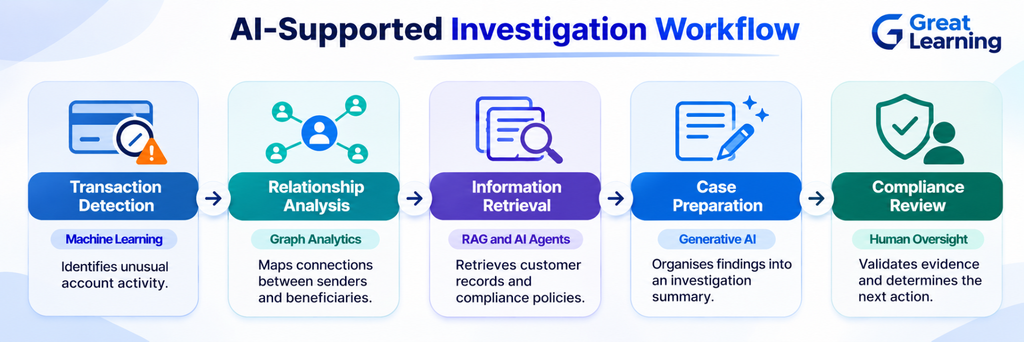
| Investigation stage | Technology | Action |
| Transaction detection | Machine learning | Identifies unusual account activity. |
| Relationship analysis | Graph analytics | Maps connections between senders and beneficiaries. |
| Information retrieval | RAG and AI agents | Retrieves customer records and compliance policies. |
| Case preparation | Generative AI | Organises findings into an investigation summary. |
| Compliance review | Human oversight | Validates evidence and determines the next action. |
Multiple specialised agents can coordinate these tasks. However, decisions involving account restrictions, suspicious activity reporting, and customer offboarding must follow approved compliance procedures and appropriate human review.
What Challenges Do Banks Face When Implementing AI in KYC and AML?
Despite its benefits, AI introduces technical and governance challenges.
1. Poor data quality: Inconsistent names, missing identification details, and outdated records can produce incorrect risk assessments. Banks need standardised customer records, validated data pipelines, and regular quality checks.
2. Lack of explainability: Investigators must understand why an account was flagged. Banks should maintain traceable evidence, model outputs, and decision logs.
3. Algorithmic bias: Incomplete historical data can lead to disproportionate risk flags across customer groups. Representative validation datasets and regular fairness assessments help identify these issues.
4. Privacy and security: AI systems process sensitive identity and financial information. Role-based permissions, encryption, data minimisation, and secure integrations are essential.
5. Uncontrolled agent actions: Agents with unrestricted access could retrieve unauthorised information or modify customer records. Banks should implement tool-level permissions, approval checkpoints, and audit trails.
The Bank of England's 2026 report on Artificial Intelligence in UK Financial Services also highlights the importance of AI governance, data protection, human oversight, model risk management, and third-party risk controls in financial services.
How Can the Agentic AI Course by Johns Hopkins University Help Professionals Build AI Agents for Financial Compliance?
The AI Agents course by Johns Hopkins University, delivered in collaboration with Great Learning, covers technologies relevant to building AI-powered financial compliance workflows.
Certificate Program in Agentic AI
Learn the architecture of intelligent agentic systems. Build agents that perceive, plan, learn, and act using Python-based projects and cutting-edge agentic architectures.
Its curriculum includes Python, LangChain, LangGraph, Retrieval-Augmented Generation (RAG), and Model Context Protocol (MCP).
These technologies help professionals develop agents that retrieve customer information, connect external data sources, coordinate investigation tasks, and generate evidence-based summaries.
Professionals also learn agent evaluation using LLM-as-a-Judge, responsible AI, safety guardrails, and human-in-the-loop mechanisms.
These capabilities are relevant to developing controlled, auditable AI workflows for KYC verification and AML investigations.
Final Thoughts
AI is helping banks improve KYC verification, identify suspicious transaction patterns, and streamline AML investigations.
However, building reliable compliance systems requires AI agents that can retrieve evidence, analyse financial information, and follow defined risk and governance controls.
The AI Agents course by Johns Hopkins University covers technologies such as Python, LangChain, LangGraph, Retrieval-Augmented Generation (RAG), and Model Context Protocol (MCP).
These concepts can be applied to financial compliance use cases, such as developing financial intelligence agents and automating compliance-related document reviews.
The programme provides a foundation for professionals interested in developing agentic AI workflows for KYC verification, AML investigations, and banking compliance.
Frequently Asked Questions
1. How does AI improve customer risk profiling in banking?
AI analyses customer information, occupation, business activities, geographical exposure, and transaction behaviour to develop more contextual risk profiles. This helps banks identify changes in customer risk levels.
2. How does AI help identify suspicious transaction patterns?
AI analyses transaction frequency, deposits, withdrawals, and beneficiary relationships to identify unusual financial activities that may require further investigation.
3. How does graph analytics support AML investigations?
Graph analytics maps relationships between customers, accounts, businesses, and beneficiaries, helping investigators identify connections that individual transaction reviews may overlook.
4. How can NLP improve customer screening in KYC?
NLP analyses names, alternative spellings, dates of birth, and organisational relationships to improve customer matching against sanctions lists, PEP databases, and watchlists.
5. Why is data quality important for AI-powered KYC and AML systems?
Accurate and consistent customer records help AI systems produce reliable risk assessments, reduce incorrect alerts, and support better compliance decisions.
6. How do AI agents support automated AML investigations?
AI agents retrieve customer records, analyse transaction histories, identify related accounts, and prepare evidence-backed investigation summaries for compliance teams.
7. Which AI Agents Course Helps Professionals Build AI Agents for Financial Compliance?
The AI Agents course by Johns Hopkins University covers Python, RAG, LangChain, LangGraph, MCP, multi-agent development, and responsible AI, helping professionals develop and evaluate AI-powered compliance workflows.