- Why Banks Are Using AI for Fraud Detection
- How Does AI Detect Fraud in Banking?
- Which AI Technologies Are Used in Banking Fraud Detection?
- What Types of Banking Fraud Can AI Help Detect?
- What Skills Do Professionals Need for AI-Based Fraud Detection?
- Which Careers Use AI for Fraud Detection in Banking?
- Conclusion: Building Skills for AI-Driven Fraud Prevention
- FAQs
TL;DR: AI for fraud detection in banking helps financial institutions identify suspicious transactions, detect unusual account activity, and assess fraud risks using machine learning, anomaly detection, and data analytics. Professionals working in this field need technical skills such as Python, SQL, and Machine Learning, along with banking knowledge, risk assessment, and responsible AI practices.
Why Banks Are Using AI for Fraud Detection
Banks use AI for fraud detection to identify suspicious transactions, recognize unusual customer behavior, and assess potential risks in near real time. By analyzing large volumes of transaction data, AI systems can help financial institutions detect emerging fraud patterns and prioritize alerts for investigation.
The need for these capabilities is growing. According to the Reserve Bank of India's Annual Report, the amount involved in bank fraud cases reported during FY2025–26 reached ₹48,021 crore, up from ₹32,803 crore in the previous financial year. These figures reflect fraud cases reported during the year, which may relate to earlier periods. Incidents such as the 2026 SBI data leak also highlight why protecting customer information is an important part of securing digital banking services.
Traditional rule-based systems can struggle to identify unfamiliar fraud patterns and may generate false alerts. AI complements these systems by learning from transaction patterns and flagging anomalies that warrant further review. Human investigators and established security controls remain essential for validating alerts and making decisions.
How Does AI Detect Fraud in Banking?
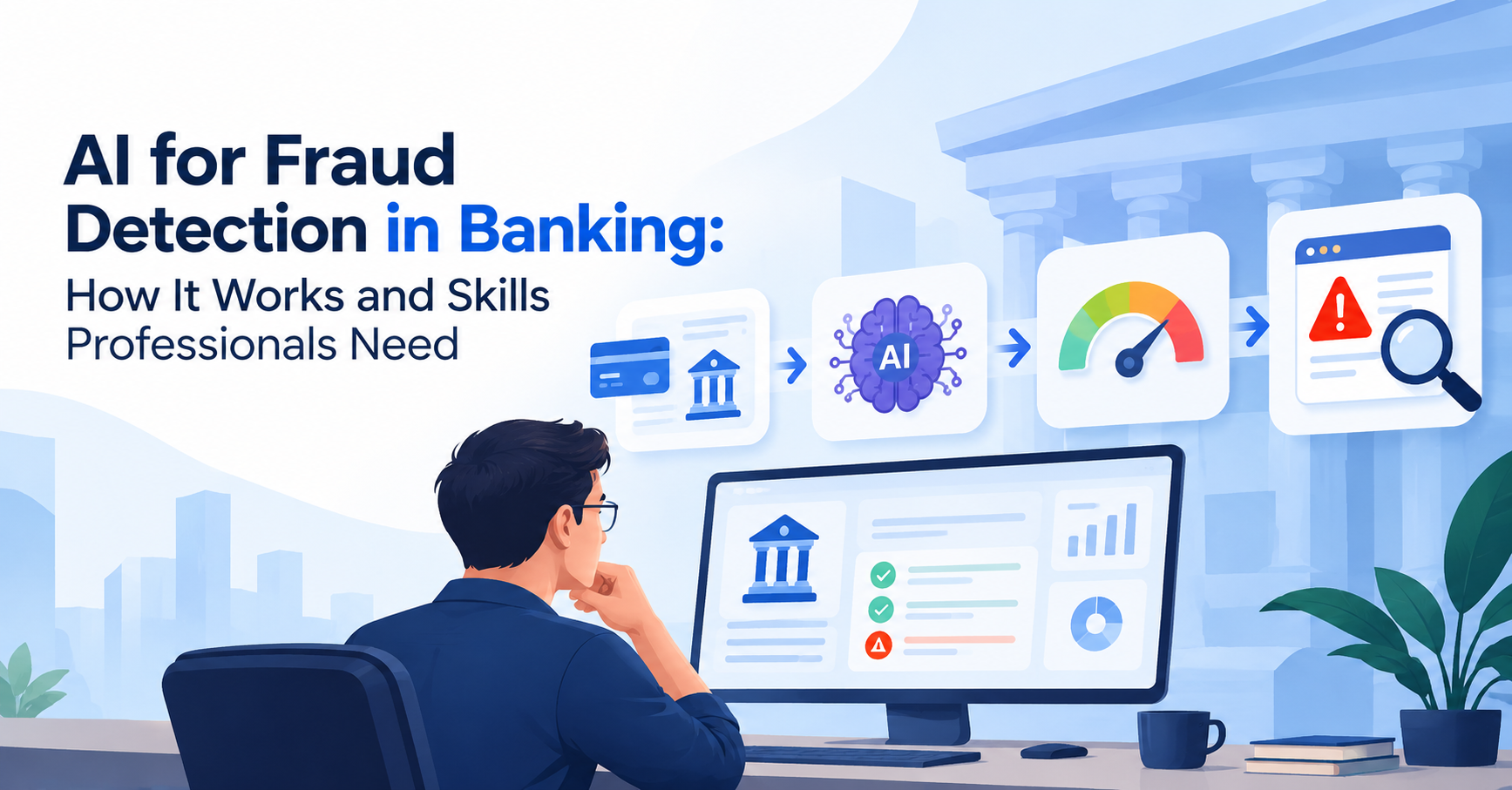
AI-based fraud detection typically involves four steps:
- Data collection: Systems analyze transaction amounts, payment locations, device information, account activity, and other relevant signals.
- Pattern recognition: Machine Learning models learn what normal transactions and customer behavior look like using historical and incoming data.
- Risk assessment: The system identifies anomalies or assigns a risk score to suspicious transactions.
- Action and investigation: Depending on the risk level, a bank may approve a transaction, request additional authentication, temporarily hold it, or send it for human review.
For example, if a customer who typically makes small domestic purchases suddenly initiates a high-value transfer from an unfamiliar device, the system may flag the transaction for additional verification.
This approach helps banks assess transactions in near real time without automatically treating every unusual activity as fraud.
Which AI Technologies Are Used in Banking Fraud Detection?
Several technologies support AI fraud detection:
- Machine learning: Analyses historical fraud patterns to estimate the likelihood that a transaction is fraudulent.
- Anomaly detection: Identifies unusual activity, such as unexpected transaction frequency, amounts, or account access patterns.
- Graph analytics: Examines relationships between accounts, devices, and transactions to uncover suspicious networks or potential money-mule activity.
- Generative AI: Can help investigators summarize alerts, review case information, and organize evidence. Its outputs require appropriate validation and oversight.
Banks often combine these methods with rule-based systems rather than relying on a single AI model. This layered approach helps balance detection accuracy, processing speed, and explainability. It also reinforces the need for cybersecurity practices in financial services to address threats across banking systems and customer data. As AI changes the threat landscape, banks must also reconsider how cybersecurity strategies adapt to AI.
What Types of Banking Fraud Can AI Help Detect?
AI in banking can support the detection of several fraud types:
- Payment and card fraud: Flags transactions that deviate from established spending patterns.
- Account takeover: Identifies unusual login behavior, device changes, or suspicious account activity.
- Identity fraud: Helps detect inconsistencies in identity information and potentially synthetic identities.
- Suspicious money transfers: Identifies unusual transaction sequences or connections between accounts.
- Loan and application fraud: Helps identify suspicious applications, inconsistencies, and patterns associated with potentially fraudulent submissions.
Detection capabilities depend on the available data, model quality, and the type of fraud involved. AI can also produce false positives, so suspicious activity may require additional checks before a decision is made.
Also read: How Machine Learning is Changing Identity Theft Detection
What Skills Do Professionals Need for AI-Based Fraud Detection?
Professionals need a combination of technical expertise, financial crime knowledge, and responsible AI skills.
Technical skills: Python and SQL help professionals process transaction data and investigate patterns. Statistics, data analysis, machine learning, and anomaly detection are useful for building and evaluating fraud detection models.
Banking and risk knowledge: Understanding transaction monitoring, fraud typologies, payment systems, financial crime risks, and anti-money laundering (AML) fundamentals helps professionals interpret suspicious activity in context.
Responsible AI skills: Model evaluation, explainability, data privacy, bias monitoring, and human oversight are essential for ensuring that detection systems are reliable and that legitimate customers are not unfairly affected.
Professionals looking to strengthen their expertise can explore an AI Security course to learn more about securing AI systems and addressing AI-related security risks.
Johns Hopkins Certificate Program in AI Security
Build AI security skills for LLMs, RAG, and AI agents. Learn threat modeling, secure architectures, runtime guardrails, and AI governance with Johns Hopkins University.
The depth of technical knowledge required varies by role. A fraud analyst may focus on investigating alerts and interpreting risk indicators, while a Machine Learning engineer may develop and deploy predictive models.
Which Careers Use AI for Fraud Detection in Banking?
Skills in machine learning for fraud detection can be relevant to several roles:
- Fraud analyst: Reviews alerts, investigates suspicious transactions, and identifies fraud patterns.
- Fraud data analyst: Uses SQL, Python, and data visualization to examine transaction trends and detection performance.
- Risk analytics specialist: Evaluates financial risks and helps improve fraud monitoring strategies.
- Machine learning engineer: Develops, tests, and maintains models used to detect potentially fraudulent activity.
- Financial crime analyst: Investigates suspicious financial activity and supports fraud prevention and AML processes.
These roles have different entry requirements, but analytical thinking, domain knowledge, and the ability to interpret data are valuable across the field. For professionals interested in building broader cybersecurity expertise, the JHU Cybersecurity Program is worth exploring to understand cybersecurity concepts and practices relevant to protecting digital systems.
JHU Cybersecurity Certificate Course
Build in-demand cybersecurity skills with JHU experts. Learn AI, cloud, and network security. Hands-on projects. Flexible online format.
Conclusion: Building Skills for AI-Driven Fraud Prevention
AI is changing how banks identify and respond to suspicious financial activity. Effective fraud prevention requires more than sophisticated algorithms: it also depends on reliable data, banking expertise, clear risk controls, and human judgment. Professionals who combine data analytics and machine learning skills with financial crime knowledge can contribute to developing and evaluating more effective fraud detection systems.
FAQs
How does AI detect suspicious bank transactions?
AI analyzes transaction data, account behaviour, and other relevant signals to identify unusual patterns or assign risk scores. Banks can use these signals to trigger additional verification or investigation.
What skills are needed to work in AI-based fraud detection?
Key skills include Python, SQL, statistics, data analysis, and Machine Learning, alongside knowledge of banking fraud, risk assessment, and AML. Model evaluation and responsible AI practices are also important.