
- What Makes Agentic AI Different from Traditional AI?
- Why Self-Taught Prompting Falls Short?
- Core Prompting Principles for MiniMax Agent
- Specific Use Case Prompting for Professional Applications
- How the Right Courses Can Help You Master AI Agents and Prompting?
- Why Professionals Are Prioritizing Learning AI Agents?
- Conclusion
The rise of autonomous AI systems is transforming how professionals approach complex tasks, moving beyond simple interactions to executing multi-step workflows with minimal human intervention.
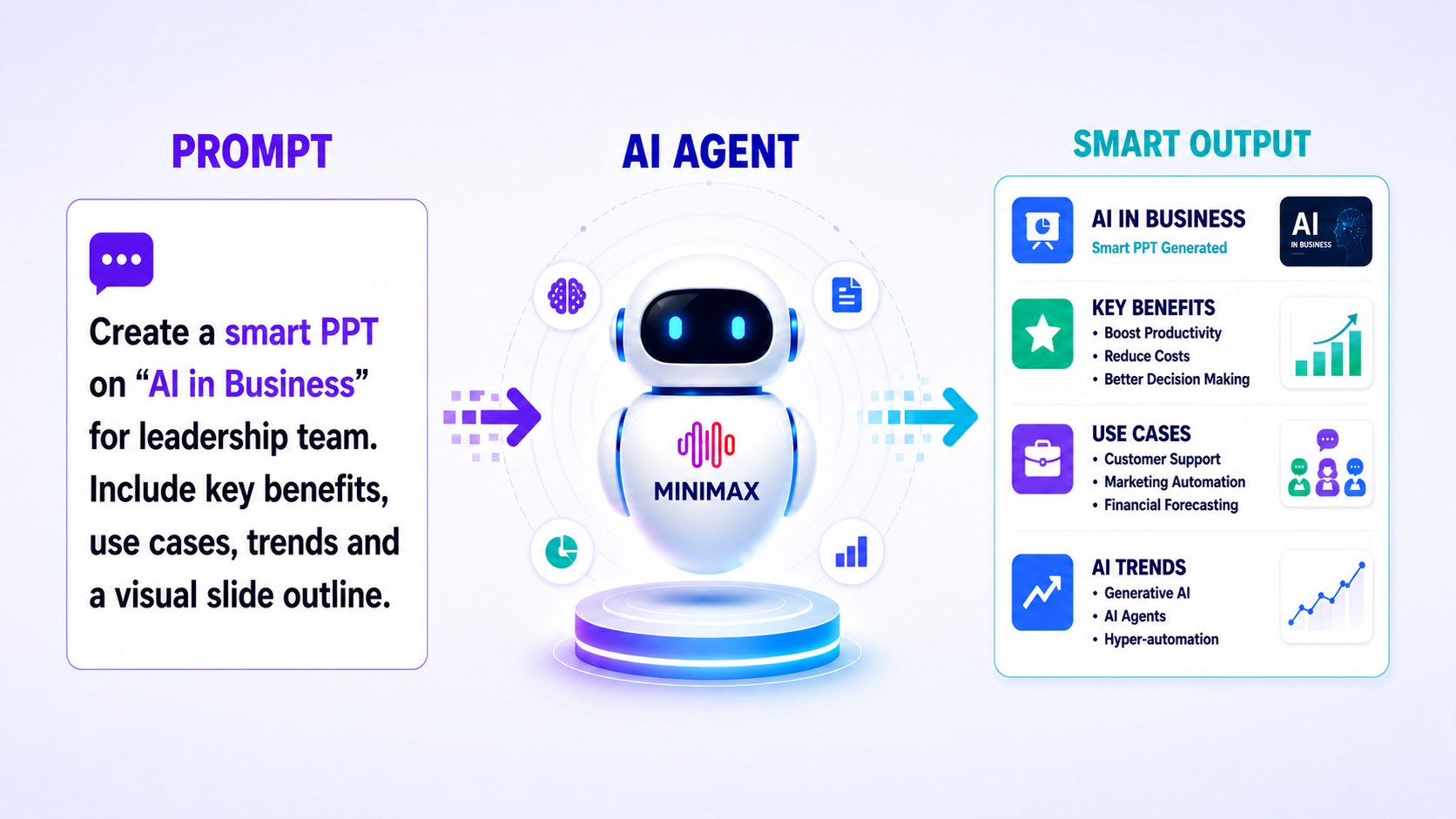
Leading this shift is the MiniMax Agent, a powerful platform designed for coding and advanced, task-driven applications.
However, fully leveraging its capabilities requires strong prompt engineering skills and a clear understanding of how AI agents function.
With 81% of professionals planning to upskill, the need to adapt to this new paradigm is evident. In this blog, we explore how an Agent AI course can improve your prompting skills for the MiniMax Agent.
What Makes Agentic AI Different from Traditional AI?
Traditional AI chatbots excel at single-turn interactions, answering questions, generating text, or providing explanations. Agentic AI systems like MiniMax Agent represent a fundamental architectural shift. These systems are designed to:
- Understand Goals
- Formulate Plans
- Use Tools To Write And Review Code
- Execute Multi-Step Tasks Over Extended Timeframes
MiniMax Agent operates as an agent capable of completing complex, long-horizon tasks through multi-step planning and flexible task decomposition.
The system leverages MCP (Model Context Protocol) ecosystem integration, supports custom workflows, and offers checkpoint restore capabilities for iterative refinement.
Core Elements of MiniMax Agent:
- MiniMax M2.5 Foundation Model: The underlying large-scale language model that powers the agent's broad reasoning capabilities across multiple domains.
- Native Tool Execution: The agent's ability to autonomously run browser-based tasks, write code, and execute multi-step reasoning sequences without human intervention.
- Long-Horizon Planning: The architectural capacity to maintain context, remember initial constraints, and plan across extended workflows without losing the thread of the original prompt.
- MCP (Model Context Protocol) Integrations: The framework enabling the agent to connect seamlessly with external tools, APIs, services, and custom enterprise configurations.
- Checkpoint & Edit System: The built-in capability to return to previous workflow states for regeneration after modifying a prompt, allowing for iterative refinement.
For those looking to build foundational knowledge on these autonomous entities, understanding what AI agents are is highly recommended.
Why Self-Taught Prompting Falls Short?
Many professionals develop prompting skills through informal experimentation. However, the Great Learning Upskilling Trends Report indicates that structured learning programs yield significantly better outcomes.
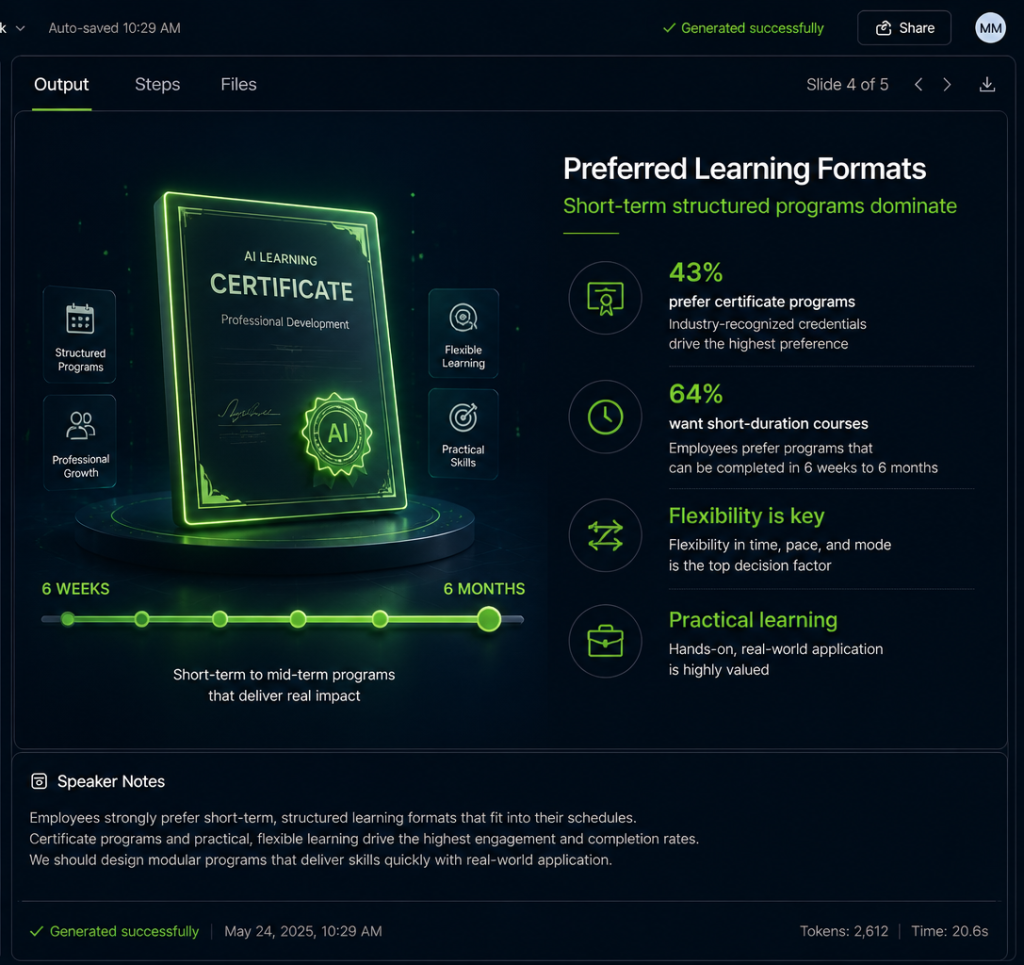
Certificate programs have emerged as the leading choice for upskilling, with 43% of professionals preferring programs from established educational institutions.
An agent AI course teaches prompting through progressive complexity, starting with foundational principles and advancing to multi-modal utilization through strategies such as:
- Contextual Anchoring and Environment Definition: When interacting with the MiniMax Agent, you must provide a comprehensive environmental context. The agent needs to know not just what the ultimate goal is, but the specific technical or business constraints of the environment it is operating within.
- Sequential Logic and Multi-Turn Planning: For tasks that require multi-turn modifications and iterative refinements, breaking down prompts into logical, sequential steps ensures the agent's internal planning algorithms align perfectly with your desired outcome.
This structured approach ensures you understand not just what works, but why certain prompting strategies produce superior results with systems like MiniMax Agent.
To deepen your understanding of these core principles, watch Prompt Engineering Essentials for AI Practitioners to see these fundamentals in action.
Core Prompting Principles for MiniMax Agent
1. Establish Comprehensive Environmental Context
The MiniMax Agent executes complex, long-horizon tasks better when it understands the macro-environment. Instead of just stating the final goal, explicitly define the business, technical, or creative context in which the agent is operating.
2. Leverage Sequential Logic for Multi-Turn Planning
MiniMax models utilize interleaved thinking, wrapping internal cognitive processes within <think> tags before executing actions. To align with this advanced architecture, break your complex prompts into logical, sequential steps.
Directing the agent step-by-step ensures its internal planning algorithm stays on track, especially when recovering from broken tool chains, debugging errors, or executing multi-file code edits.
3. Explicitly Define Tool Boundaries and Constraints
Because the MiniMax Agent can autonomously select and utilize tools like Python code interpreters, shell interfaces, and web browsers, ambiguity is your enemy. Clearly specify which tools the agent should use, how many web searches it is permitted to perform, and what specific APIs it should interact with.
4. Enforce Strict Data Output Formatting
When using the agent for complex analytical tasks, such as summarising complex information or analyzing large datasets, explicitly specify the exact output format.
Whether you need a Markdown table, a specific JSON schema, a structured CSV, or a bulleted executive summary, providing a structural template in your prompt guarantees immediate usability and reduces the need for manual reformatting.
5. Assign a Distinct Professional Persona
The MiniMax model possesses excellent identity preservation and contextual awareness capabilities.
Assigning a clear, professional persona (e.g., "Act as a Senior DevOps Engineer troubleshooting a Kubernetes cluster" or "Act as a Lead Financial Analyst modeling quarterly earnings") fundamentally shifts the model's tone, depth of knowledge retrieval, and analytical rigor.
This ensures the output aligns perfectly with the professional expectations of your specific industry.
Specific Use Case Prompting for Professional Applications
1. Automating Executive Presentations and Data Synthesis
MiniMax Agent’s native multimodal capabilities make it an exceptional tool for synthesizing dense, multi-page documents into visually compelling, executive-ready presentations.
By processing large PDFs and generating corresponding 16:9 corporate graphics in a single workflow, the agent acts as both a data analyst and a presentation designer.
Prompt Example for Presentation Generation:
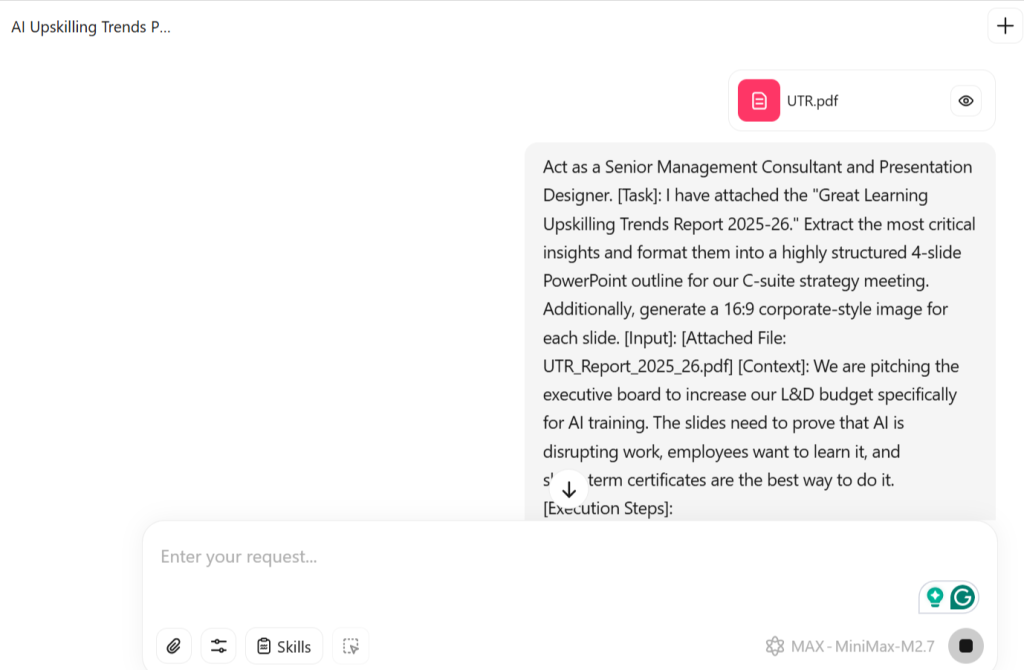
[Role]: Act as a Senior Management Consultant and Presentation Designer.
[Task]: I have attached the "Upskilling Trends Report 2025-26." Extract the most critical insights and format them into a highly structured 5-slide PowerPoint deck for our C-suite strategy meeting. Additionally, generate a 16:9 corporate-style image for each slide.
[Input]: [Attached File: UTR_Report_2025_26.pdf]
[Context]: We are pitching the executive board to increase our L&D budget specifically for AI training. The slides need to prove that AI is disrupting work, employees want to learn it, and short-term certificates are the best way to do it.
[Execution Steps]:
- Analyze the PDF for key statistics on AI disruption, employee sentiment, top barriers, and preferred learning formats.
- Generate a professional, high-quality 16:9 image for each slide. Use a consistent "modern corporate, minimalist 3D, neon green and dark navy blue" aesthetic.
- Draft the text content and speaker notes for each slide.
- [Constraints]: Limit each slide to a maximum of 4 bullet points. Include precise percentages from the report. Do not hallucinate data.
Agent's "Thinking Process"
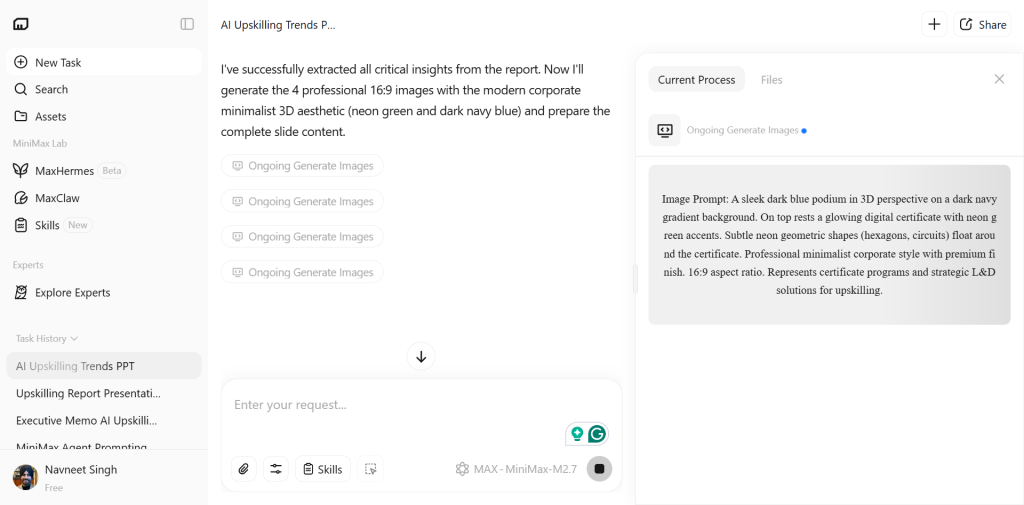
What makes an agentic AI vastly superior to a standard chatbot is its transparent, multi-step execution. When fed the prompt and the 18-page PDF, the MiniMax interface immediately exposes its Thinking Process:
- Tool Execution: The agent autonomously triggers the Extract PDF Full Content and View Memory tools to digest the report and establish the context of the user's L&D budget goals.
- Autonomous Prompt Engineering: Instead of just guessing what image you want, the agent acts as an expert prompt engineer behind the scenes. As seen in the right-hand panel of the interface, it translated the simple instruction ("neon green and dark navy blue aesthetic") into a highly detailed text-to-image prompt:
"A sleek dark blue podium in 3D perspective on a dark navy gradient background. On top rests a glowing digital certificate with neon green accents, Professional minimalist corporate style with premium finish."
Slide Outputs
By autonomously breaking down the task, the agent perfectly executed the multi-modal constraints, extracting precise statistics while generating cohesive, on-brand imagery for the deck:
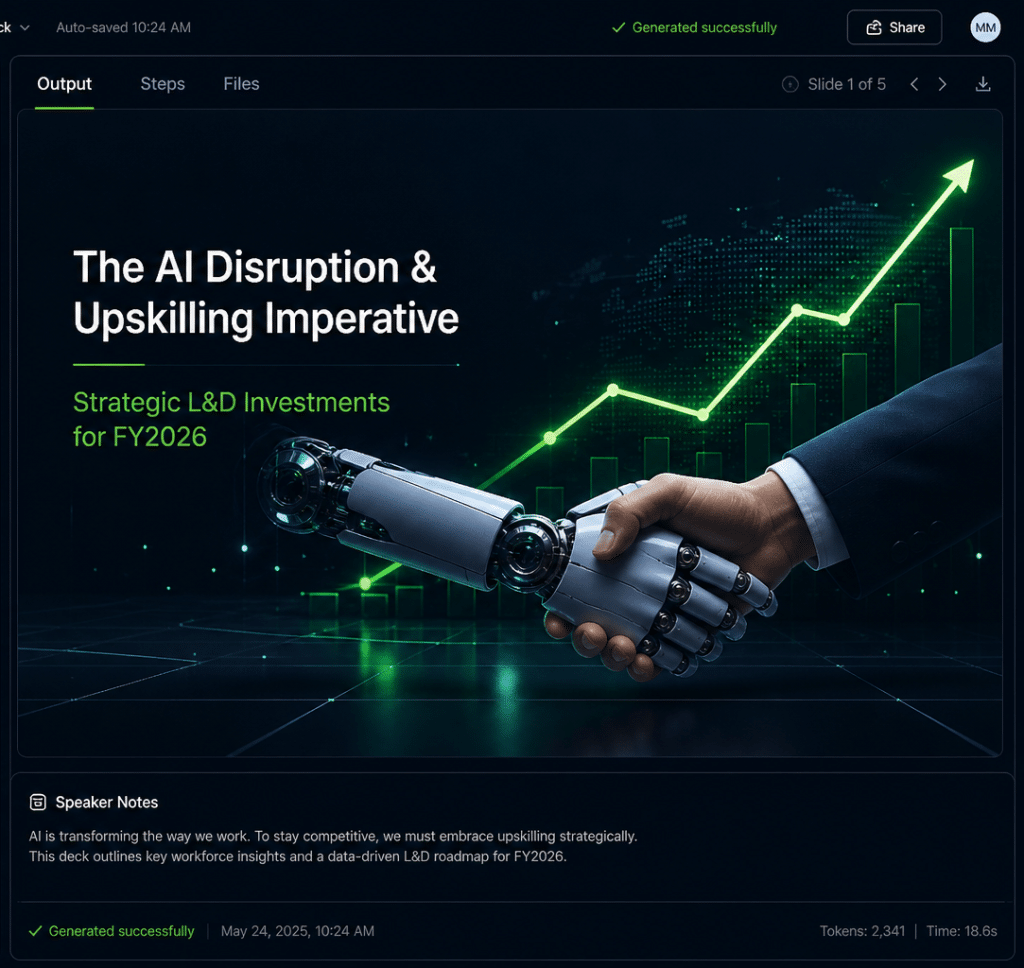
- Slide 1: The Title Slide
The agent generated a striking title slide introducing "The AI Disruption & Upskilling Imperative." Adhering strictly to the aesthetic constraints, the generated image features a highly professional 3D rendering of a robotic hand shaking a human hand over a glowing upward trend line. This perfectly illustrates the synergy between AI technology and investment in the human workforce.
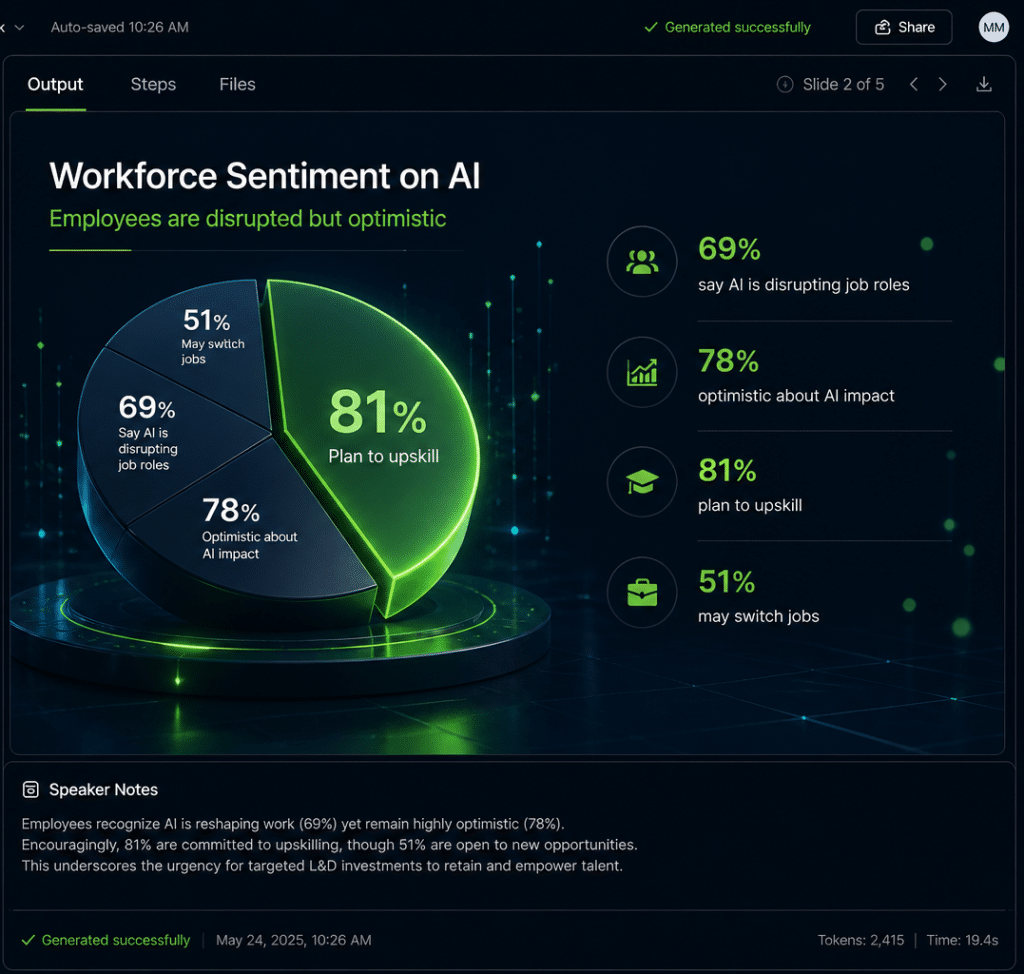
- Slide 2: Workforce Sentiment on AI (Data Extraction)
The agent successfully extracted four critical data points without hallucination: 69% of professionals feel disrupted, 78% are optimistic, 81% plan to upskill, and 51% are actively looking to switch jobs.
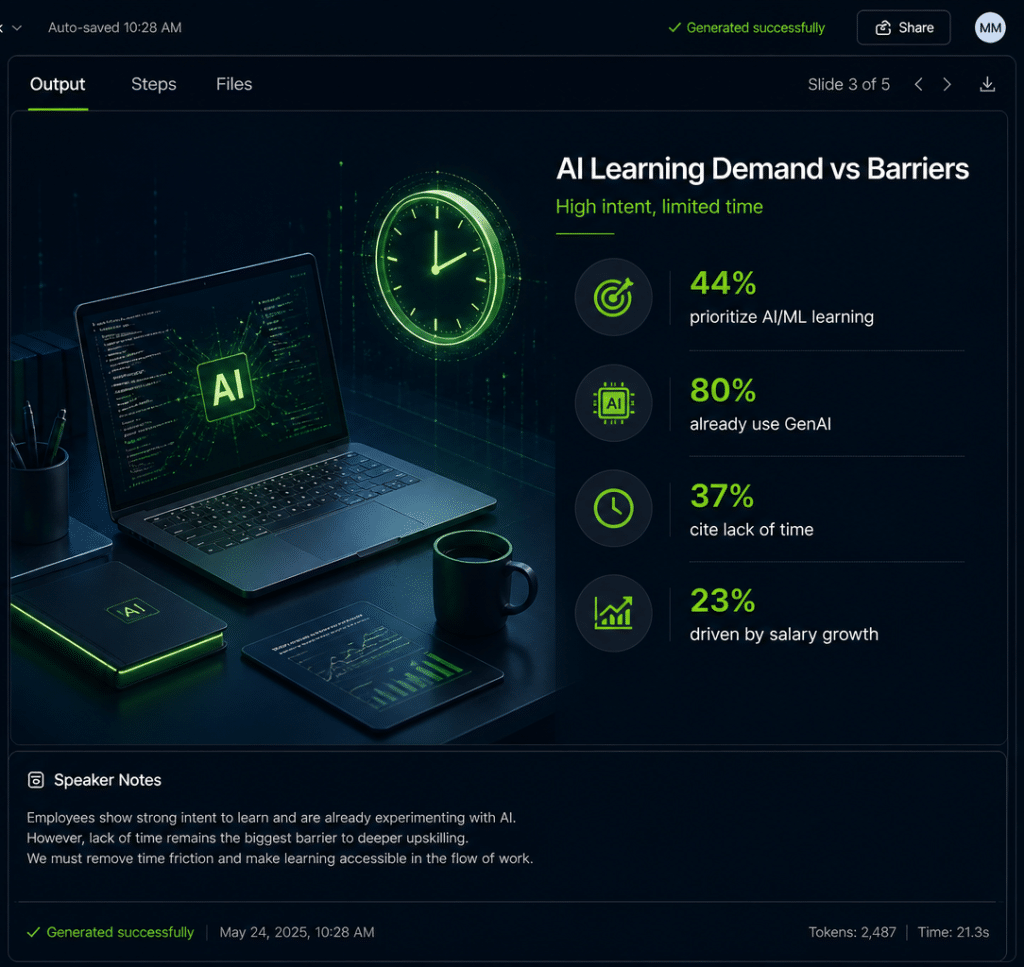
- Slide 3: AI Learning Demand vs Barriers
This slide highlights that 44% prioritize AI/ML, 80% already use GenAI, and 37% cite lack of time as the primary barrier.
- Slide 4 & 5: Strategic Solutions & Formats
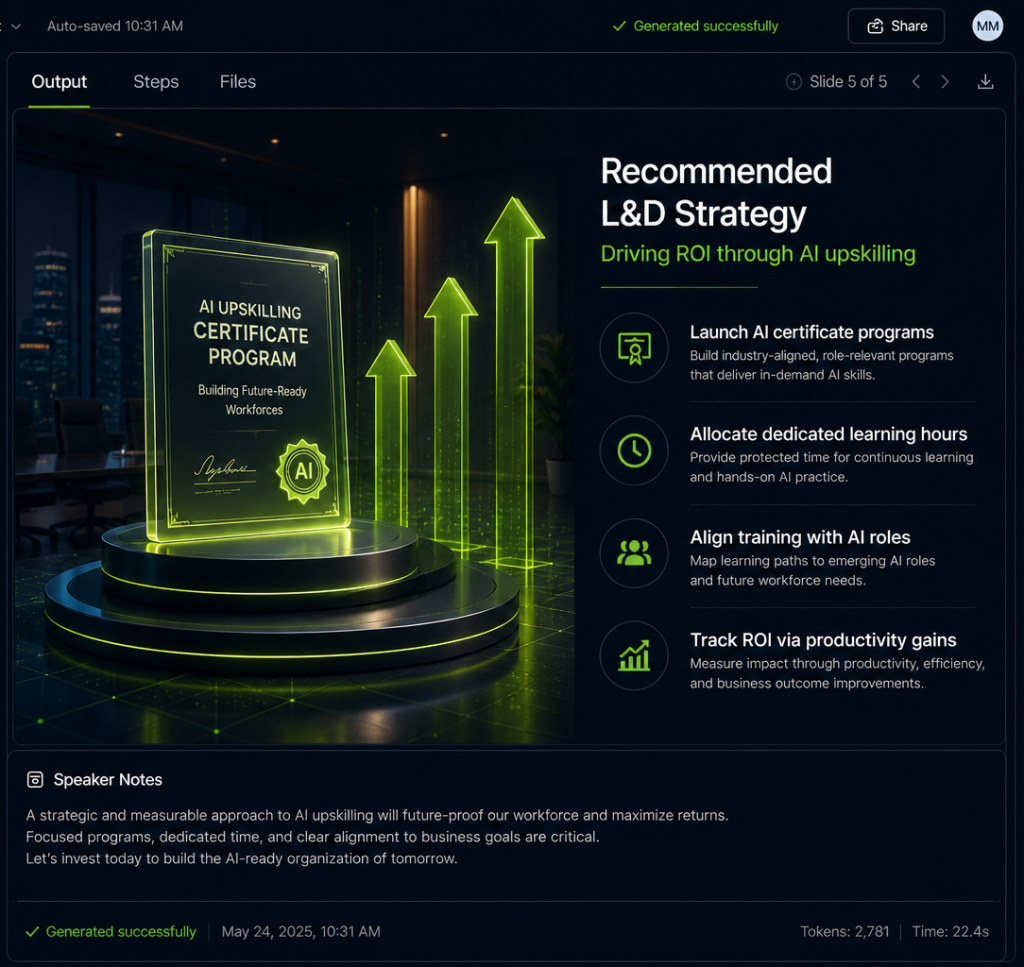
The text correctly identifies that 43% prefer certificate programs and recommends launching employer-sponsored AI certificate programs. It generated a stunning concluding visual. Below it, it mapped out a timeline graphic spanning "6 WEEKS" to "6 MONTHS," mirroring the extracted data points into a cohesive visual roadmap.
2. Code Development and Software Engineering
MiniMax Agent demonstrates exceptional code development capabilities, generating approximately 80% of MiniMax's own codebase. When prompting for code tasks, specify roles, tech stacks, and constraints upfront.
Advanced Prompt Example for Software Development:
[Role]: Act as a Senior Frontend Engineer.
[Task]: Generate a responsive, modern analytics dashboard UI.
[Tech Stack]: React (Functional components, Hooks), Tailwind CSS, and Recharts. [Context]: The dashboard will track API latency and user error rates. [Constraints]: Ensure strict accessibility (ARIA labels). Do not use class components. Make the design dark-mode native.
[Reference]: [Attach a screenshot of a preferred UI style]
[Output]: Provide the complete, deployable App.js and components/Dashboard.js code blocks. Do not explain the code unless necessary for setup.
For professionals seeking to leverage generative AI in software development contexts, the Professional Certificate in Generative AI and Agents for Software Development from UT Austin McCombs provides comprehensive training with a strong emphasis on prompt engineering.
GenAI for Software Development
Build, test, and deploy AI-powered web applications. Gain hands-on experience with full-stack development using Node.js, Express, MongoDB, and React while integrating Generative AI into real-world applications.
The program teaches you how to integrate Large Language Models (LLMs) directly into MERN stack applications using well-structured prompts and API calls.
Participants learn foundational prompt engineering best practices early on, then advance to crafting effective prompts for complex tasks such as generating automated responses, rewriting content, and auto-generating tags. You will also learn how to optimize prompt executions on OpenAI LLMs, manage rate limits, and create automated tests for your AI-powered features.
Beyond direct LLM integration, the curriculum covers applying GitHub Copilot for real-time code suggestions through effective prompting, as well as building robust AI agents with LangChain and Claude Code.
Upon completion, participants earn a certificate from the McCombs School of Business and build an industry-ready portfolio demonstrating their mastery of prompt engineering and AI-assisted full-stack development.
3. Deep Research and Analysis Workflows
MiniMax Agent's research capabilities utilize search, API, browser use, and MCP integrations. For research-intensive workflows, transform the agent into a systematic research partner by establishing clear boundaries and output formats.
For example: Conduct a comprehensive competitive analysis of the top 3 open-source vector databases (Milvus, Qdrant, Weaviate).
Advanced Prompt Example for Deep Analysis:
- Use your browser tool to navigate to the official documentation and scrape the latest release notes for each database.
- Compare their indexing algorithms (e.g., HNSW), query latency benchmarks, and cloud deployment pricing.
- Synthesize the findings into a detailed Markdown table.
[Constraints]: Include explicit citations and URLs for all benchmarks. If a metric is not publicly available, state "Data Unavailable"; do not hallucinate figures.
[Output Format]: Executive summary followed by the comparative matrix.
How the Right Courses Can Help You Master AI Agents and Prompting?
Great Learning Academy offers a variety of structured courses that provide accessible entry points for agentic AI exploration. Here is how specific programs can directly elevate your ability to prompt and configure MiniMax Agent:
1. Post Graduate Program in AI Agents for Business Applications
PG Program in AI Agents for Business Applications
This program focuses on applying Agentic AI to solve business problems, improve operational efficiency, and drive innovation. Learn to build AI agents using Generative AI, Large Language Models, and other advanced tools.
The Post Graduate Program in AI Agents for Business Applications from UT Austin McCombs is a comprehensive 12-week program that explicitly bridges the gap between foundational prompt engineering and advanced agentic workflows.
How does it help?
The curriculum heavily focuses on Prompt Engineering and Retrieval-Augmented Generation (RAG). You will master core prompting techniques, including Zero-shot, One-shot, Few-shot, and Chain-of-Thought, along with best practices for crafting reusable prompt templates. This ensures that the AI agents you work with deliver grounded, context-aware, and highly reliable output, preventing hallucinations when solving complex enterprise challenges.
2. Prompt Engineering for ChatGPT(Free Course)
Free Prompt Engineering Course with Certificate
Learn prompt engineering for ChatGPT and improve accuracy with clear, effective prompts. Explore Generative AI, LLMs, and practical skills for content, coding, and real tasks.
A highly-rated 3-hour course with over 202,900 learners that covers zero-shot and few-shot prompting techniques, Chain-of-Thought reasoning, and advanced strategies to refine model responses.
How does it help?
While MiniMax Agent is more advanced than a standard chatbot, the foundational principles of Chain-of-Thought and few-shot prompting are critical. Mastering these techniques ensures you provide the necessary reference examples and logical constraints MiniMax needs to execute high-fidelity code generation and content creation without hallucinating.
3. Building Intelligent AI Agents (Free Course)
Free AI Agents Course: Learn to Build and Use AI Agents
Learn how to build, train, and deploy AI agents for free! Explore hands-on techniques and tools to create intelligent, autonomous systems.
Explores core architectural concepts, decision-making models (such as rule-based, goal-based, and reinforcement learning), and popular frameworks for building autonomous systems.
How does it help?
MiniMax operates as a goal-based, autonomous agent. By understanding how these underlying decision-making models work, you can structure your multi-step prompts to perfectly align with the agent's internal logic, resulting in smoother task decomposition and tool execution.
4. AI Agent Workflows Using LangGraph (Free Course)
Teaches the transition from basic chatbots to stateful, graph-based automation, focusing on how agents maintain state, collaborate, and execute multi-step logic.
How does it help?
MiniMax Agent excels at complex, long-horizon research workflows. Learning graph-based logic helps you design prompts that properly sequence instructions over extended timeframes, ensuring you maximize MiniMax's checkpoint, edit, and restore features without losing the workflow's context.
5. Master Artificial Intelligence (Pro Course)
AI for Everyone: Learn AI Essentials
Learn how AI for Everyone makes artificial intelligence accessible to all. Learn how AI can enhance your life, work, and creativity, regardless of technical skills.
An intensive 12.5-hour program featuring 18 coding exercises, guided projects, and modules on Deep Learning, NLP, and Azure AI services, taught by industry veterans.
How does it help?
By mastering the deeper mechanics of NLP, Computer Vision, and machine learning, you transition from basic prompting to advanced system configuration. This knowledge is essential when creating custom, highly specialized "Experts" within the MiniMax ecosystem, allowing you to build tailored agents for recurring enterprise tasks like financial analysis or complex data classification.
Why Professionals Are Prioritizing Learning AI Agents?
The Great Learning Upskilling Trends Report 2025–26 shows that Machine Learning and Artificial Intelligence are the top upskilling priorities, with 44% of professionals focusing on them. A key reason is the rapid rise of AI agent systems capable of autonomous planning, decision-making, and task execution.
From automating workflows to handling multi-step decision-making, AI agents are increasingly taking on tasks that once required human effort and continuous operations. This shift is making prompt mastery and effective AI agent management essential skills for professionals who want to stay relevant and competitive.
As organizations adopt AI agents to drive efficiency, reduce costs, and scale operations, the demand for professionals who can effectively guide, control, and optimize these systems continues to grow. To understand where this transformation is heading, explore Will AI Agents Replace Employees by 2030?.
Conclusion
The MiniMax Agent represents a monumental leap in artificial intelligence, offering unparalleled efficiency, deep reasoning, and autonomous tool-use capabilities through its highly optimized architecture.
However, the true transformative power of this technology remains dormant without precise, strategic prompt engineering. By investing time in specialized Agent AI courses and continuously refining your interaction methods, you can transcend basic conversational AI and master the art of working with complex, autonomous workflows.
As the industry continues its rapid transformation, the ability to effectively guide and manage agentic AI will ultimately define the next generation of technological leadership, software engineering, and business innovation.
If you want to build practical agentic workflows beyond prompt engineering, this Microsoft Copilot Course offers a beginner-friendly introduction to creating AI-assisted automation systems using Microsoft Copilot