

The integration of generative artificial intelligence (AI) into the domain of predictive analytics represents a significant shift in how enterprise organizations approach data-driven decision-making.
Historically, predictive modeling has focused on identifying patterns in historical data to forecast future outcomes. While highly effective, these traditional methodologies often face limitations related to data scarcity, feature engineering complexity, and the rigidity of statistical frameworks.
The emergence of generative AI, specifically Large Language Models (LLMs) and generative adversarial networks (GANs), offers a complementary set of capabilities.
By leveraging generative techniques to augment, refine, and interpret predictive models, organizations can achieve higher levels of accuracy and operational agility.
This synthesis of technologies does not replace traditional predictive analytics; rather, it provides a toolkit for overcoming long-standing data challenges and enhancing the depth of forensic insights.
Foundational Concepts: Predictive Analytics vs. Generative AI
To understand the synergy between these technologies, it is essential to distinguish their core objectives and functional architectures.
Core Objectives of Predictive Analytics
Predictive analytics is primarily discriminative. Its objective is to analyze historical datasets to identify correlations and trends, which are then used to predict specific target variables. Common applications include
- Forecasting Customer Churn
- Estimating Demand
- Assessing Credit Risk
The mathematical foundation relies on statistical techniques and supervised machine learning algorithms, such as regression analysis, decision trees, and neural networks, to output a probability or a specific numerical value.
Key Characteristics of Generative AI
In contrast, generative AI is designed to create new data instances that mirror the distribution of the input training data.
Using architectures like Transformers or GANs, generative models learn the underlying structure of data to produce novel content, including text, code, images, or synthetic tabular data.
Its primary strength lies in its ability to understand high-dimensional patterns and generate outputs that are contextually relevant.
Comparative and Complementary Nature
The fundamental difference lies in their output: predictive AI categorizes or predicts existing data points, while generative AI creates new ones. However, they are increasingly viewed as complementary.
Generative AI can prepare and enrich the data environment, while predictive AI executes the specific forecasting tasks. Together, they bridge the gap between "what is likely to happen" and "what scenarios are possible."
Get the complete breakdown in Generative AI vs. Predictive AI: What’s the Difference?
Mechanisms of Enhancement in Predictive Modeling
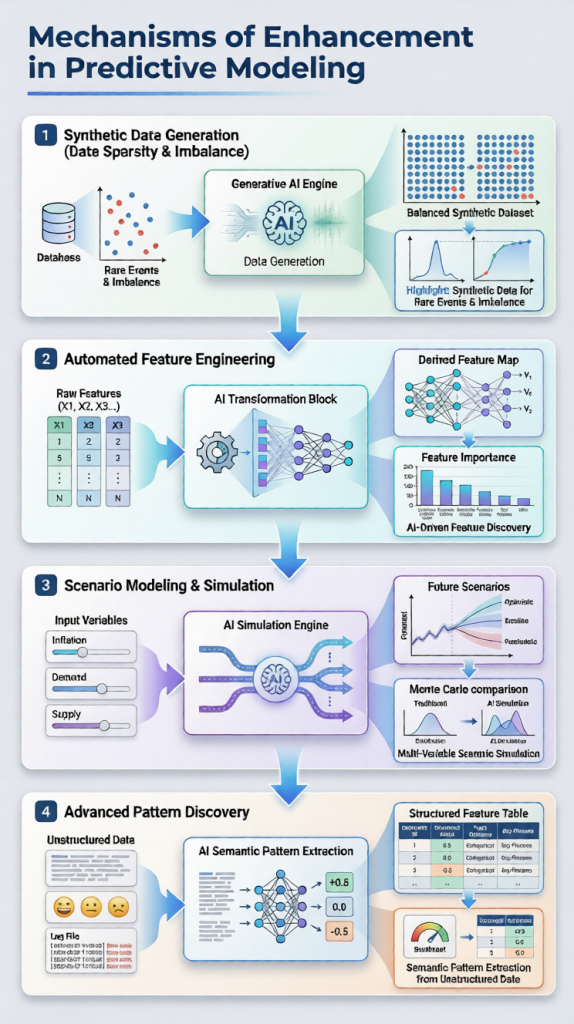
Generative AI enhances predictive analytics through several technical mechanisms that address common bottlenecks in the data science lifecycle.
- Synthetic Data Generation for Sparsity and Imbalance:
One of the most significant hurdles in predictive modeling is the lack of high-quality, diverse data, particularly for rare events such as fraud. Generative models can produce synthetic datasets that maintain the statistical properties of real-world data without compromising privacy. This allows models to be trained on balanced datasets, significantly improving their ability to detect anomalies and infrequent patterns.
- Automated Feature Engineering and Enrichment
Feature engineering, the process of selecting and transforming variables to improve model performance, is often the most time-consuming aspect of modeling. Generative AI can automate the identification of latent features and suggest new variable combinations that human analysts might overlook, thereby increasing the predictive power of the final model.
- Scenario Modeling and Simulation:
Traditional forecasting often struggles with multi-variable "what-if" scenarios. Generative AI can simulate thousands of potential future states by varying input parameters in a way that traditional Monte Carlo simulations cannot match for complexity. This provides a more robust foundation for stress-testing predictive models against economic shifts or supply chain disruptions.
- Pattern Discovery Beyond Traditional Statistics:
While traditional ML is excellent at finding linear and non-linear correlations, generative AI can identify deeper semantic relationships within unstructured data, such as sentiment in customer reviews or technical specifications in logs,s and convert these into structured inputs for predictive algorithms.
For senior professionals looking to master these specific mechanisms of enhancement, the Post Graduate Program in Data Science with Generative AI: Applications to Business from the McCombs School of Business at The University of Texas at Austin provides a comprehensive, structured path.
Post Graduate Program in Data Science with Generative AI: Applications to Business
Learn how to turn data into strategy in this UT Data Science and Business Analytics Course — now with a focus on Generative AI. Gain practical experience through 7 hands-on projects over a 7-month duration.
This program is designed to bridge the gap between traditional predictive capabilities and the creative automation of Generative AI, empowering leaders to drive intelligent business transformation.
By blending foundational statistical rigor with cutting-edge tools, you will learn to solve complex business challenges and stay ahead in an evolving digital ecosystem.
What You Will Gain:
- Hands-on Technical Proficiency: Master over 15 industry-standard tools and technologies, including Python, ChatGPT, Hugging Face, NumPy, Pandas, Scikit-learn, Tableau, and SQL.
- Extensive Practical Exposure: Work through 7 hands-on projects and over 40 real-world case studies. You will tackle diverse scenarios such as Hotel Booking Cancellation Prediction, Restaurant Review Analysis using LLMs, and Dynamic Pricing Models for device sellers.
- Specialized AI Workflows: Build expertise in Prompt Engineering, utilize Large Language Models (LLMs), and apply AI-powered text analysis to extract strategic insights.
- End-to-End Modeling Skills: Develop the ability to build, test, and deploy Machine Learning and Generative AI solutions that predict trends, support real-time decisions, and personalize consumer experiences.
Whether you are a mid- to senior-level leader aiming to influence business strategy or a professional transitioning into data science, this program provides the foundation to lead with innovation and impact.
Impact on Predictive Modeling Workflows
Integrating generative AI into the predictive pipeline fundamentally alters the workflow, shifting the focus from manual data manipulation to high-level architectural oversight.
1. Data Preparation and Augmentation
In the initial stages of the pipeline, generative tools serve as data cleaners and augmenters. They can fill in missing values by inferring contextually accurate data points rather than relying on simple mean or median imputation. This results in a cleaner, more robust dataset that serves as a stronger foundation for any subsequent modeling efforts.
2. Model Training and Validation
During training, generative AI can act as an "adversary" to help validate model robustness. By generating "edge case" data, it forces the predictive model to account for extreme variables, leading to improved generalization and reduced overfitting. This stress-testing is critical for models deployed in volatile environments.
3. Decision Support and Interpretability
One of the historical critiques of predictive modeling is the "black box" nature of complex algorithms. Generative AI can bridge this gap by providing natural language explanations for why a certain prediction was made.
By translating complex coefficient weights and feature importance into executive-level narratives, generative AI improves the interpretability and trustworthiness of predictive outputs.
Enterprise and Industry Use Cases
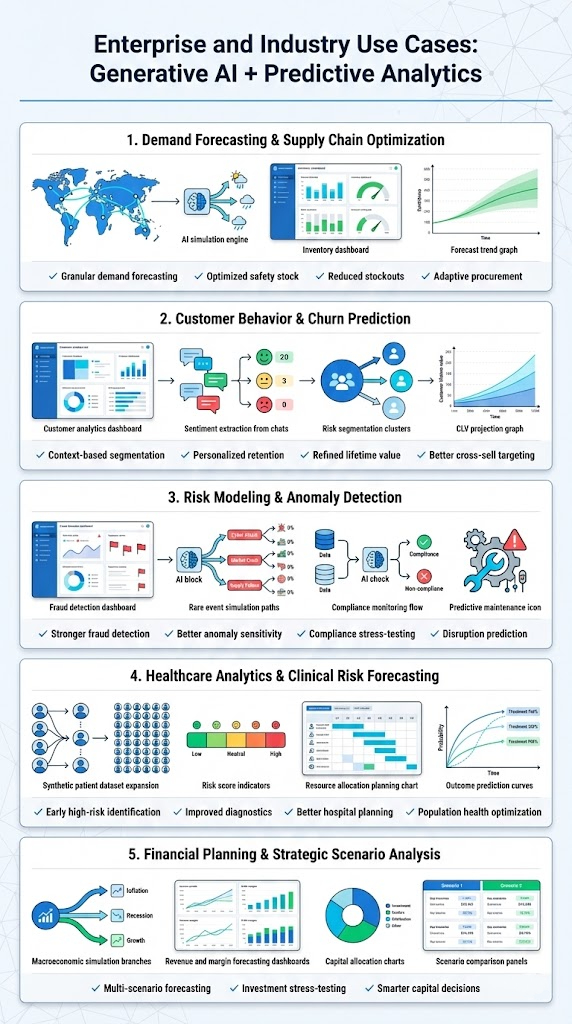
1. Demand Forecasting and Supply Chain Optimization
Generative AI can simulate complex global logistics disruptions such as port congestion, supplier instability, or geopolitical shifts while predictive models quantify their downstream effects on inventory, fulfillment timelines, and procurement cycles.
By integrating internal sales data with generatively processed external variables, such as weather trends or macroeconomic sentiment indicators, organizations can achieve:
- Granular, location-specific demand forecasting
- Improved safety stock optimization
- Reduced stockouts and overstock scenarios
- More adaptive procurement strategies
2. Customer Behavior and Churn Prediction
Predictive models identify customers with a high probability of churn based on behavioral signals and transactional data.
Generative AI enhances this process by analyzing unstructured sources such as support tickets, chat transcripts, and customer feedback to uncover nuanced dissatisfaction drivers. This combination enables organizations to:
- Segment customers based on contextual risk factors
- Develop personalized retention strategies beyond generalized incentives
- Refine customer lifetime value projections
- Improve cross-sell and upsell targeting accuracy
3. Risk Modeling and Anomaly Detection
In financial services and enterprise risk management, generative models can produce realistic fraud or threat scenarios to strengthen predictive systems against emerging attack patterns. By simulating rare but high-impact risk events, organizations can:
- Improve fraud detection model robustness
- Enhance anomaly detection sensitivity without increasing false positives
- Stress-test compliance monitoring systems
- Predict operational disruptions before escalation
Similarly, generative simulations of equipment malfunction scenarios can enhance predictive maintenance models, reducing downtime and optimizing asset lifecycle management.
4. Healthcare Analytics and Clinical Risk Forecasting
Generative AI can create synthetic patient data reflecting rare medical conditions or complex comorbidities, addressing data scarcity challenges in clinical modeling. Predictive systems trained on enriched datasets can better forecast treatment outcomes, readmission risks, and disease progression. This integrated approach supports:
- Early identification of high-risk patients
- Improved diagnostic accuracy using both structured and unstructured clinical data
- Enhanced hospital resource allocation planning
- More precise population health management strategies
5. Financial Planning and Strategic Scenario Analysis
Generative AI can simulate macroeconomic volatility, regulatory shifts, commodity price fluctuations, and market demand changes. Predictive analytics then evaluates the financial impact of these simulated scenarios on revenue, margins, and cash flow. Organizations benefit through:
- Multi-scenario financial forecasting
- Stress-testing of long-term investment strategies
- Improved capital allocation decisions
Limitations, Risks, and Governance Considerations
Despite the clear advantages, integrating generative AI into predictive workflows introduces specific challenges that require rigorous governance.
The primary risk involves synthetic data bias. If a generative model is trained on skewed data, it will propagate and even amplify those biases in the synthetic datasets it creates. If these datasets are then used to train predictive models, the resulting forecasts will be fundamentally flawed and potentially discriminatory.
Furthermore, there is the challenge of computational intensity. Generative models, particularly LLMs, require significant infrastructure and energy resources. Organizations must conduct a cost-benefit analysis to ensure the marginal gain in predictive accuracy justifies the increased computational expenditure.
Transparency remains a critical concern. As models become more complex by layering generative and predictive techniques, maintaining a clear audit trail for regulatory compliance becomes more difficult. Organizations must implement strict version control and "human-in-the-loop" validation to ensure that generative outputs remain grounded in reality and do not introduce "hallucinations" into the predictive pipeline.
Adoption Strategy and Best Practices
For enterprise leaders, a successful adoption strategy requires a balanced approach that prioritizes data integrity and business alignment.
- Align Use Cases with Objectives: Organizations should not deploy generative AI for the sake of novelty. Instead, they should identify specific predictive bottlenecks, such as poor data quality or lack of interpretability, and apply generative solutions specifically to those areas.
- Hybrid Modeling Frameworks: The most effective strategy involves combining generative outputs with traditional machine learning. For example, using generative AI for feature extraction and synthetic augmentation while retaining tried-and-tested regression models for the final prediction ensures reliability.
- Establish Robust Validation Protocols: Any synthetic data used for training must be validated against real-world distributions to ensure accuracy. Continuous monitoring of model performance is necessary to detect drift that may be introduced by generative components.
- Cross-Functional Expertise: Bridging the gap between traditional data science and generative AI requires a diverse team. Organizations should invest in training that covers both statistical modeling and prompt engineering/model fine-tuning to ensure a cohesive technical vision.
- Continuous Feedback and Model Refinement Loops:
The integration of generative and predictive systems should not be static. Establishing structured feedback mechanisms such as performance dashboards, stakeholder reviews, and automated retraining cycles ensures that models evolve alongside changing business conditions and emerging data patterns.
Conclusion
The convergence of generative AI and predictive analytics marks an evolution in the maturity of data science.
By addressing the inherent limitations of historical data, such as sparsity, imbalance, and lack of context, next-generation generative models provide a more fertile ground for predictive algorithms to operate.
The value of this integration lies not in replacing the statistical rigor of predictive modeling but in enhancing it through superior data preparation, scenario simulation, and interpretative clarity.
For the enterprise, this translates to forecasts that are not only more accurate but also more actionable, providing a tangible competitive advantage in an increasingly complex, data-packed change.