
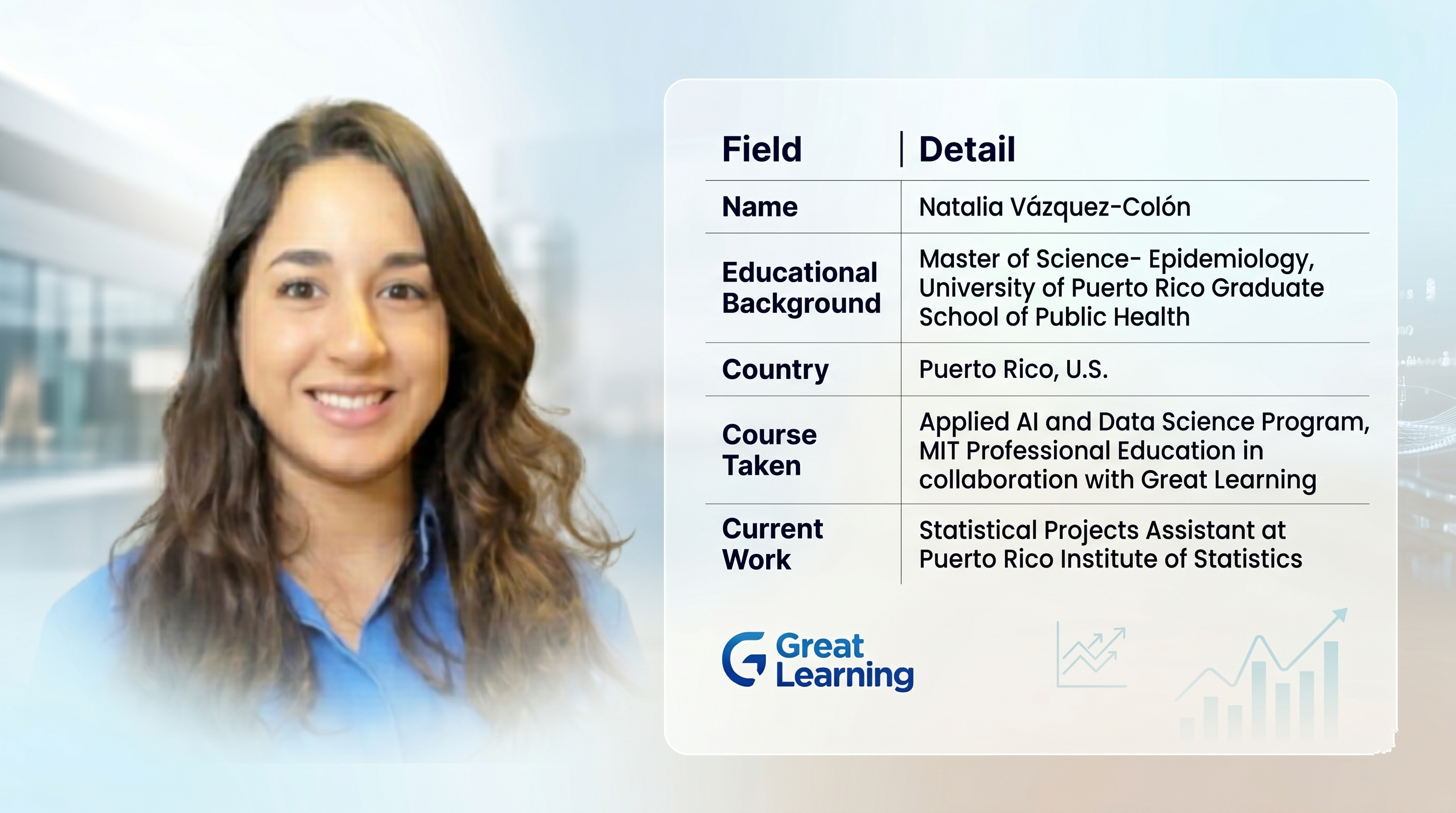
Natalia Vázquez-Colón had always lived at the intersection of numbers and impact. Trained in epidemiology and quantitative analysis, she had spent years working with surveillance data, building statistical models, and developing dashboards that helped public health systems make sense of complex, high-stakes information. She was good at her work. The problem wasn't her skill. It was the fragility of the sector in which she had built her career.
When public health funding became increasingly unstable, Natalia faced a choice that many analytically-minded professionals quietly dread: do you wait it out, or do you deliberately expand so that the uncertainty becomes irrelevant? She chose to widen her scope by investing in upskilling by enrolling in the Applied AI and Data Science Program from MIT Professional Education, offered in collaboration with Great Learning.
MIT Professional Education's Data Science Course
Gain the expertise top companies seek and open doors to Data Science jobs.
Before the Program
As she explored opportunities beyond public health, she began to encounter a consistent gap in the skills employers were seeking. machine learning and Python, in particular, were becoming essential requirements across industries such as finance, consulting, operations, and applied data science. While she already knew how to think like a scientist, she wanted to build like one, too.
She wasn't looking for a career reinvention. She was looking to expand her career, and she needed a program that understood the difference.
Why She Chose the MIT Professional Education Applied AI and Data Science Program?
For someone with Natalia's profile, technically grounded but looking to bridge from one analytical tradition into another, the choice of program mattered a lot. She needed something that would meet her at her level and provide genuine depth in areas where she had gaps.
Applied AI and Data Science Program from MIT Professional Education, offered exactly that combination: 27+ hours of live online sessions from MIT faculty, multiple hands-on projects, and a curriculum infused with the latest advancements in artificial intelligence and generative AI. The Program included extensive work with high-demand tools such as Python, TensorFlow, and ChatGPT.
The program's emphasis on real-world application, with 50+ case studies and a capstone project focused on solving actual business problems, matched how Natalia already thought about problems: from data to decision.
The program's recognition and institutional credibility also mattered. MIT is ranked #1 university in the world (QS World University Rankings in AI and Data
Science and the #2 national university in the U.S. (U.S. News & World Report). Upon completion, the program offered a Certificate of Completion from MIT
Professional Education and 16 Continuing Education Units (CEUs).
The Learning Journey: Scientific Thinking Meets Machine Learning
Natalia entered the program with strong statistical knowledge and exited it with a substantively expanded technical toolkit.
The curriculum covered foundational Python programming and statistics, machine learning model building and evaluation, deep learning, computer vision, recommendation systems, generative AI and prompt engineering, retrieval-augmented generation (RAG), and agentic AI approaches. She worked with tools including Python, TensorFlow, ChatGPT, Hugging Face Transformers, and OpenCV throughout the program.
The capstone project brought everything together in the most concrete way possible. Natalia built and evaluated machine learning models in Python for a loan default prediction problem, a genuine finance domain challenge that sits squarely within the program's sample capstone projects. It was her first sustained experience applying ML methodology to a finance domain, and it clicked in an important way.
That realization, that the discipline of thinking she had developed in epidemiology was the same discipline machine learning demanded, was more than reassuring. It was clarifying. She wasn't changing who she was professionally. She was extending what she could do.
Real Impact at Work
The proof is in how Natalia works now. She currently operates across two domains simultaneously, the financial sector and ongoing health-related projects, in a way that would have been much harder before the MIT Applied AI and Data Science Program gave her the technical vocabulary and tools to move fluidly between them.
The machine learning models she built during the program. The Python workflows she developed. The understanding of how to apply AI to structured prediction problems. These are now part of her professional toolkit, extending what her prior R-based training had built, because Python and ML opened different doors.
Her ability to work across finance and public health simultaneously isn't a compromise or a side effect. It's the outcome she designed for, and the program helped her get there.
Who Should Take This Program?
The program is designed for three professional profiles:
- Data Science & Analysis Professionals- Those in Data Science, Data Analysis, and related roles who wish to extract actionable insights from large volumes of data and build solid AI and Data Science solutions.
- AI & GenAI Skill-Builders- Professionals aiming to strengthen skills in AI, Generative AI, and Data Science through a broad program suited for both early-career professionals and senior managers.
- Technical & Business Managers- Professionals with a background in technical management, business intelligence, Data Science management, IT, management consulting, or business management, including AI enthusiasts.
What You Will Be Able to Do After This Program?
- Understand AI, GenAI & Data Science- Explore core concepts and real-world applications of AI, Generative AI, and Data Science.
- Choose Effective Data Representations- Transform and structure data to build more accurate, reliable Machine Learning models.
- Apply AI to Complex Problem Solving- Solve data-driven challenges and support decision-making across business functions.
- Explore Recommendation Systems- Understand the theory and applications of intelligent recommendation systems across industries.
- Work with Advanced Technologies- Apply AI to NLP, GenAI, Computer Vision, and Recommendation Systems.
- Build a Real Project Portfolio- Complete hands-on projects, including a 3-week Capstone that showcases your ability in meaningful business scenarios.
Frequently Asked Questions
Exposure to computer programming and a high school-level knowledge of Statistics and Mathematics. The program is not designed for complete beginners to analytical or technical work. Applicants are screened by a Great Learning panel on academic performance, work experience, and motivation.
USD 3,900 for the full 14-week program. The application process has three steps: complete the online form, pass the Great Learning screening panel, and receive your seat offer for the upcoming cohort.
Learners must score at least 60% in each course, including the Elective and Capstone Project. The program has a 92% completion rate.
Upon successful completion, learners earn a Certificate of Completion from MIT Professional Education and 16 Continuing Education Units (CEUs). Great Learning is the delivery and program management collaborator; MIT issues the credential.
Yes, Natalia's story is direct evidence. If you have quantitative research experience and some programming exposure (even in R), you meet the prerequisites and the low-code approach will ease your transition into Python-based ML.
MIT faculty lead live online sessions on Mondays, Wednesdays, and Fridays at 9:30 AM EST. Weekend mentored learning sessions are led by industry Data Science and ML experts. Recordings of all live sessions are available to review at your own pace. Total time commitment: 12–18 hours per week.
Course Details
| Course | Applied AI and Data Science Program |
| Provider | MIT Professional Education, delivered in collaboration with Great Learning |
| Duration | 14 Weeks |
| Live Sessions | Mondays, Wednesdays, and Fridays at 9:30 AM EST (MIT Faculty) |
| Mentorship | Weekend mentored learning sessions with industry experts |
| Weekly Commitment | 12 to 18 hours per week |
| Projects | 50+ case studies + hands-on projects + 3-week Capstone Project |
| Tools Covered | Python, TensorFlow, ChatGPT, Hugging Face Transformers, OpenCV |
| Credential | Certificate of Completion from MIT Professional Education + 16 CEUs |
| Prerequisites | Exposure to computer programming, high school-level statistics, and mathematics |
| Link | Learn More / Apply Now |