- How Are Data Analyst, Data Scientist, and ML Engineer Roles Different?
- What Does a Data Analyst Do?
- What Does a Data Scientist Do?
- What Does a Machine Learning Engineer Do?
- How Can You Choose the Right AI Career Based on Your Background?
- What Skills and Learning Opportunities Can Help You Get Started?
- Which AI Career Path Should You Pursue?
Artificial Intelligence and Data Science offer several career paths, but choosing the right one can be challenging. Data Analyst, Data Scientist, and Machine Learning Engineer are three popular roles in this field. Although they all work with data, their responsibilities, technical requirements, and outcomes differ considerably.
Understanding how these roles differ can help you identify a career direction that matches your strengths.
TL;DR
Choose an AI career path based on your interests and technical strengths. Data Analytics focuses on business insights, Data Science on statistical analysis and predictive modeling, and Machine Learning Engineering on building and deploying ML models.
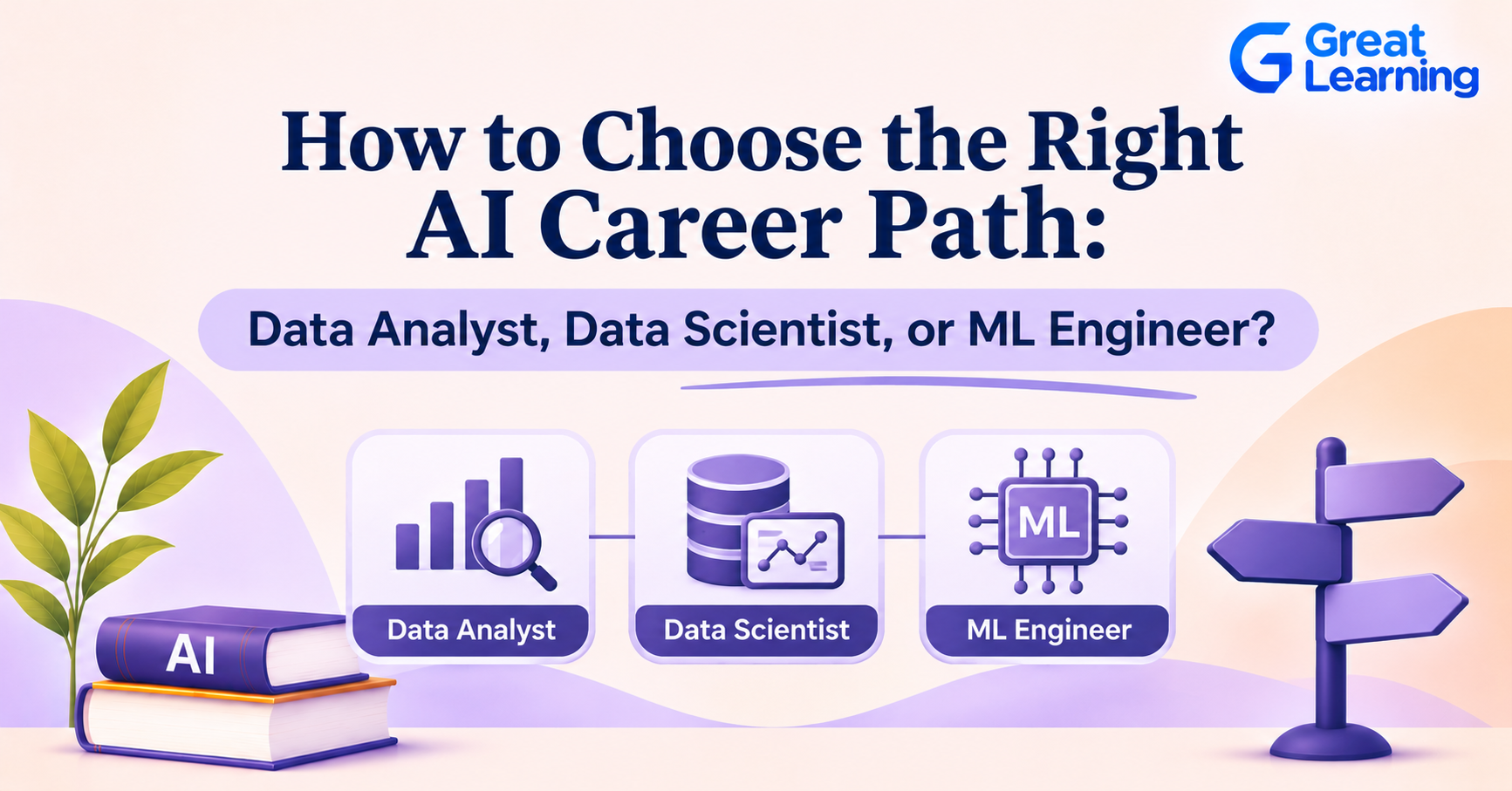
How Are Data Analyst, Data Scientist, and ML Engineer Roles Different?
The main difference is how each professional uses data to solve problems.
- Data Analyst: Examines existing data to identify trends, explain business performance, and support decisions.
- Data Scientist: Uses statistics, programming, and machine learning to investigate complex problems and develop predictive models.
- Machine Learning Engineer: Builds, deploys, and maintains machine learning models within software applications and production systems.
A Data Analyst explains what happened, a Data Scientist investigates what might happen, and an ML Engineer develops systems that use predictive models to perform tasks.
What Does a Data Analyst Do?
A Data Analyst examines datasets to identify patterns, prepare reports, and communicate insights that help organizations make informed decisions.
Key responsibilities:
- Collecting, cleaning, and organizing datasets.
- Analyzing trends and identifying patterns.
- Creating dashboards and visual reports.
- Preparing reports for business stakeholders.
- Presenting findings to support decisions.
Skills required: SQL, Excel, Python fundamentals, statistics, Power BI or Tableau, and data visualization.
Who should consider this role?
Data Analytics can suit graduates and professionals who enjoy working with numbers, interpreting business information, and communicating findings. People from finance, marketing, operations, and business administration can also build on their domain knowledge to enter this field.
What Does a Data Scientist Do?
A Data Scientist investigates complex problems using statistical methods, programming, and machine learning. Unlike analysts who primarily interpret existing information, Data Scientists develop models to identify patterns and estimate possible outcomes.
Key responsibilities:
- Exploring and analyzing large datasets.
- Applying statistical techniques to business problems.
- Developing and evaluating predictive models.
- Conducting experiments and testing hypotheses.
- Communicating findings and recommendations.
Skills required: Python or R, probability, statistics, machine learning algorithms, data preprocessing, feature engineering, and deep learning fundamentals.
Who should consider this role?
Data Science may appeal to people interested in mathematics, programming, experimentation, and analytical problem-solving. Engineering, mathematics, statistics, and computer science backgrounds can provide a strong foundation.
What Does a Machine Learning Engineer Do?
A Machine Learning Engineer focuses on converting machine learning models into applications that operate reliably in real-world environments. The role combines machine learning knowledge with software engineering and deployment practices.
Key responsibilities:
- Developing and implementing machine learning models.
- Building and optimizing ML pipelines.
- Integrating models into software applications.
- Deploying and monitoring models in production.
- Improving performance, scalability, and reliability.
Skills required: Advanced Python, machine learning, deep learning, software engineering, TensorFlow or PyTorch, APIs, Docker, cloud technologies, and model deployment.
Who should consider this role?
Machine Learning Engineering suits people who enjoy programming, algorithms, software architecture, and building technical solutions. Computer science and engineering graduates with strong coding foundations may find this path particularly suitable.
How Can You Choose the Right AI Career Based on Your Background?
Your educational background and professional experience can help narrow your career options. Start by considering what interests you and the skills you already have.
Consider the following comparison to understand which path may align with your strengths.

The career paths outlined above are starting points, not strict eligibility requirements. Your existing skills and professional interests can help you determine which role best aligns with your strengths.
To build the technical capabilities these roles require, consider the Artificial Intelligence and Machine Learning course, developed in collaboration with the McCombs School of Business at The University of Texas at Austin and Great Lakes Executive Learning. Its 12-month curriculum covers Python, Machine Learning, Deep Learning, and AI applications, supported by hands-on projects and industry mentorship.
PG Program in Artificial Intelligence & Machine Learning
Master AI, Machine Learning, Generative AI, Agentic AI, NLP, and Deep Learning with expert faculty and industry mentorship. Earn dual certificates from UT Austin and Great Lakes Executive Learning.
Before choosing a career path, assess your comfort with mathematics, coding, analytical reasoning, and software development. This can help you identify your skill gaps and determine which areas require further learning.
What Skills and Learning Opportunities Can Help You Get Started?
Regardless of your preferred role, building foundational knowledge can make the transition into AI and Data Science easier.
Focus on these areas:
- Programming: Learn Python and understand how it supports data analysis and machine learning.
- Mathematics and statistics: Develop familiarity with probability, statistical analysis, and relevant mathematical concepts.
- Data management: Practice SQL, data cleaning, preprocessing, and working with different datasets.
- Machine learning: Understand supervised and unsupervised learning, model training, and evaluation.
- Practical application: Complete projects that demonstrate how you use data and AI to solve problems.
If you prefer structured learning, the e-Postgraduate Diploma in Artificial Intelligence and Data Science from IIT Bombay offers an 18-month online learning pathway designed and delivered by IIT Bombay faculty.
IIT Bombay ePGD in AI & Data Science
Master AI and data analytics with IIT Bombay's e-Postgraduate Diploma. Build hands-on skills to advance your career.
Its curriculum includes programming for Machine Learning and Data Science, statistical foundations, Machine Learning, Deep Learning and GenAI, AI-ML in Practice, and electives. Learners also work on projects involving consumer behavior analysis, house price prediction, credit card default prediction, stock market activity, and language model applications.
The program covers tools such as Python, SQL, NumPy, Pandas, Scikit-learn, TensorFlow, PyTorch, and Hugging Face. This mix of coursework and practical projects can help learners explore different areas before choosing a specialization.
Which AI Career Path Should You Pursue?
Choosing between Data Analytics, Data Science, and Machine Learning Engineering starts with identifying the kind of problems you want to solve.
Rather than choosing a role based only on its popularity or perceived career opportunities, assess your existing strengths, technical interests, and willingness to develop new skills.
Work on small projects across data analysis, predictive modeling, and machine learning implementation to understand which activities you enjoy most. This practical exposure can help you make a more informed career decision and identify the learning path that aligns with your long-term goals.