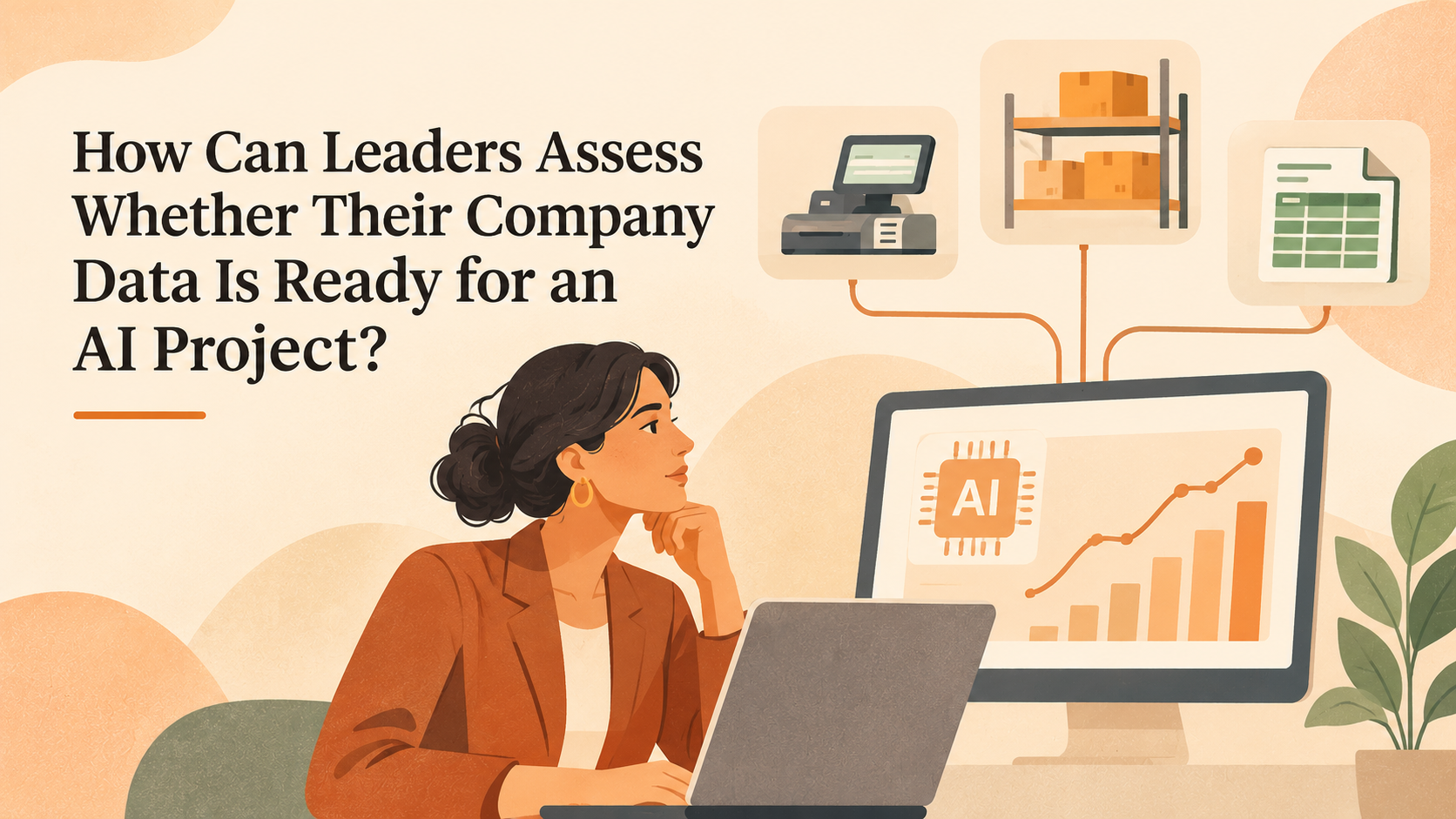
An AI project can fail when data is fragmented or inaccessible. A retailer may store sales in its POS system, inventory in its ERP, and supplier updates in spreadsheets. It has data, but not necessarily a usable foundation.
Dun & Bradstreet's October 2026 AI Momentum Survey of 10,000 businesses across 32 countries found that only 8% consider their enterprise data fully ready for AI at scale. Among businesses with fully ready data, 81% report broad or strong AI returns, compared with 12% of those with partially ready data.
Before funding AI, leaders must assess whether the business problem, data, and infrastructure are aligned.
1. Define the business decision
What should AI improve: stockouts, excess inventory, or replenishment delays? Set a baseline and identify who will act on recommendations. Also ask whether AI is necessary: a rules-based process may need conventional automation.
2. Map the data and identify its owners
Work backwards from the use case. Demand forecasting may require sales, inventory, returns, promotions, supplier lead times, and stockout records from POS, ERP, warehouse, and supplier systems.
Identify who is accountable for each source’s quality, updates, and access approvals. Check whether systems use consistent product and location identifiers.
3. Test whether the data is fit for the task
Ask the data team to assess completeness, accuracy, consistency, freshness, and representativeness. Are fields missing? Do records reflect actual events? Do systems use matching codes and units? Are updates timely, and does data cover relevant products, locations, and seasons?
Without inventory availability data, a model may mistake stockouts for low demand. Banking models must account for changing policies and customer mix.
Build non-technical AI evaluation skills through the AI for managers program.
Post Graduate Program in Artificial Intelligence for Leaders
Turn insights into action—use AI to make faster decisions, optimize teams, and lead digital transformation.
4. Confirm access, privacy, and permissions
Check rights to use personal data and restrict access to authorized users. A healthcare provider cannot assume patient records can be transferred to an external AI tool.
Agentic AI projects add another concern: autonomous agents need controlled system access and permissions. Read how project managers manage AI workflows, risks, and outcomes.
5. Check whether the architecture can support the workflow
Can systems exchange data reliably? Does the project need real-time updates or will a daily feed work? Can infrastructure handle the volume, and are transformations traceable?
Retailers adjusting replenishment daily need fresher data than those forecasting weekly. These requirements affect integration costs and timelines. Project managers also need technical fluency to work with engineering teams; this project manager’s experience developing AI and data science skills through MIT IDSS illustrates why.
6. Price the gaps before approving funding
Before funding, confirm the business outcome, data sources, ownership, quality, access, privacy, and architecture have been assessed. Estimate the cost and time to resolve gaps.
Classify each area as ready, requiring remediation, or unresolved. Then run a pilot using representative data excluded from training. Compare results with the existing process before funding a wider rollout.
For an outcome-focused data strategy, consider JHU’s Certificate Program in AI for Business Strategy; for enterprise AI governance and scaling, check the AI for Senior Executives Program.
JHU Certificate Program in AI Business Strategy
Master the AI landscape and drive business value. Learn key frameworks to devise and manage large-scale AI projects in your organization.
Data readiness is not a one-time approval gate. It means matching reliable, governed information to a business decision and strengthening that foundation as AI scales.