
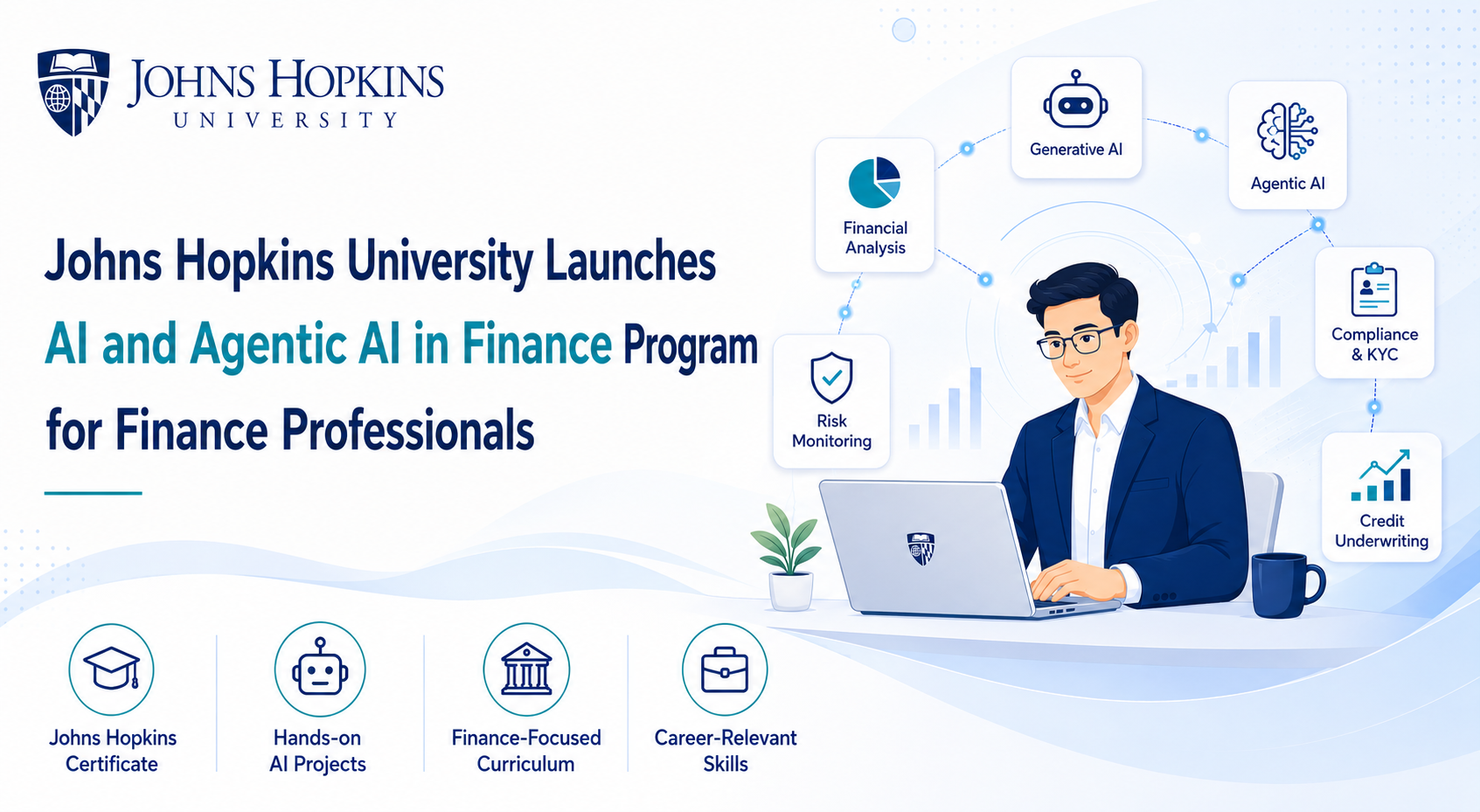
- The 13-week online program focuses on applying Generative AI and Agentic AI across financial analysis, compliance, credit underwriting, risk monitoring, and finance operations.
- Participants will learn through recorded lectures, monthly masterclasses from Johns Hopkins University faculty, live mentorship from industry experts, case studies, and hands-on projects.
- Successful participants will receive a Certificate of Completion and 10 Continuing Education Units from Johns Hopkins University.
Johns Hopkins University has announced the launch of its AI and Agentic AI in Finance program, a 13-week online offering designed for professionals working across finance, investment, risk, compliance, credit, underwriting, and financial strategy.
The Agentic AI in Finance course by Johns Hopkins University addresses a growing need within financial institutions. Organizations now have access to advanced AI tools, but many finance teams still lack the technical understanding, governance frameworks, and strategic judgment required to use them in regulated financial environments.
JHU AI and Agentic AI in Finance
Develop skills in financial analysis, credit decision-making, and compliance automation. Master AI workflows and earn a certificate from JHU.
The curriculum combines core AI concepts with finance-specific applications. Participants will study Generative AI, Prompt Engineering, Natural Language Processing, Retrieval-Augmented Generation, explainable AI, compliance automation, autonomous agents, and multi-agent systems.
Why AI in Finance Matters Now
AI adoption across finance has increased, but the transition from small experiments to business-critical workflows remains limited.
According to The State of AI in Finance 2026, 56% of finance leaders use AI, twice the adoption rate recorded in 2023. Yet 45% of finance teams remain at the pilot stage, while only 17% have integrated AI into core workflows.
This gap points to a challenge beyond access to technology. Finance professionals need to assess AI outputs, manage model risks, maintain audit trails, protect financial data, meet regulatory requirements, and decide where human review must remain part of a workflow.
The new program aims to help professionals move beyond general AI awareness and develop practical knowledge for evaluating, designing, and governing AI systems in financial settings.
Curriculum and Learning Outcomes
The curriculum begins with a pre-work module covering the finance functions environment, differences between traditional machine learning, Generative AI, and Agentic AI, agent fundamentals, and prompting techniques.
Participants then study how AI is used across financial services and how to separate established applications from early-stage pilots and aspirational use cases. The program also examines the role of human oversight in financial workflows.
Natural Language Processing forms another part of the curriculum. Participants learn how AI systems process earnings calls, regulatory filings, market commentary, and other financial documents. They also study sentiment analysis and methods for evaluating whether an AI-generated signal is reliable enough to support a decision.
The program covers structured and unstructured financial data, Prompt Engineering, data validation, privacy risks, and Personally Identifiable Information. Participants then study Retrieval-Augmented Generation and how financial institutions might use source-grounded systems to produce traceable responses based on regulatory documents.
Compliance and Responsible AI
A major part of the program focuses on regulated financial workflows.
Participants explore how structured prompt chains support Know Your Customer and Anti-Money Laundering processes. Topics include customer due diligence, sanctions screening, Politically Exposed Person checks, fuzzy matching, error handling, workflow logging, and audit-ready reasoning.
The curriculum also examines AI-assisted fraud detection. Participants study precision, recall, false alarms, missed fraud, alert triage, and the role of human review in fraud investigation workflows.
In credit decision-making, the program covers machine learning-based scoring, AI-generated underwriting memos, key credit ratios, explainable AI, and SHAP analysis. These topics help participants understand how financial institutions might improve speed and consistency while maintaining transparency and regulatory oversight.
Agentic AI for Financial Workflows
The later stages of the program move from AI-supported tasks to autonomous and multi-agent workflows.
Participants learn how agents use tools, memory, reasoning, and iterative action loops to monitor portfolio risk and generate structured assessments. The curriculum also examines how multiple agents divide work, exchange information, retrieve supporting evidence, and collaborate across complex financial processes.
Alongside system design, participants study agent failure modes, including repeated loops, conflicts between agents, cascading errors, rising inference costs, and missing human checkpoints.
The governance module asks participants to assess AI initiatives based on business value, explainability, auditability, security, operational risk, and financial viability. The module also introduces a framework for deciding whether an organization should build an AI system internally or purchase an external solution.
Projects and Finance-Focused Case Studies
The program includes hands-on projects and case studies based on finance operations, investment research, compliance, credit risk, and portfolio management.
Indicative projects include an automated invoice reimbursement system. The system processes documents, extracts invoice information, checks reimbursement policies, and produces auditable decisions through a Retrieval-Augmented Generation pipeline.
Another project involves developing a multi-agent credit memo underwriting system. Participants work with loan data to classify borrower risk, conduct policy and KYC checks, and produce structured credit memos supported by explainable reasoning.
Sample case studies cover earnings call sentiment analysis, KYC and AML compliance pipelines, AI-augmented credit memos, portfolio risk monitoring agents, and a multi-agent “Bank-in-a-Box” system. The last case study brings together agents working across investment analysis, compliance review, and risk assessment to produce financial recommendations and decision memos.
Program Delivery and Learner Experience
The program runs for 13 weeks and requires an estimated weekly commitment of six to eight hours.
Delivery combines recorded video lectures, monthly live masterclasses led by Johns Hopkins University faculty, and weekend mentorship sessions with industry experts. Participants also receive access to case studies, practical projects, peer groups, discussion forums, AI-assisted academic support, and a dedicated program manager.
The program includes a Claude-based AI workflows module covering Prompt Engineering, model selection, agent orchestration, tool integration, the Model Context Protocol, workflow reliability, cost considerations, and responsible AI principles. An optional module also explores AI-assisted workflows for Excel and Google Sheets. Learners will also explore tools such as Claude, Claude Code, and NotebookLM.
Faculty and Industry Expertise
The curriculum is led by Johns Hopkins University faculty and industry specialists with experience across artificial intelligence, financial systems, analytics, and agent technologies.
Faculty members featured in the program include Dr. Ian McCulloh, Manager of Artificial Intelligence Executive and Professional Education at Johns Hopkins University, and Dr. Jim Kyung-Soo Liew, Senior Lecturer at the Johns Hopkins Whiting School of Engineering.
Their experience spans applied AI, machine learning, human behavior, financial markets, fintech, blockchain, data science, and entrepreneurship.
Who Is the Program For?
The program is designed for finance professionals who have a foundational understanding of finance. Previous experience in artificial intelligence or machine learning is not required.
The intended audience includes:
- Financial planning and analysis, corporate finance, and treasury professionals working with forecasting, reporting, and financial analysis.
- Investment research, asset management, and fintech professionals interested in AI-supported research, portfolio monitoring, and decision support.
- Risk, compliance, credit, and underwriting professionals responsible for explainable, regulated, and auditable workflows.
- Finance leaders and strategy professionals assessing AI investments, proofs of concept, business value, and operational feasibility.
- Financial consultants and advisors evaluating AI providers and supporting client adoption strategies.
Certificate and Program Recognition
Participants who successfully complete the program will receive a Certificate of Completion and 10 Continuing Education Units from Johns Hopkins University.
The program also supports the development of an e-portfolio that documents project work, applied skills, and experience with selected AI tools and financial workflows.
About Johns Hopkins University
Johns Hopkins University brings together expertise in Artificial Intelligence, applied Machine Learning, Deep Learning, Finance, and interdisciplinary research. The program draws on this academic and research foundation to examine how AI systems operate within financial environments where accuracy, explainability, regulation, and human judgment hold significant importance.
About Great Learning
Great Learning is a leading global ed-tech company for professional and higher education. It develops industry-relevant programs in collaboration with leading academic institutions, including Johns Hopkins University, across technology, data, and business domains. Its programs have reached more than 15 million learners across over 170 countries.