
- Why AI in Healthcare Matters Now
- Curriculum and Learning Outcomes
- Agentic AI for Healthcare Workflows
- From AI Pilots to Healthcare System Deployment
- AI Governance and Responsible Healthcare Deployment
- Projects and Healthcare-Focused Case Studies
- Program Delivery and Learner Experience
- Faculty and Industry Expertise
- Who Is the Program For?
- Certificate and Program Recognition
- FAQs
- About Johns Hopkins University
- About Great Learning
- The 9-week online AI and Agentic AI in Healthcare Program focuses on applying Gen AI and Agentic AI across clinical decision support, healthcare workflow automation, revenue cycle management, EHR integration, and AI governance.
- Participants will learn through recorded lectures, live masterclasses from Johns Hopkins University faculty, weekly mentorship from industry experts, healthcare case studies, and hands-on projects.
- Successful participants will receive a Certificate of Completion and 7 Continuing Education Units from Johns Hopkins University.
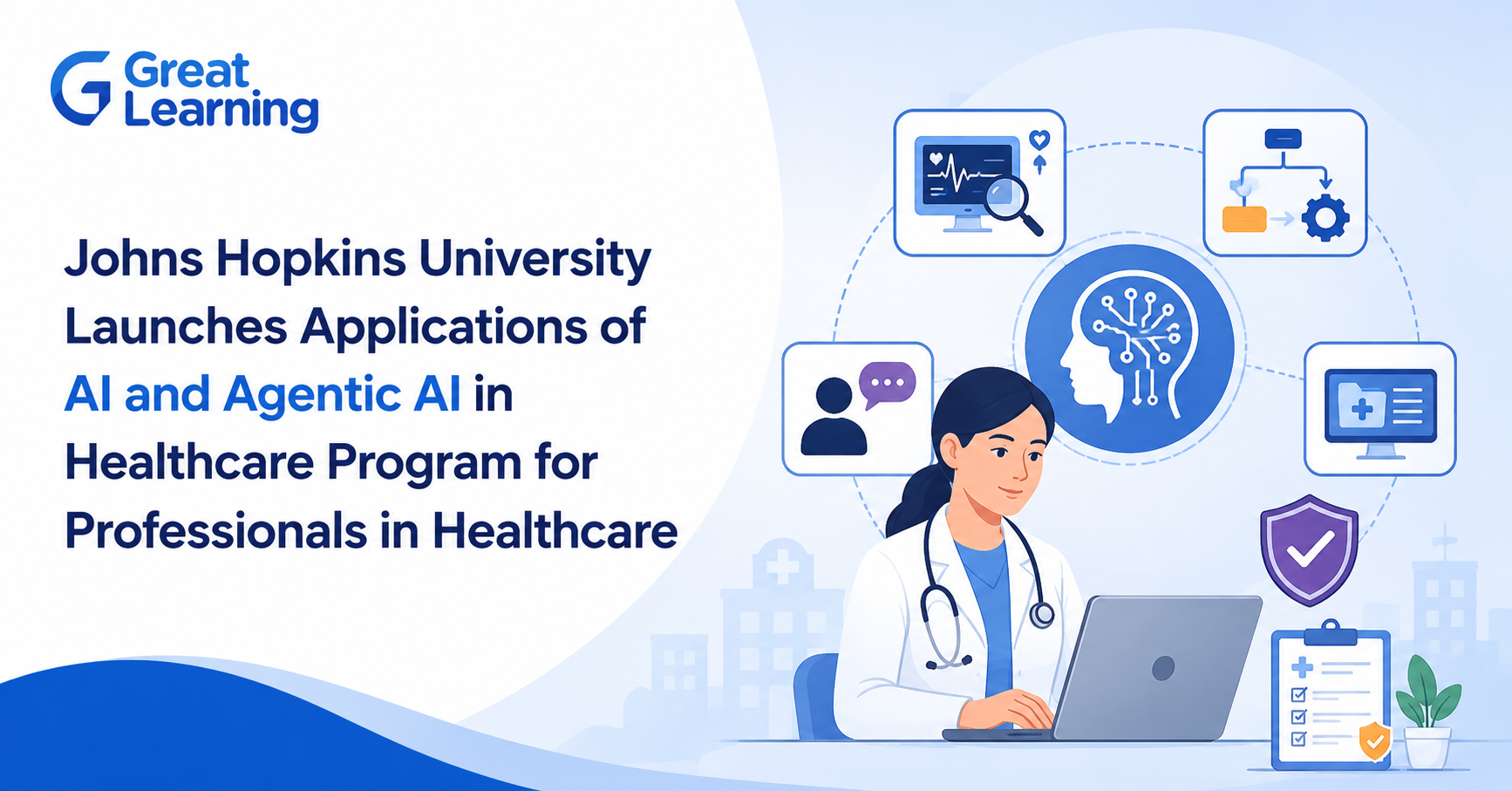
Johns Hopkins University has launched the Applications of AI and Agentic AI in Healthcare program, a 9-week online healthcare program designed for professionals working across healthcare, clinical practice, research, operations, technology, compliance, and leadership. The program focuses on applying AI to real clinical and operational settings, from documentation and clinical decision support to revenue cycle automation and healthcare system deployment.
The program addresses a shift taking place across healthcare organizations. AI is increasingly being used in clinical documentation, medical research, diagnostics, decision support, and administrative workflows. According to the Augmented Intelligence Report 2026 cited in the program brochure, 81% of physicians now use AI in their practices, compared with 38% in 2023.
As AI becomes more integrated into healthcare workflows, professionals need to understand more than how to use individual AI tools. They also need to evaluate outputs, identify appropriate use cases, understand clinical and operational risks, integrate AI with existing systems, and determine where human oversight is necessary.
Why AI in Healthcare Matters Now
The growing use of AI in healthcare is changing how clinical and administrative work is performed. However, adoption also introduces questions around reliability, patient safety, data privacy, regulatory compliance, and accountability.
Healthcare professionals may need to assess whether an AI-generated recommendation is reliable enough to support a clinical or operational decision. They may also need to understand how an AI system handles patient information, how its outputs can be validated, and how it should be monitored after deployment.
The program therefore focuses on the full clinical AI lifecycle rather than AI tools in isolation. Participants examine how to identify high-impact use cases, evaluate AI outputs, validate models, integrate AI into healthcare workflows, and establish governance processes for responsible deployment.
Applications of AI and Agentic AI in Healthcare
Build, deploy, and govern AI applications in healthcare. Master low-code tools to optimize patient care and clinical workflows with Johns Hopkins.
Curriculum and Learning Outcomes
The program begins with a pre-work module covering AI and Machine Learning fundamentals, applications across clinical and operational settings, differences between general-purpose LLMs and specialized healthcare models, and the tools used throughout the program.
The first module introduces the clinical AI landscape and the foundations of Generative AI and Agentic AI. Participants examine the clinical AI lifecycle, healthcare use cases, Prompt Engineering, AI safety evaluation, AI-assisted coding, LLMs, AI agents, and RAG systems.
During the AI-assisted coding component, participants use natural-language prompts with tools such as ChatGPT and Claude to generate, explain, and debug Python code. They also work with Jupyter Notebooks and Google Colab, without requiring prior programming experience.
The program then moves into practical healthcare applications. Participants explore clinical decision support systems and learn how to prepare patient records for AI models, handle missing clinical information, and explain predictions to clinicians.
Another part of the curriculum focuses on evaluating AI systems. Participants study pragmatic randomized controlled trial methodology, bias and fairness evaluation, survival analysis, power analysis, and clinical validation using readmission prediction as a case study.
Agentic AI for Healthcare Workflows
The program examines how AI agents can extend healthcare workflows beyond individual AI-assisted tasks. Participants explore agentic AI frameworks, multi-agent orchestration, RAG, and applications in revenue cycle processes, including medical coding, claims processing, and payer policy interpretation, with an emphasis on human oversight.
They also examine the differences between chatbots and AI agents, including memory, tools, and decision-making, and work through a guided n8n workflow for healthcare applications.
From AI Pilots to Healthcare System Deployment
The program also addresses the challenges of moving AI from prototypes to production, covering EHR integration, enterprise scaling, human-in-the-loop design, and governance.
In Week 7, participants explore the Epic ecosystem and interoperability standards such as FHIR and CDS Hooks, along with n8n workflows for connecting AI outputs with Epic. The following week focuses on scaling AI across healthcare organizations, including deployment readiness, clinical adoption, change management, and human oversight.
AI Governance and Responsible Healthcare Deployment
Governance is a key part of the curriculum, covering HIPAA, the EU AI Act, GDPR, FDA Software as a Medical Device guidance, and the HTI-1 rule.
Participants also examine liability, medical malpractice, model drift, bias, data shifts, and compliance auditing, highlighting the importance of patient safety, privacy, explainability, and accountability when deploying AI in healthcare.
Projects and Healthcare-Focused Case Studies
The program includes hands-on projects covering clinical, operational, and administrative healthcare use cases.
The capstone takes a healthcare AI use case from problem framing to a governance-ready deployment plan, with indicative tracks including a 30-day readmission risk tool, prior authorization automation, and AI-assisted clinical documentation.
The project brings together concepts such as prompting, AI-assisted coding, prediction modeling, clinical validation, agentic workflows, Epic integration, enterprise deployment, and AI governance.
Program Delivery and Learner Experience
The nine-week program requires an estimated eight to ten hours per week and combines recorded lectures, live masterclasses by Johns Hopkins University faculty, and weekly mentorship sessions with industry experts. Participants also receive access to case studies, hands-on projects, peer groups, discussion forums, and academic support.
The program includes two live masterclasses covering AI career paths in healthcare and emerging applications such as Generative AI for clinical documentation, multimodal models, decision support, and agentic healthcare workflows.
Participants can also access a self-paced Claude-based AI workflows module covering model selection, API integration, agentic workflow design, tool integration, and enterprise deployment. A Claude subscription is required for this module.
Faculty and Industry Expertise
The program is delivered by Johns Hopkins University faculty with expertise across AI, healthcare, Machine Learning, analytics, and clinical applications.
Featured faculty include Daniel Byrne, Dr. Ian McCulloh, Dr. Robert Stevens, and Dr. Ahmed Hassoon, with expertise spanning healthcare AI evaluation, clinical informatics, AI governance, regulatory compliance, and healthcare AI deployment.
Weekly mentorship is provided by industry practitioners, with the indicative mentor list including G Anthony Reina, Sharath M S, and Rishov Chatterjee. The brochure notes that mentors are industry practitioners and are not members of the Johns Hopkins University faculty.
Who Is the Program For?
The program is designed for healthcare professionals who want to apply AI to clinical, operational, and administrative challenges. Previous coding experience is not required.
The intended audience includes:
- Medical practitioners and researchers interested in AI-assisted clinical decision-making, documentation, and workflow optimization.
- Healthcare leaders and executives responsible for AI initiatives, operational efficiency, deployment strategies, and measuring clinical and financial ROI.
- Regulators, compliance officers, and policymakers working on healthcare AI governance, privacy, safety, bias, and regulatory requirements.
- Healthcare consultants and technology professionals working with healthcare data, predictive clinical decision support systems, and workflow automation.
Certificate and Program Recognition
Participants who successfully complete the program receive a Certificate of Completion from Johns Hopkins University along with 7 Continuing Education Units. The program also includes a portfolio of hands-on projects that document applied work with AI tools and healthcare workflows.
FAQs
Do I need a coding background to enroll?
No. The program is built for learners with no prior programming experience, using guided notebooks and AI-assisted coding.
What is the fee of the program?
Please contact a Program Advisor regarding fee structure, payment plans, available offers, and financial assistance options.
Are the mentors Johns Hopkins faculty?
No. Mentors are industry practitioners who provide weekly guidance; program faculty are separate and listed above.
What credentials do I get on completion?
A Certificate of Completion and 7 Continuing Education Units from Johns Hopkins University.
About Johns Hopkins University
Johns Hopkins University brings together expertise across healthcare, engineering, Artificial Intelligence, Machine Learning, medicine, and public health. The program draws on this interdisciplinary environment to examine AI applications in healthcare settings where clinical judgment, safety, validation, and regulatory considerations are important.
About Great Learning
Great Learning is a leading global ed-tech company for professional and higher education. It develops industry-relevant programs in collaboration with leading academic institutions, including Johns Hopkins University, across technology, data, and business domains. Its programs have reached more than 15 million learners across over 170 countries.