

Every successful business, from startups to global enterprises, has one thing in common: a well-defined marketing strategy. Great products matter, but long-term growth depends on reaching the right audience, communicating the right message, and consistently delivering value.
A marketing strategy is the roadmap that guides all marketing decisions, helping businesses understand their customers, differentiate from competitors, and hit measurable goals. Without one, even creative campaigns struggle to deliver results.
This guide covers what a marketing strategy is, why it matters, its key components, how to build one, and real-world examples.
What Is a Marketing Strategy?
A marketing strategy is a long-term plan that outlines how a business will attract, engage, and retain customers to achieve its objectives. It defines the target audience, value proposition, competitive positioning, marketing channels, and success metrics.
Unlike individual campaigns, which promote a product for a limited period, a strategy provides long-term direction for all marketing activity, ensuring every campaign and customer interaction supports broader business goals.
A good strategy answers:
- Who are your ideal customers?
- What problems do they face?
- How does your product solve those problems?
- Why should customers choose you over competitors?
- Which channels will deliver the best results?
Why a Marketing Strategy Matters
Many businesses spend heavily on advertising without a clear strategy first, leading to inconsistent messaging, wasted budgets, and weak results. A strong strategy aligns marketing with business objectives and gets sales, marketing, product, and customer service teams working toward common goals.
Key benefits:
- Clear direction: resources go toward initiatives that support growth, not random campaigns.
- Better customer understanding: research into demographics, behavior, and pain points enables personalization.
- Competitive advantage: a defined strategy clarifies what makes you different.
- Optimized budgets: spend flows to the highest-return channels.
- Brand consistency: the same value proposition shows up everywhere, from website to social to email to ads.
- Better decisions: strategy becomes the framework for launches and new markets.
- Measurable performance: clear KPIs let you track and improve over time.
Key Components of a Marketing Strategy
1. Business Goals
Marketing should support broader objectives: revenue growth, market share, product launches, expansion, retention, or brand awareness. Clear goals provide direction and a way to measure success.
2. Target Audience
Rather than marketing to everyone, identify ideal customers by age, gender, location, income, occupation, interests, buying behavior, challenges, and purchase motivations. Buyer personas, detailed profiles of ideal customers, help marketers craft relevant messaging and pick the right channels.
3. Market Research
Good strategy relies on data, not assumptions. Research should cover industry trends, customer expectations, emerging opportunities, demand, consumer behavior, and pricing preferences, gathered through surveys, interviews, competitor analysis, analytics, and industry reports.
4. Competitive Analysis
Understanding competitors, including their products, pricing, channels, content, reviews, positioning, strengths, and weaknesses, reveals opportunities to stand out. A SWOT analysis (Strengths, Weaknesses, Opportunities, Threats) is a common tool here.
5. Unique Value Proposition (UVP)
Your UVP explains why customers should choose you. It should communicate the problem you solve, the benefits customers get, what differentiates you, and why your solution is more valuable.
For example, instead of "We offer online courses," a stronger UVP is: "Gain job-ready skills through industry-led online programs featuring hands-on projects, mentorship, and career support."
6. Marketing Channels
Common channels include SEO, content marketing, social media, email, paid advertising (PPC), influencer marketing, affiliate marketing, webinars/events, PR, and video. Focus on where your audience actually spends time rather than trying every platform.
7. Budget and Resource Allocation
A realistic budget covers ad spend, content creation, SEO tools, marketing automation, creative design, events, and agency/freelancer costs. Strategic allocation maximizes ROI while keeping spend sustainable.
8. Key Performance Indicators (KPIs)
Track website traffic, organic rankings, lead generation, customer acquisition cost (CAC), conversion rate, CTR, ROAS, customer lifetime value (CLV), email open rates, and revenue growth to know what's working.
You can strengthen these skills through management courses that cover market research, strategic planning, consumer behavior, and business analytics. An Online MBA in Marketing can provide a broader understanding of marketing strategy, business management, and consumer-focused decision-making.
How to Create a Marketing Strategy: Step-by-Step
1. Define your business and marketing goals.
Use the SMART framework (Specific, Measurable, Achievable, Relevant, Time-bound). For example, increase revenue 20% this year, or generate 1,000 qualified leads a month.
2. Research your target market.
Combine primary research (surveys, interviews, feedback) with secondary research (industry reports, competitor sites, market studies) to understand competitors, customer needs, market size, and trends.
3. Understand your customers.
Build buyer personas covering demographics, professional background, interests, goals, pain points, preferred channels, and purchasing behavior. A B2B SaaS strategy targeting IT managers looks very different from one for a Gen Z fashion brand.
4. Analyze your competitors.
Evaluate their product offerings, pricing, website experience, SEO, social presence, content, reviews, and positioning, not to copy them, but to find gaps you can fill better.
5. Develop your value proposition and messaging.
Answer: What problem do you solve? How do you solve it? Why are you different? Keep messaging consistent across every touchpoint.
6. Choose the right marketing channels.
Select platforms based on audience behavior: SEO, content, email, social, paid ads, influencer and video marketing, affiliates, webinars, and partnerships. An omnichannel approach often performs best.
Once you've built a marketing strategy, the next step is executing it across digital channels. For learners looking to build foundational knowledge in this area, an Online BBA in Digital Marketing can provide exposure to digital marketing concepts alongside core business fundamentals.
7. Allocate your budget.
Decide how much to invest and where, including advertising, tools, content, design, automation, events, and agency support, then shift spend toward what performs.
8. Measure, analyze, and optimize.
Track traffic, conversions, leads, CAC, CLV, ROI, email engagement, and organic performance. Strategies should evolve as customer behavior and market trends shift.
You can strengthen these skills through management courses that cover market research, strategic planning, consumer behavior, and business analytics. An online MBA can also help professionals build broader knowledge across business, management, and strategic decision-making.
Advance your career with an AICTE-approved online PGDM from Great Lakes. Build management and leadership skills with a cutting-edge curriculum designed for working professionals.
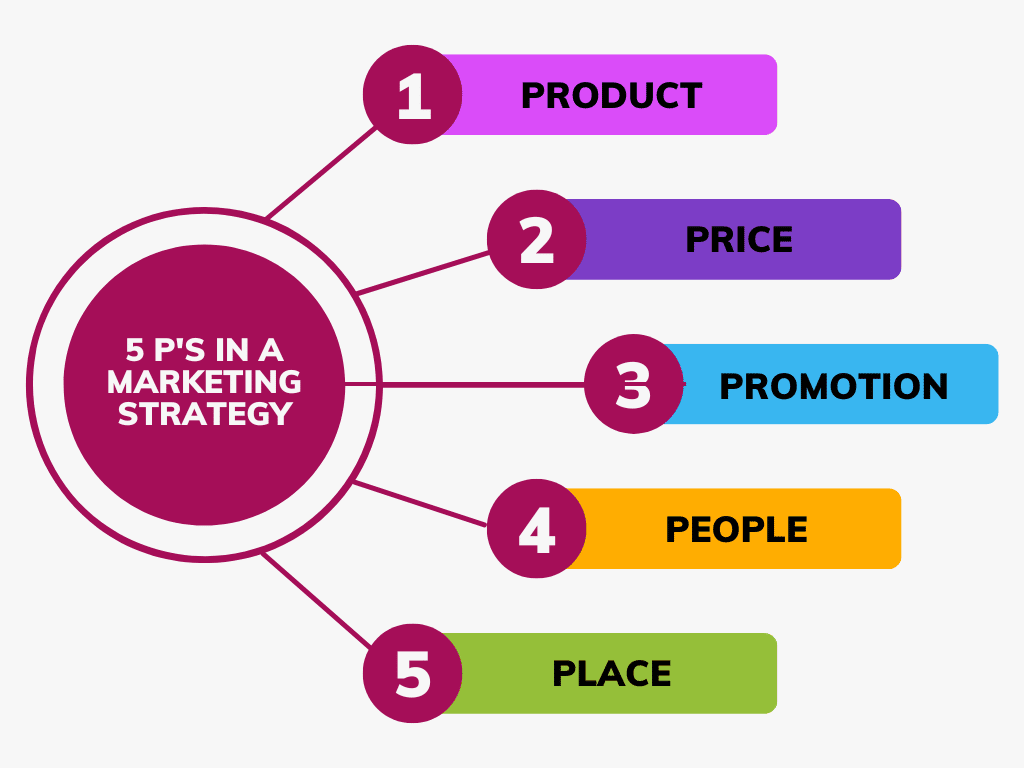
The 5 Ps of Marketing Strategy
| P | Description |
| Product | The goods or services that solve customer problems |
| Price | Pricing that reflects customer value and market competition |
| Place | The channels through which customers access or buy the product |
| Promotion | How you create awareness and generate demand |
| People | Employees, partners, and customer-facing teams shaping the experience |
Balancing these five elements creates a customer-focused strategy built for long-term success.
Real-World Examples
Looking at how established brands apply these principles makes the theory easier to put into practice.
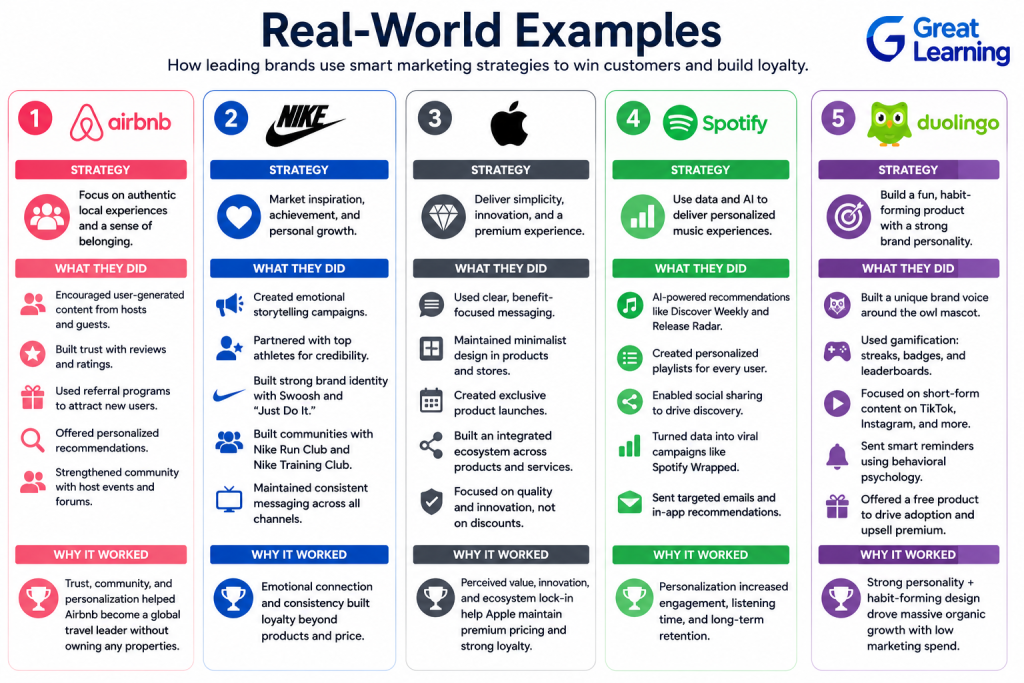
1. Airbnb
Airbnb built its entire strategy around a simple insight: travelers wanted authentic local experiences, not just a place to sleep. Instead of positioning itself as a hotel alternative, it built a marketplace around belonging and community. Key tactics include:
- User-generated content from hosts and guests, which doubles as both marketing material and social proof
- Community building through local host meetups and guest forums
- Referral programs that turned early users into an acquisition channel
- Personalized recommendations based on browsing and booking behavior
- Trust signals built through detailed reviews and ratings on both sides of the transaction
This customer-first approach helped Airbnb scale into one of the world's most recognized travel brands without owning a single property.
2. Nike
Nike doesn't market shoes and apparel so much as it markets identity. The strategy centers on inspiration, achievement, and personal growth rather than product specifications. This shows up through:
- Emotional storytelling that centers the customer's own journey, not just the product
- High-profile athlete partnerships that lend credibility and aspiration
- A strong, instantly recognizable brand identity (the swoosh, the "Just Do It" tagline)
- Community engagement through apps like Nike Run Club and Nike Training Club
- Consistent messaging across TV, social, retail, and digital channels
Campaigns like "Just Do It" have run for decades because they connect with consumers on an emotional level rather than competing purely on features or price.
3. Apple
Apple focuses its strategy on simplicity, innovation, and a premium customer experience rather than competing on cost. Core elements include:
- Clean, minimal product messaging that avoids technical jargon in mainstream marketing
- Minimalist design carried consistently across products, packaging, and retail stores
- Exclusive, tightly choreographed product launches that generate anticipation and media coverage
- Deep ecosystem integration (iPhone, Mac, Watch, services) that increases switching costs and loyalty
- A strong brand position built on innovation and quality rather than price
Rather than competing on price, Apple leans on perceived value and experience to sustain premium pricing.
4. Spotify
Spotify relies heavily on data-driven personalization to keep users engaged and reduce churn. Its strategy includes:
- AI-powered recommendations (Discover Weekly, Release Radar) built from listening behavior
- Personalized playlists that make the platform feel tailored to each individual user
- Social sharing features that turn listening into a discovery and marketing loop
- The annual Wrapped campaign, which turns personal listening data into a shareable, viral moment
- Targeted email and in-app marketing based on listening habits and engagement
By combining technology with personalization, Spotify increases both engagement and long-term retention.
5. Duolingo
Duolingo shows that even a low-budget, education-focused brand can build outsized reach through personality-led marketing. Its approach includes:
- A distinct, irreverent brand voice built around its owl mascot, used heavily on social media
- Gamification (streaks, leaderboards, badges) that turns a learning habit into daily engagement
- Consistent short-form content on platforms like TikTok and Instagram rather than traditional ads
- Push notifications and reminders designed around behavioral psychology to drive retention
- Free-to-use core product that drives organic growth before monetizing through premium subscriptions
Duolingo's strategy demonstrates that strong brand personality and habit-forming product design can substitute for a large paid media budget.
Common Mistakes to Avoid
- Targeting everyone instead of a specific audience
- Setting goals without measurable KPIs
- Ignoring customer feedback and research
- Inconsistent messaging across channels
- Chasing short-term sales over long-term relationships
- Underestimating competitor analysis
- Neglecting performance tracking
- Spending without clear objectives
- Failing to adapt as the market changes
Conclusion
A marketing strategy is more than a promotional plan. It's the foundation that guides how a business attracts, engages, and retains customers.
By defining clear goals, understanding customer needs, analyzing competitors, and choosing the right channels, businesses build strategies that support sustainable growth.
The most successful companies don't rely on isolated campaigns; they build strategies backed by research, data, and continuous optimization, staying competitive as customer expectations and technology evolve.
Marketing Blogs to Read:
Frequently Asked Questions
1. What is a marketing strategy?
A long-term plan for how a business attracts, engages, and retains customers to achieve its goals, covering target audience, value proposition, channels, and measurable objectives.
2. What's the difference between a marketing strategy and a marketing plan?
The strategy defines the overall direction: what the business wants to achieve and why. The plan defines execution: how, when, and where specific campaigns happen.
3. What are the key components of a marketing strategy?
Business objectives, target audience understanding, market and competitor research, a unique value proposition, channel selection, budget allocation, and KPIs.
4. What are the 5 Ps of marketing?
Product, Price, Place, Promotion, and People: the core elements that shape what you offer, how you price and deliver it, how you promote it, and how people shape the customer experience.
5. Why is a marketing strategy important?
It gives businesses a roadmap for their goals, deepens customer understanding, strengthens competitive positioning, improves brand consistency, optimizes budgets, and makes performance measurable.
6. How often should a marketing strategy be updated?
Most organizations review it annually, though major shifts in customer behavior, technology, or competition may call for more frequent updates.