

Artificial intelligence (AI) tools have become essential for coding, research, content creation, and everyday problem-solving.
Large language models (LLMs) like ChatGPT, Claude, Gemini, and other AI assistants can quickly recommend websites, documentation, software libraries, and online resources. However, these tools are not always accurate. In some cases, they generate website addresses that do not exist—a phenomenon known as domain hallucination.
This has given rise to an emerging Cybersecurity threat called phantom squatting. Attackers can register these AI-generated domains and use them for phishing, malware distribution, or credential theft.
As AI adoption grows across industries, understanding what phantom squatting is and how to avoid it is becoming increasingly important.
In this blog, you'll learn what phantom squatting is, why LLMs hallucinate website domains, how attackers exploit these AI-generated URLs, the cybersecurity risks they pose, and the best practices to protect yourself and your organization from this emerging AI-driven threat.
What Is Phantom Squatting?
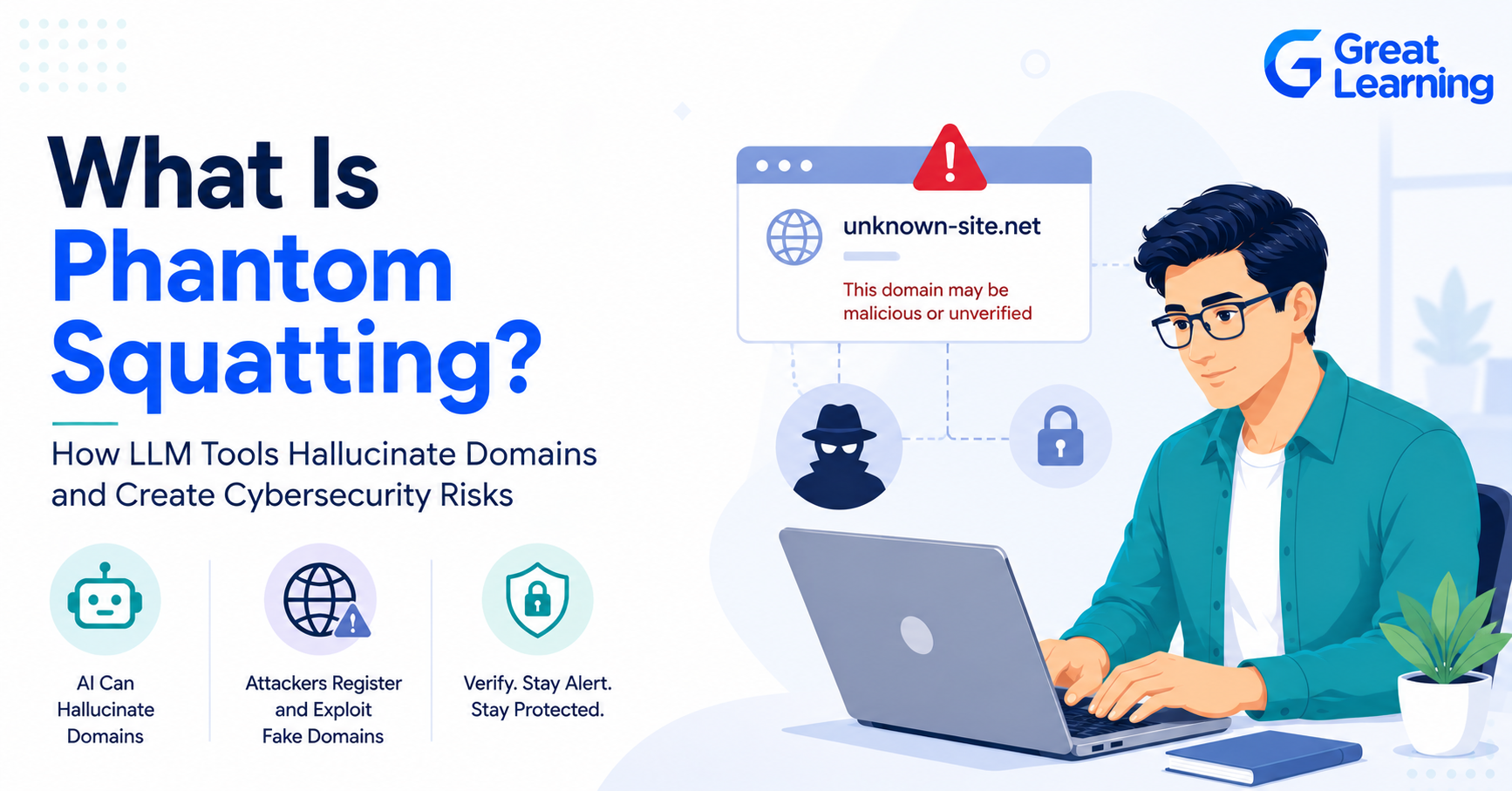
Phantom squatting is a cybersecurity attack in which threat actors register domain names that were hallucinated by AI tools. Since LLMs generate text based on patterns rather than verifying domain ownership or availability, they may recommend websites that appear legitimate but have never existed.
Cybercriminals monitor or predict these AI-generated domains, register them, and create malicious websites.
When users trust an AI-generated recommendation and visit the fake domain, they may unknowingly download malware, enter sensitive credentials, or interact with fraudulent services.
Unlike traditional attacks that rely on human typing mistakes, phantom squatting exploits misplaced trust in AI-generated information. As more users rely on AI assistants for technical guidance and online recommendations, the potential impact of this attack continues to grow.
Why Do LLMs Hallucinate Website Domains?
Large language models generate responses by predicting the most likely sequence of words based on patterns learned during training. They do not inherently verify whether a website currently exists unless they are connected to real-time web search or retrieval systems.
As a result, an AI model may combine familiar brand names, keywords, or domain structures into URLs that look authentic but are actually nonexistent. For example, an AI assistant might generate a convincing documentation website or software repository that has never been registered.
This issue is not unique to a single AI platform. Any LLM can hallucinate domain names if it lacks access to live verification or produces responses with low confidence.
Because these fabricated domains often resemble legitimate websites, users may assume they are trustworthy without checking their authenticity.
Understanding how large language models and intelligent AI systems work can help you better recognize their limitations and security risks. Explore the Artificial Intelligence Certificate Program from Johns Hopkins University to build practical AI and machine learning expertise.
Johns Hopkins Applied AI Certificate Program
Master practical AI implementations and drive real-world impact. Learn to deploy cutting-edge applied AI solutions to transform your organization.
How Does Phantom Squatting Work?
A phantom squatting attack typically follows a straightforward sequence.
First, a user asks an AI assistant to recommend a website, software library, or online resource. Instead of returning a verified URL, the model hallucinates a domain that appears genuine.
Next, an attacker registers the hallucinated domain before anyone else does. The attacker then builds a convincing website that mimics a trusted service or hosts malicious content.
When another user receives the same AI-generated recommendation and visits the website, they may download infected software, reveal login credentials, or install compromised code packages. In developer environments, this can even introduce vulnerabilities into applications and software supply chains.
Because AI-generated recommendations are often presented confidently, users may not realize they are interacting with an attacker-controlled website.
Why Is Phantom Squatting a Cybersecurity Risk?
Phantom squatting introduces a new attack surface created by the growing use of generative AI. Instead of exploiting software vulnerabilities, attackers exploit the confidence users place in AI-generated responses.
One major concern is phishing. Fake websites can imitate login portals, cloud platforms, or business applications to steal usernames, passwords, and multi-factor authentication codes.
Another risk involves malware distribution. Cybercriminals can host infected software, browser extensions, or fake developer tools on hallucinated domains, leading users to install malicious files.
Developers also face supply chain risks. If an AI assistant recommends a nonexistent package repository or project website, attackers can register it and distribute compromised libraries that become part of production applications.
Businesses are equally vulnerable. Employees increasingly use AI assistants for research, troubleshooting, and software recommendations. Without proper verification, a single AI-generated domain could expose sensitive corporate systems or confidential information.
As organizations integrate AI into daily workflows, phantom squatting demonstrates why human verification remains an essential part of cybersecurity.
Phantom Squatting vs. Cybersquatting vs. Typosquatting
Although these attacks involve domain names, they differ significantly.
| Attack Type | How It Works | Primary Target |
| Phantom Squatting | Registers AI-hallucinated domains | Users relying on AI recommendations |
| Typosquatting | Exploits spelling mistakes in URLs | Internet users making typing errors |
| Cybersquatting | Registers brand-related domains for profit or misuse | Businesses and trademark owners |
The defining difference is that phantom squatting originates from AI-generated misinformation, making it one of the first cybersecurity threats directly linked to generative AI hallucinations.
How to Prevent Phantom Squatting Attacks
Protecting yourself from phantom squatting starts with verifying every AI-generated website before visiting it.
Whenever an AI recommends a domain, confirm that it belongs to the official organization by checking trusted search engines or the company's official website. Developers should download software only from verified repositories and avoid installing packages from unfamiliar sources suggested by AI without validation.
Organizations should train employees to treat AI responses as helpful suggestions rather than authoritative facts. Security awareness programs should include AI-specific risks such as hallucinated domains, prompt injection, and AI-assisted phishing.
As AI-driven cyber threats continue to evolve, building real skills in AI-powered defense is essential. Explore the Cybersecurity course by JHU to learn real-world AI-driven cyber defense techniques, including a dedicated module covering how AI is applied to threat detection, automated incident response, and agentic security tools like Darktrace, while preparing for certifications like CISSP and CompTIA Security+.
JHU Cybersecurity Certificate Course
Build in-demand cybersecurity skills with JHU experts. Learn AI, cloud, and network security. Hands-on projects. Flexible online format.
Businesses can further reduce risk by implementing DNS filtering, browser security protections, endpoint security solutions, and URL reputation services that block access to suspicious websites.
As AI becomes more integrated into enterprise workflows, combining AI productivity with human oversight will be the most effective defense against emerging threats like phantom squatting.
As organizations increasingly adopt autonomous AI systems, understanding how to build secure and reliable AI agents is becoming a valuable skill. Explore the Agentic AI Course from Johns Hopkins University to learn how to design and deploy AI-powered workflows responsibly.
Certificate Program in Agentic AI
Learn the architecture of intelligent agentic systems. Build agents that perceive, plan, learn, and act using Python-based projects and cutting-edge agentic architectures.
Final Thoughts
Phantom squatting highlights how AI hallucinations can create real-world cybersecurity risks. By registering domains invented by large language models, attackers can exploit user trust to deliver phishing campaigns, malware, and software supply chain attacks.
While AI assistants significantly improve productivity, they should not be treated as a source of verified website information.
Understanding what phantom squatting is, recognizing how LLMs hallucinate domains, and verifying every AI-generated URL can help individuals and organizations use AI more safely while reducing exposure to this emerging cybersecurity threat.
Frequently Asked Questions
1. What is phantom squatting?
Phantom squatting is a cybersecurity attack where criminals register website domains hallucinated by AI tools and use them to launch phishing attacks, distribute malware, or steal user credentials.
2. Why do AI tools hallucinate website domains?
Large language models generate responses by predicting likely text patterns rather than checking whether every website exists in real time. This can result in convincing but nonexistent URLs.
3. How is phantom squatting different from typosquatting?
Typosquatting relies on users making spelling mistakes when entering website addresses, whereas phantom squatting exploits domain names that were fabricated by AI systems.
4. Who is most at risk from phantom squatting?
Developers, researchers, students, businesses, and anyone who relies on AI-generated website recommendations without verifying them can be affected by phantom squatting.
5. How can I protect myself from phantom squatting?
Always verify AI-generated URLs through official sources, use trusted software repositories, avoid downloading files from unfamiliar websites, and treat AI recommendations as suggestions rather than verified facts.