
- Why Tool-Using AI Agents Need a Different Security Model
- How Zero Trust Changes AI Agent Identity and Authorization
- How Least Privilege Controls AI Agent Tool Access
- How Zero Trust Handles High-Risk AI Agent Actions
- How Zero Trust Helps Defend Against Prompt Injection
- How Monitoring and Auditing Improve AI Agent Security
- A Zero-Trust Architecture for Tool-Using AI Agents
- How Professionals Can Design More Secure AI Agents
- How the Johns Hopkins University Agentic AI Program Builds These Skills
- Final Thoughts
- Frequently Asked Questions
AI agents that can use tools introduce a different security challenge from traditional AI applications.
An agent may interact with APIs, databases, files, communication platforms, or business systems to complete a task, which means a compromised or incorrectly instructed agent could potentially perform actions beyond what was intended.
This is where zero trust security for AI agents becomes important.
What Is Zero Trust Security for AI Agents?
Zero Trust security for AI agents means every agent action is verified before access is granted. Instead of assuming an AI agent is safe after authentication, organizations evaluate identity, permissions, context, and risk before allowing the agent to use tools or access data.
Zero Trust is a security approach that does not automatically trust users, devices, applications, or agents based on their location or previous access.
Instead, access is continuously evaluated based on identity, permissions, context, and risk.
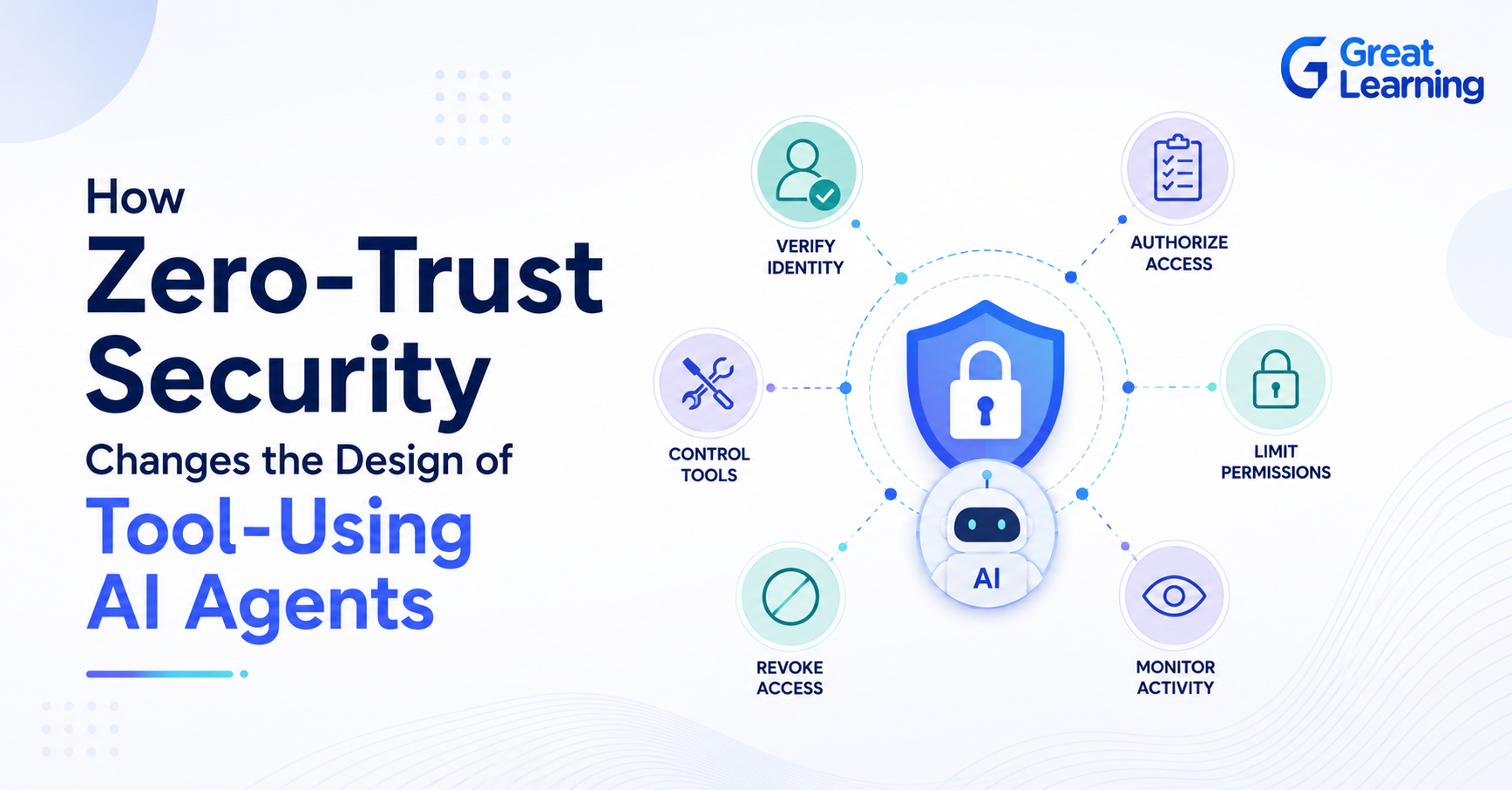
For tool-using AI agents, this means every important action should be authenticated, authorized, limited, and monitored rather than automatically trusted.
NIST's 2026 work on AI-agent security highlights agent identity, authentication, authorization, least privilege, auditing, and prompt-injection mitigation as important considerations for securing agentic systems.
The core security model is:
Agent Identity → Verify → Authorize → Limit → Monitor → Revoke
Why Tool-Using AI Agents Need a Different Security Model
Traditional applications generally operate within predefined workflows. Developers determine which actions an application can perform and under what conditions.
Tool-using AI agents introduce more flexibility because an agent can decide which tools to use and what sequence of actions may be required to complete a goal.
For example, a business agent might have access to a CRM, email system, internal documents, and customer databases.
If the agent is given excessive permissions, a manipulated instruction or compromised workflow could potentially cause it to expose information, modify records, or perform unauthorized actions.
This makes AI agent security different from simply securing the underlying model. Teams must also control what the agent can access and what it is allowed to do.
These changes are also reshaping cybersecurity in the age of AI, where autonomous systems can expand the attack surface.
The scale of this challenge is becoming clearer. A 2026 Cloud Security Alliance study found that 53% of organizations had experienced AI agents exceeding their intended permissions, highlighting the risks created when agent access is not tightly controlled.
Zero Trust addresses this problem by treating every agent action as something that must be evaluated rather than assuming that an authenticated agent should automatically be trusted.
The key principle is:
An agent being trusted to perform one task does not mean it should automatically be trusted to perform every task.
How Zero Trust Changes AI Agent Identity and Authorization
The first step in securing an AI agent is knowing which agent is acting, on whose behalf, and what that agent is authorized to do. Unlike a traditional application, an AI agent may make multiple tool calls while pursuing a broader objective, so permissions need to be tied to the specific task and context.
With AI agent identity and authorization, organizations can treat each agent as a distinct identity rather than simply inheriting all permissions from the user who initiated it. The system can then verify the agent before allowing it to access a tool, database, API, or other resource.
Authentication answers “Who is requesting access?”, while authorization answers “What is this agent allowed to do?”. Both are essential for a Zero-Trust approach.
For example, if a sales agent is asked to prepare a customer report, it may be authorized to read CRM records but not modify customer accounts or access financial systems. Its permissions should reflect the task rather than the user's entire access profile.
NIST's 2026 guidance emphasizes establishing, authenticating, and authorizing AI-agent identities and determining how human authorization should be incorporated into agent actions.
This creates a more controlled model:
User Request → Agent Identity → Authentication → Authorization → Tool Access
The result is that an agent does not receive broad access simply because it is operating within a trusted application or environment.
How Least Privilege Controls AI Agent Tool Access
Once an agent has been identified and authenticated, Zero Trust applies the principle of least privilege. This means giving the agent only the permissions and tool access necessary to complete its assigned task.
For tool-using AI agents, least privilege can apply at several levels. An agent might be allowed to read specific customer records but not modify them, access one API but not another, or use a tool only for a limited period.
Consider an HR agent that helps employees find information about benefits. It may need access to policy documents and employee-specific information, but it should not automatically have permission to change payroll details or delete employee records.
This distinction is critical because tool availability does not equal tool authorization.
Organizations can further reduce risk through narrowly scoped permissions, short-lived credentials, read-only access where possible, and separate controls for high-impact actions. If an agent is compromised or manipulated, these restrictions limit what it can do.
Least privilege therefore changes the design of an AI agent from:
“The agent can access this tool.”
to:
“The agent can access this tool, for this task, with these permissions, under these conditions.”
That shift is central to securing tool-using AI agents as they become capable of performing increasingly complex actions.
How Zero Trust Handles High-Risk AI Agent Actions
Not every action performed by an AI agent carries the same level of risk. Reading a document may be relatively low risk, while deleting data, sending an external message, changing permissions, or initiating a financial transaction can have significant consequences.
A Zero-Trust architecture for AI agents therefore uses risk-based controls to determine how an action should be handled. Low-risk tasks may proceed automatically when the agent has the required permissions, while high-impact actions can require additional verification or human approval.
For example, an AI agent may be allowed to read customer information automatically but require human confirmation before changing account details or issuing a refund.
This approach creates different levels of control:
- Low-risk actions: Allow within defined permissions
- Moderate-risk actions: Apply additional authentication or policy checks
- High-risk actions: Require human approval or step-up verification
- Unauthorized actions: Block and record the attempt
Microsoft's Zero Trust guidance for AI recommends binding tool calls to the initiating identity, authorizing the specific action and target, and using narrowly scoped credentials. It also recommends fresh human confirmation for high-impact actions.
The principle is simple: the more consequential the action, the stronger the verification should be. This prevents an AI agent from turning broad access into unrestricted autonomy.
How Zero Trust Helps Defend Against Prompt Injection
Prompt injection becomes more serious when an AI agent can use external tools. An attacker may place malicious instructions inside a webpage, document, email, or other source that the agent processes.
This highlights the growing cybersecurity risks of LLM tools that can interact with external systems.
If the agent follows those instructions, it could potentially attempt an unauthorized tool action.
Zero Trust does not eliminate prompt injection, but it can limit what a manipulated agent is capable of doing.
For example, an agent processing an untrusted document might receive an instruction to send sensitive customer data to an external address.
Even if the agent interprets the instruction as valid, a Zero-Trust control can block the email tool because the requested action falls outside the agent's authorized permissions.
Security controls can include:
- Separating trusted instructions from untrusted data
- Restricting tool permissions
- Validating tool calls before execution
- Sandboxing risky operations
- Requiring human approval for sensitive actions
- Logging blocked and successful tool calls
NIST's 2026 work on AI-agent identity and authorization specifically considers prompt injection and how authorization controls can help reduce the impact of a compromised or manipulated agent.
This changes the security objective from simply “prevent the agent from being manipulated” to “limit what the agent can do even if it is manipulated.”
How Monitoring and Auditing Improve AI Agent Security
Zero Trust does not stop at authentication and authorization. Organizations also need to understand what AI agents are doing after they receive access.
Monitoring and auditing help identify unusual behavior, failed authorization attempts, unexpected tool calls, and potential security incidents.
For tool-using AI agents, useful audit records can include:
- Agent identity
- User or system that initiated the task
- Tool being accessed
- Requested action and target
- Authorization decision
- Execution result
- Time and context of the action
These records create an audit trail that helps security teams investigate incidents and understand how an agent reached a particular outcome.
The need for this visibility is becoming more urgent as agent adoption increases. A 2026 Cloud Security Alliance survey found that 82% of enterprises had unknown AI agents operating in their environments, highlighting the challenge of maintaining visibility over agent activity.
Monitoring can also support automated responses. If an agent suddenly attempts to access an unfamiliar system or repeatedly makes unauthorized requests, security controls can restrict its permissions, suspend the agent, or require human intervention.
The goal is to establish continuous oversight:
Observe → Detect → Investigate → Respond → Review
This makes monitoring an essential part of AI agent security, particularly when agents can act across multiple systems without requiring a human to approve every routine action.
A Zero-Trust Architecture for Tool-Using AI Agents
A secure tool-using AI agent can be designed around several interconnected security layers rather than relying on a single access-control mechanism.
User → Agent Identity → Policy Engine → Risk Check → Tool Authorization → Tool/API → Monitoring & Audit

Each layer serves a specific purpose:
- User authentication: Establishes who initiated the request.
- Agent identity: Identifies which agent is performing the action.
- Policy engine: Determines what the agent is permitted to access.
- Risk check: Evaluates the action, context, and potential impact.
- Tool authorization: Grants only the permissions required for that specific tool call.
- Tool/API: Executes the approved action.
- Monitoring and audit: Records activity and supports detection and investigation.
This architecture changes how organizations approach secure AI agent architecture. Instead of giving an agent broad access and trusting it to behave correctly, security controls are placed between the agent and the systems it can influence.
For example, an AI agent may be able to access a CRM, but the policy layer could restrict it to reading customer records. If the agent later attempts to export those records or modify account information, the request can be evaluated separately and blocked or sent for human approval.
The result is a system where identity, authorization, least privilege, and monitoring work together rather than treating security as a one-time authentication step.
How Professionals Can Design More Secure AI Agents
Building secure AI agents requires security to be considered from the beginning rather than added after the agent is deployed.
Designing Production AI Agents also requires guardrails, evaluation, monitoring, and controlled tool access.
Developers and security teams need to understand what the agent can access, which actions it can perform, and what should happen when a request falls outside its normal permissions.
A practical approach includes:
- Define agent identities: Give each agent a distinct identity that can be authenticated and tracked.
- Map available tools: Identify every API, database, application, or system the agent can access.
- Apply least privilege: Provide only the permissions required for the agent's intended tasks.
- Classify actions by risk: Separate routine actions from sensitive or irreversible operations.
- Require approval when needed: Add human confirmation for high-impact actions.
- Monitor behavior: Track tool calls, authorization decisions, errors, and unusual activity.
- Prepare for incidents: Establish procedures to suspend credentials, revoke access, and investigate compromised agents.
This approach can be summarized as:
Identify → Authenticate → Authorize → Execute → Monitor → Revoke
The objective is not to prevent agents from acting autonomously. Instead, it is to make autonomy controlled, observable, and limited by clearly defined security policies.
As AI agents gain access to more enterprise systems, these principles become increasingly important for organizations looking to secure AI agents without preventing them from delivering useful automation.
How the Johns Hopkins University Agentic AI Program Builds These Skills
The AI Agents course by Johns Hopkins University can help professionals develop the skills needed to design, build, and secure AI agents that interact with tools and external systems.
Certificate Program in Agentic AI
Learn the architecture of intelligent agentic systems. Build agents that perceive, plan, learn, and act using Python-based projects and cutting-edge agentic architectures.
The program covers key areas relevant to secure agent development, including Agentic AI, Zero-Trust security, tool safety and access control, data protection, prompt injection, monitoring, and incident response.
These topics help professionals understand both the capabilities of AI agents and the controls needed to deploy them responsibly.
Learning how to manage agent permissions, tool access, security risks, and monitoring can be particularly valuable as organizations adopt agents for increasingly complex workflows.
The program also provides a practical foundation for understanding how agentic systems can be designed, evaluated, and applied to real-world business scenarios.
Final Thoughts
Zero-Trust security changes how organizations should design tool-using AI agents. Instead of assuming an agent can be trusted once authenticated, every important action should be verified, authorized, limited, and monitored.
As agents gain access to business applications, APIs, databases, and sensitive information, least-privilege permissions and continuous monitoring become increasingly important.
These controls can limit the impact of compromised agents, prompt injection, excessive permissions, and unauthorized actions.
The Johns Hopkins University Agentic AI Program can help professionals develop practical knowledge of Agentic AI, Zero-Trust security, tool access control, prompt injection, monitoring, and incident response.
Ultimately, secure agentic systems are not about eliminating autonomy. They are about making autonomy controlled, observable, and accountable.
Frequently Asked Questions
1. What is Zero-Trust security for AI agents?
Zero-Trust security for AI agents means that agents are not automatically trusted based on their identity, location, or previous access. Each important request and tool action is evaluated according to its identity, permissions, context, and risk.
2. Why do tool-using AI agents need Zero Trust?
Tool-using agents can interact with APIs, databases, files, and business applications. If an agent has excessive permissions or is manipulated, it could perform unauthorized actions. Zero Trust helps limit these risks through authentication, authorization, least privilege, and continuous monitoring.
3. How does Zero Trust control AI agent access?
Zero Trust can give each agent a distinct identity and restrict its access to specific tools, data, and actions. Permissions can also be limited by the task, context, and risk level.
4. What is least privilege for AI agents?
Least privilege means giving an AI agent only the access and permissions it needs to complete its assigned task. For example, an agent may be allowed to read customer records without being allowed to modify or delete them.
5. How can Zero Trust protect AI agents from prompt injection?
Zero Trust cannot prevent every prompt injection, but it can limit the damage if an agent is manipulated. Tool-level authorization, restricted permissions, validation, monitoring, and human approval for high-risk actions can prevent a compromised agent from performing unauthorized operations.
6. How should organizations monitor AI agent actions?
Organizations should maintain audit trails covering agent identity, user requests, tool calls, authorization decisions, targets, and execution results. Monitoring these activities can help detect unusual behavior and support incident response.
7. Which AI Agents course can help professionals learn these security concepts?
The Johns Hopkins University Agentic AI Program covers areas including Agentic AI, Zero-Trust security, tool safety and access control, data protection, prompt injection, monitoring, and incident response. These topics can help professionals understand how to build and manage more secure AI agent systems.