

Artificial intelligence is no longer future talk. In workplaces around the world, AI tools are shaping how work gets done and redefining the skills leaders seek.
Front-line managers, HR leaders, and technology heads agree that workers today face a clear choice: learn the right AI capabilities or risk falling behind.
The question for many learners is simple. Which skills matter in 2026 and beyond, and which are hype? Answering this requires examining real data, employer demand trends, and practical learning paths.
Key Insights
• AI hiring momentum remains strong in Q4 2025 and Q1 2026, with employers actively recruiting digital and AI-skilled professionals across sectors.
• Over 1.3 million AI-related roles have emerged globally in the last two years, signaling structural change in the job market, not a temporary spike.
• AI is reshaping jobs more than eliminating them, increasing demand for hybrid skills that combine technical knowledge with human judgment.
• Employers value applied AI skills such as machine learning, data analysis, generative AI applications, and problem-solving over surface-level tool familiarity.
• Fear around AI-driven job loss often overlooks the rise of AI-augmented roles and the premium placed on adaptable, digitally fluent professionals.
• Structured learning pathways reduce confusion in a crowded AI education market and help learners focus on durable, career-relevant skills.
Employer Demand Signals
Recent global hiring surveys make one point clear. Employers want people who understand how to use digital and AI skills to solve problems, not just automate tasks.
According to an Experis survey, one in four employers were hiring specifically to keep pace with digital and AI advancements. Q4 hiring intentions in tech remained strong even amid economic uncertainty, with 58 percent of tech companies expecting higher headcount. The survey also showed 24 percent of employers were actively recruiting talent with digital skills tied to AI capabilities.
In Q1 2026, hiring intentions in India grew 27 percent over Q4 2025. India ranked second globally in employer outlook, with sectors like finance, professional services, and technical industries showing strong demand.
LinkedIn’s latest labour market report found at least 1.3 million new AI-related job opportunities created across the globe over the past two years. These roles include data annotators, AI engineers, and forward-deployed AI specialists.
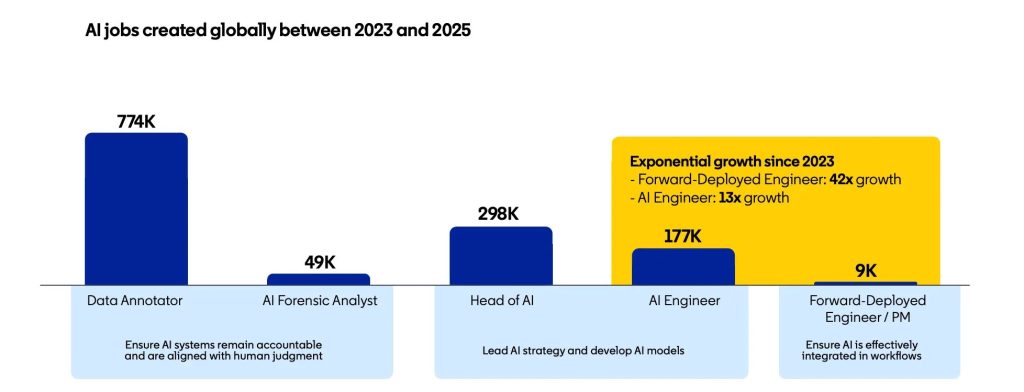
This data illustrates a shift. AI roles are expanding into mainstream business functions, not just research labs or specialized tech teams. The market is moving from simple automation to AI-augmented work, where people and machines collaborate.
Fear and Uncertainty in the Workforce
Fear about AI often centers on job loss. Headlines and social posts argue that automation will replace humans. These fears are not entirely unfounded, but they omit a crucial trend. Research shows AI tends to complement human skills more than replace them outright.
An academic paper analysing millions of job postings found that AI increases the demand for human-centric skills such as digital literacy, teamwork, resilience, and cognitive ability. These complementary skills have grown faster than tasks that AI can substitute.
Canada’s latest employment trends report cautions that AI’s potential to transform work includes replacing some routine tasks. But the bigger impact is in reshaping job tasks and creating hybrid roles that blend human judgement with automated support.
High-profile corporate moves add to both fear and urgency. A major professional consultancy recently linked staff promotions to regular use of internal AI tools. This has motivated employees to learn AI quickly, but it has also raised concerns among those who fear lagging behind.
Taken together, demand data and workforce trends reveal two truths. AI will change job roles fast. People who learn relevant skills earn more opportunities. Those who do not risk stagnation.
What Skills Employers Actually Value?
To separate hype from reality, it helps to look at which skills employers list in job postings and hiring surveys.
Technical skills remain important. Employers look for proficiency in:
- Machine learning and deep learning fundamentals
- Data analysis and statistics
- Natural language processing
- Generative AI and prompt design
- AI tool usage and model deployment
But the trend shows practical capabilities matter most. Foundational coding skills, such as Python, are useful, but companies also value the ability to apply AI in real business scenarios. Roles like AI product management or AI strategy emphasise problem-solving and business thinking as much as pure coding.
Soft skills such as ethical judgement, communication, and adaptive learning ability feature prominently in demand trends, especially for leadership and cross-functional roles. These “AI-adjacent” skills help people work with AI systems responsibly and effectively.
What Is Hype vs What Is Real?
AI hype often centers on buzzwords and vague claims. Examples of inflated expectations include:
- Thinking AI will replace entire jobs overnight.
- Believing simple tool use equals deep AI skill.
- Following every new tool trend without a learning foundation.
In contrast, real AI education focuses on building capabilities that endure market shifts. These include:
- Understanding the principles behind AI systems.
- Applying machine learning models to real data.
- Integrating AI tools to solve meaningful business problems.
- Interpreting results and making data-based decisions.
Reports such as PwC’s Global AI Jobs Barometer for 2025 underline how AI makes people more valuable even in automatable jobs, because human oversight, context understanding, and ethical judgment are essential.
Today’s reality is clear. AI will change tasks, but it does not eliminate the need for human skills. Learning must focus on durable capabilities, not fashion-driven buzz.
How to Approach AI Learning?
Faced with rapid change, learners often ask two questions:
What should I learn?
Start with foundational AI literacy, including understanding machine learning basics, data handling, and how AI tools operate. Progress to specialised areas such as generative AI, NLP, or MLOps, depending on your career goals.
How should I learn?
Blend theoretical knowledge with real projects and tool experience. Apply learning on real data. Join communities and networks that expose you to current practices.
Does learning AI make sense?
The data shows yes. Demand for AI competencies in the job market is strong, and people with practical skills will find opportunities in technical and non-technical roles alike. The ability to collaborate with AI tools will become part of core job requirements across functions.
How Great Learning Helps Clear the Noise?
Great Learning offers structured courses designed with industry needs in mind. These programs help learners avoid confusion by providing clear learning paths built around real market demand and job outcomes.
Here are examples of course pathways learners might take to match employer needs:
- PG Program in Artificial Intelligence & Machine Learning by UT Austin: This longer program covers fundamental AI concepts, machine learning techniques, generative AI, and real project work. It helps build great skills employers value in data and AI roles.
Post Graduate Program in AI & Machine Learning: Business Applications
Master in-demand AI and machine learning skills with this executive-level AI course—designed to transform professionals into strategic tech leaders.
- Artificial Intelligence Core Courses: These include modules on neural networks, natural language processing, computer vision, and AI tools, giving learners skills needed for practical AI applications.
- Free AI and Generative AI Courses: For individuals exploring AI or building a foundation, free courses cover basics like prompt engineering, ML algorithms, and Python. These are useful for early-career learners or professionals validating interest before advancing to deeper programs.
- Data Science Courses with AI Integration: Combining data science and analytics with AI prepares learners for jobs that require data-driven decision-making and predictive modeling.
These courses follow a logical progression from fundamentals to advanced application, helping people avoid chasing fleeting tool names or fads without context.
Great Learning’s emphasis on project work, industry perspectives, and career support helps learners not only understand concepts but also demonstrate them in job settings. Reviews from learners highlight how structured curriculum and practical exercises build confidence and capability.
What to Prioritize in Your AI Journey?
If you are planning your learning roadmap, focus on the following steps:
- Start with foundational AI literacy. Understand what AI can do and where it fits in business.
- Develop practical data skills. Techniques like data cleaning, visualization, and exploratory analysis are crucial.
- Build specific AI competencies. Choose pathways aligned to roles such as AI engineer, data scientist, or AI strategist.
- Apply your knowledge. Work on real datasets, build small AI solutions, and practice with tools used in industry.
- Stay updated. AI trends evolve. Follow reputable research and adapt your skills accordingly.
Conclusion
AI is mainstream. The hype is loud, but what matters is substance. Learners who focus on real, foundational competencies and apply them in real contexts will be in demand. Employers want people who not only understand tools but also use them to solve real problems.
Structured programs from established edTech platforms, such as Great Learning, guide learners from initial interest to real skills, reducing confusion and saving time and effort. The future of work is AI-augmented, and those who learn with clarity and purpose will benefit.