
- Why Is Agentic AI Considered a Major Leap in Artificial Intelligence?
- Why Judgment Is the New Differentiator?
- Isn't this just about learning to use the new tools?
- How Agentic AI is being Adopted Across Industries?
- What are the Risks Leaders Must Govern?
- Why Is Deploying an AI Agent the Beginning, Not the End?
- How should leaders prepare for Agentic AI?
- What Should You Do Right Now?
Much of the conversation around Artificial Intelligence focuses on the technology itself. But as highlighted by Mohan Lakhamraju in Great Learning’s May 2026 leadership message:
The more consequential shift is the changing relationship between humans and machines, and the new ways in which work is beginning to be organized around that partnership.
That shift is now accelerating through Agentic AI. Unlike traditional AI systems built mainly to assist, Agentic AI can reason, plan, adapt, and execute workflows with minimal supervision.
For leaders, this is not simply a technology upgrade; it is a transformation in how decisions, operations, and human-AI collaboration will define the future of enterprise productivity, governance, and business impact.
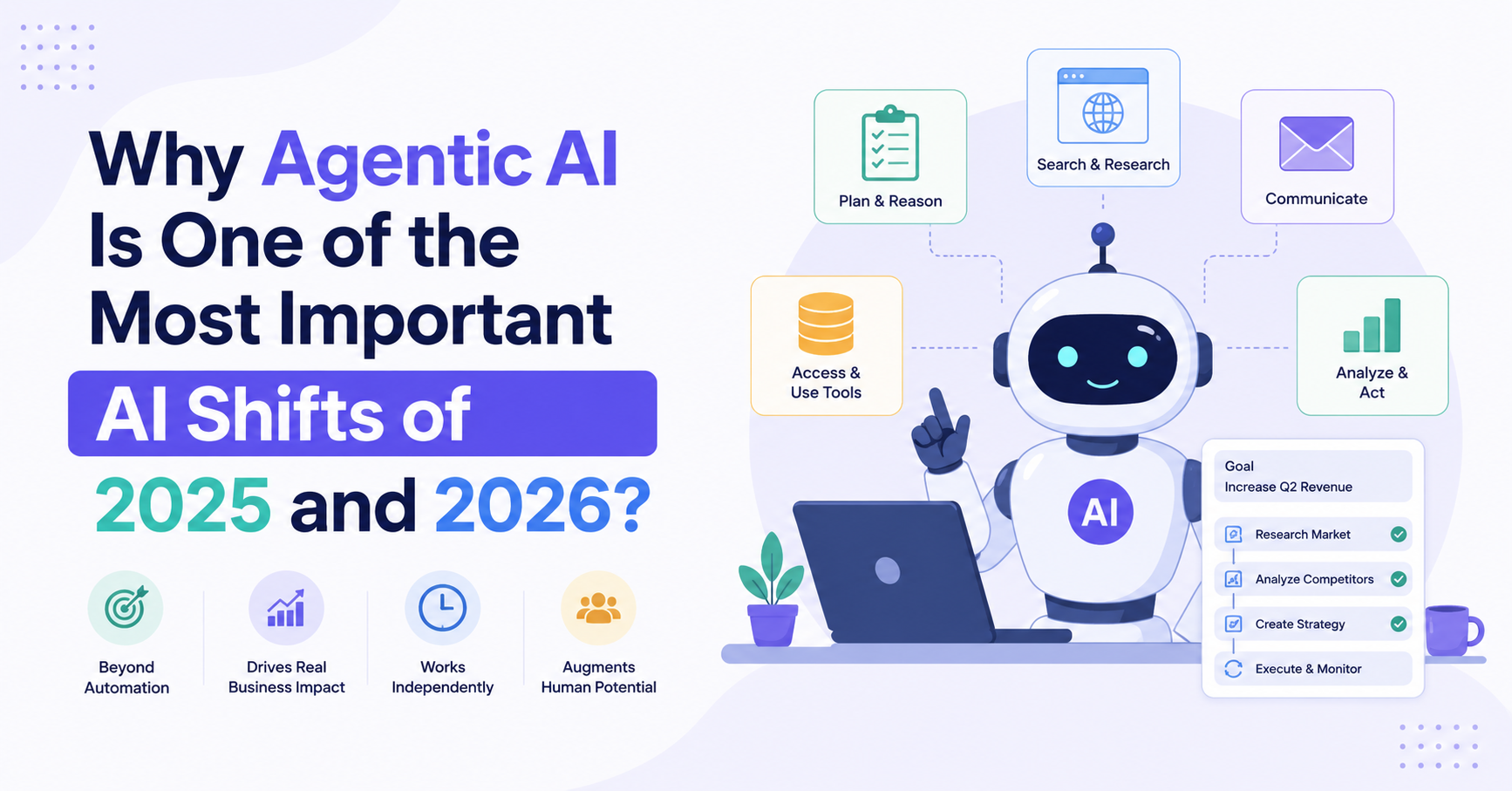
Why Is Agentic AI Considered a Major Leap in Artificial Intelligence?
The defining transformation of 2025 and 2026 is Agentic AI, AI systems capable of independently planning, reasoning, using tools, adapting to changing conditions, and completing multi-step workflows with minimal human supervision.
Unlike traditional AI assistants that wait for instructions at every stage, Agentic AI systems can:
- Analyze goals and context
- Create execution plans
- Interact with APIs, databases, and software tools
- Adjust actions based on real-time feedback
- Complete end-to-end business processes autonomously
This marks a major change from reactive AI to action-oriented AI.
Why Agentic AI Matters for Enterprises?
Agentic AI is not simply an incremental improvement in automation. It introduces a new operational model where AI functions more like a digital collaborator than a passive tool.
Organizations are already using AI agents for:
- Software development and debugging
- Customer support automation
- Business operations management
- Workflow orchestration
- Research and data analysis
- IT and cybersecurity monitoring
The business impact is accelerating rapidly.
The Shift Leaders Must Understand
The rise of Agentic AI changes how enterprises think about software, workflows, productivity, and governance.
Traditional AI systems were built to support decisions. Agentic AI systems are increasingly capable of executing decisions within defined boundaries.
This requires leaders to rethink:
- Operational oversight
- Human-AI collaboration
- AI governance frameworks
- Risk management
- Workforce transformation
- Enterprise workflow design
The question is no longer whether AI can assist employees. The new question is whether AI can independently manage parts of the workflow itself.
That shift demands a new leadership mindset, one focused not only on adopting AI tools, but on managing autonomous AI systems at scale.
Why Judgment Is the New Differentiator?
The challenge is no longer access to AI tools, but the ability to evaluate outputs critically, apply AI responsibly, and translate these systems into real-world impact.
The professionals who will thrive are those who can evaluate AI outputs critically, understand the limitations of autonomous systems, and direct them toward meaningful business outcomes.
AI tools can now deliver the first 80% of most tasks with ease. The real differentiation, the 20% that creates genuine professional value, lies in the ability to evaluate outputs critically, apply contextual judgment, and translate AI capability into outcomes meaningful to a specific role or business context. It means shifting from managing task completion to governing autonomous systems.
The skills that are gaining strategic value are not just the ability to use AI tools. It is the ability to design and direct AI-driven workflows and systems that drive business impact.
”Leaders must increasingly define operational boundaries, evaluate AI outputs critically, and establish governance structures for autonomous systems operating at scale. The core competencies are domain expertise, systems thinking, and AI literacy, not coding ability.
Isn't this just about learning to use the new tools?
No. Structured learning, combining expert-led instruction, hands-on application, and real-world problem solving, is how professionals develop judgment. It cannot be acquired by simply using the tools more. The challenge is no longer access to AI tools, but knowing how to evaluate outputs critically, apply AI responsibly, and translate these systems into real-world impact.
What separates AI-era leaders?
Effective leadership in the age of agentic systems requires three interlocking capabilities working together. Each is necessary; none is sufficient alone.
1. Domain Expertise: Understanding the business context, industry dynamics, and stakes well enough to know when an AI's output is correct and when it's confidently wrong. No AI replaces this. It is the foundation that makes all other capabilities meaningful.
2. Systems Thinking: Designing workflows where humans and AI collaborate effectively. Knowing where to inject oversight, where to delegate autonomously, and how to architect processes that hold up under real-world pressure, not just in demos.
3. AI Literacy: Understanding how autonomous systems function, where they predictably fail, and how to govern them without either micromanaging everything or abdicating responsibility entirely. Governance at the right level of abstraction.
How Agentic AI is being Adopted Across Industries?
Across industries, organizations aren't experimenting with Agentic AI on the whiteboard; they're deploying it in production.
- In software engineering, tools like GitHub Copilot, Cursor, and Claude Code can analyze entire codebases, propose multi-file changes, run tests, and iterate until builds succeed.
- In financial services, Capital One deployed an agentic system called Chat Concierge for auto dealerships that handles queries, schedules appointments, and coordinates test drives entirely autonomously, yielding a 55% improvement in lead conversions.
- In healthcare, practitioners are building multi-agent systems for clinical workflows that handle triage routing, compliance documentation, and patient follow-up coordination, with privacy, traceability, and regulatory compliance built in from day one.
What are the Risks Leaders Must Govern?
The 2024 CrowdStrike–Microsoft global outage made the stakes viscerally clear: when automated systems operate at scale, errors propagate just as fast as efficiencies. Airlines, banks, and hospitals were disrupted by a single faulty update cascading across millions of systems. Agentic AI deployments carry comparable amplification potential in both directions.
- Data Security: Autonomous agents interacting with enterprise systems must operate within strict permission boundaries. One misconfigured access scope can expose proprietary or regulated data at a speed and scale impossible for a human operator.
- Operational Risk: Automated workflows scale errors rapidly when agents execute actions without adequate validation or human checkpoints. A small logic error becomes a fleet-wide incident before anyone notices.
- Cybersecurity: Agents interfacing with external tools and APIs introduce vulnerabilities, including prompt injection and model manipulation. The attack surface for intelligent systems is categorically different from traditional software.
Organizations successfully scaling Agentic AI share one defining characteristic: they treat governance as infrastructure rather than compliance.
”They define operational boundaries before deployment, implement monitoring systems that trace decision paths, and establish escalation protocols for when agents defer to human judgment. Governance isn't a constraint on autonomy; it is what makes secure, large-scale deployment possible in the first place.
Why Is Deploying an AI Agent the Beginning, Not the End?
Deploying an agent is therefore not the end of a project. It is the beginning of an ongoing management relationship. Unlike traditional software systems that remain relatively fixed after implementation, AI agents operate in dynamic environments where business data, regulations, customer behavior, and workflows constantly evolve.
Because of this, agentic AI systems require ongoing monitoring, workflow adjustments, governance, and performance evaluation to remain effective and aligned with organizational goals. AI agents can adapt to:
- Changing business processes
- Updated compliance and regulatory requirements
- New customer interactions and data patterns
- Evolving enterprise objectives
- Real-time operational environments
This shift is creating entirely new professional responsibilities focused on:
- AI workflow design
- Agent supervision and orchestration
- AI governance and accountability
- Monitoring autonomous system behavior
- Managing human-AI collaboration
What Does Human-AI Collaboration Actually Look Like in Practice?
The future workplace will increasingly depend on humans and autonomous systems working together effectively. Instead, organizations will need leaders who can effectively manage teams that include both human employees and autonomous AI systems.
As agentic AI adoption increases, businesses must focus not only on deploying AI agents but also on building frameworks for long-term oversight, governance, trust, and responsible decision-making.
How should leaders prepare for Agentic AI?
Leaders should build three capabilities:
- Domain expertise to evaluate AI outputs with authority;
- Systems thinking to design human-AI workflows that hold up under pressure;
- AI literacy to govern autonomous systems responsibly.
They should treat governance as infrastructure, not compliance, and understand that deploying an AI agent begins an ongoing management relationship, not a completed project.
To systematically build these exact capabilities, structured learning is the most effective path forward. Depending on your background and goals, Great Learning offers specialized programs to help you operationalize this shift:
- To gain a deep understanding of the technology and deployment of these systems, the PG Program in Artificial Intelligence & Machine Learning, a 12-month online program, helps working professionals master industry-valued skills through 60+ case studies, 11+ hands-on projects, and 1 capstone project with a comprehensive curriculum covering Advanced Generative AI, RAG Pipelines, and Agentic AI.
- To cultivate systems' practical application across your teams and tasks, the 6-week AI-Native Professional: Workflows and Agents for Productivity program turns AI from a threat into an advantage. Requiring zero coding, it helps you chain tools together (like Claude, Gemini, and OpenAI) via drag-and-drop interfaces to ship fully working systems like an Email Triage Assistant, saving you hours weekly and helping you become the go-to AI person on your team.
What Should You Do Right Now?
The competitive advantage will increasingly belong to professionals who understand how to apply AI responsibly and translate it into measurable outcomes.
The tools are everywhere. The judgment to deploy them responsibly, evaluate them critically, and translate them into real-world impact, that is what structured learning builds. The window to get ahead of this shift is right now.
The technology is becoming widely accessible. The real differentiator is the expertise to apply it meaningfully, manage it responsibly, and translate it into measurable business impact.