
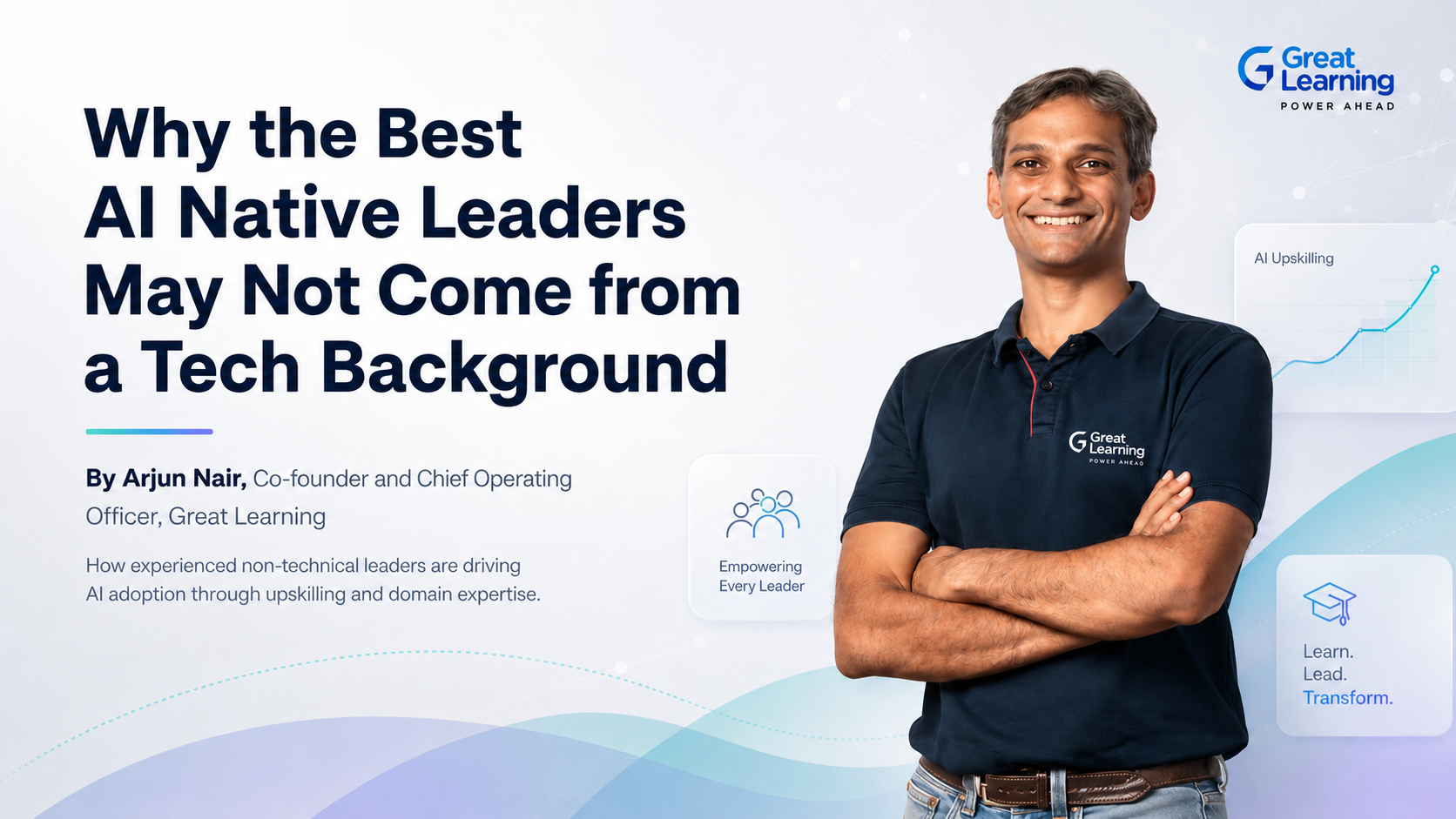
By Arjun Nair, Co-founder and Chief Operating Officer, Great Learning
If you want to understand how AI is transforming the workforce, don't look at the technology. Look at the people choosing to learn it. The profile of today's AI learner reveals something important about where AI adoption is headed. Increasingly, the professionals investing in AI upskilling are not software engineers or data scientists, but experienced business leaders and functional experts looking to apply AI within their own domains.
The data we're seeing at Great Learning suggests this isn't a passing trend. It's a fundamental shift in who is preparing to lead in an AI-first world.
Two Out of Three AI Learners Are Not Engineers
In FY26, 66% of enrolments in our AI programs came from professionals with non-technical educational backgrounds. This marks a significant shift from how AI learning has traditionally been perceived.
An even more telling finding is this: nearly 64% of these non-technical learners had over 12 years of work experience. These aren't early-career professionals exploring their options. They are senior leaders, functional heads, consultants, entrepreneurs, and business unit owners from industries such as BFSI, healthcare, manufacturing, FMCG, education, and consulting. Professionals who have spent years building deep domain expertise are now deliberately adding AI fluency to their toolkit.
One of our learners, Jennifer Seyler from MIT Professional Education's No Code and Agentic AI program, described this shift well:
"I do not have a formal background in coding or Data Science. I use AI in multiple ways nearly every day. I wanted to enhance what I could do in the business world for my clients, so they could become more efficient and effective."
Jennifer's motivation reflects what we're increasingly seeing across thousands of learners. They aren't trying to become AI engineers. They're trying to become better business leaders in an AI-enabled world.
AI Is No Longer Just for Those Who Code
For years, organizations largely approached AI as a technology initiative. Technical teams built models, experimented with algorithms, and delivered outputs to the business. Functional teams consumed those outputs, often with limited visibility into how AI could be applied within their own workflows.
That dynamic is changing.
Today's business leaders want to understand AI well enough to identify opportunities, evaluate solutions, and drive adoption within their own functions. A marketing leader wants to redesign campaign workflows using AI. A CFO wants to improve forecasting and financial planning. A CHRO wants to identify which HR processes can be intelligently automated.
This shift matters because successful AI adoption increasingly depends on business leaders identifying where AI can create value, not simply on technical teams building the underlying technology.
None of this reduces the importance of engineers or AI specialists. Organizations will always need technical experts to develop, deploy, and govern AI systems. What's changing is that AI leadership is no longer confined to technical teams. Competitive advantage increasingly depends on functional leaders who understand enough about AI to ask better questions, identify meaningful use cases, and lead responsible adoption.
At the same time, no-code AI platforms and agentic AI tools have dramatically lowered the barriers to entry. Professionals can now build AI-powered workflows, automate repetitive business processes, and prototype practical solutions without extensive programming knowledge. The gap between understanding AI and applying AI has never been smaller.
What Today's AI Learner Actually Looks Like
The profile of who is learning AI has fundamentally changed, and honestly, it's reshaped how I think about our own programs.
The experienced professional coming to us today isn't approaching AI as a theoretical curiosity. They're asking very specific, very practical questions: How do I use AI to reduce the time my team spends on weekly reports? How do I automate this approval workflow? How do I use generative AI to improve how I communicate with my clients?
They're not just interested in academic overviews of machine learning. They want to leave a program with something they can deploy on Monday morning.
We've seen this shift reshape how we design our own programs. Beyond launching dedicated no-code AI programs, we've introduced no-code learning pathways across several existing programs in Data Science, Machine Learning, Generative AI, and Agentic AI. Learners can now choose learning paths aligned to their technical background while focusing on practical business application.
We've also shortened many of our newer AI programs into three-to-five-month formats to better match the pace at which AI technologies are evolving and professionals need to apply new skills.
Across our AI portfolio, nearly 70% of the learning experience is application-oriented, delivered through industry case studies, hands-on projects, practical exercises, and live demonstrations from experienced practitioners.
The Leadership Implication Nobody Is Talking About Enough
There's a broader point here that I think deserves more attention.
We talk a lot about AI strategy: about how organizations need to develop AI roadmaps, governance frameworks, and adoption playbooks. But a strategy without functionally capable leaders is just a document. The real question is: who in your organization actually knows how to make AI work within a specific function?
The answer, increasingly, has to be the functional leaders themselves.
As AI becomes the underlying logic of how work gets done—not just a feature bolted into one-off operations. Organizations will need leaders who can integrate AI into their day-to-day decision-making, not just sponsor technology projects from a distance. This is why I believe the willingness of experienced professionals to upskill in AI is one of the most important trends in the global workforce right now.
The Microsoft Work Trend Index 2026 found that 65% of AI users feel pressure to use AI at work to stay competitive. That pressure is real. But pressure alone doesn't create capability; structured, high-quality learning does. That is the philosophy behind our collaborations with MIT Professional Education, Johns Hopkins University, McCombs School of Business at the University of Texas, at Austin, Chicago Booth, Duke University and IIT Bombay. These programs are meant to meet professionals where they are and build the AI fluency they need to lead in their specific domain.
Being in the business of professional learning for over a decade, I've seen many possible revolutionary moments come and go. AI feels different because the barriers to using it have fundamentally changed. It has evolved from being a field reserved for programmers to one where professionals can create value simply by understanding their domain, asking better questions, and applying AI to real business problems.
When a 20-year veteran of the banking industry sits through a live session on Agentic AI workflows at 9 pm on a weeknight, she's not doing it because her company mandated it. She's doing it because she understands what's at stake: for her function, for her organization, and for her own relevance as a leader.
That motivation, experienced, purposeful, and deeply practical, is what gives me genuine confidence in how AI adoption will unfold in India over the next few years. The leaders who will drive it aren't all going to come from engineering backgrounds. And that, I think, is a very good thing.
For experienced professionals looking to build AI capability without a traditional technical background, there has never been a better time to start. Here are a few no-code and business-focused AI programs designed to help professionals apply AI confidently in their day-to-day work.
- Certificate in Agentic AI by IIT Bombay: For professionals wanting depth in one of the fastest-moving areas of AI.
- No-Code Generative AI and Agentic AI by Johns Hopkins University: Designed specifically for non-technical professionals who want to apply AI immediately.
- Post Graduate Program in AI Agents for Business Applications by the McCombs School of Business: Blends business strategy with practical AI applications for senior professionals.
- No Code and Agentic AI by MIT Professional Education: Accessible, rigorous, and application-focused for professionals across industries.
Arjun Nair is the Co-founder and Chief Operating Officer of Great Learning, a leading global edtech company for professional learning and higher education.