
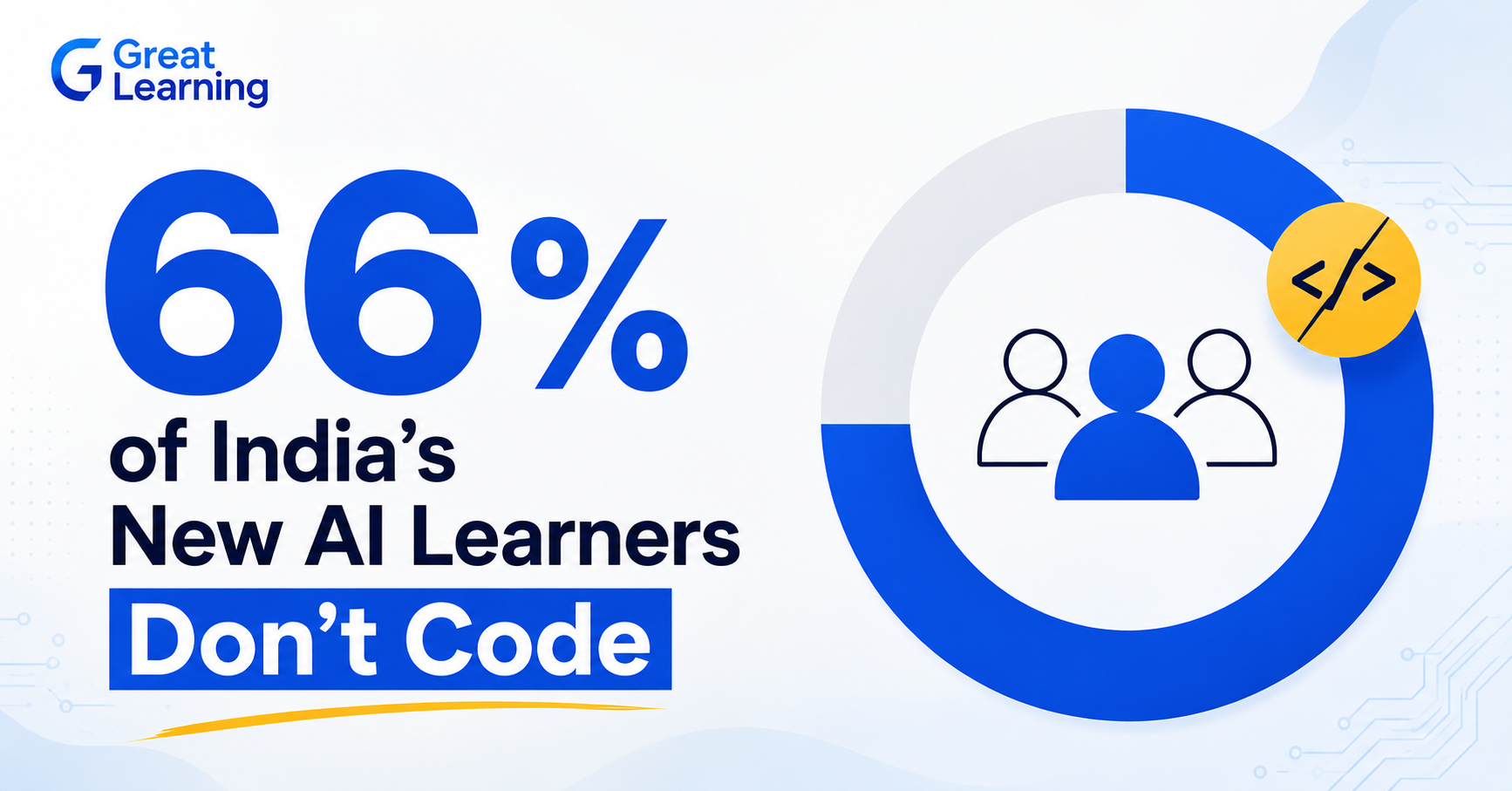
AI literacy is no longer a skill set confined to engineering teams. At Great Learning, enrollment data from FY26 shows that 2 in every 3 professionals who enrolled in AI programs came from non-technical backgrounds, and most of them were senior leaders with over a decade of work experience.
The number is specific: 66% of all AI program enrolments at Great Learning in FY26 came from professionals with non-technical educational backgrounds. Of these, nearly 64% had more than 12 years of work experience. These are not career-switchers exploring a new field. These are functional heads in BFSI, healthcare, manufacturing, FMCG, retail, and education, who have decided that AI capability is now inseparable from doing their existing jobs well.
This shift reflects a broader pattern playing out across Indian workplaces. According to Microsoft's Work Trend Index 2026, 65% of AI users feel pressure to use AI at work to stay competitive. That pressure has crossed functional lines. It is no longer a concern exclusive to data teams or product organizations. It sits in the office of the CFO, the CMO, and the Chief HR Officer.
Key Takeaways
- 66% of Great Learning's AI program enrolments in FY26 came from non-technical professionals, marking a structural shift in India's AI upskilling market.
- 64% of these learners had 12+ years of work experience; senior and functional leaders are driving demand, not early-career professionals.
- No-code AI learning tracks are the primary enabler, removing programming fluency as a prerequisite for AI upskilling.
- Shorter, 3–5 month programs are replacing long-format certificates as experienced professionals prioritize deployable, role-relevant skills.
- The trend signals a growing organizational need for AI-fluent functional leadership (not just technical AI talent) as adoption moves from experimentation to operations.
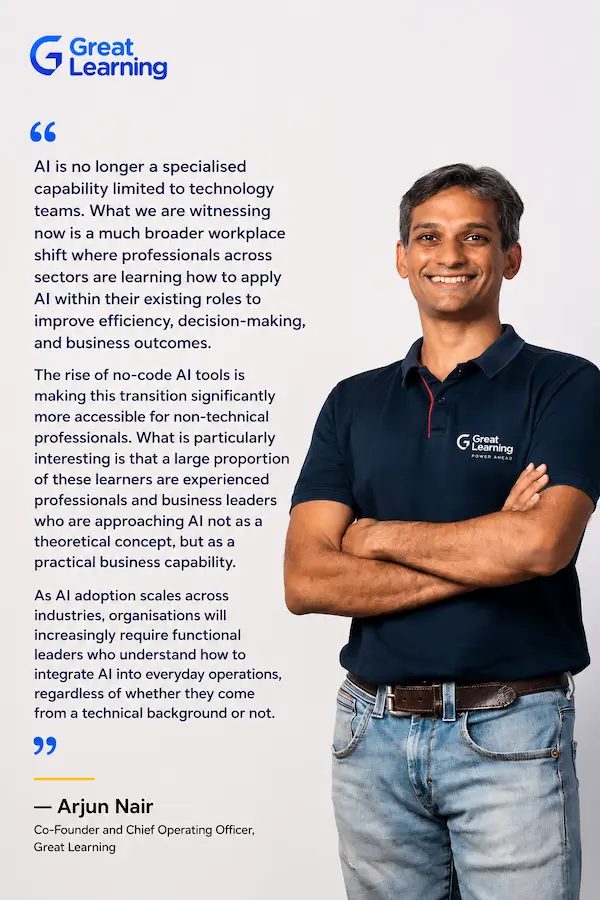
Why Are Non-Technical Professionals Upskilling in AI?
The reasons are operational, not aspirational.
Professionals across marketing, HR, finance, operations, product, and sales are encountering AI-powered tools in their day-to-day workflows at an accelerating rate. The question is no longer whether AI will touch their function; it already has. The question is whether they understand it well enough to use it with judgment, integrate it into their teams' processes, and make informed decisions about where it adds real value.
Senior leaders face a specific gap. An executive who doesn't understand what an AI system can and cannot do cannot effectively sponsor its adoption, set meaningful success metrics, or hold teams accountable for outcomes. Technical fluency at the leadership layer isn't about building models; it's about being able to ask the right questions of the people who do.
This is the competency gap driving experienced professionals into AI classrooms.
What Are No-Code AI Learning Tracks?
One of the most significant enablers of this shift is the emergence of no-code AI tools and learning pathways.
For most of the past decade, AI upskilling was implicitly gated behind programming fluency. Python literacy was treated as a prerequisite. This conflated two distinct activities: building AI systems and applying them. For the majority of professionals, the latter is what matters — and it does not require writing code.
Great Learning introduced no-code learning tracks across most of its AI program portfolio in response to this demand. Programs in Data Science, Machine Learning, Generative AI, and Agentic AI now offer learners a choice between a coding track and a no-code track within the same program. Both tracks maintain the same emphasis on application: nearly 70% of learning time is dedicated to projects, real-world implementation, case studies, and live demonstrations by industry experts.
The no-code track removes the programming barrier without removing the rigour. It makes AI learning accessible to the professional who understands business processes deeply and needs to understand how AI improves them, not the professional who wants to build the AI from scratch.
Why Are Short-Term AI Courses Growing in Popularity?
Traditional 7- to 9-month AI certificate programs are losing ground to shorter, application-oriented formats. This is not a drop in learning ambition — it is a rational response to how experienced professionals learn and what they need.
A business unit head with 15 years of experience at a manufacturing company does not need foundational instruction on what a workflow is. They need a precise, practical answer to one question: where does AI enter my function, what does it do there, and what do I need to know to make it work? Extended programs built for early-career learners do not answer that question efficiently.
Great Learning's response has been to design most newly launched AI programs within a 3-to-5-month window. The learning is concentrated, application-driven, and built around immediate deployability—skills that transfer to the role without waiting for a program to conclude.
How Does AI Upskilling Affect Organizational AI Adoption?
The shift in who is enrolling in AI programs has direct implications for how AI adoption scales inside organizations.
AI initiatives stall most often not because the technology underperforms but because the people with decision-making authority don't understand it well enough to push adoption past the pilot stage. When functional leaders lack AI fluency, the gap between what a technology team can build and what an organization can actually operationalize stays wide.
Experienced professionals upskilling in AI at the leadership layer is the mechanism by which that gap closes. These are the professionals who can translate AI capability into process change, resource allocation, and organizational commitment.
Which AI Courses Are Non-Technical Professionals Taking in India?
Demand from non-technical professionals has been concentrated in programs that combine institutional credibility with applied, role-relevant learning. Programs currently driving enrolments include:
- Certificate in Agentic AI by IIT Bombay
- Applied AI and Data Science Program by MIT Professional Education
- No-Code Generative AI and Agentic AI by Johns Hopkins University
- Post Graduate Program in AI Agents for Business Applications by the McCombs School of Business at The University of Texas at Austin
- Applied Generative AI and Agentic AI by Johns Hopkins University
- No Code And Agentic AI by MIT Professional Education
- Certificate Program in Agentic AI by Johns Hopkins University
These programs are developed in collaboration with IIT Bombay, Johns Hopkins University, MIT Professional Education, The University of Texas at Austin McCombs School of Business, Duke University, and SP Jain Institute of Management and Research.
Frequently Asked Questions
1. What percentage of AI learners in India come from non-technical backgrounds?
According to Great Learning's FY26 enrolment data, 66% of AI program enrolments came from professionals with non-technical educational backgrounds.
2. Can non-technical professionals learn AI without coding?
Yes. No-code AI learning tracks allow professionals to learn and apply AI tools without writing code. Great Learning offers both coding and no-code tracks within the same AI programs.
3. Which industries are seeing the most AI upskilling among non-tech professionals?
BFSI, healthcare and pharma, manufacturing, FMCG, retail, and education are the top sectors where non-technical professionals are actively upskilling in AI.
4. How long does it take to learn AI for non-technical professionals?
Most AI programs for non-technical professionals now run between three and five months, focusing on applied, role-relevant skills rather than foundational technical instruction.
5. Why are experienced professionals learning AI now?
65% of AI users report feeling pressure to use AI at work to stay competitive, according to Microsoft's Work Trend Index 2026. Senior professionals are upskilling to apply AI within their existing roles, not to switch careers.
6. What is a no-code AI learning track?
A no-code AI learning track teaches professionals how to use and apply AI tools without programming knowledge. It removes Python or coding as a prerequisite while maintaining hands-on, application-focused learning.
7. Are short-term AI courses effective for working professionals?
Yes. Short-term AI courses of three to five months are built around immediate deployability, skills that professionals can apply to their current roles without extended time away from work.
8. Why do organizations need AI-fluent functional leaders?
AI initiatives stall when decision-makers don't understand the technology well enough to push adoption past the pilot stage. Functional leaders with AI fluency can translate AI capability into process change and organizational commitment.
9. Which AI courses are popular among non-technical professionals in India?
Programs with high enrolment from non-technical professionals include No-Code Generative AI and Agentic AI by Johns Hopkins University, No Code and Agentic AI by MIT Professional Education, and Certificate in Agentic AI by IIT Bombay, all offered in collaboration with Great Learning.
10. What work experience do most non-technical AI learners have?
64% of non-technical professionals enrolling in AI programs at Great Learning had more than 12 years of work experience, indicating that senior and functional leaders are the primary learner segment.