

With the emergence of AI, the modern marketer is now responsible for creating more effective content, generating measurable engagement, and customizing customer experiences, all with reduced time and resources.
This is where Generative AI for marketing professionals is redefining the profession. From helping teams scale content creation to automating strategic optimization, GenAI is becoming an essential competence for those who aim to increase the pace of growth and make a genuine competitive difference.
In this article, we explore why GenAI is a game-changer and the specific skills you need to build to lead in this new era.
The Barriers Preventing Marketers from High-Impact Creative Strategy
Before looking at the solution, we must acknowledge the "Operational Noise" currently stifling marketing departments.
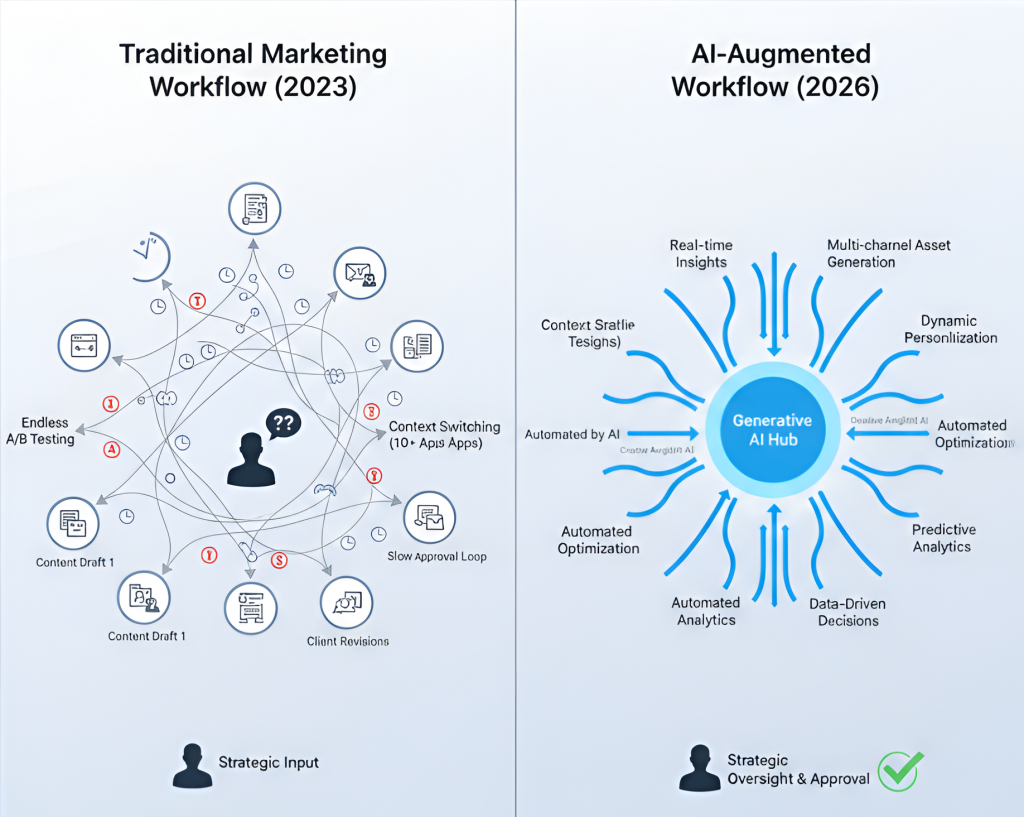
- The Content Treadmill: Marketing teams spend approximately 41% of their workday on administrative tasks, iterative content tweaks, manual asset resizing, A/B test variations, and basic copy updates. Many of these time-consuming activities, such as reporting, approvals, formatting, and workflow coordination, are increasingly being handled through AI-driven automation, as outlined in this guide on automating routine tasks with AI.
- Creative Burnout: When a creative lead has to jump between 10+ apps to coordinate a single campaign, the resulting "context switching" can reduce productive time by up to 40%.
- Data-to-Action Gap: While marketers have access to vast amounts of data, turning insights into timely creative or strategic action remains a challenge. Analysis often lags execution, resulting in reactive rather than proactive marketing.
- Pressure to Deliver Measurable ROI: With rising expectations for speed, personalization, and performance, marketers are expected to do more with fewer resources, often prioritizing short-term execution over long-term brand and growth strategy.
Generative AI changes this equation by shifting talent from operational overload to strategic control.
How Generative AI Streamlines Work for High-Impact Marketing Outcomes
Generative AI serves two distinct but complementary purposes: Automation (taking over the "doing") and Augmentation (enhancing the "thinking").
1. Hyper-Personalization and Dynamic Segmentation
Modern marketing requires moving beyond static personas toward continuously evolving audience intelligence. Manually segmenting customers and tailoring experiences at scale is both time-intensive and structurally limited.
How Generative AI Helps:
Generative AI enables real-time segmentation by synthesizing behavioral, transactional, and contextual data across channels. Messaging, offers, and journeys can be dynamically tailored to individual users, improving relevance while reducing manual intervention. This allows marketing leaders to deliver personalization at scale without operational complexity.
For a specific look at how dynamic personalization plays out in audience targeting and messaging, see this article on hyper-personalization in email marketing.
2. Rapid Content Creation and Creative Optimization
Marketers face constant pressure to produce high volumes of channel-specific content. Manually creating, resizing, and iterating assets across formats drains creative capacity without increasing strategic value.
How Generative AI Helps:
Generative AI produces high-quality creative drafts, copy variations, and multimodal assets from a single strategic brief. Generative AI for marketing professionals can provide “bottom-line-up-front” output that enables teams to focus on emotional resonance, brand differentiation, and performance optimization, rather than file production, as explored in this detailed guide on AI for content creation.
3. Predictive Consumer Intelligence and Real-Time Insights
Traditional insight generation relies on retrospective analysis and slow research cycles, limiting the ability to respond proactively to market shifts.
How Generative AI Helps:
By acting as an intelligence layer across data sources, Generative AI synthesizes customer sentiment, campaign performance, and market signals into actionable insights. Predictive modeling enables leaders to anticipate outcomes, stress-test scenarios, and adjust strategy before performance declines, shifting marketing from reactive optimization to strategic foresight.
4. Process Automation Across the Marketing Value Chain
Marketing operations are burdened by repetitive, low-value tasks such as approvals, reporting, versioning, and cross-platform coordination.
How Generative AI Helps:
Generative AI automates operational workflows across the marketing lifecycle, from content adaptation and testing to reporting and internal documentation. By reducing friction and manual handoffs, teams reclaim time for higher-order decision-making and cross-functional collaboration.
For a broader look at technologies that eliminate manual bottlenecks across marketing functions, explore this guide on key automation tools.
5. Strategic Decision Support and Leadership Enablement
As complexity increases, marketing leaders must make faster, higher-stakes decisions with incomplete information.
How Generative AI Helps:
Generative AI supports executive decision-making by summarizing trade-offs, highlighting risks, and presenting strategic options grounded in data. Rather than replacing judgment, it augments leadership thinking, enabling clearer prioritization, faster alignment, and more confident execution.
Mastering the Shift: The 3 Skills Every Marketer Needs
To lead this transition effectively, marketers must move beyond surface-level tool use. To "master" the tech, you need to develop these three core competencies:
- Advanced Prompt Architecture: Beyond simple instructions, you must master Chain-of-Thought (CoT) prompting. This involves building multi-step workflows in which the AI breaks down complex marketing problems into logical sequences, ensuring the output aligns with your brand voice.
- AI Data Literacy & Synthesis: Your value now lies in interpretation. Marketers must be able to audit AI-generated insights, identify "hallucinations" in performance data, and synthesize disconnected signals into a cohesive narrative.
- AI Governance & Risk Management: You are the guardian of brand integrity. This means developing "Human-in-the-Loop" (HITL) protocols to prevent brand dilution, bias, and legal risks. Mastery includes establishing internal guardrails to ensure data safety and quality audits.
Strategic Pathway: Moving from a single prompt to a scalable workflow requires specialized skill. Programs like the Johns Hopkins University’s Generative AI Course provide the strategic frameworks needed to move from technical hype to actual business value.
Certificate Program in Applied Generative AI
Master the tools and techniques behind generative AI with expert-led, project-based training from Johns Hopkins University.
Challenges and Risks Marketers Must Navigate
While the benefits are vast, a strategic architect must navigate the following challenges:
| Challenge / Risk | Description | Strategic Mitigation |
| Brand Dilution | AI content may lack a distinctive voice or cultural context. | Enforce Human-in-the-Loop protocols for emotional depth. |
| Legal & Ethical Bias | Models may reproduce copyrighted material or data biases. | Use enterprise-grade platforms with indemnity protections. |
| Automation Bias | Over-reliance on AI may weaken critical thinking. | Treat AI as a consultant whose outputs must be validated. |
| Loss of Differentiation | Widespread use of similar tools can lead to homogenized messaging. | Anchor AI outputs in proprietary, first-party data. |
Conclusion
The future of marketing does not lie in creating more content, but in better results. Generative AI helps marketing experts to leave the noise behind operations and head to strategic clarity. Today, the people who make use of these tools as a decision-support partner will determine the speed, strength, and competitiveness of their brands in the future.