Free Computer Vision Course with Certificate
Introduction to Computer Vision
 4.34
Beginner level
0.75 learning hr
4.34
Beginner level
0.75 learning hr
Extend your knowledge of Computer Vision through this free online course and apply it to work with real-time applications. It gives you fundamental and advanced-level knowledge to work with OpenCV for various AI tasks.





About this course
This Computer Vision course is designed to ensure that you gain a thorough knowledge of image processing and how the OpenCV library is inculcated practically with Python to function in Artificial Intelligence and Machine Learning tasks. This course helps you understand the basics, such as sampling the data, digitizing images, and compressing or quantizing them. It will throw insights into different methods to work with pictures, including identification, classification, detection, and other processes in Computer Vision. Later, you will learn various Computer Vision applications to understand What Computer vision is. You will learn about Transfer Learning in the latter part of this course.
After this self-paced beginner-level guide to Computer Vision, you can continue learning AI ML by registering for the Artificial Intelligence courses with millions of keen aspirants across the globe!
Course outline
Introduction to Computer Vision
Computer Vision is one of the essential components of AI. This section explains how a computer system visualizes and understands images and videos. It also explains how every pattern is segmented and recognized by the machine and discusses different tasks employed in the process.
What is Computer Vision?
In this chapter, you will understand computer vision, architecture, why, and how it is practiced. With examples, you will also gain knowledge about when and where the technology sees its application.
Approaches to computer vision-Pixel Intensity Histograms and CNN
This chapter discusses pixel intensity histograms, their philosophy, features, and process. It also demonstrates the convolution in different layers with its function and image filters. You will learn to obtain the result for an image using the convolution function.
Types of Computer Vision problems
This chapter explains different tasks in computer vision, which are-- classification, classification with localization, object detection, and instance segmentation to help you work with different applications of computer vision.
Digital Image and Pixels-Analog to digital Images Pixel Neighborhood
This chapter equips you with a thorough understanding of digital images, pixels, and amplitude quantization. It discusses the functions of converting analog spaces into digital images and sampling, and it then explains digital images and neighborhood concepts involved in computer vision with examples.
Get access to the complete curriculum once you enroll in the course
 4.34
4.34














Frequently Asked Questions
Will I receive a certificate upon completing this free course?
Is this course free?
How long does it take to complete this free Computer Vision course?
Introduction to Computer Vision is half an hour-long course. You can, however, learn from the course at your convenience since it is self-paced.
How can a beginner learn Computer Vision?
Great Learning Academy offers a free course to learn Computer Vision with examples from basics online. The course includes an easy guide to learning concepts to work with Artificial Intelligence and Machine Learning tasks.
What jobs demand that you learn Computer Vision?
It is essential for every professional and aspirant in the machine learning and artificial intelligence sectors to have high competency in working with computer vision. The prevalent careers for the subject include
- Deep Learning and Computer Vision Engineer
- Image Processing Engineer
- Computer Vision Optimization Engineer
- Research Scientist - Computer Vision
- AI Engineer - Computer Vision
After completing this Computer Vision course, will I get a certificate?
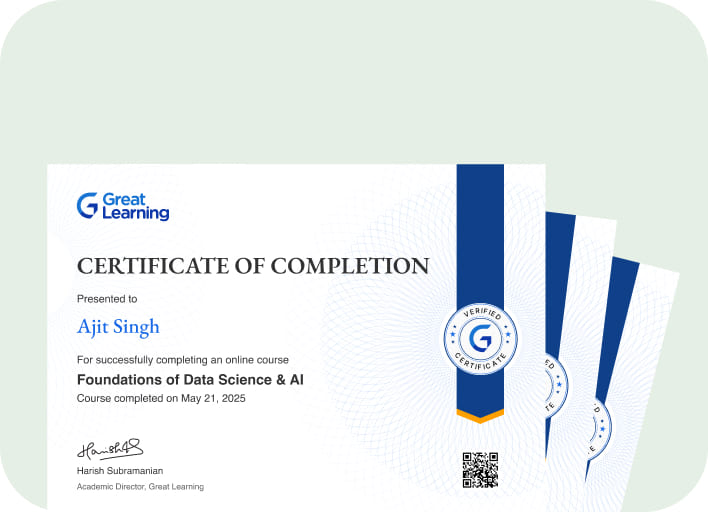
Yes. The course constitutes different modules for different topics in computer vision with examples to work with AI and ML tasks, like digitizing images, sampling the data, quantizing, identification, classification, detection, padding, pooling, filtering, and transfer learning. Gain a thorough understanding of these concepts to earn a free Computer Vision certificate.
What knowledge and skills will I gain upon completing this Computer Vision course?
You will gain expertise in working with different techniques used in Computer Vision, hands-on experience working with Keras, and understanding how CV betters the traditional machine learning methods. You will understand CNN, different processes, Analog and Digital images carried out in different layers, and the concept of a fully connected layer.
Can I sign up for multiple courses from Great Learning Academy at the same time?
Yes. You can enroll in multiple courses simultaneously.
Why choose Great Learning Academy to learn Computer Vision?
Data science, machine learning, artificial intelligence, product management, digital marketing, and big data engineering are among the subjects covered in the full-time and short-term programs offered by Great Learning, a top provider of ed-tech services. Some justifications for choosing Great Learning include the following:
- One of the few businesses, Great Learning, provides full-time, online, and offline training across various fields.
- You can get support for your learning journey from the experienced mentors on the Great Learning team who are specialists in their industry.
- The programs offered by Great Learning are created with consideration for the demands of the industry and are frequently updated to reflect the most recent developments.
Who is eligible to take this Computer Vision course?
Anybody with a basic understanding of Artificial Intelligence and Machine Learning and knowledge of Keras can take up this course.
Recommended Free AI courses
 FREE
FREE


.jpg "Course thumbnail image")
Related Artificial Intelligence Courses

-

6 Weeks · Online · Weekend
Money Back GuaranteeKnow More
-
Johns Hopkins University
Certificate Program in AI Business Strategy10 weeks · Online
Know More
-
Walsh College
MS in Artificial Intelligence & Machine Learning2 Years · Online
Know More