
- How These Courses Were Evaluated for Non-Coders
- Overview of the 6 Agentic AI Courses and Programs
- Free Agentic AI Courses from Great Learning for Building Foundational Knowledge
- 1. Getting Started With Agentic AI
- 2. Building Intelligent AI Agents
- 3. Agentic AI With ChatGPT and AutoGPT
- Paid Programs from Great Learning for Building Applied No-Code Agentic AI Skills
- 4. Post Graduate Program in AI Agents and Generative AI for Business Applications, Texas McCombs
- 5. No Code and Agentic AI Program, MIT Professional Education
- 6. No-Code Generative AI and Agentic AI Program, Johns Hopkins University
- How Should a Non-Coder Start Using AI Agents at Work?
- What Should You Include in an Agentic AI Project Portfolio?
- Conclusion
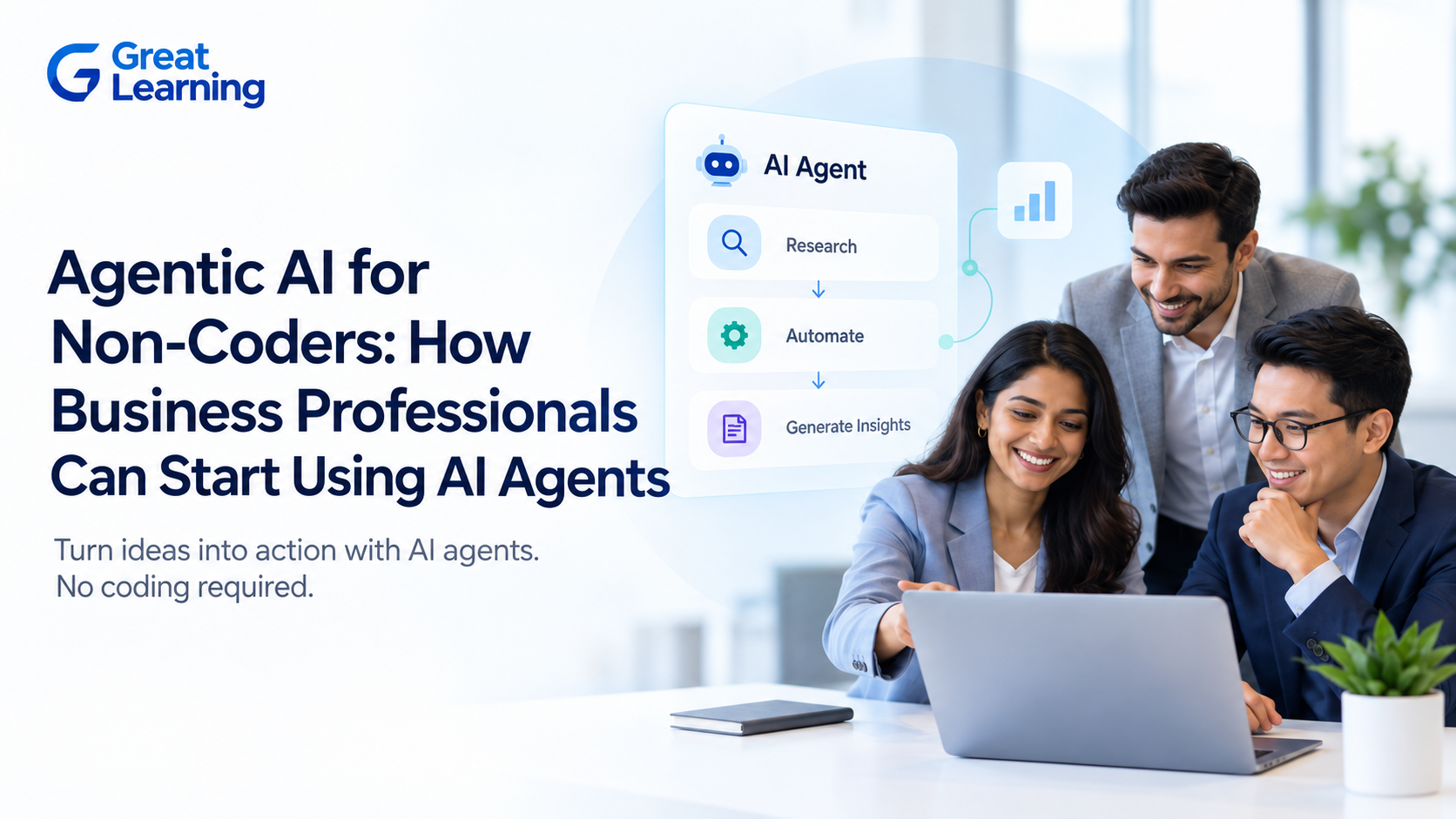
Agentic AI helps business professionals move beyond one-time prompts and use AI for connected tasks such as research, document review, customer support, workflow routing, and decision preparation. Unlike standard chatbots, AI agents work toward a goal by planning steps, using tools, retrieving information, and responding to changing inputs. You do not need a programming background to start learning these concepts.
The selected courses suit non-technical professionals because they start with agent fundamentals, business use cases, leadership decisions, and practical tools. The Great Learning free courses explain agent concepts, leadership decisions, workflow structures, and ChatGPT-based automation. The Great Learning paid programs provide deeper no-code or flexible-track learning through projects, faculty instruction, mentorship, assessments, and business case studies.
How These Courses Were Evaluated for Non-Coders
- Business relevance: Coverage of workflows in marketing, finance, HR, operations, sales, consulting, and customer support
- Non-technical/coding background: Options designed for learners without a programming background
- Agent fundamentals: Clear instruction on goals, planning, reasoning, memory, tool use, and execution
- Applied learning: Demonstrations, projects, case studies, workflow exercises, or practical tools
- Risk awareness: Attention to data access, output validation, responsible AI, security, and human approval
- Learning depth: Short courses for initial exposure and longer programs for applied proficiency
- Professional value: Skills suited to workplace projects, cross-functional collaboration, portfolio evidence, and AI adoption decisions
Overview of the 6 Agentic AI Courses and Programs
| # | Course or Program | Type | Duration | Coding Expectation | Best Fit |
|---|---|---|---|---|---|
| 1 | Getting Started With Agentic AI | Free | 3 hours | No prior programming required |
|
| 2 | Building Intelligent AI Agents | Free | 3 hours | Basic Python is helpful |
|
| 3 | Agentic AI With ChatGPT and AutoGPT | Free | 3 hours | No prior agent experience required |
|
| 4 | Post Graduate Program in AI Agents and Generative AI for Business Applications, Texas McCombs | Paid | 13 weeks | Code and No-Code tracks available |
|
| 5 | No Code and Agentic AI Program, MIT Professional Education | Paid | 14 weeks | No coding required |
|
| 6 | No-Code Generative AI and Agentic AI Program, Johns Hopkins University | Paid | 12 weeks | No prior programming required |
|
Free Agentic AI Courses from Great Learning for Building Foundational Knowledge
The free courses help you understand Agentic AI before investing in a longer program or proposing a workplace implementation. Each course addresses a different need. Start with core concepts, explore leadership implications, learn how agents complete tasks through ChatGPT, or examine the frameworks technical teams use. Course content is free, while the optional completion certificate requires a separate fee.
1. Getting Started With Agentic AI
The Free Agentic AI course explains what AI agents are and how they operate. You study planning, reasoning, execution, and memory as connected parts of an agent workflow. The course also covers business applications, opportunities, risks, limitations, and the need for human oversight.
Getting Started With Agentic AI
Learn how AI agents plan, reason, use memory, and complete tasks through autonomous workflows. Build a foundation in agentic AI concepts and business applications.
- Delivery & Duration: Online, 3 learning hours
- Course Access: Course content is free. A separate fee applies for the completion certificate.
- Course Highlights: AI agents, agentic workflows, planning, reasoning, execution, memory, business use cases, risks, limitations, and human oversight
- How This Helps a Business Professional: The course gives you a framework for examining a process before selecting an AI tool. For example:
- A marketing professional separates campaign research into collection, comparison, summarization, and review stages.
- An HR professional identifies routine policy questions suited to automation and sensitive matters requiring an HR specialist.
- An operations professional maps how an agent detects an exception, checks a rule, recommends an action, and escalates uncertain cases.
- A finance professional defines where an agent summarizes information while qualified staff retains approval authority.
- Skills You’ll Build: Agentic AI fundamentals, workflow mapping, use-case identification, agent component knowledge, risk assessment, and human oversight planning
Why It Stands Out
- Starts with business use cases instead of programming
- Breaks agent behavior into understandable components
- Helps you evaluate whether a process needs an agent, a standard automation, or direct human work
2. Building Intelligent AI Agents
The Free AI Agents course introduces frameworks for organizing agent workflows. The curriculum covers conversational agents with CrewAI, AI agent implementation with LangGraph, multi-step workflow design, collaboration, and design patterns. Basic Python knowledge supports the practical sections, though non-coders still gain useful architecture and project-planning knowledge.
Building Intelligent AI Agents
Learn how to build AI agents using concepts like agent architecture, CrewAI, LangGraph, and workflow automation with practical examples.
- Delivery & Duration: Online, 3 learning hours
- Course Access: Course content is free. A separate fee applies for the completion certificate.
- Course Highlights: CrewAI, LangGraph, conversational agents, agent collaboration, workflow states, multi-step decisions, design patterns, and introductory Python-based implementation
- How This Helps a Business Professional: You learn how technical teams structure agents behind the interface. For example:
- A product manager defines separate agent roles for request classification, information retrieval, response preparation, and escalation.
- A business analyst turns a manual process into workflow states, decision rules, inputs, outputs, and failure conditions.
- A customer-support manager explains when specialist agents should hand a request from one stage to another.
- A consultant prepares a workflow specification before working with developers on a prototype.
- Skills You’ll Build: Agent workflow design, CrewAI awareness, LangGraph awareness, agent-role definition, decision mapping, collaboration patterns, and communication with technical teams
Why It Stands Out
- Introduces two widely used agent frameworks in one short course
- Helps non-coders understand the structure behind agent applications
- Supports clearer collaboration with developers, data teams, and AI engineers
3. Agentic AI With ChatGPT and AutoGPT
The Agentic AI with ChatGPT and AutoGPT Free Course shows how agents handle goal-based, multi-step work. You study AutoGPT Agent and ChatGPT Agent Mode, including setup, task planning, browser-based actions, tool use, reusable prompts, agent loops, and API limits. Practical modules also address troubleshooting, performance improvement, and workflow limitations.
Agentic AI with ChatGPT and AutoGPT
Learn to plan, automate, and execute multi-step tasks using ChatGPT agents, AutoGPT, tools, and effective prompts.
- Delivery & Duration: Online, 3 learning hours
- Course Access: Course content is free. A separate fee applies for the completion certificate.
- Course Highlights: ChatGPT Agent Mode, AutoGPT Agent, goal setting, multi-step prompts, browser actions, tools, reusable prompt structures, troubleshooting, and output review
- How This Helps a Business Professional: You move from asking one question to designing a complete task with defined steps and checks. For example:
- A marketer organizes public competitor research and requests a source-linked comparison for review.
- A recruiter collects public role information, groups required skills, and prepares a sourcing brief without automating hiring decisions.
- An analyst sets research criteria, requires evidence, flags missing information, and produces a structured first draft.
- A project manager consolidates approved updates, identifies missing owners, and prepares a status summary.
- A small-business owner compares vendors against price, service, security, and support requirements.
- Skills You’ll Build: Goal definition, task decomposition, prompt sequencing, browser-action planning, tool use, reusable workflows, troubleshooting, validation, and human review
Why It Stands Out
- Focuses on tools business professionals already recognize
- Moves from isolated prompts toward complete tasks
- Includes limitations and troubleshooting alongside automation techniques
Paid Programs from Great Learning for Building Applied No-Code Agentic AI Skills
The paid programs extend beyond short introductions. You study through recorded content, live mentorship, faculty sessions, assessments, projects, and business case studies over 12 to 14 weeks. This added structure helps you build working prototypes, receive feedback, evaluate performance, document safeguards, and present a portfolio of applied work. The programs differ in emphasis, from business-focused agent systems to broader no-code machine learning or specialized Gen AI orchestration.
4. Post Graduate Program in AI Agents and Generative AI for Business Applications, Texas McCombs
The Post Graduate Program in AI Agents and Generative AI for Business Applications is a 13-week online program from the McCombs School of Business at The University of Texas at Austin. The program offers a Python-based Code Track and a tools-based No-Code Track. The curriculum covers LLMs, prompt engineering, RAG, Agentic RAG, single-agent and multi-agent systems, evaluation, security, and responsible AI.
UT Austin PG Program in AI Agents & Generative AI
Master GenAI, large language models, and multi-agent systems to automate business workflows. Learn to build and deploy intelligent AI agents with no coding background.
- Delivery & Duration: Online, 13 weeks, with recorded lectures, weekly live sessions from industry experts, and monthly Texas McCombs faculty masterclasses
- Program Access: Paid, application-based program with Code and No-Code track options
- Credential: Certificate of Completion and Continuing Education Units from Texas McCombs
- Program Highlights: Learn from Texas McCombs Faculty, 3 hands-on projects, 15+ case studies, 15+ tools and technologies, Learn Without Code, and Build GenAI and Agentic AI Workflows
- How This Helps a Business Professional: The No-Code Track supports applied workflow development without requiring Python. For example:
- A customer-support leader develops an agent workflow for ticket classification, policy retrieval, response preparation, and escalation.
- A finance professional builds a RAG assistant to locate and compare information across annual reports.
- A supply chain manager designs a multi-agent process for delivery exceptions, policy checks, customer communication, and audit records.
- An HR professional automates routine policy support while routing personal or legally sensitive matters to specialists.
- A consultant presents a prototype alongside its value case, evaluation plan, security controls, and implementation requirements.
- Skills You’ll Build: Business use-case selection, no-code workflow development, prompt engineering, RAG, agent design, Model Context Protocol, multi-agent coordination, output evaluation, security, and responsible implementation
Why It Stands Out
- Provides a dedicated No-Code Track for business professionals
- Connects agent development with measurable business problems
- Includes project work across several functions and industries
- Covers evaluation, grounding, security, and human control alongside workflow creation
5. No Code and Agentic AI Program, MIT Professional Education
The No Code and Agentic AI Program is a 14-week online certificate program from MIT Professional Education. The curriculum combines machine learning, Generative AI, RAG, single-agent systems, and multi-agent collaboration. You use no-code platforms such as KNIME and n8n to develop models and workflows without writing software code.
MIT No Code AI and Machine Learning Program
Learn Artificial Intelligence & Machine Learning from world-renowned MIT faculty. Get a completion certificate and grow your professional career.
- Delivery & Duration: Fully online, 14 weeks, with 20 hours of recorded lectures and 14+ live mentored sessions
- Program Access: Paid certificate program with pre-work, case studies, 3 projects, and additional self-paced modules
- Credential: Certificate of Completion from MIT Professional Education
- Program Highlights: Data exploration, clustering, regression, classification, recommendation systems, prompt engineering, RAG, agent planning, memory, tool use, multi-agent systems, computer vision, time-series concepts, and responsible AI
- How This Helps a Business Professional: The curriculum supports professionals who need both predictive AI and agent workflow knowledge. For example:
- A hotel manager builds a no-code model to predict booking cancellations and identify factors linked to revenue loss.
- A marketer segments customers and creates recommendation logic for more relevant offers.
- A finance professional designs a document assistant grounded in long financial reports.
- A customer-service manager develops an agent workflow to classify, answer, and escalate requests.
- A product manager tests an AI solution before requesting full engineering investment.
- Skills You’ll Build: No-code machine learning, KNIME, n8n, predictive modeling, recommendation systems, RAG, prompt engineering, agent workflows, multi-agent evaluation, and responsible AI
Why It Stands Out
- Combines traditional machine learning with Generative AI and Agentic AI
- Uses no-code tools for models, RAG systems, and automated workflows
- Includes live mentorship and assessed project work
- Suits professionals who need wider AI coverage beyond agent systems alone
6. No-Code Generative AI and Agentic AI Program, Johns Hopkins University
The No-Code Generative AI and Agentic AI Program is a 12-week online program from Johns Hopkins University. No prior programming experience is required. The curriculum centers on NLP, prompt engineering, RAG, agent reasoning, memory, tools, multi-agent systems, orchestration, evaluation, and responsible AI.
JHU No-Code Generative AI and Agentic AI
Build practical expertise in Generative AI, intelligent agents, and AI workflows using no-code tools. Automate enterprise-wide workflows without prior programming experience.
- Delivery & Duration: Online, 12 weeks, with an expected commitment of 8 to 10 hours per week
- Program Access: Paid program with self-paced modules, weekly live expert sessions, Johns Hopkins faculty masterclasses, graded quizzes, and a final assessment
- Credential: Certificate of Completion and 9 Continuing Education Units from Johns Hopkins University
- Program Highlights: 2 real-world business projects, 9+ case studies, earn 9 CEUs , learn from Johns Hopkins University faculty, No-Code AI Curriculum, and weekly graded quizzes
- How This Helps a Business Professional: You learn to connect AI agents with trusted business information and structured review rules. For example:
- A sales professional creates an account-research workflow focused on public signals and approved talking points.
- A healthcare operations professional develops an administrative assistant grounded in approved procedures while routing clinical questions to qualified staff.
- An HR professional classifies requests, retrieves policy guidance, prepares responses, and escalates sensitive cases.
- A logistics manager builds an exception workflow for interpreting issues, checking policies, recommending actions, and escalating.
- A subject matter expert converts approved documents into a searchable internal assistant with source grounding and rule-based validation.
- Skills You’ll Build: No-code automation, n8n, prompt engineering, NLP, RAG, classification, sentiment analysis, agent reasoning, multi-agent orchestration, output validation, and responsible AI
Why It Stands Out
- Requires no prior programming experience
- Focuses specifically on Gen AI workflows, RAG, and agent orchestration
- Includes cases across sales, healthcare, finance, HR, logistics, support, and operations
- Awards a Johns Hopkins University Certificate of Completion with 9 Continuing Education Units
How Should a Non-Coder Start Using AI Agents at Work?
Your first agent project should address a repeatable, low-risk task with clear inputs and outputs. Avoid beginning with decisions involving employment, credit, legal advice, medical judgment, confidential information, or irreversible customer actions.
Use the following process:
- Select one recurring task: Choose work involving research, classification, summarization, routing, or document retrieval.
- Record the current process: List every step, system, information source, approval, and common exception.
- Define the desired output: Specify the format, quality standard, deadline, and reviewer.
- Limit data access: Give the workflow access only to the information required for the task.
- Add human checkpoints: Require approval before sending messages, updating records, approving requests, or taking external action.
- Test with real examples: Include common cases, missing information, unclear instructions, and unusual exceptions.
- Measure performance: Compare completion time, accuracy, revision rate, escalation rate, and user satisfaction with the original process.
- Document failures: Record where the agent produced unsupported information, selected the wrong action, or failed to follow policy.
What Should You Include in an Agentic AI Project Portfolio?
A business-focused portfolio should show more than screenshots of an AI tool. Your project needs to explain the business logic and controls behind the workflow.
Include:
- The business problem and current process
- The users and process owner
- The task assigned to each agent or workflow step
- The information sources and access restrictions
- The no-code tools or platforms used
- The prompts, rules, and escalation conditions
- The human review points
- The performance measures
- The result, errors, limitations, and next improvement
A well-documented support assistant, report-retrieval workflow, campaign research agent, HR policy assistant, or logistics exception process gives you concrete evidence to discuss with employers and stakeholders.
Conclusion
Non-coders bring valuable knowledge to Agentic AI projects because they understand customers, policies, operational steps, business risks, and success measures. The free courses help you build vocabulary, evaluate opportunities, and understand agent workflows. The paid programs add guided implementation, broader tools, projects, feedback, and university credentials.
Start with one measurable business problem. Keep the first workflow narrow, use approved information, require human review, and test performance before wider adoption. This approach helps you move from using AI for isolated tasks to designing agent workflows tied to real business outcomes.