
- What Is the Difference Between Data Science, AI and ML, and Agentic AI?
- When Should You Learn Data Science?
- When Should You Learn AI and Machine Learning?
- When Should You Learn Agentic AI?
- Should You Learn Data Science Before AI or Agentic AI?
- How Should You Choose the Right AI Learning Path?
- What Skills Should You Build Across Data Science, AI & ML, and Agentic AI?
- How Does the Texas McCombs Artificial Intelligence Course Build These Skills?
- Final Thoughts
- Frequently Asked Questions
The AI field has expanded far beyond a single set of skills. Data Science, Artificial Intelligence and Machine Learning, and Agentic AI each focus on different types of problems and require different technical capabilities.
Data Science focuses on working with data to uncover patterns, generate insights, and support business decisions. AI and ML focus on building systems that can learn from data to make predictions, classifications, or automated decisions.
Agentic AI goes further by enabling AI systems to reason through tasks, use tools, retrieve information, and execute multi-step workflows.
The right learning path therefore depends on what you want to build, the problems you want to solve, and your existing technical background.
The demand for AI skills is also expanding beyond traditional AI roles. Upwork's 2026 In-Demand Skills report found that skills specifically related to applying AI within existing roles grew 109% year over year, including AI integration, AI data annotation, and AI chatbot development.
This makes choosing the right learning path more important. The goal is not to learn every AI technology at once. It is to choose the skill set that best matches your career direction and then build from there.
What Is the Difference Between Data Science, AI and ML, and Agentic AI?
The three areas overlap, but they solve different problems.
| Area | Primary focus | Typical work |
| Data Science | Understanding and using data | Analysis, forecasting, experimentation, business insights |
| AI & ML | Building systems that learn or make predictions | Predictive models, classification, recommendation, computer vision |
| Agentic AI | Building AI systems that can reason and act | AI agents, tool use, RAG, planning, multi-step workflows |
Data Science is often the starting point when the main challenge is understanding what the data says. Professionals work with statistics, SQL, Python, visualization, and analytical methods to identify patterns and support decisions.
AI and ML become more relevant when the goal is to build systems that can learn from data and make predictions or decisions. This includes areas such as machine learning, deep learning, natural language processing, and computer vision.
Agentic AI focuses on systems that can go beyond generating predictions or responses. Agents can break down goals, retrieve information, use external tools, and complete multiple steps with limited human intervention.
The right choice depends on the type of work you want to perform, rather than which technology is currently receiving the most attention.
When Should You Learn Data Science?
Data Science is a strong learning path when your work involves data analysis, business insights, forecasting, experimentation, or decision-making.
You may benefit from learning Data Science if you want to:
- Analyze large and complex datasets
- Identify trends and patterns
- Build dashboards and analytical reports
- Perform statistical analysis
- Create forecasts
- Support data-driven business decisions
- Prepare data for machine learning models
Core skills typically include Python, SQL, statistics, data visualization, data analysis, and predictive analytics.
For example, a retail company may use Data Science to analyze customer behavior, identify purchasing patterns, forecast demand, and understand which factors influence sales.
Data Science is particularly useful when the primary question is:
“What does the data tell us, and how can we use those insights to make better decisions?”
If you enjoy working with data, finding patterns, explaining business trends, and turning raw information into actionable insights, Data Science can provide a strong foundation for a career in the broader AI field.
When Should You Learn AI and Machine Learning?
Artificial Intelligence and Machine Learning are the right direction when you want to build systems that can learn from data, recognize patterns, make predictions, or automate decisions.
You may benefit from learning AI and ML if you want to:
- Build predictive models
- Develop recommendation systems
- Work with natural language processing
- Build computer vision applications
- Develop intelligent business applications
- Work as an ML engineer or AI engineer
- Move from analytics into model development
The learning path typically includes Python, statistics, machine learning, deep learning, model evaluation, and AI application development.
For example, a financial services company could use machine learning to identify potentially fraudulent transactions. A retailer could build a recommendation model to personalize products for customers.
The key question here is:
“How can I build a system that learns from data and makes useful predictions or decisions?”
This path is also becoming increasingly valuable in the job market. PwC's 2026 Global AI Jobs Barometer found that jobs requiring specific AI skills, such as prompt engineering and machine learning, grew by 69%, compared with 9% growth across the overall jobs market.
The report analyzed more than one billion job advertisements across 27 countries and territories.
When Should You Learn Agentic AI?
Agentic AI becomes relevant when you want to build AI systems that can reason through goals, use tools, retrieve information, make decisions, and complete multi-step tasks.
You may want to learn Agentic AI if you want to:
- Build AI agents
- Develop autonomous or semi-autonomous workflows
- Connect LLMs with enterprise tools and APIs
- Build RAG-based applications
- Work with Model Context Protocol (MCP) and tool calling
- Develop single-agent or multi-agent systems
- Build AI applications that can take actions rather than only generate responses
For example, instead of building an AI system that simply answers a customer's question, you could build an agent that identifies the customer, checks an order system, retrieves company policies, determines what action is allowed, and updates the appropriate system.
The key question becomes:
“How can I build an AI system that can understand a goal and take the steps needed to complete it?”
Agentic AI also requires a broader skill set than simply learning how to prompt an LLM. Professionals need to understand agent architecture, tool use, RAG, orchestration, evaluation, security, and monitoring.
Should You Learn Data Science Before AI or Agentic AI?
Not necessarily. The best starting point depends on your current skills and the type of work you want to do.
If you are new to technical fields and want to work extensively with data, Data Science can provide a strong foundation in statistics, Python, data analysis, and problem-solving.
If you already have programming or technical experience and want to build intelligent applications, you may move more directly into AI and Machine Learning.
If you already understand AI, software development, or LLM-based applications and want to build systems that can reason and act, Agentic AI may be the more relevant next step.
A simple progression can look like:
Data & Statistics → Machine Learning → AI Applications → Generative AI → Agentic AI
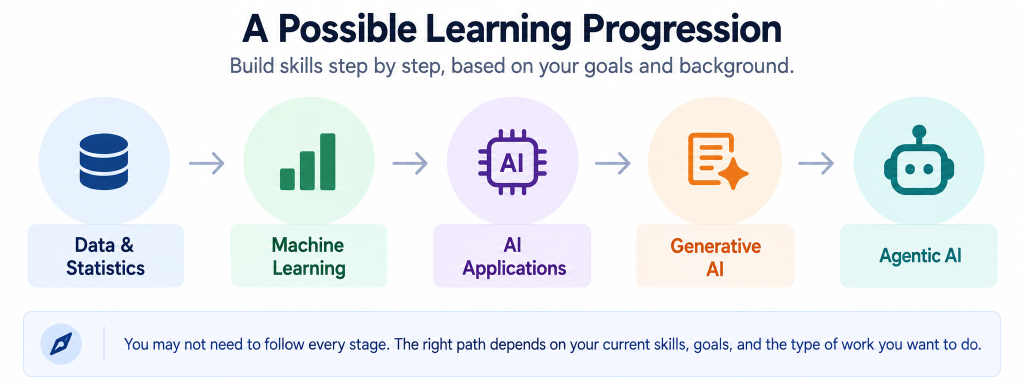
However, this does not mean everyone needs to complete every stage. The right path depends on the role you want and the depth of expertise you need.
The broader workforce is also changing quickly. The International Labour Organization's 2026 research notes that AI adoption is increasing demand for AI, digital, data science, cognitive, and socioemotional skills, while AI-specific technical roles remain a smaller but rapidly growing part of the labor market.
How Should You Choose the Right AI Learning Path?
The right learning path depends on the type of work you want to do, not simply on which AI technology is currently most popular.
A simple way to decide is to start with your career goal:
| Your goal | Recommended learning path |
| Analyze data and generate business insights | Data Science |
| Build predictive models | AI & Machine Learning |
| Develop intelligent applications | AI & Machine Learning + Generative AI |
| Build AI agents and automated workflows | Agentic AI |
| Lead AI projects and business transformation | AI + business strategy |
| Build end-to-end AI solutions | Data Science → AI/ML → GenAI → Agentic AI |
Your existing skills also matter. Someone with strong statistics and analytics experience may benefit from moving into machine learning, while a software developer with LLM experience may be able to move more directly into Agentic AI.
The depth you need will also depend on your role. A data scientist may need deeper statistical and modeling skills, while an AI product manager may need enough technical understanding to evaluate models, AI workflows, and business trade-offs.
The key is to build skills progressively rather than trying to master every area at once.
What Skills Should You Build Across Data Science, AI & ML, and Agentic AI?
Each learning path requires a different combination of technical and problem-solving skills.
Data Science generally emphasizes Python, SQL, statistics, data visualization, exploratory data analysis, and predictive analytics.
AI and Machine Learning build on these foundations with supervised learning and unsupervised learning, model evaluation, deep learning, NLP, computer vision, and model deployment.
Agentic AI adds capabilities such as LLMs, prompt engineering, RAG, tool calling, memory, reasoning, agent workflows, and multi-agent systems.
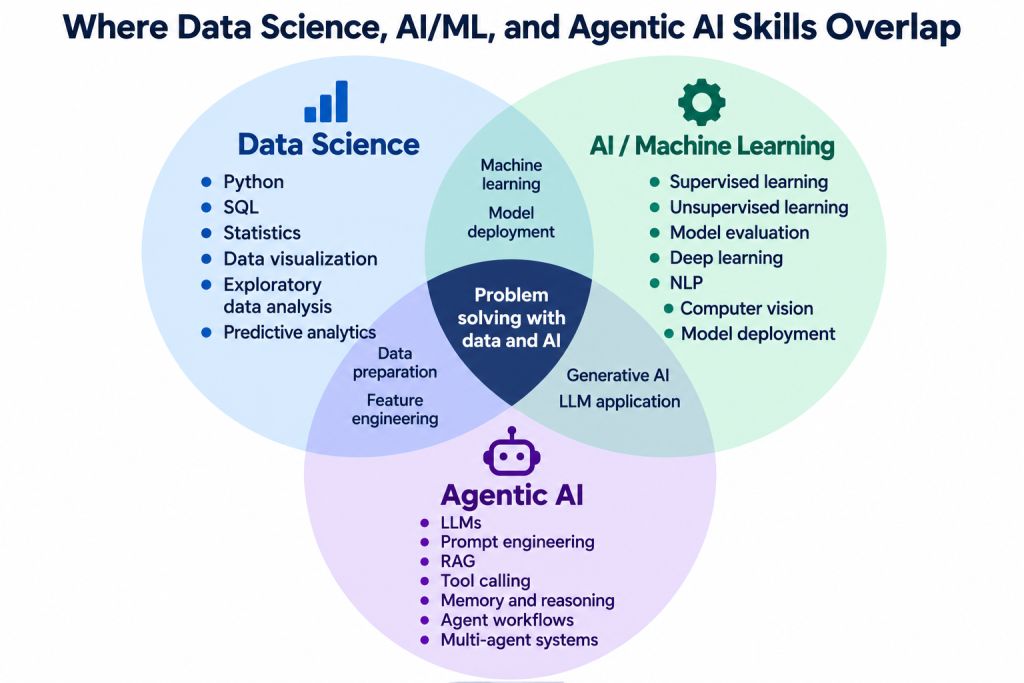
These areas are not completely separate. They can form a progression:
Data → Analysis → Machine Learning → Generative AI → Agentic AI
However, professionals do not always need to follow this entire sequence. The appropriate depth depends on the problems they want to solve and the role they want to pursue.
This is especially important as AI roles increasingly combine multiple skill areas.
The Texas McCombs AI & ML program, for example, currently covers Python and predictive modeling before progressing into Generative AI, RAG, single- and multi-agent systems, and AI deployment.
How Does the Texas McCombs Artificial Intelligence Course Build These Skills?
The Artificial Intelligence course by Texas McCombs is designed as an end-to-end learning path covering AI and ML foundations through Generative AI and Agentic AI.
Post Graduate Program in AI & Machine Learning: Business Applications
Master in-demand AI and machine learning skills with this executive-level AI course—designed to transform professionals into strategic tech leaders.
The curriculum starts with Python and data manipulation before moving into predictive modeling, machine learning, neural networks, Generative AI, RAG, and responsible AI. It then introduces single-agent and multi-agent systems, AI workflows, evaluation, and deployment.
This structure can be useful for professionals who want broader AI capabilities rather than specializing in only one layer of the AI stack.
The program also includes hands-on projects, case studies, and 30+ tools and technologies, allowing learners to apply concepts to practical AI and ML problems.
For someone deciding between Data Science, AI/ML, and Agentic AI, the program provides exposure across these connected areas and can help build a broader understanding of how modern AI solutions are developed and deployed.
Final Thoughts
Data Science, AI and Machine Learning, and Agentic AI are connected, but they prepare professionals for different types of work.
If your goal is to analyze data and generate insights, Data Science is a strong starting point. If you want to build predictive models and intelligent applications, AI and ML are more relevant.
If you want to build AI systems that can reason, use tools, and complete multi-step tasks, Agentic AI is the natural next step. Understanding how AI agents work across multiple enterprise systems can also help professionals see how these systems are applied to real-world business workflows.
There is no single learning path that works for everyone. Your choice should depend on your current skills, career goals, and the type of AI problems you want to solve.
For professionals who want broader AI capabilities, the Artificial Intelligence course by Texas McCombs provides a progression across AI and ML foundations, Generative AI, RAG, Agentic AI, and deployment.
The most important question is not “Which AI skill is the most popular?” It is “Which skills will help me do the work I want to do?”
Frequently Asked Questions
What is the difference between Data Science, AI and ML, and Agentic AI?
Data Science focuses on analyzing data and generating insights. AI and ML focus on building systems that learn from data and make predictions or decisions. Agentic AI focuses on building systems that can reason, use tools, and complete multi-step tasks.
Should I learn Data Science before AI and Machine Learning?
Not always. Data Science can provide a strong foundation in statistics, Python, and data analysis, but professionals with programming or technical experience may move directly into AI and ML.
When should I learn Agentic AI?
Agentic AI is useful when you want to build AI agents that can reason through goals, retrieve information, use tools, interact with external systems, and complete multi-step workflows.
Is Data Science still useful for AI careers?
Yes. Data Science skills such as statistics, data analysis, Python, and data preparation remain useful across many AI and ML roles.
Which is better for a career, Data Science or AI and ML?
Neither is universally better. Data Science is well suited to analytics and data-driven decision-making, while AI and ML are more focused on developing intelligent and predictive systems. The better choice depends on your career goals.
Can I learn Agentic AI without becoming a data scientist?
Yes. You do not necessarily need to become a data scientist first. A background in programming, AI, machine learning, or software development can provide a useful foundation for learning Agentic AI.
What skills are needed for Agentic AI?
Important skills include LLMs, prompt engineering, RAG, tool calling, APIs, memory, agent workflows, orchestration, multi-agent systems, evaluation, security, and deployment.
Which course can help me build broader AI skills?
The Artificial Intelligence course by Texas McCombs covers AI and ML foundations along with Generative AI, RAG, Agentic AI, AI agents, evaluation, and deployment. It can be useful for professionals looking to develop broader end-to-end AI capabilities.