
- Why Is Evaluating an AI Agent’s Final Answer Not Enough?
- What Is an AI Agent Reasoning Path or Trajectory?
- How Do You Evaluate an AI Agent’s Reasoning Path?
- How Can You Detect Incorrect Reasoning When the Final Answer Is Correct?
- Which Methods Can Be Used to Evaluate AI Agent Reasoning?
- How Do Enterprises Monitor AI Agent Reasoning in Production?
- How Does the Johns Hopkins University AI Agents Course Teach AI Agent Evaluation?
- Final Thoughts
- Frequently Asked Questions
An AI agent can produce the correct final answer and still follow an unreliable process to get there. It may select the wrong tool, make unnecessary calls, use irrelevant information, or reach the right result through a fragile sequence of actions.
This makes traditional AI evaluation insufficient for agentic systems. Evaluating only the final response does not show whether the agent followed the right steps, used appropriate tools, or handled information correctly along the way.
Agent evaluation therefore needs to examine the entire execution trajectory, including planning, tool calls, retrieved information, actions, and outcomes.
In 2026, 57% of respondents in LangChain's State of Agent Engineering survey reported having agents in production, while 32% identified quality as a top barrier.
Nearly 89% reported using observability for their agents, showing the growing importance of understanding agent behavior beyond the final output.
The goal is not to inspect every internal thought an agent may generate. Instead, understanding how to evaluate AI agents reasoning paths means examining the observable steps and evidence that show whether the agent followed a reliable path to complete its task.
Why Is Evaluating an AI Agent’s Final Answer Not Enough?
A final answer tells you what the agent produced, but not necessarily how it reached that result.
Consider an AI customer-support agent asked to determine whether a customer qualifies for a refund.
The agent could:
Customer Request → Retrieve Order → Check Policy → Verify Eligibility → Approve or Escalate → Respond
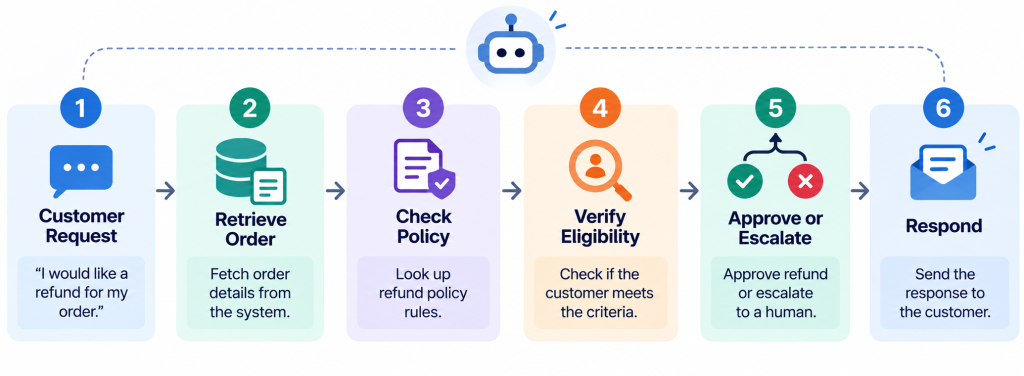
Now imagine the agent gives the correct refund decision but:
- Retrieves information from the wrong system
- Uses an outdated policy
- Calls an unnecessary tool
- Makes an unauthorized API request
- Skips an important verification step
- Reaches the result through an unsupported assumption
A final-answer evaluation might still mark the interaction as successful.
This creates a problem for production systems. An incorrect process may work for one case but fail when the input changes, a tool returns incomplete information, or a different business rule applies.
Agent evaluation therefore needs to measure both outcome quality and trajectory quality.
Recent enterprise evaluation research specifically distinguishes task success from trajectory accuracy because an agent can reach the right outcome through an unreliable execution path.
What Is an AI Agent Reasoning Path or Trajectory?
An agent trajectory is the sequence of observable steps an agent takes while working toward a goal.
A simplified trajectory can look like:
Goal → Plan → Select Tool → Retrieve Information → Interpret Result → Take Action → Observe → Continue or Complete
For example, a travel-booking agent may receive a request for a flight. It could identify the travel dates, search available flights, compare options against the user's requirements, select a suitable option, and then proceed to booking.
For more examples of how agents connect tools, data, and workflows across business applications, see our guide to building ai agents that work across multiple enterprise systems.
Each step provides information about how the agent is operating.
Enterprises can evaluate whether the agent:
- Chose the appropriate tool
- Used the correct inputs
- Retrieved relevant information
- Followed the required sequence
- Responded correctly to tool results
- Avoided unnecessary actions
- Stayed within its permissions
- Recovered appropriately from errors
- Completed the intended task
This makes the trajectory an important evaluation object alongside the final answer. Modern agent-evaluation research increasingly treats these interaction traces as essential evidence for assessing reliability, because they show how an agent planned, acted, responded to feedback, and reached its outcome.
How Do You Evaluate an AI Agent’s Reasoning Path?
Evaluating an agent’s reasoning path means examining the observable steps it takes to complete a task and checking whether those steps were appropriate.
A useful evaluation can follow this sequence:
Task → Plan → Tool Selection → Tool Input → Retrieved Result → Action → Outcome
Each stage can be evaluated against the expected behavior for that task.
For example, if an agent is asked to check an order and update its delivery address, evaluation could examine whether it:
- Identified the correct customer
- Retrieved the correct order
- Checked the relevant delivery policy
- Selected the appropriate tool
- Passed the correct information to the tool
- Interpreted the returned information correctly
- Requested approval when required
- Completed the update successfully
This creates a more detailed view of agent performance than simply checking whether the final response was correct.
Key trajectory-level metrics can include task success, tool-call accuracy, retrieval relevance, unnecessary steps, error recovery, latency, and cost.
The evaluation should also account for the type of task. A simple information-retrieval agent may require only a few checks, while a complex enterprise workflow may require evaluation across many intermediate actions.
How Can You Detect Incorrect Reasoning When the Final Answer Is Correct?
A correct final answer does not always indicate a reliable agent trajectory.
For example, suppose an AI agent is asked whether a customer qualifies for a refund. The agent checks the wrong policy document but happens to reach the same decision as the correct policy.
The final answer is correct, but the process is unreliable.
Other examples include:
- Using the wrong tool but receiving a compatible result
- Making unnecessary tool calls
- Skipping a required verification step
- Using irrelevant retrieved information
- Making unsupported assumptions
- Performing an action outside the intended workflow
- Reaching the correct outcome through an invalid sequence
These issues can remain hidden when evaluation focuses only on the final response.
Trajectory evaluation helps identify such failures by comparing the agent's actions with the expected workflow or evaluating whether each action was appropriate given the information available at that point.
This is particularly important for enterprise agents because the same incorrect process can produce a different and potentially harmful result when the underlying data or circumstances change.
Which Methods Can Be Used to Evaluate AI Agent Reasoning?
No single evaluation method can capture every aspect of an agent's behavior. Enterprises can combine several approaches depending on the task and risk level.
1. LLM-as-a-Judge
Another AI model evaluates the agent's trajectory or output against predefined criteria. This can help assess qualities that are difficult to capture through simple rules, such as whether the agent selected a reasonable approach.
2. Human Evaluation
Human reviewers can inspect difficult or high-risk agent runs and determine whether the decisions and actions were appropriate. This is particularly useful when business context or judgment is required.
3. Deterministic Evaluation
Rules can verify objective conditions, such as whether the correct tool was called, whether required parameters were present, or whether a restricted action was attempted.
4. Reference Trajectories
For repeatable tasks, teams can define an expected sequence of actions and compare the agent's execution against it.
Comparison of AI Agent Evaluation Methods
| Evaluation Method | What It Evaluates | Best For | Key Advantage | Limitation |
| LLM-as-a-Judge | Agent outputs, trajectories, and quality of decisions | Assessing reasoning quality and subjective criteria | Can evaluate nuanced behaviors that are difficult to capture with rules | May introduce evaluator bias or inconsistency |
| Human Evaluation | Decisions, actions, and overall task performance | High-risk, complex, or business-critical tasks | Provides contextual judgment and domain expertise | Time-consuming and difficult to scale |
| Deterministic Evaluation | Objective conditions and rule-based outcomes | Tool calls, parameters, permissions, and required actions | Fast, consistent, and highly reliable for measurable criteria | Cannot easily assess nuanced reasoning or judgment |
| Reference Trajectories | Agent actions compared with an expected sequence | Repeatable and well-defined workflows | Makes deviations from an expected process easy to identify | Can penalize valid alternative approaches |
Combined Evaluation
In practice, enterprises can combine these methods rather than relying on a single approach. Deterministic checks can verify objective requirements, LLM-as-a-Judge can assess more nuanced behaviors, and human evaluation can provide additional oversight for complex or high-risk cases.
This layered approach provides broader coverage of agent reasoning and behavior in production.
For example:
Automated Checks → LLM Evaluation → Human Review for High-Risk Cases
This provides broader coverage while reserving human effort for cases where automated evaluation is insufficient.
How Do Enterprises Monitor AI Agent Reasoning in Production?
Evaluating an agent before deployment is only one part of the process. Once an agent is operating in production, enterprises need to continuously monitor how it behaves across real tasks.
Agent observability can capture the execution trace, including:
- Agent inputs and outputs
- Tool calls and responses
- Retrieved information
- Execution time
- Errors and retries
- Number of steps
- Task completion
- Escalations to humans
- Resource usage and cost
For example, if an agent that normally completes a customer-support task in five steps suddenly starts making twelve tool calls, the execution trace can help identify what changed.
Monitoring can also reveal recurring problems. An agent may consistently select an inefficient tool, retrieve irrelevant documents, or fail to recover when an API returns an error.
This creates a continuous evaluation loop:
Monitor → Identify Failure → Evaluate Trajectory → Improve Agent → Monitor Again
Production evaluation should therefore look beyond individual outputs and track patterns across many agent runs.
How Does the Johns Hopkins University AI Agents Course Teach AI Agent Evaluation?
Evaluating AI agents requires professionals to understand both the final outcome and the sequence of actions that produced it.
The AI Agents course by Johns Hopkins University covers agent evaluation through areas such as task success, reasoning trajectories, system efficiency, LLM-as-a-Judge, DeepEval, Human-in-the-Loop evaluation, and deterministic evaluation methods.
Certificate Program in Agentic AI
Learn the architecture of intelligent agentic systems. Build agents that perceive, plan, learn, and act using Python-based projects and cutting-edge agentic architectures.
The program also covers monitoring and observability, helping learners understand how agent behavior can be traced and evaluated during execution.
This provides a practical foundation for evaluating whether an agent is selecting appropriate tools, following reliable workflows, recovering from failures, and producing the intended outcomes.
Final Thoughts
Evaluating an AI agent only by its final answer can hide important failures.
An agent may produce the correct result while using the wrong tool, skipping a required step, relying on irrelevant information, or following an unreliable workflow.
A stronger evaluation approach examines the complete observable trajectory:
Goal → Plan → Tool Selection → Retrieval/Action → Observation → Decision → Outcome
Enterprises can combine deterministic checks, LLM-based evaluation, human review, and production observability to understand whether agents are not only successful, but also reliable, efficient, and safe.
The objective is not to evaluate every internal thought an agent may generate. It is to evaluate the observable decisions and actions that determine whether the system can be trusted to perform its assigned task.
Frequently Asked Questions
1. Why is evaluating an AI agent's final answer not enough?
A final answer does not show whether the agent used the correct tools, retrieved appropriate information, followed the required workflow, or made unauthorized actions. Evaluating the trajectory provides greater visibility into how the result was produced.
2. What is an AI agent trajectory?
An agent trajectory is the sequence of observable actions taken by an agent while completing a task. It can include tool calls, retrieved information, actions, observations, errors, and the final outcome.
3. What should be evaluated in an AI agent's reasoning path?
Important areas include task completion, tool selection, tool inputs, retrieval quality, action sequence, error recovery, policy compliance, efficiency, latency, and cost.
4. Can an AI agent reach the right answer through the wrong process?
Yes. An agent can produce a correct final answer while using an incorrect tool, skipping a required verification step, or relying on unsupported information. This is why trajectory-level evaluation is important.
5. What is LLM-as-a-Judge for AI agents?
LLM-as-a-Judge uses another language model to evaluate an agent's output or execution against predefined criteria. It can assess aspects that are difficult to capture through simple deterministic rules.
6. What is deterministic evaluation for AI agents?
Deterministic evaluation uses predefined rules to check objective conditions, such as whether the correct tool was called, whether required parameters were provided, or whether a restricted action was attempted.
7. How do enterprises monitor AI agents in production?
Enterprises can use tracing and observability to monitor tool calls, retrieved information, errors, latency, task completion, retries, escalations, and costs. These traces help teams identify recurring problems and improve agent behavior.
8. Which course can help professionals learn AI agent evaluation?
The Johns Hopkins University Certificate Program in Agentic AI covers reasoning trajectories, task success, system efficiency, LLM-as-a-Judge, DeepEval, human evaluation, deterministic evaluation, monitoring, and observability.