
- Why Did a Physician Decide to Learn Agentic AI?
- What Did He Learn About Agentic AI in Healthcare?
- How Can Agentic AI Support Patient Consent?
- Why Does Human-Centered Design Matter in Healthcare AI?
- How Did Learning Agentic AI Change His Approach?
- What Does His Journey Reveal About the Future of Agentic AI in Healthcare?
The practical use of Agentic AI is gaining attention as professionals look beyond experimentation and explore how AI can address real-world problems. According to Great Learning’s enrollment report, the share of learners motivated by hands-on product building and workflow automation increased from 20% to 45%, reflecting growing interest in applying Agentic AI to practical workflows.
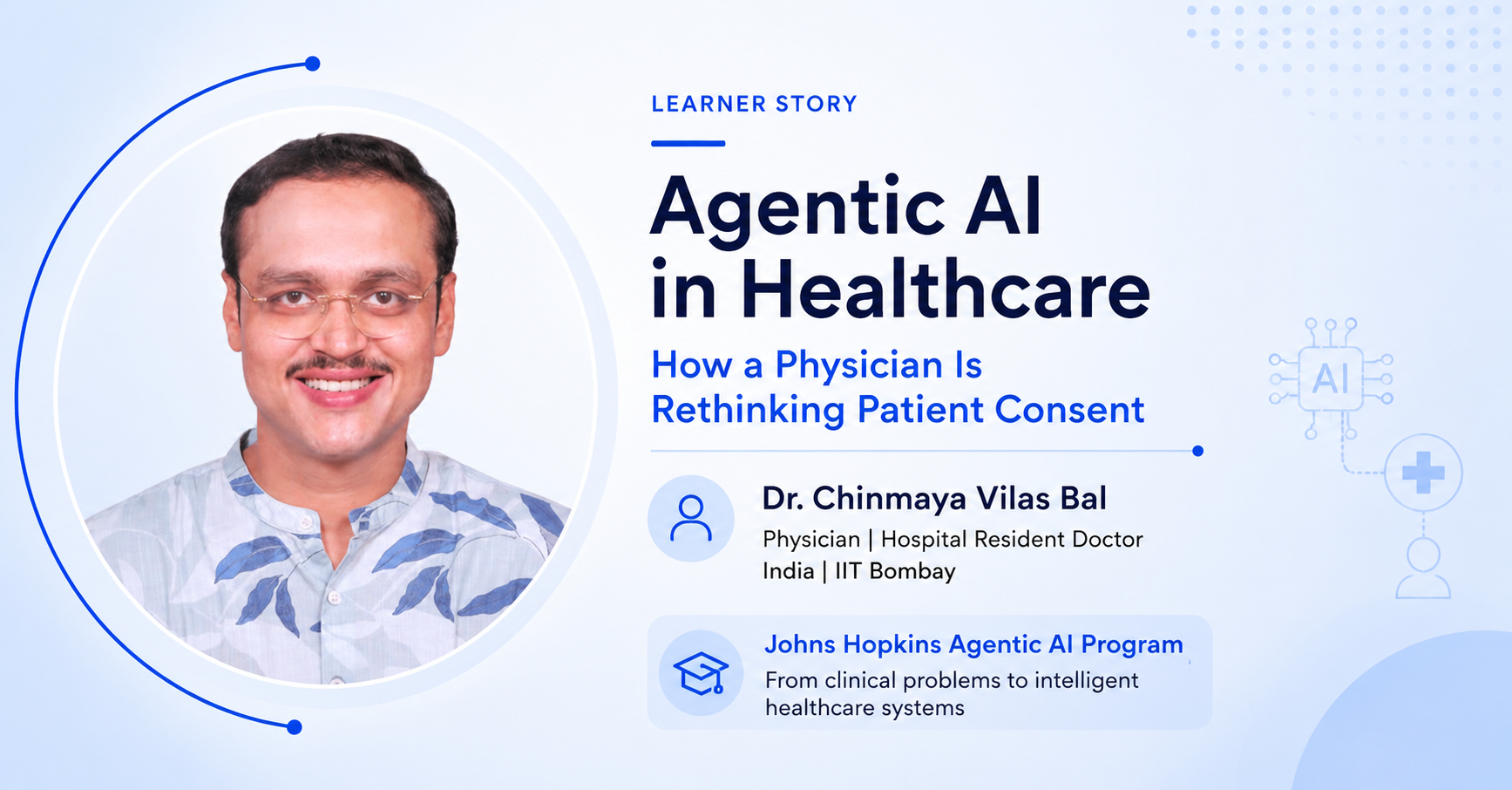
For Dr. Chinmaya Vilas Bal, a physician, that shift connects directly to a challenge he had observed in healthcare: informed consent. A form may be completed and signed correctly without necessarily ensuring that a patient understands the procedure, its alternatives, or its risks.
Rather than simply automating consent, Dr. Bal began exploring how Agentic AI could improve the information and communication surrounding an important healthcare decision while keeping clinical judgment with the physician and the decision with the patient.
Why Did a Physician Decide to Learn Agentic AI?
Dr. Bal wanted to understand how intelligent systems could address a specific healthcare problem rather than use AI only as a productivity tool.
His experience showed him that healthcare does not always lack information. Sometimes, the challenge is ensuring that the right information reaches the right person at the right moment. This became particularly apparent in informed consent, where the process can vary depending on the clinician, time available, and circumstances.
This led him to develop ConsentPod, a bedside concept designed to make consent a process of education, communication, comprehension, and shared decision-making rather than simply document signing.
To develop such a system responsibly, Dr. Bal needed to understand more than generative AI tools. He wanted to understand how agents pursue goals, retrieve information, use tools, coordinate responsibilities, manage uncertainty, and determine where human oversight should remain.
That became his motivation for undertaking the Johns Hopkins University Agentic AI program.
Certificate Program in Agentic AI
Learn the architecture of intelligent agentic systems. Build agents that perceive, plan, learn, and act using Python-based projects and cutting-edge agentic architectures.
What Did He Learn About Agentic AI in Healthcare?
The program shifted Dr. Bal’s perspective from using AI tools to designing AI systems around human needs. Instead of viewing AI primarily as a model that generates an answer, he began thinking about Agentic AI as a system operating within an environment.
His earlier mental model was:
Question → Model → Answer
The Agentic AI approach introduced a broader sequence:
Goal → Context → Reasoning → Retrieval → Tools → Action → Evaluation → Human Oversight
For healthcare, context became particularly important. A clinician may have access to immediate patient information but still need previous encounters, institutional knowledge, relevant guidelines, clinical priorities, and other context before making a decision.
This perspective connected concepts such as retrieval-augmented generation (RAG), tool use, orchestration, memory and state, evaluation, and human-in-the-loop systems to challenges he had already encountered in clinical practice.
How Can Agentic AI Support Patient Consent?
Agentic AI could support patient consent by coordinating information, communication, comprehension checks, documentation, and escalation while leaving clinical judgment with the physician and the decision with the patient.
For ConsentPod, Dr. Bal's exploration focuses on breaking the consent workflow into separate responsibilities. An AI-enabled system could potentially:
- Retrieve procedure-specific information from approved sources
- Explain information in an appropriate language and format
- Check whether the patient has understood key concepts
- Identify unanswered questions
- Document what was discussed
- Escalate uncertainty or clinically sensitive situations to the responsible clinician
The boundaries are equally important. AI would not be positioned as the decision-maker. Its value would lie in strengthening the workflow around a healthcare decision rather than making the decision itself. Dr. Bal describes this as an “orchestration, communication, and context layer” around the clinical decision.
Why Does Human-Centered Design Matter in Healthcare AI?
For Dr. Bal, a technically capable AI system is not necessarily a successful one. Healthcare involves incomplete information, uncertainty, time pressure, emotional vulnerability, accountability, and decisions whose consequences can be significant.
This changes how an AI system should be evaluated. Success should not be measured only by whether the system completes a workflow but also by whether it improves the human outcome that the workflow was intended to achieve.
In patient consent, for example, recording that a patient clicked “I agree” does not establish whether the patient understood the information needed to make an informed decision.
How Did Learning Agentic AI Change His Approach?
Learning Agentic AI shifted Dr. Bal’s focus from the technology itself to the human and clinical problem it could help solve.
Before: Start with the technology and ask what it can do.
After: Start with the human problem, the decision being made, and the workflow surrounding it.
RAG became a question of whether the right information was reaching the clinician or patient. Agent orchestration became a question of how different steps in a healthcare workflow should be coordinated. Human-in-the-loop became a question of where clinical responsibility must remain with a person.
This led him to ask four questions when evaluating an AI application:
What is the human problem? What decision is being made? What context is missing? What workflow surrounds that decision?
The program helped Dr. Bal start with the healthcare problem first and identify where AI fits into the solution.
What Does His Journey Reveal About the Future of Agentic AI in Healthcare?
Dr. Bal’s journey suggests that the value of Agentic AI in healthcare may lie not simply in giving AI more autonomy, but in designing intelligent systems that help people access information, navigate workflows, and make decisions more effectively.
His ConsentPod concept illustrates this approach. The goal is not merely to digitize consent but to explore whether an intelligent workflow can help patients receive relevant information, understand it, identify questions, and communicate uncertainty before a decision is made.
For Dr. Bal, the lasting outcome of the program is a change in perspective. He entered as a physician trying to understand technology and came away thinking more like a systems designer, viewing AI not as an end in itself, but as a potential component of better-designed solutions to healthcare problems.