
- Why Are Computer Science Professionals Moving Into AI?
- What Makes Hands-On AI Projects Valuable for Career Growth?
- Career Outcome: Landed an AI Engineer Role
- What Challenges Can You Face When Learning AI?
- How Can You Make the Most of an AI and Machine Learning Program?
- What Can You Learn From This AI Career Transition?
Artificial intelligence is reshaping the technology job market, creating demand for professionals who can apply AI and Machine Learning in practical settings. The World Economic Forum’s Future of Jobs Report 2025 lists AI and Machine Learning Specialists among the fastest-growing job roles through 2030, while AI and big data rank among the fastest-growing skills.
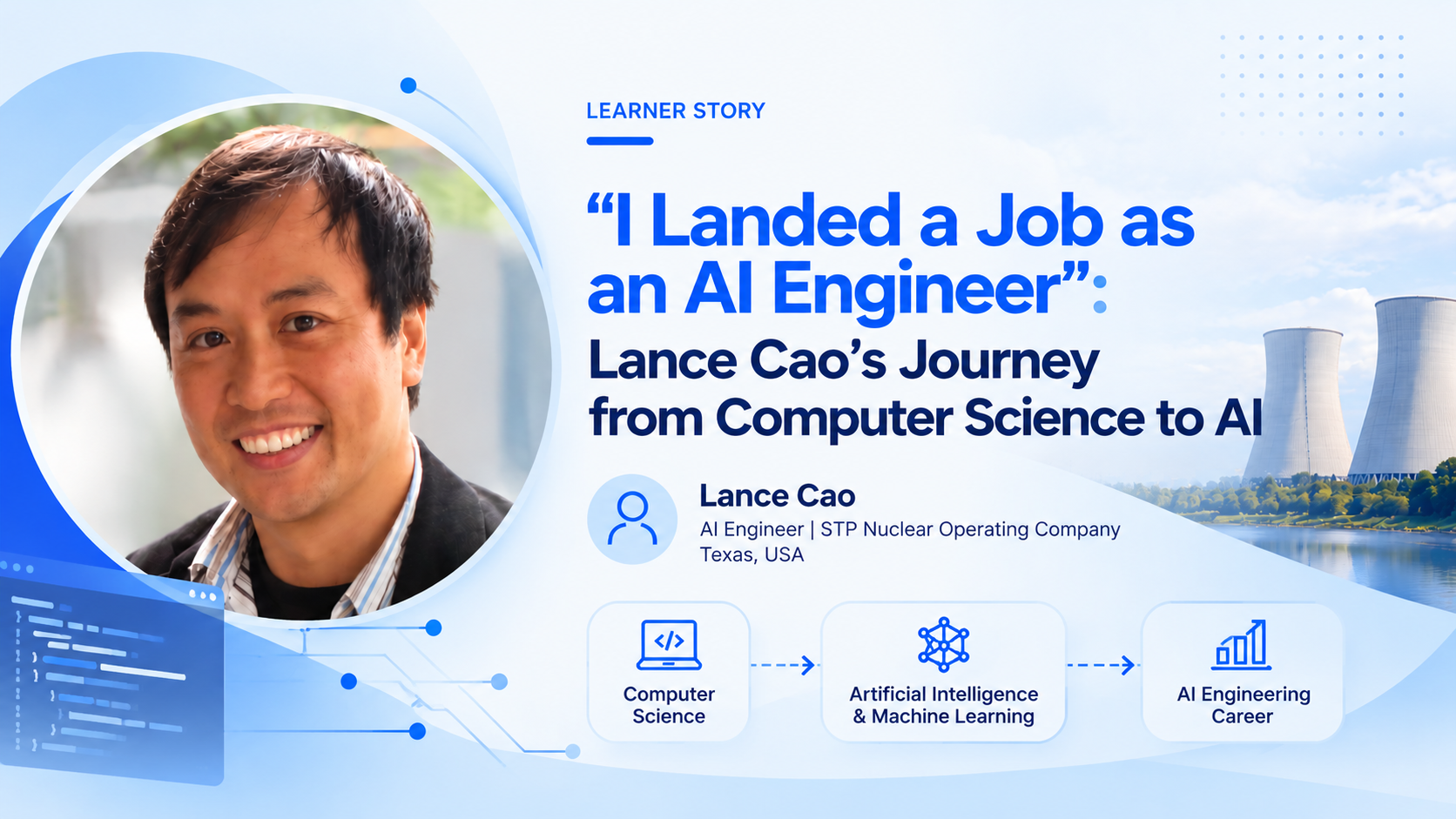
For Computer Science graduates and technology professionals, this shift is creating opportunities to build on existing technical knowledge and move into AI-focused careers. Lance Cao’s experience offers one example. After completing the Post Graduate Program in Artificial Intelligence and Machine Learning: Business Applications, he landed an AI Engineer role at STP Nuclear Operating Company in Texas.
Rather than another technical roadmap for becoming an AI engineer, this learner story focuses on the career transition: what motivated the move into AI, the value of hands-on projects, and how practical learning supported the job search.
Post Graduate Program in AI & Machine Learning: Business Applications
Master in-demand AI and machine learning skills with this executive-level AI course—designed to transform professionals into strategic tech leaders.
Why Are Computer Science Professionals Moving Into AI?
A Computer Science background can provide a strong starting point for developing AI and Machine Learning skills, particularly for professionals who already understand programming and technology concepts.
That was the case for Lance, who holds a Bachelor's degree in Computer Science and had also completed another program focused on Generative AI. He saw AI as an emerging field he wanted to pursue more seriously, particularly after being laid off from work.
“Seeing how AI was about to take off and that I was always fascinated with it, I really wanted to get into the field.”
His experience reflects one way professionals can build on an existing technical background rather than starting their technology careers from scratch.
What Makes Hands-On AI Projects Valuable for Career Growth?
Hands-on projects can help learners turn AI concepts into practical applications while building work they can showcase to potential employers. The program includes project-based learning across areas such as machine learning, Generative AI, RAG, and AI deployment, giving learners opportunities to develop an AI portfolio.
For Lance, the projects were the highlight of the program:
“My favorite part of the program is the projects. These were well thought out, and I learned so much.”
He also found them valuable beyond the learning experience, particularly during his job search:
“It’s something that I could use as a portfolio for job hunting.”
His experience shows how practical AI projects can help professionals demonstrate applied skills alongside their existing technical background.
Career Outcome: Landed an AI Engineer Role
After completing the program, Lance landed a job as an AI Engineer at a nuclear facility in Texas. His journey brought together his Computer Science background, prior exposure to Generative AI, structured learning in artificial intelligence and Machine Learning, and hands-on project experience
As he puts it:
“As soon as the program ended, I landed a job as an AI Engineer at a Nuclear facility in Texas.”
His experience demonstrates one possible pathway from a Computer Science background to an AI engineering role. However, an individual learner's career outcome should not be interpreted as a guarantee of employment after completing a program.
What Challenges Can You Face When Learning AI?
Time and commitment can be significant challenges when building new technical skills, particularly when learning involves assignments and projects.
Lance had more time available for learning because he was between jobs when he enrolled. He acknowledged the commitment required and noted the difficulty of balancing the program with employment.
“Since I didn’t have work, I had a lot of time, and I needed it. I don’t know how those that have a job do it, but kudos to them.”
His experience highlights the importance of setting aside sufficient time for coursework, projects, practice, and independent learning when pursuing AI skills.
How Can You Make the Most of an AI and Machine Learning Program?
Active participation can make the learning experience more valuable than simply completing coursework. Asking questions, clearing doubts, experimenting with available resources, and connecting with peers can help learners engage more deeply with the material.
Lance's advice is straightforward:
“Really learn the material, use all the tools available to ask questions, to clear doubts, and to connect with others.”
For someone moving into AI, this approach can help turn structured learning into practical understanding that can be applied beyond the classroom.
What Can You Learn From This AI Career Transition?
A move from Computer Science into AI can involve building on existing technical knowledge while developing specialized skills through practical experience. Lance's journey highlights a few career-learning takeaways:
- Build on your existing technical background: A Computer Science foundation can provide a base for further AI and Machine Learning learning.
- Prioritize hands-on experience: Practical projects can help connect concepts with real applications.
- Create a portfolio: Projects can give job seekers tangible examples of their work to showcase during a career transition.
- Stay actively engaged: Asking questions, using available learning resources, and connecting with peers can strengthen the learning experience.
- Keep the career goal in focus: Structured learning can be more meaningful when connected to a specific professional direction.
For professionals exploring how to transition from Computer Science to AI, the journey is not necessarily about starting over. It can be about adding AI and Machine Learning capabilities to an existing technical foundation and demonstrating those skills through practical work.