
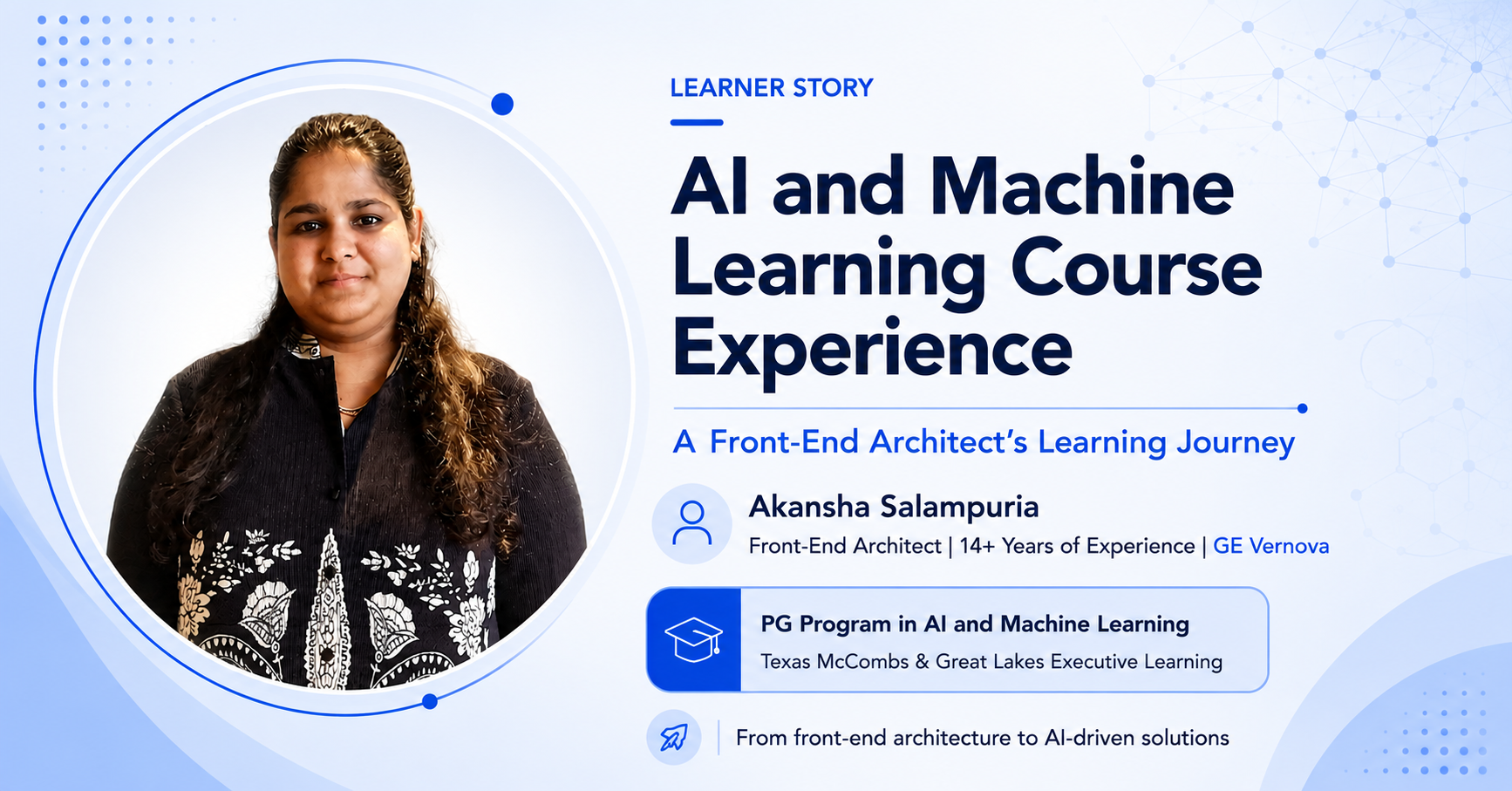
For experienced technology professionals, an AI and Machine Learning course can provide a structured way to build new skills while extending existing technical expertise. For Akansha Salampuria, a Front-End Architect at GE Vernova with 14+ years of experience, the goal was to move beyond front-end architecture and contribute more meaningfully to data-driven and AI-led solutions.
She chose the PG Program in AI and Machine Learning from Texas McCombs and Great Lakes Executive Learning to develop these skills through structured learning, practical application, and mentorship.
“My biggest professional challenge was transitioning from a purely front-end architecture role to understanding and contributing to data-driven and AI-led solutions.”
PG Program in AI & Machine Learning
Master AI with hands-on projects, expert mentorship, and a prestigious certificate from UT Austin and Great Lakes Executive Learning.
Starting With AI/ML Fundamentals
For professionals transitioning into AI/ML, building the right foundation is an important first step. Concepts in statistics, data handling, and Machine Learning can provide the groundwork for understanding more advanced applications.
For Akansha, developing these fundamentals helped her approach AI/ML systematically rather than as a collection of individual technologies.
“My advice would be to focus on building strong fundamentals in statistics, data handling, and core Machine Learning concepts before jumping into advanced topics.”
The structured curriculum gave her a pathway to build this foundation while gradually developing the ability to apply these concepts. The program supports this systematic approach by starting with a "Pre-Work" module focused on Python programming fundamentals and an introduction to the world of data, ensuring learners aren't overwhelmed. This transitions into dedicated modules on data manipulation, exploratory data analysis, and predictive modeling, systematically introducing foundational algorithms like linear regression, decision trees, and ensemble techniques before advancing to complex neural networks.
How Important Are Hands-On Projects in an AI/ML Course?
Hands-on projects are important because they allow learners to apply theoretical concepts to practical problems and understand how different parts of an AI/ML workflow work together. For Akansha, practical application was one of the factors that attracted her to the program.
“I chose this program because of its strong industry relevance, structured curriculum, and focus on practical, hands-on learning in AI and Machine Learning.”
She applied her learning through end-to-end use-case prototypes involving data analysis, model building, and basic deployment concepts. The curriculum emphasizes experiential learning, integrating over 30 real-world case studies and 4 major hands-on projects. These projects require learners to build actual prototypes, such as predictive maintenance systems and credit card fraud detection models. Furthermore, the inclusion of a dedicated module on "Deploying AI Solutions" directly supports the translation of these models into real-world production environments and web applications.
This experience helped her move beyond understanding individual concepts and see how they could come together in an AI/ML solution.
How Does Mentorship Help When Learning AI/ML?
Mentorship can help learners clarify complex concepts, receive feedback, and connect theoretical knowledge with practical application. This can be particularly useful for experienced professionals transitioning into a new technical domain.
Akansha found the mentored learning sessions especially valuable:
“Mentored learning sessions have been extremely valuable for me, as they provide personalized guidance and help bridge the gap between theory and practical application.”
She also described the sessions as interactive and focused on real-world applications rather than theory alone.
Connecting AI/ML With Existing Technical Expertise
An AI/ML learning journey does not necessarily mean starting over professionally. Existing technology experience can provide a foundation for understanding how AI fits into broader products and systems.
Akansha was able to connect her experience in front-end architecture with her growing understanding of data-driven solutions.
“I have been able to better understand and work with data-driven solutions, bridging the gap between front-end systems and intelligent back-end models.”
This broader perspective has enabled her to approach solution development more holistically and participate more confidently in AI-led product and solution discussions.
How Can You Continue Building AI/ML Skills After Completing The Course?
You can continue developing AI/ML skills by regularly practicing concepts through hands-on projects and applying them to real-world problems. A course can provide structure and foundational knowledge, but continued application is important for developing practical proficiency.
Akansha's advice is:
“Consistency is key—practice regularly through hands-on projects rather than just theory.”
Her experience highlights a practical approach to AI/ML learning: build strong fundamentals, apply concepts through projects, seek guidance when needed, and continue learning beyond the course.
Frequently Asked Questions
What does an AI and Machine Learning course typically cover?
An AI/ML course typically covers foundational concepts and practical applications. Depending on the curriculum, this can include statistics, data handling, Machine Learning, and other AI topics, along with projects or use cases.
What should I look for in an AI/ML course?
Look for a course with strong fundamentals, hands-on projects, experienced instructors or mentors, and opportunities to apply concepts to practical problems. You should also consider the format, duration, cost, credential, and relevance to your career goals.
Is the Texas McCombs AI & ML program worth considering?
The PG Program in AI and Machine Learning from Texas McCombs and Great Lakes Executive Learning may be worth considering for professionals seeking structured learning, mentorship, and practical application. It can be particularly relevant for experienced technology professionals looking to build AI/ML capabilities and apply them to existing technical or business contexts.