- What Is Credit Underwriting?
- Why Are Traditional Credit Underwriting Processes Difficult to Scale?
- How Is AI Transforming Credit Underwriting?
- How Does an AI-Powered Credit Underwriting Workflow Work?
- What Challenges Do Banks Face When Implementing AI in Credit Underwriting?
- How Can the Agentic AI Course by Johns Hopkins University Help Professionals Build Financial AI Agents?
- Final Thoughts
- Frequently Asked Questions
Credit underwriting requires lenders to evaluate borrowers' financial positions, repayment capacity, and potential default risks before approving loans.
However, manually reviewing financial statements, credit histories, and supporting documents can slow down lending decisions.
AI is helping financial institutions streamline underwriting by analysing borrower information, identifying financial risks, and preparing evidence-backed credit assessments.
What Is Credit Underwriting?
Credit underwriting is the process lenders use to determine whether a borrower can repay a loan. It involves evaluating credit history, income, existing debt, employment details, and other financial risk factors to establish creditworthiness.
Underwriters also assess the requested loan amount, repayment terms, interest rates, and collateral where applicable.
For mortgage loans, this may include property appraisals and insurance records, while personal loans and credit cards require greater emphasis on unsecured credit risk and repayment capacity.
These assessments help lenders determine suitable lending terms and make informed approval or rejection decisions.
TL;DR
AI agents streamline credit underwriting by analysing borrower data, identifying risks, and preparing credit assessments. The Johns Hopkins University Certificate Program in Agentic AI teaches professionals to build single-agent and multi-agent systems using Python, RAG, LangGraph, and MCP for practical financial AI applications.
Why Are Traditional Credit Underwriting Processes Difficult to Scale?
Traditional credit underwriting depends heavily on manual financial analysis and information collection. As lending volumes increase, these processes can become time-consuming and difficult to standardise.
Four challenges affect underwriting efficiency:
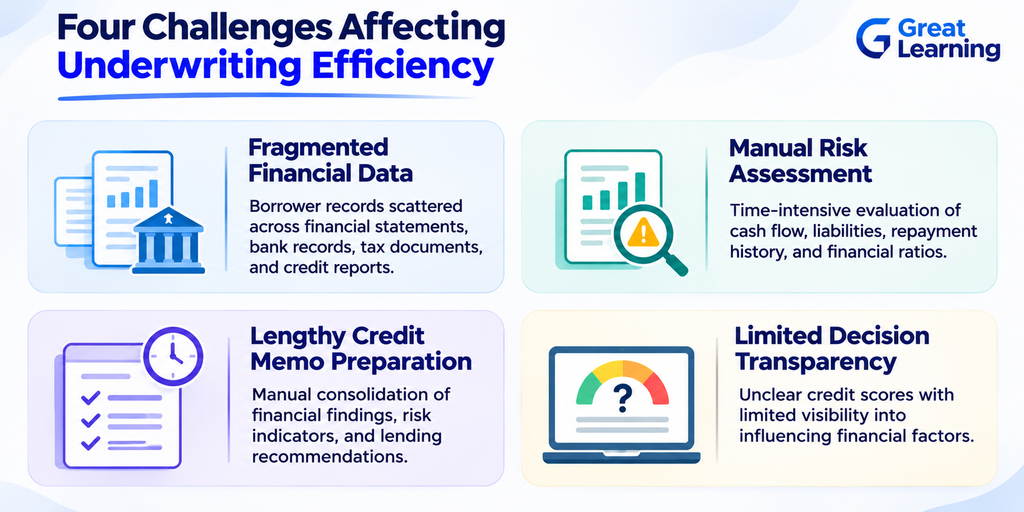
- Fragmented financial information: Analysts must collect borrower details from financial statements, bank records, tax documents, and credit reports stored across different systems.
- Manual risk assessment: Evaluating cash flow, outstanding liabilities, repayment history, and financial ratios requires extensive analysis.
- Time-consuming credit memos: Underwriters manually consolidate financial findings, identify risks, and document lending recommendations.
- Limited decision transparency: Some credit scoring models provide risk classifications without clearly explaining which financial factors influenced the outcome.
AI can help address these limitations by connecting financial information, automating analysis, and making risk assessments easier to review.
How Is AI Transforming Credit Underwriting?
AI supports different stages of underwriting, helping analysts evaluate borrowers and prepare more consistent lending assessments.
1. Improving Borrower Risk Assessment
Machine learning models analyse financial statements, income patterns, existing liabilities, repayment histories, and cash flows to identify potential credit risks.
Consider a small business applying for a working capital loan. Its revenue has increased, but its outstanding debt has also grown, while customer payments are becoming increasingly delayed.
An AI-powered risk assessment system can analyse these indicators together to identify potential repayment concerns.
It can evaluate:
- Debt-to-income and debt-to-equity ratios.
- Cash flow consistency and liquidity.
- Existing loan obligations.
- Historical repayment behaviour.
- Changes in revenue and operating expenses.
These insights help underwriters identify financial weaknesses that may not be immediately apparent from individual documents. The final risk assessment still requires validation against the lender's credit policies.
2. Automating Credit Memo Preparation
A credit memo documents the borrower's financial position, repayment capacity, collateral, identified risks, and proposed lending terms.
Generative AI can assist analysts in preparing these documents by extracting information from financial statements, summarising borrower performance, and organising relevant findings.
For example, when evaluating a business loan application, an AI system can:
- Extract revenue, expenses, assets, and liabilities.
- Summarise changes in the borrower's financial performance.
- Highlight declining cash flows or increasing debt.
- Organise collateral details and repayment information.
- Generate a structured credit memo draft with supporting evidence.
This reduces the effort involved in consolidating financial information. Underwriters must still verify extracted figures, validate calculations, and approve the final memo.
3. Making Credit Decisions Explainable
A credit score indicates a borrower's risk level, but it does not always explain why the applicant received that assessment.
Explainable AI helps identify the financial factors influencing a model's prediction.
For example, if a business receives a high-risk classification, the system can highlight declining cash flows, high existing debt, irregular repayments, or insufficient liquidity as contributing factors.
Techniques such as SHAP (SHapley Additive exPlanations) can help explain how individual features contribute to a model's prediction.
This allows underwriters to examine the reasoning behind risk assessments, identify potential data errors, and document decisions more transparently.
How Does an AI-Powered Credit Underwriting Workflow Work?
Consider a small business applying for a working capital loan. The bank needs to assess its financial stability, repayment capacity, and existing debt obligations.
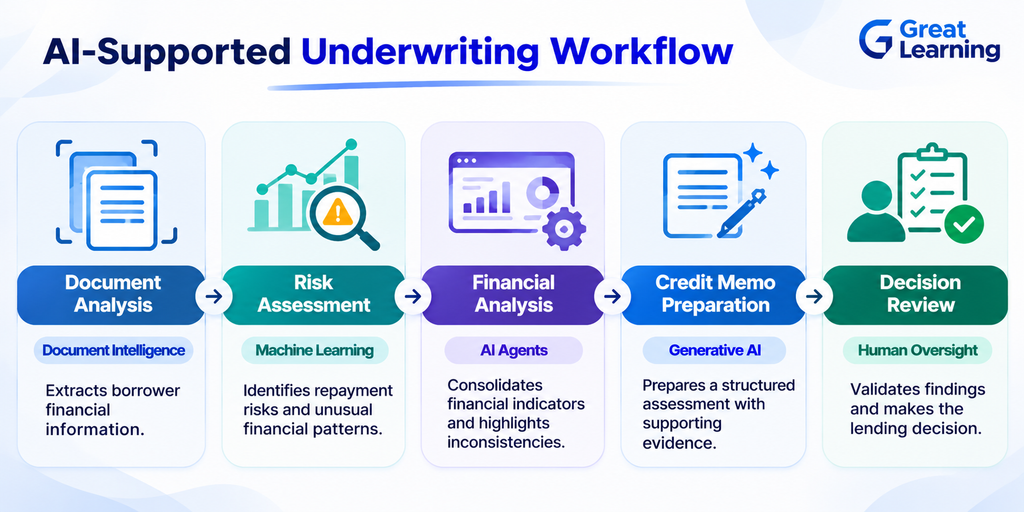
An AI-supported workflow can coordinate the following activities:
| Underwriting stage | AI application | Action |
| Document analysis | Document intelligence | Extracts borrower financial information. |
| Risk assessment | Machine learning | Identifies repayment risks and unusual financial patterns. |
| Financial analysis | AI agents | Consolidates financial indicators and highlights inconsistencies. |
| Credit memo preparation | Generative AI | Prepares a structured assessment with supporting evidence. |
| Decision review | Human oversight | Validates findings and makes the lending decision. |
Specialised AI agents can handle individual tasks, retrieve relevant information, and coordinate findings. A human underwriter reviews the complete assessment before the bank makes its lending decision.
What Challenges Do Banks Face When Implementing AI in Credit Underwriting?
Despite its benefits, AI introduces several challenges that financial institutions must address.
1. Inaccurate financial data: Missing transactions or inconsistent statements can distort risk assessments. Banks need data validation and reconciliation checks.
2. Model bias: Historical lending data may contain biases that influence predictions. Regular fairness assessments and representative validation datasets are essential.
3. Lack of explainability: Underwriters need clear reasons behind risk scores and recommendations. Banks should maintain decision logs and traceable evidence.
4. Data privacy: Borrower financial records require secure access controls, encryption, and appropriate data retention policies.
5. Overreliance on automation: AI-generated recommendations must be reviewed before lending decisions are finalised.
How Can the Agentic AI Course by Johns Hopkins University Help Professionals Build Financial AI Agents?
The AI Agents course by Johns Hopkins University, delivered in collaboration with Great Learning, covers building single-agent and multi-agent systems using Python.
Certificate Program in Agentic AI
Learn the architecture of intelligent agentic systems. Build agents that perceive, plan, learn, and act using Python-based projects and cutting-edge agentic architectures.
Its curriculum includes RAG, LangGraph, and MCP, which are relevant to developing agents that retrieve borrower financial information, coordinate risk analysis, and organise credit assessment findings.
The programme also covers agent evaluation, LLM-as-a-Judge, and responsible AI practices.
These capabilities help professionals develop financial AI applications with better information retrieval, traceable outputs, and human oversight.
Final Thoughts
AI in credit underwriting is changing how lenders evaluate borrower information and prepare lending recommendations.
Its value lies in connecting financial documents, risk indicators, and credit analysis into a traceable assessment workflow. However, lenders must ensure that AI-generated findings are supported by accurate data and that credit decisions remain accountable.
As these workflows become more sophisticated, AI agents can help coordinate financial analysis and document preparation. The AI Agents course by Johns Hopkins University provides practical exposure to building agentic applications that can support such financial workflows.
Frequently Asked Questions
1. Can AI assess borrowers with limited credit histories?
Yes. AI can analyse alternative indicators, such as transaction patterns, verified income, and cash flow. However, limited data may reduce prediction reliability.
2. What role does human oversight play in AI-powered credit underwriting?
Underwriters verify AI-generated assessments, review lending recommendations, and ensure decisions comply with credit policies.
3. Can AI credit underwriting be used for both personal and business loans?
Yes. Personal loans focus on income, repayment history, and debt, while business loans also consider cash flow, profitability, and liabilities.
4. How can lenders identify whether an AI credit model is becoming less accurate?
Lenders can monitor prediction accuracy, default rates, and approval patterns. Regular validation helps identify performance deterioration.
5. How does explainable AI improve transparency in lending decisions?
Explainable AI highlights factors influencing risk predictions, such as high debt or declining cash flows, helping underwriters understand credit assessments.
6. Which AI Agents course helps professionals build financial AI applications?
The AI Agents course by Johns Hopkins University covers agent development, RAG, LangGraph, MCP, and agent evaluation, helping professionals develop AI-powered applications for financial analysis and enterprise workflows.